

Pricing used items is where most sellers lose money, and they don't even realize it. You either price too high and watch your listing sit for weeks, or you price too low and leave real cash on the table. Learning how to determine fair price selling used items comes down to one thing: using real market data instead of guessing. This guide walks you through a practical, step-by-step framework built on sold listings, condition grading, and urgency strategies so you can price with confidence and sell faster.
Table of Contents
- Key takeaways
- Gathering data before you price anything
- Step-by-step pricing methods
- Common pricing mistakes to avoid
- Tools and digital resources for smarter pricing
- My honest take on pricing used items
- Price smarter with Dealflip
- FAQ
Key takeaways
| Point | Details |
|---|---|
| Use sold data, not asking prices | Active listings are wishful thinking; sold listings show what buyers actually paid. |
| Condition drives price more than age | Honest condition grading predicts your sale price better than the original retail price alone. |
| Match price to your urgency | Quick, standard, and patient sale price points give you control over how fast you sell. |
| Account for fees before you list | Platform fees and shipping costs must factor into your price or your profit shrinks fast. |
| Adjust if nothing moves in 7-10 days | A timely price drop keeps your listing visible and prevents stale inventory. |
Gathering data before you price anything
Before you type a single number into a listing, you need two things: a clear understanding of what you're selling and real data on what it actually sells for. Skipping this step is the number one reason sellers price wrong.
Start by writing down the item's brand, model, age, and original retail price. These details matter because brand value and demand directly affect how much of a premium you can charge. A used Sony headset and a generic off-brand headset in identical condition will sell for very different prices, even if you paid the same amount for both.
Next, and this is the part most sellers get wrong, look at sold listings rather than active ones. Active listings reflect aspirational prices, not real market value. On eBay, filter by "Sold Items" under the search options. On Poshmark, check the "Sold" tab on similar listings. What you find there is the truth about what buyers are willing to pay.
Condition grading is the other piece you cannot skip. Be honest with yourself here. Condition tiers predict achievable sale prices more reliably than original retail price alone. Use these standard tiers as your guide:
- Like new / open box: Minimal or no signs of use, all original parts included
- Excellent / gently used: Light wear, fully functional, no major flaws
- Good: Visible wear but works perfectly, minor cosmetic issues
- Fair: Noticeable wear or minor defects, still functional
- Poor / for parts: Significant damage or missing components
Pro Tip: Take photos in natural light before you grade your item. What looks fine in dim lighting often reveals scratches or stains in daylight, and catching this early keeps your listing honest and your buyer happy.
Step-by-step pricing methods
Once you have your data, here is how to turn it into a real price. This process works for clothing, electronics, furniture, and almost anything else you sell.
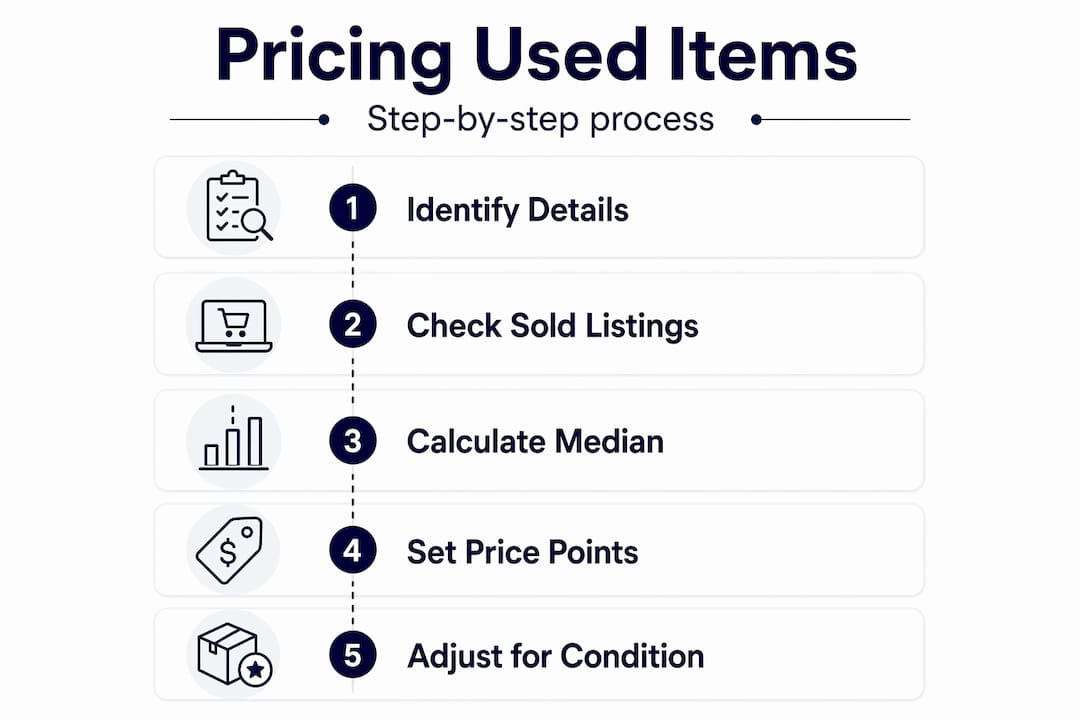
Step 1: Pull 5 to 10 sold listings for your item. Search for your specific item on eBay, Facebook Marketplace, or Poshmark. Filter by sold or completed listings and match the condition as closely as possible. Aim for at least five data points so one outlier doesn't skew your thinking.
Step 2: Calculate the median sold price. Add up the sold prices and find the middle value. The median of 5 to 10 sold listings gives you a realistic price anchor. Avoid using the average if there are extreme outliers pulling the number up or down.
Step 3: Set three price points based on your urgency.
| Sale Type | Price Range | Best For |
|---|---|---|
| Quick sale | 60-70% of median sold price | Need cash fast or clearing space |
| Standard sale | 75-85% of median sold price | Balanced speed and return |
| Patient sale | 90-100% of median sold price | Premium item, no rush |
Step 4: Adjust for condition, brand, and demand. If your item is in excellent condition and the brand carries prestige, you can push toward the top of your range. Premium brands can command significantly higher multipliers compared to generic alternatives. If your item shows obvious wear, drop toward the lower end.

Step 5: Factor in platform fees and shipping. This step is where a lot of sellers quietly lose money. eBay charges around 13% in fees, and Poshmark takes 20% on sales over $15. If you list at $50 on Poshmark, you walk away with $40 before shipping. Build that math into your asking price from the start.
Here are category-specific starting points when sold comps are hard to find:
- Clothing (good condition): 25 to 35% of original retail is a reliable baseline
- Furniture (gently used): Expect 50 to 70% of original price for items in solid shape
- Garage sale style pricing: A rough rule is around 10% of original price, up to 20% for quality or tagged items
Pro Tip: Trending styles and limited edition items can sell well above standard percentages. If you notice your item showing up in recent fashion content or news, seasonality and demand may justify a higher ask than the comps suggest.
Common pricing mistakes to avoid
Even experienced sellers fall into these traps. Knowing them ahead of time saves you time and frustration.
- Pricing from active listings. Seeing a similar item listed for $200 does not mean buyers are paying $200. That listing might have been sitting unsold for three months. Always anchor to sold data.
- Ignoring local market differences. A couch priced at $300 in a high-income urban area might sit unsold at $150 in a rural market. Check local sold data when selling locally.
- Underestimating pickup friction. For bulky items like furniture, difficult pickup conditions lower buyer willingness to pay. If your couch is on the third floor with no elevator, price it lower than a ground-floor item or offer to help with loading.
- Setting it and forgetting it. Most listings need attention. If you get no serious inquiries in the first week, something is off.
- Ignoring buyer feedback signals. If multiple people ask "is this still available?" but never follow through, your price is probably at the ceiling of what buyers will pay. That is market feedback telling you to adjust.
"Pricing is dynamic and should adapt based on market feedback and how urgently you want to sell." — Asherfield
When an item stalls, drop the price by 10 to 15% after 7 to 10 days without a sale. Many platforms reward updated listings with a visibility boost, which means more eyes on your item right when you need them. Set a mental deadline before you list so you don't second-guess yourself later.
Tools and digital resources for smarter pricing
Doing all of this research manually takes time. The good news is that several tools can speed up the process significantly and reduce the guesswork.
| Tool / Resource | What It Does | Best For |
|---|---|---|
| eBay Sold Listings Filter | Shows completed sales filtered by condition | Electronics, collectibles, general items |
| Poshmark Sold Tab | Displays sold prices for clothing and accessories | Apparel pricing |
| Dealflip Value Estimator | Uses marketplace data to estimate fair prices | Facebook Marketplace sellers |
| Cross-listing profit calculator | Compares net profit across eBay, Mercari, Poshmark | Multi-platform sellers |
| eBay fee calculator | Calculates seller fees and final profit | eBay sellers checking margins |
AI-powered tools can analyze listings and suggest fair prices based on brand, condition, demand signals, and past sales data. This kind of analysis used to require hours of manual research. Now it takes seconds.
For Facebook Marketplace specifically, the Dealflip Listing Analyzer evaluates listings against real market data so you know whether a price is fair before you commit to it. This matters whether you're buying to flip or selling from your own home.
Pro Tip: Use at least two platforms to cross-check your pricing. If eBay sold data and Poshmark sold data both point to the same price range, you can list with confidence. If they diverge significantly, dig into why. Condition differences or platform audiences are usually the cause.
My honest take on pricing used items
I've worked with enough resellers to know that pricing is where most people overthink things and underprepare at the same time. They spend an hour agonizing over whether to list at $47 or $52, but they never actually checked what the item sold for last month. That's backwards.
In my experience, the sellers who do best are the ones who treat pricing like a quick research task, not a gut-feel exercise. Pull your sold comps, grade your condition honestly, pick a price tier based on how fast you need to move the item, and list it. The data does the heavy lifting.
What I've also found is that buyers respond to honest listings. If your item has a scratch, say so and price it accordingly. Buyers who feel surprised by a flaw will leave bad feedback or back out entirely. Buyers who feel like you were upfront will often pay your asking price without negotiating.
One thing most pricing guides won't tell you: the psychological sweet spot for used items is just below a round number. A $48 listing feels meaningfully cheaper than $50 to most buyers, even though the difference is trivial. Small adjustments like this can be the difference between a quick sale and a listing that lingers.
Price confidently, adjust without ego when the market tells you to, and remember that a sold item at a fair price beats an unsold item at a perfect price every single time.
— Apex
Price smarter with Dealflip

If you're serious about getting the most from your used item sales, Dealflip has the tools to back you up. The Facebook Marketplace Value Estimator pulls real market data to give you a grounded price range in seconds. The free reseller tools suite includes fee calculators, profit estimators, and a cross-listing comparison tool so you always know your actual take-home before you list. For sellers who want to go deeper, the AI-powered listing analyzer scores deals based on condition, demand, and market trends. Whether you're clearing out your home or building a reselling side income, Dealflip gives you the data to price right and sell faster. Start finding better deals today.
FAQ
What's the best way to determine fair price selling used items?
Use sold listings on platforms like eBay or Poshmark filtered by condition, then calculate the median of 5 to 10 recent sales. This gives you a realistic price anchor based on what buyers actually paid.
How much should I price used clothing?
Used clothing in good condition typically sells for 25 to 35% of its original retail price. Excellent condition can reach 35 to 40%, while poor condition drops to 10 to 20%.
How do platform fees affect my pricing?
Platform fees reduce your net proceeds significantly. eBay charges around 13% and Poshmark takes 20%, so you need to build those costs into your asking price before you list to protect your profit.
When should I lower my price if an item isn't selling?
If your item gets no serious offers within 7 to 10 days, drop the price by 10 to 15%. Many platforms boost the visibility of updated listings, which helps you reach new buyers quickly.
Does condition matter more than original price when selling used items?
Yes. Condition tiers are more predictive of your final sale price than the original retail price. An honest assessment of wear and functionality will guide your pricing more accurately than what you paid for the item new.