

Resale market arbitrage is defined as the practice of buying undervalued goods in one market and reselling them at a higher price in another to capture the price difference as profit. The formal industry term for this is price arbitrage, and it applies to everything from clearance-rack sneakers to estate sale electronics. Part-time resellers earn $500 to $1,000 monthly, while full-time teams regularly exceed $40,000 per month. That spread exists because markets are inefficient. A thrift store in rural Ohio prices a vintage Levi's jacket at $8 because its customers don't know the eBay market. You do. That knowledge gap is your profit.
What is resale market arbitrage and how does it work?
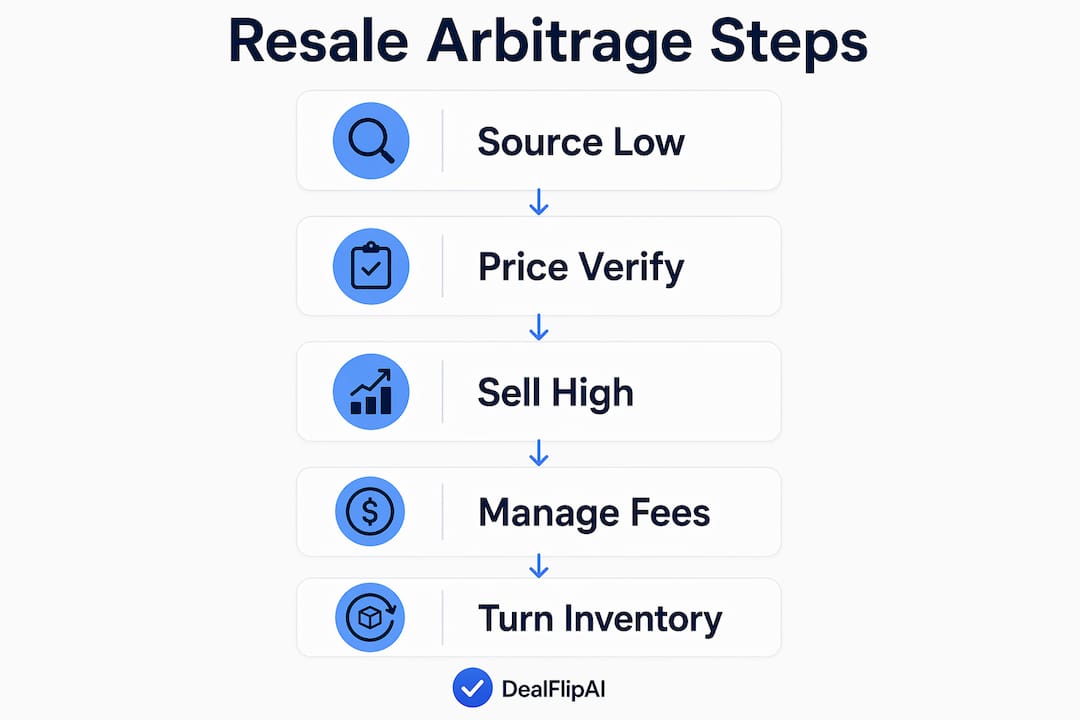
Resale market arbitrage works in three steps: source low, verify the price gap, and sell high. The sourcing side pulls inventory from clearance sections, thrift stores, estate sales, liquidation pallets, and online deals. The verification step is where most beginners skip ahead and lose money. You check the sold price on eBay or Amazon, not the listed price, because listed prices tell you what sellers want. Sold prices tell you what buyers actually pay.

The cost formula you need before buying anything
Every purchase decision should run through one calculation. The minimum selling price formula is: (Item Cost + Shipping + Fees + Supplies) divided by (1 minus your target margin). That formula forces you to account for every dollar leaving your pocket before you commit to a buy. Skipping it is the single most common reason new resellers undercut themselves.
Here is a realistic cost breakdown for a $25 thrift store find sold on eBay for $65:
| Cost Category | Estimated Amount |
|---|---|
| Item purchase price | $25.00 |
| eBay seller fees (approx. 13%) | $8.45 |
| Shipping supplies | $2.50 |
| Shipping cost (if seller-paid) | $7.00 |
| Net profit | $22.05 |
| Net margin | ~34% |
A 34% net margin clears the minimum 30% margin target that experienced resellers use as their floor. You should also reserve 5 to 10% of your sale price for returns, especially in clothing categories where fit and condition disputes are common.
Pro Tip: Use the Flip Profit Calculator before every purchase to run the numbers in under 30 seconds. It factors in platform fees, shipping, and your margin target automatically.
Inventory turnover matters as much as margin. Moving products within 30 to 45 days maximizes profitability and prevents storage fees from eating into your returns. Cash tied up in slow inventory is cash you cannot use to buy the next deal.
Retail arbitrage vs. online arbitrage: which one fits you?
These are the two dominant forms of resale arbitrage, and they suit different budgets, schedules, and risk tolerances.
Retail arbitrage means walking into physical stores like Walmart, Target, or TJ Maxx and scanning clearance items with apps like Amazon Seller App or ScoutIQ to check live prices and sales rank. Retail arbitrage typically requires around $500 in starting capital, making it the more accessible entry point. The downside is time. You drive, you scan, you haul. Scaling retail arbitrage means more hours on the road.
Online arbitrage flips that equation. You source from ecommerce sites using software like Tactical Arbitrage, which scans thousands of product listings across retailers and compares them against Amazon prices automatically. Online arbitrage requires $2,000 to $5,000 to start but scales significantly better because you can process more deals per hour from your desk.
| Factor | Retail arbitrage | Online arbitrage |
|---|---|---|
| Starting capital | ~$500 | $2,000 to $5,000 |
| Scalability | Limited by time | High with software |
| Risk level | Lower per item | Moderate (price drops) |
| Best platform | Amazon FBA, eBay | Amazon FBA |
| Key tool | Amazon Seller App, ScoutIQ | Tactical Arbitrage |
A third option worth knowing is liquidation pallet flipping, where you buy bulk returns or overstock from retailers like Amazon or Home Depot through liquidation marketplaces. The per-item cost is low, but you accept more uncertainty about condition. Individual item flipping, by contrast, gives you full control over what you buy and inspect.
Pro Tip: Start with retail arbitrage to learn the fundamentals of pricing and condition grading. Move to online arbitrage once you understand what sells fast and what sits.
Strategies to maximize profits in resale market arbitrage
Profitable resellers do not rely on instinct. They follow rules that remove emotion from buying decisions.
- Apply tiered margin rules. Profitable resellers target 50%+ margin for items under $30, 30% for items priced $30 to $100, and 25%+ for items over $100. Higher-priced items carry more absolute dollar profit, so a lower percentage margin still makes sense.
- Research sold prices, not listed prices. On eBay, filter by "Sold Listings" to see real transaction data. On Amazon, check the sales rank history using tools like Keepa to confirm an item actually sells at the price you see.
- Set a maximum hold time. Professional resellers use a maximum hold period, often 14 days, and strict exit strategies to avoid tying up capital in slow inventory. If an item does not sell within your window, drop the price and move on.
- Limit single-item exposure. No single item should represent more than 1 to 3% of your total deployable capital. This rule protects you from one bad buy wiping out a week of profits.
- Reinvest profits with a structure. A recommended reinvestment split is 50% back into inventory, 30% into operations, and 20% as personal pay. This compounds your buying power over 6 to 12 months without draining your cash buffer.
Managing platform restrictions is also part of the strategy. Amazon, eBay, and Facebook Marketplace each have category-specific rules, brand restrictions, and condition requirements. Selling a restricted brand or misrepresenting condition leads to account flags that can freeze your funds for 30 to 90 days.
Pro Tip: Avoid chasing viral trends without data. Sustainable resale relies on verified signals and confirmed exit prices, not social media hype. A product trending on TikTok today may be oversupplied on eBay by next week.
How digital tools improve your resale arbitrage decisions
Technology has made resale arbitrage more precise and less dependent on guesswork. The right tools help you price accurately, avoid bad deals, and compare platforms before you list.
Here is how the main tool categories support your workflow:
- Fee calculators for eBay, Poshmark, Mercari, and Facebook Marketplace tell you exactly what each platform takes before you commit to a listing price. Use the eBay fee calculator or Poshmark fee calculator to avoid pricing errors that shrink your margin.
- Cross-listing profit calculators compare your net profit across platforms for the same item. The cross-listing profit calculator from Dealflip shows you whether eBay, Mercari, or Poshmark returns the most after fees for a specific price point.
- Listing analyzers evaluate Facebook Marketplace deals before you buy. Dealflip's listing analyzer tool scores listings based on price, profit potential, and risk factors so you can act on the best deals before other buyers do.
- Scam checkers flag suspicious listings before you send money. This is especially relevant on Facebook Marketplace, where scam detection protects you from fake listings designed to steal payment.
Tools like Dealflip's suite of reseller calculators improve pricing accuracy and help you manage fees and margins across platforms simultaneously. The practical result is fewer pricing mistakes and more consistent margins on every flip.
For sellers using Amazon FBA, restocking inventory efficiently is a separate discipline that becomes critical as your volume grows. Keeping FBA stock levels balanced prevents both stockouts and long-term storage fees.
Key takeaways
Resale market arbitrage succeeds when you combine disciplined sourcing, margin rules, and the right tools to capture price gaps before other buyers find them.
| Point | Details |
|---|---|
| Core definition | Buy undervalued goods in one market and resell at a higher price in another to capture the spread. |
| Margin discipline | Target 30%+ net margin minimum, with tiered rules based on item price category. |
| Arbitrage types | Retail arbitrage suits beginners with $500; online arbitrage scales better with $2,000 to $5,000. |
| Risk management | Limit single-item exposure to 1 to 3% of capital and set a maximum hold time of 14 days. |
| Technology advantage | Fee calculators, listing analyzers, and scam checkers reduce errors and protect margins on every deal. |
What I've learned after years of watching resellers win and lose
The resellers I've seen build real income from arbitrage share one trait: they treat it like a business from day one, not a hobby. They track every cost, set rules before they buy, and exit positions without ego when an item stalls.
The ones who struggle almost always make the same mistake. They find one hot product, go deep on inventory, and then watch the market shift. Trend chasing without data is the fastest way to tie up your capital in items that won't move. I've watched people buy 20 units of a "viral" product only to find 200 other sellers already listing it at half the price two weeks later.
What actually works is boring and repeatable. You build a sourcing checklist. You set a margin floor and refuse to go below it. You keep a cash buffer that covers at least 30 to 90 days of unexpected costs, including platform holds. You reinvest profits on a schedule rather than spending them as they come in.
Technology is not a shortcut. It is a multiplier. If your process is undisciplined, a faster tool just helps you make bad decisions faster. But if you have a solid framework, tools like Dealflip's deal scoring and fee calculators genuinely extend what one person can evaluate and act on in a day.
Start small, stay consistent, and let the data tell you what to buy. That is the whole system.
— Apex
Find your next profitable flip with Dealflip
If you are ready to put resale arbitrage into practice, Dealflip gives you the tools to make data-backed buying decisions on Facebook Marketplace from the start.

Dealflip's AI scores listings by price, profit potential, and risk so you know which deals are worth pursuing before you make an offer. Use the Facebook Marketplace deal finder to locate undervalued items in your area, then run the numbers through the Flip Profit Calculator to confirm your margin before you buy. Real-time alerts surface fresh listings before the competition, and built-in scam detection keeps your capital safe. Start with the free tools and build from there.
FAQ
What is resale market arbitrage in simple terms?
Resale market arbitrage is buying an item for less than you can sell it somewhere else, then pocketing the difference. The profit comes from the price gap between where you source and where you sell.
How much money do you need to start resale arbitrage?
Starting capital is often between $50 and $200 for a basic start, though retail arbitrage on Amazon typically benefits from around $500 to cover initial inventory and supplies.
What margin should resellers target?
The standard floor is a 30% net margin after all costs, with higher margins required for lower-priced items. Items under $30 should clear 50% margin to be worth your time.
Is retail arbitrage or online arbitrage better for beginners?
Retail arbitrage is the better starting point because it requires less capital and teaches you condition grading and pricing fundamentals hands-on. Online arbitrage scales better once you understand what sells.
How do you avoid losing money on resale arbitrage?
Set a maximum hold time for every item, limit single-item exposure to 1 to 3% of your capital, and always verify sold prices rather than listed prices before buying. These three rules eliminate most of the common losses.