

Seller-side deal scoring is a predictive 0–100 rating that tells you, as the buyer, how likely a Facebook Marketplace listing is to be a real, profitable deal worth pursuing. Think of it as a quick gut-check that replaces hours of manual research. Here's why it matters to you:
- Speed: Scores surface the best listings fast, so you act before other flippers do.
- Risk reduction: Behavioral and listing signals flag scams, hidden damage, and pricing traps before you drive across town.
- Profit focus: A score comes paired with a suggested offer range, so you know your margin before you message the seller.
Dealflip AI is built specifically for this workflow, scoring Facebook Marketplace listings on price, profit potential, and seller trust signals in one place.
Table of Contents
- How seller-side deal scoring actually works
- Which seller signals does the model actually watch?
- How to read a score and decide what to do next
- Where automated scores can mislead you
- A real example: scoring a PlayStation 5 listing with Dealflip AI
- Five steps to start using deal scoring in your workflow this week
- Key Takeaways
- Why scores are a tool, not a verdict
- Dealflip AI puts seller-side scoring to work for you
- Useful sources for further reading
How seller-side deal scoring actually works
Deal scoring assigns a numerical value on a 0–100 scale, where higher numbers mean a stronger probability that the transaction will succeed on your terms. Higher scores signal clean listings with motivated seller behavior, while lower scores indicate friction, risk, or overpricing.
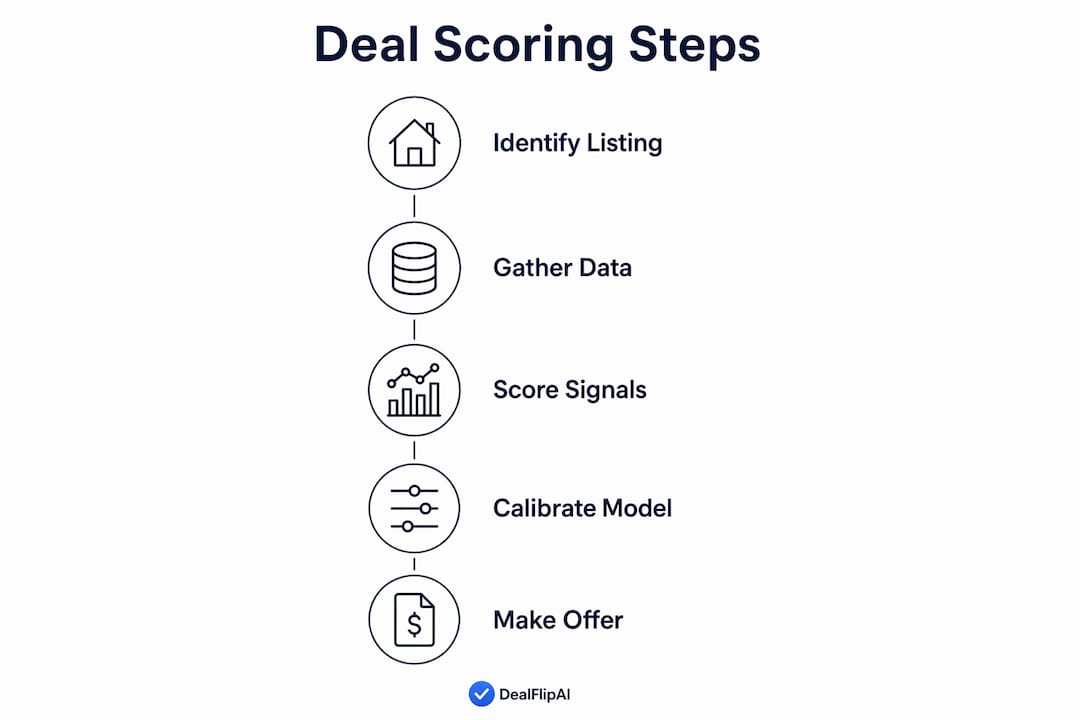
The model pulls from multiple data sources: listing price versus local sold comps, photo count and quality, description completeness, listing age, repost history, and seller response patterns. Some systems layer in engagement signals like comment count and cross-posting activity. Scoring outputs often include an overall score, a probability estimate, and category subscores for things like listing quality and seller trust.

Update cadence matters a lot on Marketplace, where listings change hourly, making streamlined workflows essential for efficient deal evaluation like shown in examples of streamlined sales workflows for SMBs. Fast triggers such as a price drop or a new message from the seller can refresh a score within hours. Slower triggers, like reprocessing a seller's full engagement history, may take longer. Static scores that never update are a real liability here, because a listing that looked risky Monday morning may be a steal by Tuesday afternoon after the seller drops the price $80.
The most useful models are calibrated to your own win/loss history. A generic score informs; a score tuned to your category and price range actually directs your next move.
Which seller signals does the model actually watch?
Behavioral signals like response velocity and willingness to meet in person are often stronger predictors of a good deal than price alone. Here's the full list of signals a well-built scoring model watches:
- Price vs. local comps: Is the asking price below recent sold listings in your ZIP code?
- Listing age and repost history: Listings reposted multiple times signal a motivated seller.
- Photo count and quality: Blurry, stock, or mismatched photos are red flags.
- Description completeness: Missing model numbers, vague condition notes, or no accessory list lower the score.
- Seller response speed: Fast replies correlate with real, motivated sellers.
- Views, comments, and shares: High engagement on a low-price listing means competition; act fast.
- Cross-posting activity: A seller listing on multiple platforms is motivated to move the item.
- Stated condition and accessories: "Works great" with no photo of the power cord is a gap.
- Pickup vs. shipping: Local pickup only can mean the seller wants a quick, clean transaction.
- Red flags: Brand mismatches, suspiciously low prices, and requests for payment outside Marketplace are scam indicators.
Pro Tip: Signal weights shift by category. For electronics, prioritize response velocity and model number accuracy. For furniture, photo quality and pickup logistics matter more. For collectibles, description detail and seller history carry the most weight. Dealflip AI's electronics deal finder applies category-specific weighting automatically.
Scam-detection checklist: Refuse to meet in person, inconsistent photos (stock images mixed with real ones), requests for Zelle or Venmo outside Marketplace, and prices more than 50% below comp all warrant immediate skepticism. Use Dealflip AI's scam checker to run a quick trust audit before you reply.
How to read a score and decide what to do next
Deal scoring frameworks use weighted categories to prioritize which opportunities to pursue. Here's how to translate a score into action:
| Score band | What it means | Your move |
|---|---|---|
| High score band | Strong listing, motivated seller, price below comp | Inspect photos, message promptly, offer near asking price |
| Medium score band | Decent listing, one or two gaps | Ask clarifying questions, request extra photos, verify model |
| Lower medium band | Multiple gaps or weak signals | Negotiate hard or pass; only pursue if margin is exceptional |
| Low score band | High risk or likely scam | Skip unless you have specific local knowledge |
For offer sizing, a simple rule works well: start your offer at the discount implied by the score off asking price. Higher scores indicate motivated sellers; lower scores indicate friction and a need for lower offers or passing. Before sending any offer, run a quick verification: confirm the model number, check one sold comp on eBay, and confirm the seller will meet in a public place.
Where automated scores can mislead you
Replacing gut feel with evidence-based scoring reduces wasted effort, but no model is perfect. Know the failure modes:
- Cold-start bias: New sellers with no history get a neutral score by default, not a trustworthy one.
- Stale scores: A score generated 48 hours ago on a fast-moving listing may no longer reflect reality.
- Manipulated listings: Sellers who copy professional photos or pad descriptions can fool a model that weighs those signals heavily.
- Localized pricing anomalies: A $150 asking price for a KitchenAid mixer is a steal in Manhattan and fair in rural Ohio. Models without tight geographic calibration miss this.
- Model mismatch: A scoring model trained on general sales data may not reflect Facebook Marketplace's informal, cash-based dynamics.
Your manual validation checklist before any purchase:
- Ask the seller one specific question only the real owner would answer (e.g., "What color is the charging cable?").
- Request a photo of the serial number or model ID tag.
- Check two recent sold comps on eBay or Facebook Marketplace itself.
- Confirm a public meeting spot (police station parking lots are ideal).
- For electronics, ask if the item powers on and request a short video.
One-sentence rule: trust the score for triage, but trust your eyes for the final call.
A real example: scoring a PlayStation 5 listing with Dealflip AI
Scenario: A seller lists a PS5 Disc Edition for $320, described as "like new," with four photos, posted three days ago, and responds within 10 minutes.
How the score builds:
| Signal | Value | Score contribution |
|---|---|---|
| Price vs. comp | $60 below comp | — |
| Photo count and quality | 4 clear photos | +12 pts |
| Listing age | 3 days (motivated) | +10 pts |
| Response velocity | Under 10 minutes | +15 pts |
| Description completeness | No controller photo | — |
| Red flags | None detected | +0 pts |
| Total score | 85/100 |
Suggested offer: Dealflip AI's offer suggestion tool places the opening offer at $285, targeting a resale of $360 on eBay after a $15 cleaning and $12 shipping fee. Net margin: roughly $48 on a $285 buy. The missing controller photo lowered the score enough to justify asking for one more photo before committing.
Five steps to start using deal scoring in your workflow this week
- Pick your scoring tool. Dealflip AI handles this automatically for Facebook Marketplace. If you prefer a manual approach, build a simple spreadsheet with the ten signals above and assign weights.
- Choose 3–5 repeatable signal checks. Price vs. comp, response speed, and photo quality cover most of the variance for most categories.
- Calibrate with 10 past deals. Pull your last 10 buys, score them retroactively, and see where the model would have flagged the bad ones. Adjust weights accordingly.
- Run live for one week. Score every listing you consider. Don't buy anything below 60. Track outcomes.
- Review and adjust. After week one, compare your scored predictions to actual results and tighten your thresholds.
Set up real-time deal alerts so high-scoring listings hit your phone the moment they post. Speed is a real advantage on Marketplace; a score of 85 means nothing if another flipper messages first.
Key Takeaways
Seller-side deal scoring gives Facebook Marketplace flippers a fast, repeatable way to separate real deals from risky ones using behavioral and listing signals instead of guesswork.
| Point | Details |
|---|---|
| Score = speed + risk + profit lens | A 0–100 score combines price, seller behavior, and listing quality into one triage number. |
| Behavioral signals matter most | Response velocity and willingness to meet are stronger predictors than price alone. |
| Always validate manually | Use the score to triage, then confirm model number, comps, and meeting spot before buying. |
| Static scores go stale fast | Marketplace moves hourly; prioritize tools with fast-trigger score updates. |
| Dealflip AI applies this automatically | Dealflip AI scores listings, suggests offers, and flags scams for U.S. Facebook Marketplace flippers. |
Why scores are a tool, not a verdict
Most flippers I talk to either ignore data entirely or trust a single number too much. Both are mistakes. The real value of seller-side deal scoring isn't that it tells you what to buy. It's that it forces you to look at the same signals every time, so you stop making decisions based on how excited you feel about a listing.
The caution I'd add: don't let a high score make you skip the in-person check. A listing can score 82 and still have a cracked screen the seller photographed at an angle. The score gets you to the right listings faster. Your hands and eyes close the deal safely. For readers who want to go deeper on how the model mechanics work, Dealflip AI's methodology page walks through the scoring logic in detail.
Dealflip AI puts seller-side scoring to work for you
Spending 20 minutes manually researching every Facebook Marketplace listing isn't a strategy. Dealflip AI gives you a ready-made scoring system built specifically for U.S. flippers, so you spend that time buying instead of researching.

Core features that matter to active resellers:
- Listing analyzer: Paste a URL and get a full score with signal breakdown.
- Offer suggestion: AI-calculated opening offer based on comp data and score.
- Scam detection: Flags behavioral and listing red flags before you reply.
- Real-time alerts: Get notified the moment a high-scoring listing posts in your area.
- Cross-listing profit calculator: See your margin across eBay, Mercari, and Poshmark before you buy.
Find your next deal on Facebook Marketplace or run a free analysis on any listing with the listing analyzer tool.
Useful sources for further reading
- Deal Score: Definition, Examples & Use Cases — Saber.app: Clear breakdown of score components, outputs, and use cases.
- Predict Likelihood to Close with Deal Scores — HubSpot Knowledge: Explains fast vs. slow trigger cadence and score refresh windows.
- AI Deal Scoring Explained — Clozo Blog: Details on behavioral signal weighting and response velocity as a predictor.
- Dynamic Deal Scoring — LatentView Glossary: Explains the difference between static and dynamic scoring models.
- Dealflip AI Methodology Page: How Dealflip AI derives scores, valuation confidence, and alert triggers for Facebook Marketplace.