

Overpricing is not a neutral mistake. It is a decision that burns through your most valuable resource: time. Understanding why overpriced listings waste time is the first step to protecting your reselling margins, because the cost is not just the gap between the asking price and reality. It is the lost buyer momentum, the listing that goes cold, and the hours you spend chasing deals that were never going to close at a fair price. Whether you are flipping items on Facebook Marketplace or evaluating properties as an investment, knowing how to spot an overpriced listing before you commit is a skill that directly protects your profitability.
Table of Contents
- Key takeaways
- Why overpriced listings waste time from the start
- How stale listings compound the time penalty
- The financial damage goes beyond the price cut
- How overpricing plays out on Facebook Marketplace specifically
- Practical steps to stop wasting time on overpriced deals
- My take on the real cost of chasing overpriced listings
- Stop chasing bad deals with Dealflip
- FAQ
Key takeaways
| Point | Details |
|---|---|
| Early momentum matters most | Serious buyers act in the first two weeks; overpriced listings miss this window entirely. |
| Staleness multiplies time lost | Listings sitting beyond 8 weeks require far more price cuts and still take longer to sell. |
| Financial costs compound fast | Price reductions grow from 2.7% to 16.4% the longer an overpriced listing stays active. |
| Platform algorithms punish high prices | Facebook Marketplace filters and search rankings push overpriced items out of buyer view. |
| AI tools cut through the noise | Using a listing analyzer or value estimator helps you evaluate fair price before wasting time. |
Why overpriced listings waste time from the start
Every new listing on Facebook Marketplace gets a burst of natural visibility. Buyers browsing fresh results, search algorithms surfacing recent posts, and early interest from active shoppers all collide in the first 10 to 14 days. This is what experienced resellers call the momentum window. Miss it, and you are fighting uphill from day one.
Research on 75,000 U.S. home sales shows that pricing within 1% of market value gives a seller roughly a 50% chance of reaching a contract within 14 days. Push the price 3 to 5% above market value, and that timeline stretches to 52 days. For a reseller trying to flip items quickly, that gap is not just inconvenient. It is a direct hit to your return on capital.
The behavior pattern buyers follow is surprisingly consistent. When a price looks too high, they do not negotiate. They scroll past. There is no counter-offer, no message asking for more photos, no saved listing to revisit later. Overpricing anchors buyer expectations high, which means that when a seller eventually drops the price, buyers who already saw the original figure feel like any new offer is still above what the item is worth.
Pro Tip: If a listing has been active for more than two weeks with no offers, check whether the price was set more than 5% above comparable sold items. That gap is usually the reason it stalled.
How stale listings compound the time penalty
Staleness in marketplace listings is not just a perception problem. It becomes a data problem. On Facebook Marketplace, buyers can see how long an item has been posted. That timestamp functions like a credibility meter, and when it reads "listed 45 days ago," most buyers immediately ask themselves what is wrong with it rather than whether it fits their needs.
Accurately priced homes sell in around 33 days on average. Once a listing sits for approximately 8 weeks and requires a price reduction, that average balloons to 160 days, with only about half of those listings actually selling. The price cut does not reset the clock. It just signals to buyers that the seller is desperate, which triggers a different kind of behavior: lowball offers, prolonged negotiations, and demands for concessions.
Here is what the staleness timeline looks like in practice:
- Days 1 to 14: Peak visibility and buyer interest. Serious shoppers are most active during this window.
- Days 15 to 30: Engagement drops sharply. Listings start collecting views but no meaningful inquiries.
- Days 31 to 60: Buyer psychology shifts. Interest gives way to suspicion. After 3 to 4 weeks without a sale, buyers stop evaluating fit and start looking for defects.
- Days 60 and beyond: The listing is effectively stale. Overpriced listings are 62% more likely to remain active beyond 60 days, requiring multiple rounds of price cuts before any sale occurs.
The data on price cuts reinforces this further. 57% of U.S. home sales in 2025 involved price cuts, and overpriced listings required more cuts than accurately priced ones. Each additional cut adds days to the listing's life and reduces the credibility of the seller, creating a cycle that is very hard to break once it starts.
Pro Tip: Treat days on market as a listing freshness score. Anything past 21 days on Facebook Marketplace without a visible price drop should make you question whether the seller's expectations are realistic.
The financial damage goes beyond the price cut
When resellers think about overpriced listings, they usually think about the gap between the asking price and what they would actually pay. But the real financial damage is broader than that single number.

A study from the Highlands Ranch real estate market in 2025 found that average price reductions climbed from 2.7% for listings sold within 30 days to 16.4% for listings active beyond 180 days. Concessions doubled over the same period. What started as a small pricing error grew into a significant financial loss simply because of how long the item sat.
The probability of getting the original asking price collapses just as fast. Within 30 days, there is a 34.3% chance of a seller receiving their original list price. After 30 days, that drops to 2.5%. After 90 days, it is effectively zero.
Beyond the price reduction itself, there are compounding operational costs to consider:
- Repeated negotiations with buyers who have now seen multiple price drops and treat each one as leverage.
- Deal fallbacks, where a buyer agrees to a price, then pulls out when they sense the seller is motivated to unload.
- Re-inspection or re-evaluation costs if the item is a higher-value asset like electronics or furniture.
- Opportunity cost from capital tied up in a pursuit that is unlikely to convert at acceptable margins.
- Time spent responding to inquiries that never convert, draining hours that could go toward deals with actual potential.
Prolonged time on market increases operational burdens across every step of a transaction, raising risk and extending the timeline in ways that compound the original pricing mistake.
Pro Tip: If you are evaluating a listing that has been active for more than 30 days, model your offer based on where the price is likely to land after 90 days, not where it sits today. That number is your real negotiating anchor.
How overpricing plays out on Facebook Marketplace specifically
Facebook Marketplace has its own mechanics that make overpricing especially punishing. Unlike a traditional real estate listing where buyers may be more patient, Marketplace shoppers expect to find deals. They set price filters. They sort by "lowest price." They compare three similar listings at once before sending a single message.
When an item is priced too high, several things happen simultaneously. First, price filter settings cut the item out of searches entirely. If buyers are looking for a used sofa under $300 and yours is listed at $375, they never see it. Second, the Marketplace algorithm factors in listing engagement. Low click-through rates and zero saved interactions push the listing further down in results over time.
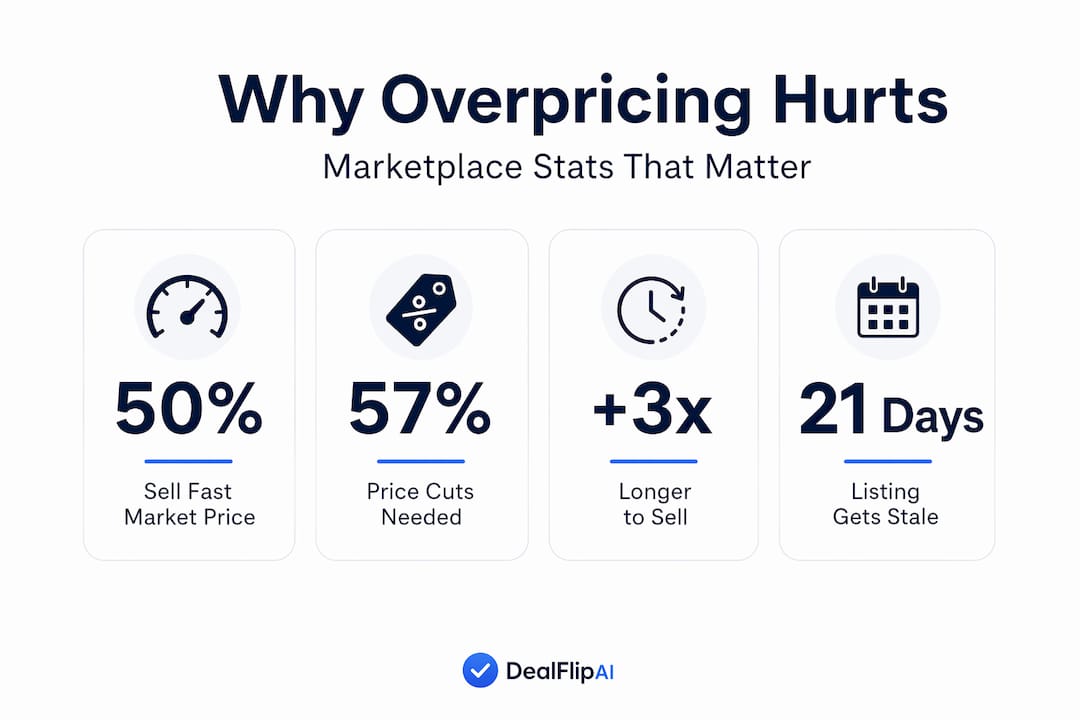
The anchoring effect is particularly damaging in digital resale. Overpricing creates an anchoring bias that distorts how buyers perceive later discounts. A buyer who sees a price history showing $400 then $350 does not think "great deal." They think "what am I missing?"
Here are the most common signs an item is overpriced on Facebook Marketplace:
- Listed for more than 14 days with no visible offers or comments from buyers.
- Price is noticeably higher than three or more comparable active listings.
- Seller has a history of frequent relisting of the same item.
- Photos and description do not justify a premium price point.
- No explanation for the higher price despite visible wear or missing accessories.
- The listing has been reposted, which often means the original received no traction.
Understanding how days on market signal credibility helps you make faster, smarter decisions on Marketplace. A fresh listing is an opportunity. An old one at the same price is almost always a warning.
Practical steps to stop wasting time on overpriced deals
Knowing the theory is useful. Having a system is better. Here is how to evaluate listing prices before you invest time in pursuing them.
Step 1: Pull comparable sold prices. Search for similar items that have actually sold, not just what others are currently asking. On Facebook Marketplace, look at the "sold" filter on search results. On higher-value items, cross-reference with eBay sold listings.
Step 2: Check listing age. Use the posted date to calculate days on market. Compare that against your 14-day momentum window benchmark. Any listing past 21 days without a price change should trigger extra scrutiny.
Step 3: Analyze price history. If a seller has already dropped the price once, check how far they dropped it and how long ago. Multiple drops in a short window signal desperation, which is useful for negotiation but also signals the item may have other issues.
Step 4: Use a value estimator. Tools like the Dealflip value estimator give you a data-driven benchmark for what an item is actually worth on the current market, so you are not relying on gut feel alone.
Step 5: Score the deal before messaging. The Dealflip listing analyzer evaluates listings based on price, profit potential, and risk signals so you can skip the time wasters and focus on real opportunities.
| Tool | What it does | Best for |
|---|---|---|
| Value estimator | Benchmarks item price against market data | Spotting overpriced items quickly |
| Listing analyzer | Scores deal potential and flags red flags | Pre-screening before outreach |
| Deal finder | Surfaces fresh, underpriced listings in real time | Finding deals before others do |
| Offer suggestion tool | Generates data-based first offer recommendations | Negotiating from an informed position |
Pro Tip: Set a personal rule: never message a seller on a listing older than 30 days unless the price has dropped at least once and sits within 10% of comparable sold items. This one filter alone will eliminate most time-wasting pursuits.
My take on the real cost of chasing overpriced listings
I have watched a lot of resellers fall into the same trap. They see an item they want to flip, the price looks negotiable, and they spend 45 minutes messaging back and forth with a seller who has no intention of pricing realistically. That is not just 45 wasted minutes. It is 45 minutes that did not go toward a deal that was actually worth closing.
The misconception I see most often is that a long listing with room to negotiate is an opportunity. In practice, a listing that has been sitting for 60 days at the same price usually signals one of two things: the seller is emotionally anchored to a number that has no market basis, or the item has a problem that is not visible in the photos.
Early pricing accuracy matters more than most people realize. Testing high prices early wastes the critical buyer interest period, and the position you recover to is almost always weaker than where you would have started with accurate pricing. This applies to the sellers creating these listings and to the resellers spending time on them.
My advice: build your filtering system before your enthusiasm takes over. Let data be the gatekeeper, not optimism. Technology now exists to make this faster than it has ever been. Use it.
— Apex
Stop chasing bad deals with Dealflip
Spending time on overpriced listings is one of the biggest drains on reseller profitability, and most of it is avoidable. Dealflip is built specifically for Facebook Marketplace resellers who want to move fast and buy smart.
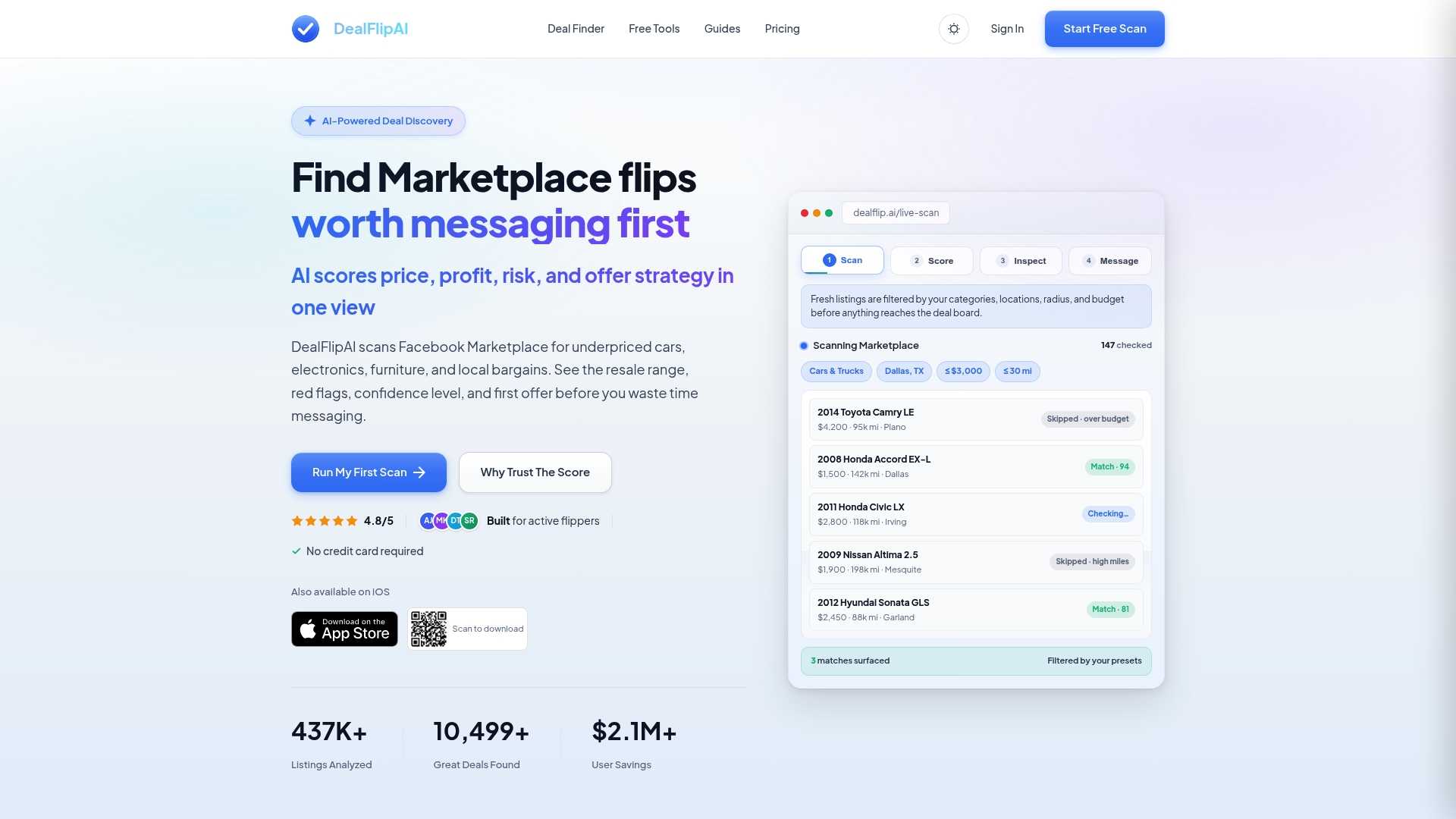
The platform uses AI to score listings based on price accuracy, profit potential, and risk signals so you can see immediately whether a deal is worth your time. The deal finder tool surfaces fresh, underpriced listings in real time, helping you get there before other buyers do. The offer suggestion tool generates a data-driven first offer based on market comps and seller behavior, so you negotiate from a position of knowledge rather than guesswork. If you want a practical guide to finding good deals on Facebook Marketplace, Dealflip's resource on how to find good deals is a strong starting point.
FAQ
Why do overpriced listings waste buyer time?
Overpriced listings pull buyers into evaluation cycles that go nowhere. Buyers spend time messaging, researching, and sometimes visiting, only to find the seller's price has no connection to market reality.
How long does it take for an overpriced listing to go stale?
Research shows buyer psychology shifts after roughly 3 to 4 weeks. After 8 weeks, accurately priced homes take an average of 33 days to sell, while overpriced ones with reductions can stretch to 160 days.
What signals an overpriced listing on Facebook Marketplace?
Key signals include a posting date older than 14 days with no activity, a price noticeably above comparable sold items, multiple relistings, and no justification for a premium in the photos or description.
Does cutting the price fix a stale listing?
Not reliably. Even after price cuts, listing history remains visible and buyer skepticism persists. Sellers often end up negotiating below market value rather than recovering to a fair price.
When should a reseller walk away from an overpriced listing?
Walk away when a listing has been active beyond 30 days at the same price, the seller shows no flexibility, and the current ask is more than 10% above comparable sold items. Your time is better spent on fresh, fairly priced opportunities.