

AI deal scoring reliably speeds up sourcing, raises your hit rate, and cuts scam risk on Facebook Marketplace. If you analyze multiple listings per week manually, switching to AI scoring can save you significant time, freeing up hours weekly and across the year. That time goes back into finding deals, not crunching numbers.
TL;DR:
- AI scoring cuts per-listing analysis from a longer duration down to a few minutes
- You get consistent valuations, profit estimates, scam flags, and confidence scores in one view
- Dealflip AI is the recommended tool for Facebook Marketplace flippers, with transparent deal breakdowns and suggested first-offer logic built in
- Treat scores as decision support. Always verify condition and local demand before you drive.
Table of Contents
- How does AI calculate a deal quality score for Marketplace listings?
- What concrete benefits does AI scoring give you as a flipper?
- How to fold AI scores into your sourcing workflow
- A real-world example: high-score listing to profitable flip
- Where AI scoring can fail and how to protect yourself
- What does AI deal scoring cost, and when does it pay off?
- Quick checklist to start using AI deal scoring today
- Is AI deal scoring worth it for Facebook Marketplace flippers?
- Key Takeaways
- Why AI scoring changed how I approach every sourcing session
- Dealflip AI gives you a faster path to profitable flips
- Useful sources and further reading
How does AI calculate a deal quality score for Marketplace listings?
The score is built from several data signals working together. Here is what goes into a typical calculation:
- Price vs. fair value: The AI pulls comparable sold listings to estimate the item's resale value (ARV)
- Profit estimate: List price minus estimated repair costs, platform fees, and shipping yields a net margin figure
- Condition estimate: Computer vision reads listing photos to flag damage, missing parts, or cosmetic wear
- Seller signals: Response time, listing history, and account age feed into a reliability score
- Scam risk indicators: Unusual pricing, stock photos, and vague descriptions trigger risk flags
- Local demand: Search volume and days-on-market for similar items in your area adjust the valuation
- Confidence score: A percentage that reflects how much comparable data backs the estimate
The flow looks like this: raw listing input → comp retrieval → condition estimate → fee and margin calculation → risk adjustment → confidence interval output.
| Input | Example Value | Score Component |
|---|---|---|
| List price | $85 | Baseline |
| Est. resale value | — | ARV / profit anchor |
| Repair estimate | $10 | Margin reducer |
| Platform fees | $14 | Net proceeds reducer |
| Scam-risk flag | Low | Risk modifier |
| Confidence % | 82% | Reliability weight |
Transparent comp retrieval matters here. When the system shows you which comps it used and why, you can spot a stale or mismatched comp and adjust before committing. That visibility is what separates a trustworthy score from a black-box guess.
What concrete benefits does AI scoring give you as a flipper?
The advantages of AI scoring show up fast in your daily routine.
- Speed: Screening drops from 15–30 minutes per listing to 2–5 minutes. Letting you cover far more ground each session
- Higher hit rate: Tighter ARV ranges mean fewer deals where you overpay and miss your margin target. AI valuation methods can reduce error margins dramatically, narrowing uncertainty bands that would otherwise cost you money
- Consistency: The same methodology applies to every listing, so optimism bias and fatigue don't skew your decisions on listing number 20 the way they do when you're doing it manually
- Scam reduction: Automated risk flags catch stock photos, price anomalies, and thin seller histories before you waste a trip. Dealflip AI's scam detection tools surface these signals at the screening stage
- Better offer strategy: Suggested first-offer logic tied to confidence bands helps you open negotiations at the right number, not too high to kill your margin and not so low you lose the deal
Statistic: Analyzing 15 deals per week manually costs you nearly 4 hours. At scale, that's 200 hours a year spent on research instead of flipping.
Pro Tip: After a listing scores high, send the seller a quick message asking for two additional photos (bottom and back). That 60-second step confirms condition before you ever leave the house.
How to fold AI scores into your sourcing workflow
A score is only useful if your workflow is built around it. Here is a repeatable process:
- Set threshold filters. Configure your minimum score, margin floor, and category presets so only qualifying listings reach your pipeline. Real-time deal alerts notify you the moment a high-scoring listing goes live.
- Run a 3–5 minute triage check. Read the description, review the photos, and confirm the score's condition assumption matches what you see.
- Apply the suggested first offer. Use the confidence band to decide: high confidence (80%+) supports an aggressive offer; lower confidence calls for a more conservative opening.
- Inspect in person. Check for damage the photos didn't show, test functionality, and verify the seller matches their profile.
- Run the cross-list decision. Use a cross-listing profit calculator to compare net proceeds across platforms before you price the resale listing.
Quick field checklist:
- Confirm model/serial number matches listing description
- Test power-on or basic function
- Check for cracks, missing parts, or water damage not visible in photos
- Verify seller ID matches account history
- Note local pickup vs. shipping cost impact on margin
A real-world example: high-score listing to profitable flip
The listing: A used smartphone listed at $85. The AI score comes back at 78/100 with 82% confidence.

| Factor | Value |
|---|---|
| List price | $85 |
| Cosmetic repair estimate | $10 |
| Net profit estimate | $47 |
The workflow:
- Alert fires at 7:14 AM. Listing is 22 minutes old.
- Quick photo check confirms screen is intact; back has minor scratches consistent with the score's condition estimate.
- Message sent asking for IMEI and two extra photos.
- Seller responds in 11 minutes. Account has 47 positive reviews.
- Offer sent at $70 (within the suggested first-offer range for 82% confidence).
- Seller accepts. In-person pickup confirms condition.
- Listed on eBay at $155. Sold in 4 days.
The realized sale price of $155 landed within $5 of the AI's ARV estimate, validating the score's confidence interval and the hybrid approach of AI scoring plus a quick human check.
The lesson: the score didn't make the decision. It narrowed the field fast enough that you caught the listing before anyone else did.
Where AI scoring can fail and how to protect yourself
AI scoring is a tool, not a guarantee. Knowing the failure modes keeps you from losing money on a high-score miss.
Common failure modes:
- Stale comps: If comparable sales data is 60+ days old, the ARV may not reflect current local demand
- Poor photo quality: Blurry or staged photos limit what computer vision can assess about condition
- Atypical local demand: A score built on national comps may overvalue an item in a low-demand zip code
- Misclassified condition: Sellers sometimes list "good" items that are actually heavily worn
- Sparse data: Niche or unusual items may have too few comps for a reliable confidence score
Mitigation tactics:
- Set a minimum confidence threshold (75%+ is a reasonable starting point for most categories)
- Always inspect condition in person before paying
- Stress-test the ARV: what does your margin look like if the resale price comes in 10–15% lower?
- Keep a local comps list for your top categories to cross-check AI estimates
Pro Tip: If a listing scores high but the confidence is below 65%, treat it like a pilot deal. Offer lower, inspect harder, and track the actual resale outcome to calibrate your threshold.
When to ignore a score entirely: unique collectibles, highly seasonal items (holiday decor in July), and listings with no verifiable seller history. The AI needs data to work with.
What does AI deal scoring cost, and when does it pay off?
Most AI deal-scoring tools follow a tiered SaaS model: a free plan for occasional scans, then paid tiers based on monthly scan volume, alert frequency, category presets, and analysis depth.
- Free tier: Good for testing the tool on 10–20 listings before committing
- Entry subscription: Covers flippers analyzing 30–50 listings per week with basic alerts
- Higher tiers: Add advanced category filters, location presets, bulk analysis, and deeper seller-signal data
The ROI math is straightforward. If software saves you 15–28 minutes per listing and you analyze 15 listings per week, you recover nearly 4 hours weekly. At even a modest hourly value of your time, a monthly subscription pays for itself within the first week of use, before accounting for the deals you catch faster or the scams you avoid.
The break-even point for most flippers is around 10 analyzed deals per week. Below that, a free tier or manual process may suffice. Above it, a paid subscription typically pays for itself in time savings alone, with margin improvements as a secondary gain.
Quick checklist to start using AI deal scoring today
- Sign up for a deal-scoring tool and set your location, preferred categories, and minimum margin threshold
- Enable real-time alerts and mobile notifications for listings above your score cutoff
- Build a 3-step in-field verification routine: photo check, seller history review, quick condition test
- Connect score outputs to a flip profit calculator to confirm net margin before every offer
- Run the tool for 30–90 days, then compare your realized sale prices to the AI's ARV estimates to refine your confidence threshold
Pro Tip: Start with one category you know well. Electronics or tools are ideal because comps are plentiful and condition is easy to verify. Once your threshold is calibrated, expand to other categories.
Is AI deal scoring worth it for Facebook Marketplace flippers?
For most active flippers, yes. Here is a quick breakdown by situation:
- Side hustlers (5–10 deals/week): Start with a free tier. Run 30 listings through the tool and compare results to your manual process before upgrading.
- Part-time flippers scaling up (10–20 deals/week): A paid subscription pays for itself in time savings within the first month. Enable alerts immediately.
- Full-time flippers (20+ deals/week): AI scoring is a near-essential part of your sourcing stack. The consistency and speed gains compound across hundreds of listings.
The clearest signal to adopt now: if you are spending more than 3 hours per week on manual listing research, the math already favors a tool. Run a 30-day pilot, track your realized sale prices against the AI's ARV, and adjust your confidence threshold based on actual outcomes.
Key Takeaways
AI deal scoring gives Facebook Marketplace flippers a faster, more consistent way to find profitable listings, reduce scam exposure, and price offers with confidence backed by real comp data.
| Point | Details |
|---|---|
| Time savings are significant | Scoring cuts per-listing analysis from 15–30 minutes per listing down to 2–5 minutes, saving substantial time annually for frequent users. |
| Tighter ARV means better margins | AI valuation narrows uncertainty bands, reducing the risk of overpaying on a deal. |
| Scam risk drops with automated flags | Seller history, photo analysis, and price anomaly detection catch red flags before you waste a trip. |
| Break-even is fast | Flippers analyzing 10+ deals per week typically recover subscription cost in time savings within the first week. |
| Dealflip AI is the recommended tool | Dealflip AI provides transparent deal breakdowns, suggested first-offer logic, and scam detection built for Marketplace flippers. |
Why AI scoring changed how I approach every sourcing session
The conventional wisdom in flipping circles is that experience is your edge. Spend enough time on Marketplace and you develop a gut feel for what sells. That is true to a point. But gut feel does not scale, and it does not catch the scam listing that looks legitimate until you are already in the seller's driveway.
What AI scoring actually changes is not your judgment. It changes the volume of listings your judgment gets applied to. When you can screen 50 listings in the time it used to take to analyze 5, you stop making decisions based on whatever happens to be in front of you and start choosing from a ranked pipeline. That shift from reactive to selective is where the real profit improvement comes from.
The flippers who get the most out of AI scoring are not the ones who trust the score blindly. They are the ones who use it to filter fast, then apply their own knowledge at the verification stage. Dealflip AI's methodology is built around exactly that workflow: transparent valuations, confidence intervals, and scam signals that give you a starting point, not a final answer.
Dealflip AI gives you a faster path to profitable flips
Spending hours manually researching listings is the single biggest drag on a flipper's weekly output. Dealflip AI replaces that grind with scored, ranked listings that show you profit potential, fair value, scam risk, and suggested offer price before you message a single seller.
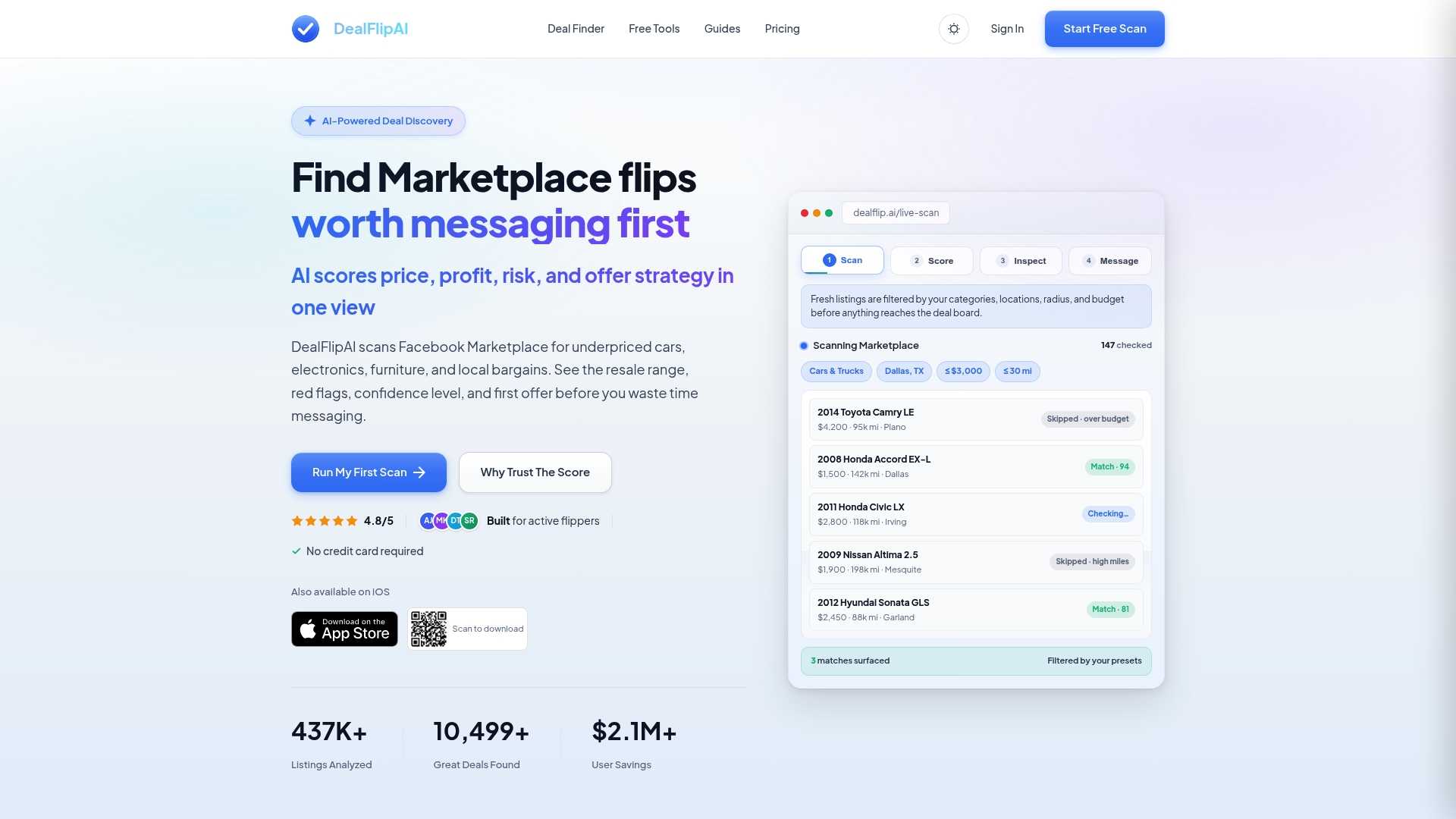
Start with the free Listing Analyzer to run your next 10 leads through the tool and see the score breakdown in real time. Then set up deal alerts so high-scoring listings reach you the moment they go live. When you are ready to scale, the Flip Profit Calculator and cross-listing tools help you decide exactly where and how to resell each item for maximum net margin. Head to dealflip.ai to get started today.
Useful sources and further reading
- Deal Analysis Spreadsheet vs Software | Deal Run — The source for the 15–30 minute manual analysis stat and the 200 hours/year time-savings calculation; useful for understanding the productivity case for scoring software.
- How AI Improves ARV Calculation for Fix-and-Flip Investors | Mojar AI — Covers AI valuation accuracy, error margin reduction, and the hybrid human-AI approach that improves outcomes over AI-only systems.
- Facebook Marketplace's New Meta AI Tools Make Selling Faster and Easier | Meta — Meta's official announcement of AI-powered listing creation and auto-reply features; useful context for how Marketplace-native AI complements specialized scoring tools.
- Facebook Marketplace's New AI Ends the 'Is This Available' Nightmare | Digital Trends — Explains how auto-reply features reduce repetitive messaging, freeing flippers to focus on high-value interactions.
- DealFlipAI Methodology | Deal Scoring, Valuation Confidence & Alerts — Primary methodology page covering how Dealflip AI scores listings, generates confidence intervals, and surfaces scam signals for Marketplace flippers.