

A fair first offer equals the median sold comp minus fees, shipping, repairs, your target margin, and a risk buffer. Run that math by hand and it takes ten minutes per listing. Run it through a scanner and you get a suggested number in seconds. Once you have that figure, use the checklist below to decide if a listing is even worth the math.
TL;DR:
- Most profitable listings have recent sold comps within the last 30 to 60 days, with at least three or four comparisons for accuracy.
- The fair first offer subtracts platform fees, shipping, repair costs, target profit margin, and a conservative risk buffer from the median sold comp.
- Automated tools like scanners and calculators speed up deal discovery, ensure transparency, and eliminate manual data cross-referencing.
- Seller motivation, such as urgency or recent price reductions, can allow offers 10 to 15 percent below the calculated fair price.
- Seasonal demand swings mean buyers should weight comps from the same season and buy off-season to maximize margins.
Table of Contents
- What Should You Check Before Calculating an Offer?
- How Do You Calculate a Fair First Offer From Sold Comps?
- Which Tools Speed Up Deal Discovery and Offer Math?
- What Should Your First Offer Message Actually Say?
- Which Red Flags Should Lower Your Offer or Kill the Deal?
- A Worked Example: Turning Comps Into a Number
- How Does Seller Motivation Change Your Offer?
- How Do Seasonal Swings Affect What You Should Offer?
- When Should You Take a Lower Margin for a Faster Flip?
- Try the Tools That Run This Math for You
- Where to Go Next
- Sources
What Should You Check Before Calculating an Offer?
Not every listing deserves a full profit calculation. Before you open a calculator, run a quick sanity check that takes under two minutes.
- Confirm at least three or four recent sold comps exist for the item's category and condition.
- Estimate repair, cleaning, or missing-parts costs at a glance. If it needs more than a wipe down and a battery, factor that in now.
- Decide whether you're picking up locally or shipping. Shipping eats margin fast, so flag it early.
- Apply your minimum profit threshold and your risk buffer before you get emotionally attached to the deal.
- If the listing fails any of these, walk away. Don't burn time modeling a loser.
This filter exists because scanning tools surface far more listings than any human can evaluate manually, and most of them aren't worth your time. The checklist keeps you from wasting effort on most listings that are unlikely to be profitable.
How Do You Calculate a Fair First Offer From Sold Comps?
The formula has six inputs, and the order you subtract them in matters.
Fair Offer = Median Sold Comp − Platform Fees − Shipping − Repair Costs − Target Margin − Risk Buffer
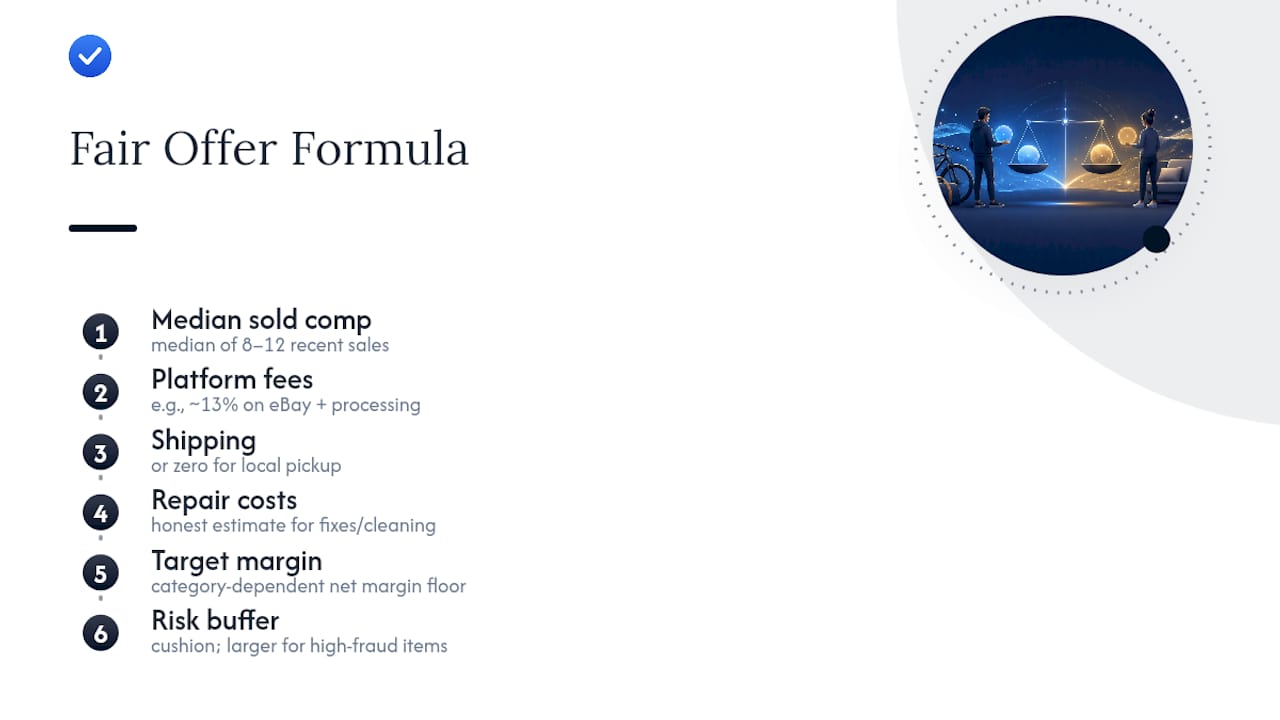
Start with the median sold comp, not the asking price and not an outlier top sale. Pull the last 8 to 12 completed sales for the item in comparable condition, then lean on the median rather than the average so one lucky auction doesn't skew your math. Recent sales (last 30 to 60 days) should carry more weight than anything older, since resale demand shifts fast, especially for electronics and seasonal gear.
Next, subtract platform fees. If you're reselling on eBay, that's roughly 13 percent of the sale price, and payment processing takes another slice. Skipping this step is the single most common way flippers turn an apparent profit into an actual loss.
Then subtract shipping (or count it as zero if it's a local pickup flip), followed by repair or cleaning costs. Be honest here. A "works great" claim in a listing rarely survives contact with reality.
After costs, subtract your target margin. Most active resellers work with a moderate net margin floor, varying by category. Furniture and tools tend to support higher margins than electronics, where competition is fiercer.
Finally, apply a risk buffer. This is your cushion against comp inaccuracy, unexpected repair costs, or a slower-than-expected sale. A conservative buffer works better for high-fraud or low-authentication categories like luxury goods and high-end electronics, while commoditized items with dense sold-comp data (power tools, common furniture pieces) can carry a smaller buffer, since you're more confident in the underlying price data. Tools like the flip profit calculator let you toggle between preset buffers instead of guessing.
Which Tools Speed Up Deal Discovery and Offer Math?
Manual scrolling misses most of the good listings before they disappear. A continuous scanner with saved searches and instant alerts catches new posts within minutes, feeding your calculator before another buyer even sees the listing.
Automated inputs save real time on three fronts:
- Sold-comp aggregation across eBay, Mercari, Poshmark, and other resale platforms, so you're not manually cross-referencing four apps.
- Platform fee presets baked into the calculator, so you never forget to subtract them.
- Shipping cost estimates pulled from box size and weight, rather than a rough guess.
Trust matters more than speed here. Before you act on any AI-suggested offer, you want a transparent line-item breakdown showing the comps, fees, and buffer that produced the number, not a black-box score. If a tool doesn't show its math, treat the output as a starting point, not a final answer.
Pro Tip: Always cross-check the listing's condition photos and the seller's response time against the tool's output before you commit capital. Software reads data. It doesn't catch a cracked screen hidden in a dark photo.
What Should Your First Offer Message Actually Say?
Speed decides more sales than wording does. On hot listings, the first serious buyer to message often locks in the deal before others respond, so keep your first message to one or two lines that state you're serious, available, and ready to pay.
- Firm price listing: "Hi, is this still available? I can pick up today with cash if you'll do [X]."
- "Open to offers" listing: "Interested. Would you take $X for a same-day pickup?"
- Needs-pickup listing: "I have a truck and can grab this within the hour for $X, cash in hand."
Cash and fast pickup are leverage. Sellers who list "must go this weekend" or mention moving deadlines will often take less for the convenience of not dealing with multiple back-and-forth buyers. When your calculated offer sits close to asking, give the exact number. When you're negotiating harder, open with a range so the seller has room to counter without feeling insulted. DealFlipAI's negotiation script generator builds these lines automatically once your offer is calculated.
Which Red Flags Should Lower Your Offer or Kill the Deal?
Some signals should shrink your buffer before you even calculate a number, and others should end the conversation entirely.
- A seller pushing for payment before you see the item in person.
- Photos that look inconsistent (different lighting, angles, or backgrounds suggesting stock images).
- No serial number, no original receipt, and vague answers about how long they've owned it.
- A pickup location that changes last minute, especially to somewhere isolated.
At pickup, test electronics before handing over cash, verify serial numbers match any listing photos, and check obvious wear points like charging ports, hinges, and casters. Speed still matters. The first serious buyer wins most hot listings, but rushing past a red flag to beat another buyer is how flippers lose capital, not gain it.
A Worked Example: Turning Comps Into a Number
Say you spot a listed power washer, asking $180, described as "barely used."
- Median sold comp (last 10 sales, similar model/condition): $150
- Platform fee if resold on eBay (commonly around one-eighth of the sale price): minus $19.50
- Shipping (assume local pickup resale, so $0): minus $0
- Estimated repair/cleaning (new hose fitting): minus $15
- Target margin (30 percent of comp): minus $45
- Risk buffer (moderate, commoditized category): minus $10
$150 − $19.50 − $15 − $45 − $10 = $60.50, rounded to a $60 first offer.
If the listing says "price firm," you might open closer to $70 to avoid losing the deal over $10, especially if the item is scarce. If the listing says "make me an offer," open at $55 to $60 and leave room to move up if the seller counters. In a scanner like DealFlipAI, the median comp, fee preset, and shipping estimate auto-populate the moment the listing gets flagged, leaving you to confirm the repair estimate and risk buffer before sending your message.
How Does Seller Motivation Change Your Offer?
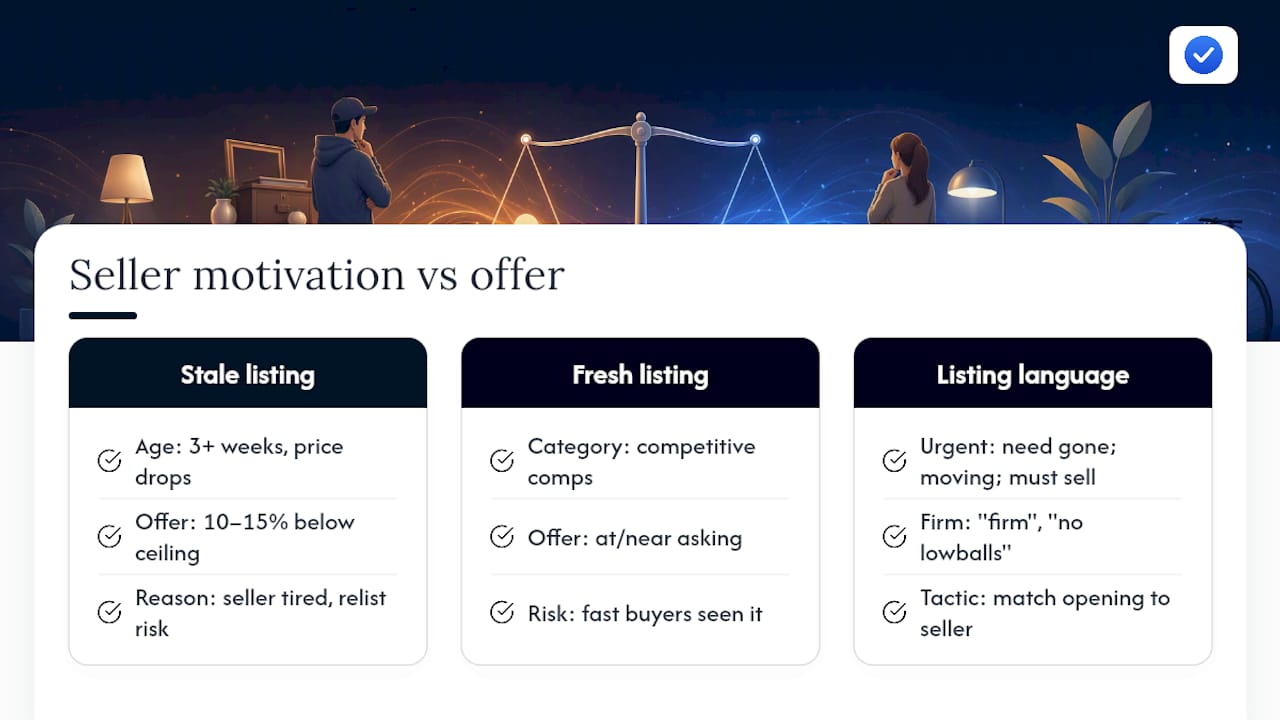
A listing sitting for three weeks with three price drops tells you something a fresh listing doesn't: the seller is tired of dealing with it. That's leverage. You can offer 10 to 15 percent below your calculated fair offer on stale listings and still close the deal, because the seller's alternative is relisting or donating.
Urgency cuts the other way on fresh, well-priced listings in competitive categories. If a listing goes up and the comps clearly support a strong margin, other flippers with scanners are seeing it at the same time you are. In that case, offer close to your calculated number, sometimes even at asking, because losing the deal to a faster buyer costs you more than the few dollars you'd save negotiating.
Read the listing language itself. "Need gone by Friday," "moving sale," and "must sell this weekend" all signal a seller who values speed over maximum price. "Firm," "no lowballs," and detailed condition write-ups signal someone who's done their homework and won't budge much. Match your opening number to which type of seller you're talking to, not just to your formula's output. The math gives you a ceiling. The seller's motivation tells you how far below it you can actually land.
How Do Seasonal Swings Affect What You Should Offer?
Sold comps shift with the calendar, and treating a comp from six months ago as current is one of the quieter ways flippers overpay. Snow blowers, patio furniture, and air conditioners swing 20 to 40 percent in resale value between their peak season and their off-season, even though the item itself hasn't changed.
Buy off-season, sell in-season. A snow blower sourced in July, when demand is low and sellers are motivated to clear garage space, costs less and resells higher in November. That timing gap is where a lot of flip margin actually comes from, more than any single negotiation tactic.
Weight your sold comps accordingly. If you're calculating a fair offer on a seasonal item outside its peak window, don't anchor to peak-season sold prices, since you'll overvalue the item and offer too much. Weight toward comps from the same season last year instead. Electronics and general household goods move more steadily year-round, so seasonal adjustment matters far less there than it does for anything tied to weather or holidays.
When Should You Take a Lower Margin for a Faster Flip?
Throughput beats per-item margin more often than most flippers want to admit. If you're working a scalable category like phone cases, common power tools, or mainstream furniture, taking 25 percent margin on five deals a week beats holding out for 40 percent on two. The math on volume almost always wins in commoditized categories where sold comps are dense and reliable.
One-off collectibles and unusual high-value items are the exception. When comps are thin and each sale takes real research to price correctly, a bigger buffer and a firmer offer protect you from a bad guess. You can't scale a category you can't confidently price.
Automation changes where you can safely set that buffer. When a scanner reliably surfaces enough volume in a category you know well, you can run a smaller buffer per deal, because your risk is spread across more transactions rather than concentrated in one. That's a different calculation than a flipper doing occasional deals by hand, where every single offer has to carry more cushion. Speed and automation don't eliminate risk. They let you spread it thinner.
— Walsh Pex
Try the Tools That Run This Math for You
DealFlipAI turns the formula in this article into a button press instead of a spreadsheet. The Facebook Marketplace Value Estimator pulls sold comps, applies fee presets, and shows you the line-item breakdown behind every suggested offer, so you're never trusting a number you can't verify.

Once a listing clears your quick checklist, the Flip Profit Calculator lets you test conservative and aggressive buffer presets before you commit to a number, and the negotiation script generator turns that number into a ready-to-send message matched to the listing's tone. Deal alerts catch new listings the moment they post, and the scam checker flags the red flag patterns covered earlier in this article before you waste a trip on a bad pickup. If you're scanning multiple categories daily, this is the difference between reviewing a handful of pre-qualified deals each morning and manually re-deriving the same math on every listing that catches your eye. Start with the free reseller tools and run your next listing through the estimator before you send an offer.
Where to Go Next
Explore the cross-listing profit calculator, the negotiation script generator, and pricing negotiation research for higher-value items.
Sources
- Facebook Marketplace Flipping: Earn Fast Profit | Gerald
- Master product price negotiation with resellers using market data - PriceShape