

AI listing moderation is defined as the automated process of analyzing marketplace listings using machine learning models to detect fraud, policy violations, and low-quality content before buyers ever see them. For resellers and buyers on platforms like Facebook Marketplace, Mercari, and Etsy, understanding how AI filters bad marketplace listings means you can work smarter, spot gaps in platform protection, and avoid wasting time on scam listings. The technology has moved far beyond simple keyword blocking. Today's systems combine image analysis, text understanding, and behavioral signals into a single, layered defense.
How AI filters bad marketplace listings using text and image fusion
Single-modality models fail at scale. A text classifier might catch a suspicious description, but miss a stolen product photo. An image classifier might flag a blurry photo, but miss a misleading title. Independent text and image detectors flagging separately miss the latent semantic relationships between what a listing says and what it shows. That gap is exactly where scammers operate.
Multimodal fusion solves this by merging image and text data into a single model representation before classification happens. Mercari's multimodal system fuses both data types into one unified model and flags listings when the probability score exceeds a configurable threshold. This means the model evaluates the relationship between a photo and its description together, not separately. A listing showing a designer handbag but describing "phone accessories" triggers a mismatch signal that neither a text nor image model alone would catch.
The practical result for you as a buyer or reseller is fewer false alarms and fewer missed scams. Here is what fusion-based filtering catches that older systems miss:
- Text-image mismatches: A listing title that does not match the product in the photo
- Obfuscated text: Sellers who replace letters with symbols to dodge keyword filters, which the model reads in context
- Category violations: Items listed in the wrong category to avoid detection, caught when the image contradicts the listed category
- Subtle adult or prohibited content: Images that pass individual checks but fail when evaluated alongside the listing description
Pro Tip: If you are sourcing deals on Facebook Marketplace and a listing's photos look unrelated to the title, that mismatch is exactly the signal AI systems are trained to catch. Trust your instincts and use a scam detection tool to confirm before you message the seller.
The fusion approach also reduces false positives, which matters a lot for legitimate resellers. Fewer good listings get incorrectly removed, which means the deals you find are more likely to be real.

How hybrid AI moderation combines rules and semantic analysis
Not every bad listing requires a sophisticated model to catch. Some violations are obvious: a listing containing a banned keyword, a price of $0, or a phone number in the title. Running a large language model on every single listing just to catch these would be slow and expensive. Hybrid moderation architectures solve this by routing obvious cases to fast rule-based systems and complex, context-dependent cases to LLM-based semantic models.
Here is how the two layers work together in practice:
- Rule-based filters run first. These are deterministic checks: blocked keywords, price anomalies, duplicate listing detection, and format violations. They process millions of listings per hour at near-zero latency.
- Semantic models handle what rules miss. An LLM reads the full context of a listing to determine whether something is a genuine policy violation or a legitimate edge case. A listing for "vintage hunting knife" might trigger a weapons keyword filter, but semantic analysis recognizes it as a collectible, not a threat.
- Policy updates apply without retraining. Because LLMs understand natural language instructions, marketplace operators can update moderation policies by editing a prompt rather than retraining an entire classifier. This is a major operational advantage when scam tactics evolve quickly.
- Volume scales without proportional cost. Clear violations are handled cheaply at the rule layer. Only genuinely ambiguous listings consume the more expensive LLM processing.
Keyword-only filtering systems show a 12% false positive rate and moderation delays averaging six or more hours, which gives scammers a window to collect payments before takedown. Hybrid systems close that window significantly. The combination of speed at the rule layer and accuracy at the semantic layer is what makes modern automated listing quality control reliable enough to trust.
Pro Tip: As a reseller, you benefit directly from hybrid moderation because it means fewer legitimate listings get pulled incorrectly. If your own listing gets flagged, it is usually the rule layer catching a surface-level signal. Rewriting your title to avoid ambiguous terms often resolves it without any human review needed.
How confidence scoring and human review work together
AI does not make binary decisions on every listing. The real architecture is a probability ladder with three zones: allow, warn, and block. Moderation systems use a policy ladder where hard-block rules override warnings, and the entire workflow is optimized for low latency on text-based checks while image and video analysis runs asynchronously.
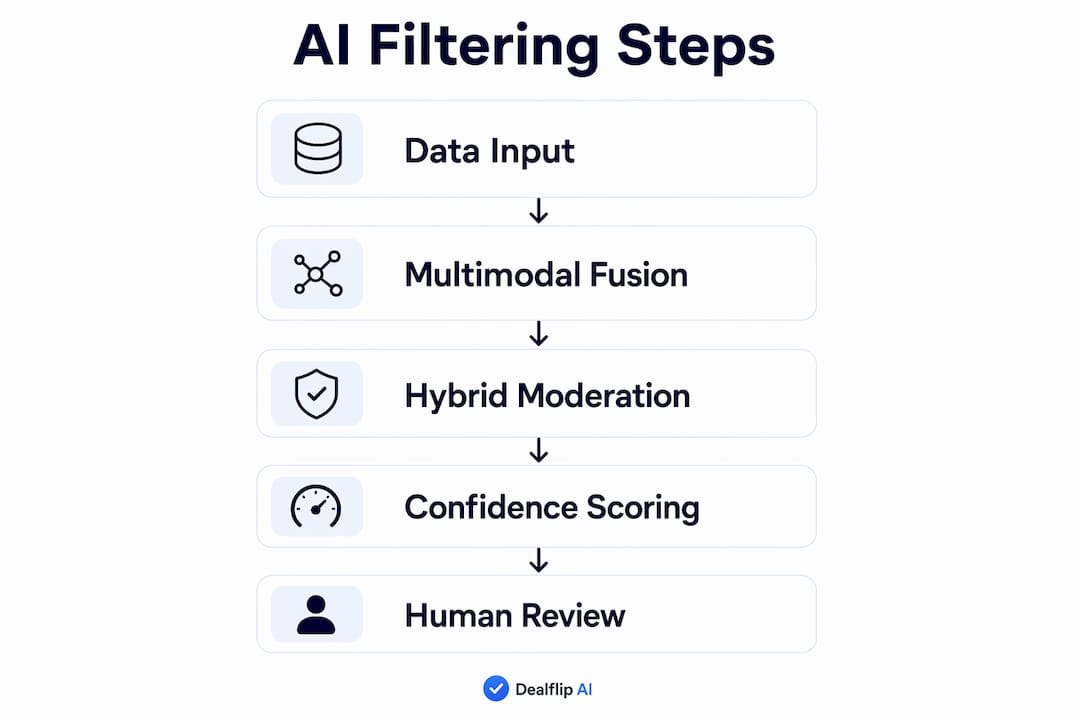
The table below shows how a typical threshold policy works across listing types:
| Confidence score | Action taken | Human review? |
|---|---|---|
| Below 30% | Listing allowed | No |
| 30% to 70% | Warning or hold | Yes, borderline review |
| Above 70% | Listing blocked | Only for appeals |
The middle zone is where human reviewers add the most value. Etsy's automated enforcement uses a Champion vs. Challenger model that evaluates ML models on precision and recall improvements against human-labeled data, then routes borderline listings to human review. Those human decisions feed back into model training, which prevents the model from drifting over time as seller tactics change.
Mercari prioritizes recall by combining multiple classifier outputs with an OR gate, meaning a listing gets flagged if any single classifier signals a violation. This approach accepts more false positives in exchange for catching more genuine violations. The operational cost is more human review, but the reputational and regulatory cost of letting bad listings through is far higher.
For you as a buyer, this means the listings you see have already passed multiple layers of automated and human review. For resellers, it means your listings may occasionally land in the borderline zone and face a short delay. That delay is the system working correctly, not a malfunction.
What scam signals does AI detect beyond keywords?
Modern AI marketplace assessment goes well beyond scanning for suspicious words. The signals that matter most are often behavioral and visual, not textual. Here is what the systems are actually looking for:
- Stock photo detection: Scam listings frequently use manufacturer images or photos pulled from other websites rather than real photos of the actual item. AI image analysis identifies stock photo characteristics, including metadata patterns and reverse-image-match signals, to flag these listings.
- Text-image semantic mismatch: As covered earlier, a description that does not match the photo is a primary fraud indicator. Agentmelt's AI uses semantic understanding and image analysis together to catch exactly this pattern.
- Account-level behavioral signals: A newly created account listing ten high-value electronics at 60% below market price is a pattern, not a coincidence. AI systems factor in account age, listing history, and pricing anomalies as part of the overall risk score.
- Duplicate listings across accounts: Scammers often run the same listing from multiple accounts to maximize exposure before a takedown. Cross-account image matching and description similarity detection catch this at scale.
- Evasion tactics: Sellers who use character substitution (replacing letters with numbers or symbols) or embed text in images to avoid keyword filters are identified through OCR and contextual pattern recognition.
The key insight here is that AI adapts to evasion. When scammers learn that a specific tactic gets flagged, they change tactics. Modern systems are trained on adversarial examples specifically to stay ahead of this. You can learn more about recognizing these patterns yourself in this guide on spotting scam listings on Facebook Marketplace.
Key takeaways
AI filters bad marketplace listings by combining multimodal fusion, hybrid rule-and-semantic architectures, probabilistic scoring, and behavioral signal analysis into a layered system that catches fraud at scale while minimizing disruption to legitimate sellers.
| Point | Details |
|---|---|
| Multimodal fusion beats single models | Combining text and image data into one model catches mismatches that separate classifiers miss entirely. |
| Hybrid systems balance speed and accuracy | Rule-based filters handle obvious violations fast; LLMs handle nuanced, context-dependent cases. |
| Confidence thresholds drive decisions | Allow, warn, and block zones route borderline listings to human review rather than making binary calls. |
| Behavioral signals reveal scam patterns | Account age, pricing anomalies, and duplicate listings are as important as the listing content itself. |
| Human feedback loops prevent model drift | Etsy and Mercari both use human review outcomes to retrain models and maintain accuracy over time. |
Why AI filtering is harder than it looks, and why it matters to you
Walsh Pex here. I have spent a lot of time studying how these systems work, and the thing that surprises most resellers is how much of this is still a tradeoff problem rather than a solved problem.
The precision vs. recall debate is not a technical footnote. It is a real policy decision that affects your experience every day. When a marketplace sets its threshold aggressively to catch more scams, more legitimate listings get flagged. When it backs off to reduce false positives, more scams slip through. Recall and precision tradeoffs are set by policy, not just model performance, and regulatory pressure increasingly pushes platforms toward higher recall even at the cost of more false positives.
What I find genuinely underappreciated is how much adversarial pressure these systems are under. Scammers are not passive. They test platform filters, identify gaps, and adapt within hours. The platforms that do this well, like Mercari and Etsy, treat moderation as a continuous process with feedback loops, not a one-time deployment. The ones that do not end up with the six-hour moderation delays and 12% false positive rates that create real buyer harm.
My honest advice for resellers: do not rely entirely on platform filtering to protect you. The systems are good, but they are not perfect, and the borderline cases are exactly where experienced flippers get burned. Use platform AI as your first filter, then apply your own judgment and purpose-built tools as a second layer.
— Walsh Pex
Find better deals faster with Dealflip AI
Dealflip AI applies the same principles of AI marketplace assessment directly to your deal-sourcing workflow on Facebook Marketplace. The platform scores every listing on price, profit potential, and risk factors so you spend your time on deals worth pursuing, not chasing scams.

The listing analyzer tool breaks down any Facebook Marketplace listing with AI-driven analysis, flagging risk signals and estimating resale value in seconds. When you are ready to calculate your actual margins, the cross-listing profit calculator shows you exactly what a flip is worth across eBay, Mercari, and Poshmark before you commit. Dealflip AI puts the filtering power of platform-grade AI directly in your hands, so you find the real deals before anyone else does.
FAQ
How does AI detect scam listings on marketplaces?
AI detects scam listings by analyzing text, images, and behavioral signals together. Systems like those used by Mercari and Agentmelt identify stock photos, text-image mismatches, pricing anomalies, and account-level patterns that keyword filters miss.
Why do legitimate listings sometimes get flagged by AI?
Legitimate listings get flagged when they trigger rule-based filters or score in the borderline confidence zone. Marketplaces like Etsy route these to human review rather than auto-removing them, which is why sellers occasionally experience short listing delays.
What is multimodal fusion in marketplace AI filtering?
Multimodal fusion is the process of combining image and text data into a single model representation before classification. Mercari uses this approach to catch violations that neither a text classifier nor an image classifier would detect independently.
How do hybrid AI moderation systems work?
Hybrid systems run fast rule-based filters first to catch clear violations, then apply LLM-based semantic analysis to complex or ambiguous cases. This combination reduces both false positives and moderation latency compared to using either approach alone.
Can AI keep up with scammers who change their tactics?
Modern AI moderation systems are trained on adversarial examples and updated continuously through human review feedback loops. Platforms like Etsy use Champion vs. Challenger model evaluation to deploy improved models as scam tactics evolve.