

Automated deal filtering is defined as an AI-driven process that ingests, scores, and routes potential deals against predefined criteria so you can act on the best opportunities without reviewing every listing manually. For individuals and small business owners buying on online marketplaces like Facebook Marketplace, understanding how automated deal filtering works is the difference between spending hours scrolling and spending minutes deciding. Tools like Dealflip, AcquiOS, and WorkWise Solutions have proven that automation can screen deals far faster than any human team, with AI deal screening reducing manual review time drastically while improving consistency. The automated deal selection process replaces gut-feel browsing with a structured, repeatable system that surfaces only the listings worth your attention.
How automated deal filtering ingests and analyzes deal data
The first step in any automated filtering system is data ingestion. The system pulls raw listing information, whether that is a Facebook Marketplace post, a broker memo, or an email, and converts it into structured fields your scoring model can actually use. WorkWise Solutions automates the reading of Confidential Information Memorandums (CIMs), normalizes the data, and calculates scores per firm-specific criteria. The same principle applies to marketplace listings: price, condition, category, seller history, and location all get extracted and standardized.
Data normalization is what makes comparison possible. Without it, "like new" in one listing and "barely used" in another are just words. With normalization, both map to a condition score your system can rank. AI parsing handles unstructured text consistently, which means it does not miss a detail because it was buried in a description or written in shorthand.

The practical benefit here is speed and coverage. A manual buyer can review maybe 20 to 30 listings per hour before fatigue sets in. An automated system processes hundreds in the same window, applying the same logic every single time. This is the foundation of how automated filtering systems function: clean inputs produce reliable outputs.
Pro Tip: When setting up any deal filtering tool, map out every data field you care about before you configure the system. If profit margin matters more than condition, that priority needs to be explicit in your criteria from day one.
What filtering layers and scoring mechanisms does automation use?
Automated deal filtering does not work as a single pass. It uses a layered architecture where each layer handles a different type of decision at a different cost.
The table below shows how the three main layers compare:
| Layer | Type | Purpose | Speed |
|---|---|---|---|
| Pre-scoring filters | Deterministic | Remove duplicates, ineligible listings, expired posts | Instant |
| ML scoring models | Probabilistic | Score remaining deals by fit and profit potential | Fast |
| Human review queue | Manual | Resolve uncertain or high-value edge cases | Slower |
The first layer uses fast deterministic filters to remove candidates that clearly do not qualify before any expensive model runs. Think of it as a bouncer at the door. Duplicates, listings outside your price range, and categories you never buy get eliminated immediately. This keeps the machine learning layer focused on deals that actually have a chance.
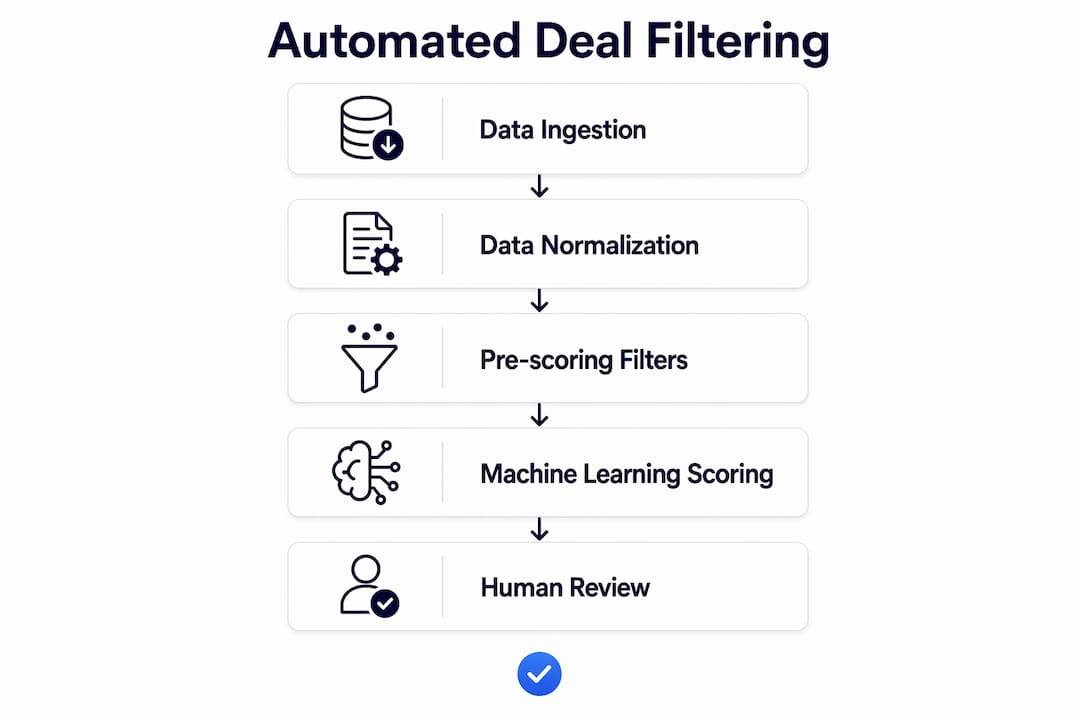
The second layer applies a scoring model. AcquiOS uses their AcquiScore system, calibrated to firm buy boxes, to assign pass, caution, or proceed signals to each deal. For marketplace buyers, this translates to a score that reflects how well a listing matches your personal buying criteria: target resale value, condition threshold, seller reliability, and price gap from market rate.
The third layer is human review. Automated filtering paired with human review focuses your attention on the deals that scored in the uncertain middle range, not on the obvious rejects. This is where your judgment adds real value, because the system has already done the mechanical work.
Pro Tip: Set your confidence thresholds conservatively at first. A system that sends too many deals to human review is still better than one that auto-rejects a profitable listing because the threshold was set too tight.
How do deal filtering systems connect to CRM and workflow tools?
Understanding how automated filtering systems function in isolation is useful. Understanding how they connect to your broader workflow is where the real efficiency gains appear. CRM platforms like ActiveCampaign allow you to trigger automations based on deal scores, routing contacts and deals to the right next step the moment a threshold is crossed. For a small business buyer, this means a high-scoring deal can trigger an immediate alert, a draft offer, or a task assignment without you lifting a finger.
One operational detail that most guides skip is filter timing. Klaviyo's documentation draws a clear line between trigger filters and profile filters: trigger filters act at entry, while profile filters recheck at every subsequent step. Getting this wrong causes silent routing errors where deals enter the wrong workflow and never surface for review. The distinction matters whether you are running an email marketing automation or a deal alert pipeline.
Here is what a connected workflow looks like in practice for a marketplace buyer:
- A new listing appears on Facebook Marketplace matching your category and price range.
- The filtering system scores it against your buy box criteria and assigns a deal score.
- If the score clears your threshold, an alert fires to your phone or inbox within minutes.
- If the score falls in the uncertain range, the listing enters a review queue for your manual check.
- If the score fails, the listing is archived automatically with no action required from you.
This kind of AI-powered workflow automation removes the repetitive scanning work and lets you focus entirely on deciding whether to buy, not on finding what to consider buying.
What are the real benefits and common pitfalls of automated deal filtering?
The benefits of automated deal filtering are concrete and measurable. The pitfalls are equally real, and most of them come from misconfiguration rather than the technology itself.
Benefits you can count on:
- Speed: automated systems screen far more listings per hour than any manual process.
- Consistency: the same criteria apply to every listing, every time, with no fatigue or mood affecting the result.
- Reduced bias: the system does not favor a listing because the photos look nice or the seller seems friendly.
- Focus: you spend your time on deals that already passed a quality check, not on sorting through noise.
Pitfalls to watch for:
- Overreliance on vendor-provided data. Parsing raw source data directly is more reliable than accepting seller-summarized numbers at face value. A listing that claims "retail value $400" needs independent verification, not automatic trust.
- Poor calibration. Running historical deals through your configured model and comparing scores to your actual past decisions is the only way to know if the system reflects your real preferences. Skipping this step means your automation is optimizing for the wrong outcomes.
- Ignoring the human review queue. Queue policies for human review are as important as model accuracy. If your queue fills up and you stop checking it, you lose the deals that needed a second look.
Pro Tip: Start with a narrow buy box and loosen it over time as you validate the system's outputs. A tight initial configuration produces fewer false positives and builds your confidence in the automation faster.
How to implement automated deal filtering for online marketplaces
The steps in automated deal filtering for a marketplace buyer are more approachable than they sound. Here is a practical sequence you can follow whether you are just starting out or refining an existing process.
-
Define your buy box. Write down the exact criteria that make a deal worth buying: price ceiling, minimum profit margin, acceptable condition levels, preferred categories, and any seller signals you trust or distrust. This document becomes your filter configuration.
-
Choose a tool built for your marketplace. For Facebook Marketplace, Dealflip is purpose-built for this use case. It scores listings based on price, profit potential, and risk factors, and it provides a value estimate for each listing so you are not relying on the seller's asking price as your only reference point.
-
Set up real-time alerts. The best deal filtering system in the world is useless if you see the results six hours after a listing goes live. Configure deal alerts so that high-scoring listings reach you within minutes of posting. Fresh listings get the most responses, so timing is a real competitive advantage.
-
Add a scam detection layer. Not every low-priced listing is a bargain. Some are fraud. Dealflip includes a scam detection feature that flags suspicious listings before you waste time or money on them. This is a pre-scoring filter in action: eliminate the ineligible before scoring the rest.
-
Review your queue and refine your criteria. After your first week, look at which deals the system flagged for review and which it auto-passed or auto-rejected. Compare those results to what you would have decided manually. Adjust your scoring weights where the system got it wrong. This calibration step is what turns a generic tool into a system that actually matches your judgment.
-
Scale your search. Once your criteria are dialed in, expand your search radius, add more categories, or increase your daily listing volume. The automation handles the extra load without extra effort from you.
Key takeaways
Automated deal filtering works because it separates the mechanical work of scanning and sorting from the judgment work of deciding, letting you focus your time where it actually matters.
| Point | Details |
|---|---|
| Layered filtering architecture | Pre-scoring filters, ML scoring, and human review each handle a different decision type for maximum efficiency. |
| Calibration is non-negotiable | Run historical deals through your model to confirm it matches your actual buying preferences before trusting it at scale. |
| Filter timing affects routing | Trigger filters and profile filters evaluate at different moments; getting this wrong causes silent deal misrouting. |
| Raw data beats seller summaries | Parsing listing data independently produces more reliable scores than accepting seller-provided numbers at face value. |
| Real-time alerts multiply value | A well-scored deal that arrives late loses to a buyer who saw it first; speed is part of the filtering advantage. |
Why I think most buyers underestimate what filtering actually does for them
I have watched a lot of people approach marketplace buying the same way: open the app, scroll until something looks interesting, and make a gut call. That process feels active, but it is mostly noise management. You are not evaluating deals. You are surviving the volume.
What automated filtering actually does is change the question you are answering. Instead of "Is this listing worth looking at?" you are answering "Should I buy this deal that already passed my criteria?" That is a much faster and higher-quality decision. The automation removes mechanical work so your judgment goes toward the deals that deserve it.
The part most people get wrong is calibration. They configure a tool once, trust the outputs, and never check whether the system is actually aligned with their real preferences. Scoring models need to be validated against historical outcomes to be trustworthy. That is not a one-time setup task. It is an ongoing practice, especially as your buying criteria evolve.
Small business owners stand to benefit the most from this shift because their time has a direct dollar value. Every hour spent scrolling is an hour not spent sourcing, listing, or selling. Automation does not replace your expertise. It protects your time so your expertise gets applied where it counts. Start narrow, validate often, and expand once you trust what the system is telling you.
— Apex
Start filtering smarter with Dealflip today
If you are ready to put the steps in automated deal filtering to work on Facebook Marketplace, Dealflip gives you the tools to do it without a technical setup or a steep learning curve.
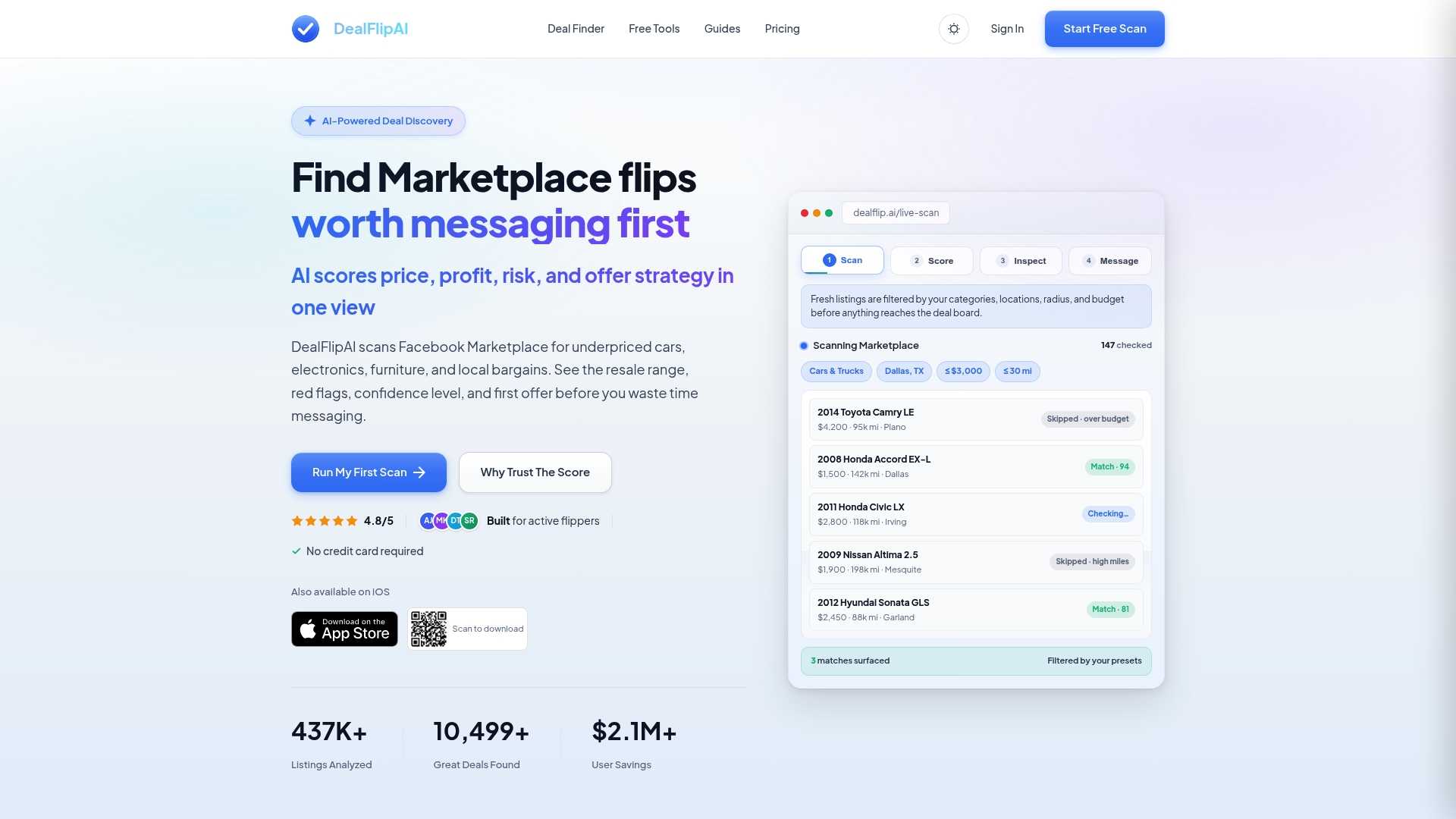
Dealflip scores every listing against price, profit potential, and risk factors, then surfaces the best opportunities before other buyers see them. You get a free listing analysis that breaks down deal quality in plain language, a value estimator that checks the seller's price against real market data, and scam detection that filters out fraud before it wastes your time. If you want to find good deals on Facebook Marketplace faster and with more confidence, Dealflip is where to start.
FAQ
What is automated deal filtering?
Automated deal filtering is an AI-driven process that extracts data from listings, scores each deal against your predefined criteria, and routes the best opportunities to you without manual searching. It replaces scrolling with a structured, repeatable selection system.
How does deal filtering work on Facebook Marketplace?
A tool like Dealflip scans new listings, pulls structured data from each post, scores it for profit potential and risk, and sends you an alert when a listing clears your threshold. The deal alert system delivers high-scoring listings in real time so you act before other buyers do.
What are the main benefits of automated deal filtering?
The core benefits of automated deal filtering are speed, consistency, and focus. You review only pre-scored deals that match your criteria, which cuts decision time and reduces the chance of missing a profitable listing buried in a high-volume feed.
How do I calibrate my deal filtering system?
Compare your system's scores on past deals to the decisions you actually made. Where the scores and your decisions diverge, adjust your scoring weights. WorkWise Solutions recommends running historical deals through your configured model before trusting it on live opportunities.
What is the difference between trigger filters and profile filters?
Trigger filters evaluate a deal once at the moment it enters your workflow, while profile filters recheck conditions at every step. Klaviyo's documentation explains that mixing these up causes deals to be routed incorrectly, which is one of the most common silent errors in automated deal pipelines.