

Market demand in reselling is defined as the collective buyer willingness to pay for a given item at a given time, and it directly determines both the price you can charge and the volume you can move. The role of market demand in reselling goes far beyond simple popularity. It shapes equilibrium pricing, controls how fast inventory turns, and decides whether a flip earns real profit or just generates activity. Tools like sellerboard, platforms like ThredUp, and frameworks from OpenStax all confirm that resellers who understand demand mechanics outperform those who chase trending items without margin discipline. This guide breaks down how demand works, what makes it commercially usable, and how you can apply it to find profitable flips consistently.
How does market demand determine pricing and inventory decisions in reselling?
Market demand sets the equilibrium price in any resale market. According to the demand curve framework from OpenStax, when demand rises, buyers are willing to pay more and sellers can move more units. When demand falls, prices compress and unsold inventory piles up. This is not theory. It plays out every day on Facebook Marketplace, eBay, and local resale platforms.
Think of it this way: when a specific gaming console becomes scarce and buyers compete for limited supply, prices spike well above retail. When that same console floods the market six months later, prices drop fast. The equilibrium price is simply where supply and demand meet, and your job as a reseller is to buy below that point and sell at or above it.

| Demand Level | Buyer Behavior | Resale Price Trend | Inventory Movement |
|---|---|---|---|
| High demand, low supply | Buyers compete aggressively | Prices rise above retail | Inventory moves fast |
| High demand, high supply | Buyers compare options | Prices stabilize near retail | Moderate turnover |
| Low demand, low supply | Buyers are selective | Prices vary widely | Slow, unpredictable |
| Low demand, high supply | Buyers have full control | Prices compress below cost | Inventory stalls |
Watching price trend signals is the practical skill here. If you see a product's average sale price rising steadily over 30 days while listing counts stay flat, that is a demand shift worth acting on. If prices are erratic with big swings week to week, demand is unstable and the risk of holding inventory increases significantly.
Pro Tip: Use the price trend analysis method of tracking 30-day and 90-day price averages side by side. A rising 30-day average against a flat 90-day average signals a short-term demand spike, not a durable trend. Be cautious before buying in bulk.
What makes market demand commercially usable for resellers?
High demand does not automatically mean profitable demand. Demand is commercially usable only when it sustains your margins after platform fees, shipping costs, returns, and your time. A product that sells fast at a price that leaves you with two dollars of profit is not a good flip. It is a time trap.
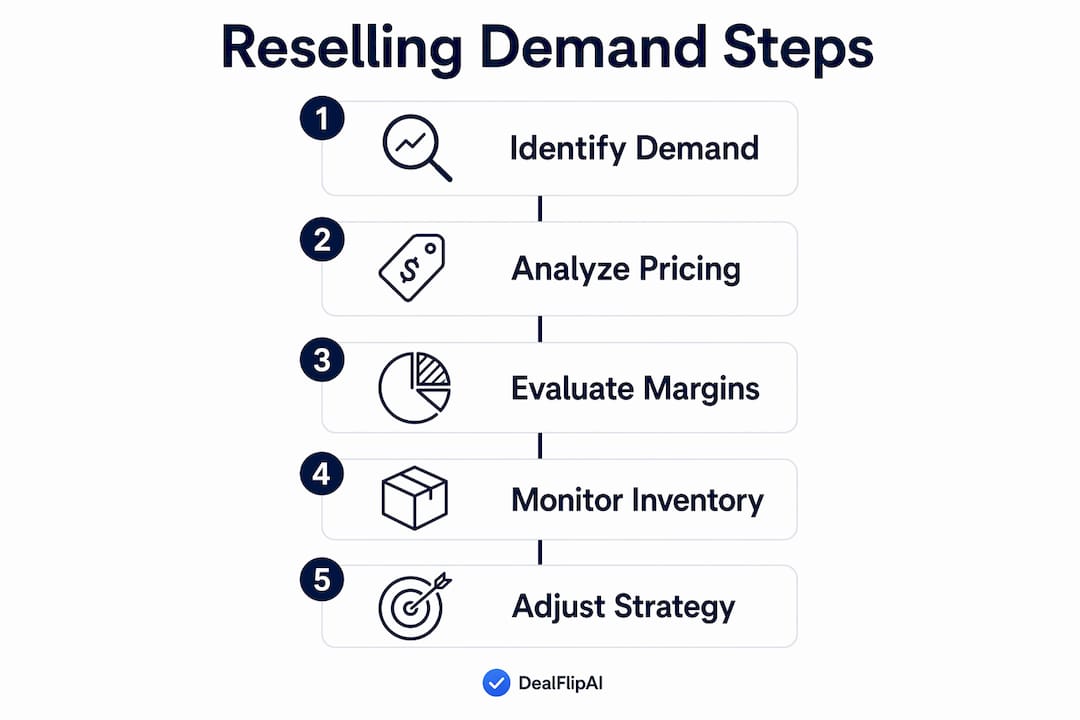
Reliable demand has specific characteristics you can verify before committing capital. The importance of market demand analysis becomes clear when you realize that most resellers skip this step and wonder why their numbers do not add up.
Here is what commercially usable demand actually looks like:
- Recurring sales: The item sells consistently week over week, not just during a seasonal spike or viral moment.
- Stable pricing: Average sale prices hold within a narrow range over 60 to 90 days, indicating steady buyer interest rather than panic buying.
- Multi-seller rotation: Multiple sellers are moving the same item, which confirms that demand is not dependent on one dominant listing. Buy box rotation across sellers is a strong signal of healthy market depth.
- Margin headroom: After all fees and shipping, your net profit per unit justifies the capital and time invested.
- No single-seller dominance: If one seller controls 80% of sales at a price you cannot match, the demand exists but you cannot access it profitably.
Pro Tip: Before buying any item to flip, run the numbers through a shipping fee calculator to confirm your true net margin. Many resellers discover that a "profitable" item becomes breakeven or worse once shipping is factored in.
The risk of trend-based demand is real. Items that spike because of a social media moment or a news cycle can collapse within weeks. Chasing hype without verifying commercial viability is one of the most common and costly mistakes in reselling.
How do reverse supply chain dynamics influence resale opportunities?
Reverse supply chains are the flow of goods moving backward from consumers to secondary markets, and they are a major force shaping resale competition and pricing. Reverse supply consists primarily of overstocks at 70% and consumer returns at 30%, and both create waves of supply that directly affect how competitive your resale environment becomes.
Understanding these dynamics gives you a real edge. Here is how reverse supply affects your resale pricing and strategy:
-
Overstock surges compress margins. When retailers clear excess inventory through liquidation channels, the secondary market floods with supply. Prices drop fast, and resellers who bought at what seemed like a fair price suddenly face a crowded field. Timing your purchases away from liquidation cycles protects your margins.
-
Returns create opportunity windows. Consumer returns often arrive in secondary markets in near-new condition at significant discounts. Resellers who source from return pallets or individual return listings can capture strong margins before the broader market catches up.
-
Consumer confidence drives supply volume. When consumer confidence drops and retail spending slows, return rates often rise and overstock levels build. Secondary market pricing cycles reflect these macroeconomic conditions directly, creating alternating buyer and seller market conditions.
-
Tariff-driven demand shifts are real and measurable. ThredUp reported a 95% surge in new buyers entering the secondhand market as tariffs pushed new apparel prices higher. This is a textbook example of macroeconomic pressure creating secondary market demand growth that resellers can capitalize on.
-
Demand gains can be offset quickly. Even when buyer demand is strong, a sudden influx of overstock supply can compress the prices you were counting on. Tracking both the demand side and the supply side simultaneously is the only way to protect your pricing strategy.
Why is accessibility crucial alongside demand for successful reselling?
Demand tells you that buyers want something. Accessibility determines whether you can actually reach those buyers and convert their interest into a sale. Demand and accessibility must be evaluated together to identify real market opportunities, not just theoretical ones.
Accessibility in reselling covers several practical barriers that can prevent you from capturing demand even when it clearly exists:
- Platform reach: Selling on a platform where your target buyers are not active means demand exists somewhere you cannot access it. Facebook Marketplace dominates local resale, while eBay and Amazon serve broader national audiences. Choosing the right platform for each item type is not optional.
- Listing quality: Poor photos, vague descriptions, and uncompetitive pricing reduce your conversion rate even when demand is strong. Listing quality directly affects how much of the available demand you actually capture.
- Competition density: A market with 50 identical listings at your price point means your accessibility is low even if total demand is high. You need to differentiate or find a less saturated channel.
- Regulatory and cost barriers: Some categories carry restrictions, permits, or platform fees that make them inaccessible to smaller resellers despite strong demand.
- Localized targeting: Micro-local demand research lets you map buyer behavior by ZIP zone, which means you can price higher in high-demand neighborhoods and route inventory to where it sells fastest.
Pro Tip: Test accessibility before scaling. List one or two units of a new item and measure your days-to-sale and final price against your target margin. If the item sells within your target window at your target price, scale up. If it stalls, diagnose whether the problem is demand, competition, or listing quality before committing more capital.
The resellers who consistently profit are not always the ones who find the hottest items. They are the ones who find items where demand is solid and their ability to reach buyers is strong.
How can resellers apply demand insights to maximize profitable flips?
Applying the impact of consumer demand on reselling requires a repeatable workflow, not a one-time research session. The goal is to build a system that filters out noise and surfaces opportunities where demand, margin, and accessibility all align.
Here is a practical framework you can start using today:
- Monitor stable demand, not spikes. Use 60 to 90-day price history data to confirm that an item sells consistently. One viral week does not make a reliable flip category.
- Check multi-seller rotation. Before sourcing, verify that multiple sellers are moving the item. Single-seller dominance signals a market you cannot enter profitably.
- Run micro-local demand tests. Treat the same product as multiple micro-markets. A used laptop may sell for $50 more in one ZIP code than another based on local income levels and competition density.
- Watch reverse supply timing. Track liquidation cycles and return season patterns, particularly after major retail holidays, to anticipate supply surges that will compress your margins.
- Factor accessibility into every decision. Platform choice, listing quality, and your operational capacity to handle volume are all part of whether you can convert demand into revenue.
- Use AI-powered tools for deal scoring. Dealflip AI scores Facebook Marketplace listings based on price, profit potential, and risk factors, giving you a data-backed starting point rather than a gut-feel decision. The resale arbitrage opportunity becomes clearer when you have structured demand data behind each listing.
The resellers who build sustainable income streams treat demand analysis as a repeatable process. They are not guessing. They are reading signals, testing assumptions, and scaling what works.
Key takeaways
Market demand in reselling is only profitable when it aligns with margin viability, supply timing, and your ability to reach and convert buyers consistently.
| Point | Details |
|---|---|
| Demand sets equilibrium price | Higher buyer demand raises both price and sales volume, directly improving flip profitability. |
| Commercial usability matters | Demand is only useful if it sustains margins after fees, shipping, and returns on every transaction. |
| Reverse supply shifts competition | Overstock and return surges can compress prices even when buyer demand remains strong. |
| Accessibility converts demand to revenue | Platform choice, listing quality, and local targeting determine how much demand you actually capture. |
| Micro-local research improves margins | Mapping demand by ZIP zone lets you price higher where competition is lower and buyers pay more. |
What I've learned about chasing demand the wrong way
I spent a long time believing that finding a hot item was the hard part. It is not. The hard part is knowing whether the demand you found will still be there when your inventory arrives, whether your margin survives the fees, and whether you can actually reach the buyers who want it.
The biggest mistake I see resellers make is treating demand as a binary signal. Either something is popular or it is not. That framing misses everything that matters. Tariff-driven demand shifts, like the surge ThredUp documented in 2026, are real and they create genuine opportunity. But they also attract a flood of new sellers within weeks, and margins compress fast for anyone who moves too slowly.
Margin discipline is not a constraint on ambition. It is the filter that separates productive revenue from activity that looks like progress but goes nowhere. I have watched resellers move hundreds of units at near-zero margin and call it a win because the sales count looked good. That is not reselling. That is expensive practice.
The combination I trust is macro trend awareness paired with micro-local data. Know what is driving demand at the category level, then verify whether your specific market, your specific platform, and your specific buyer pool will support the price you need. If both signals align, move fast. If they do not, pass and find the next opportunity.
The resale market in 2026 rewards resellers who read both sides of the equation, supply and demand, and who treat accessibility as a core variable rather than an afterthought.
— Walsh Pex
How Dealflip AI helps you act on market demand faster
Dealflip AI is built for resellers who want data behind every decision, not just instinct.
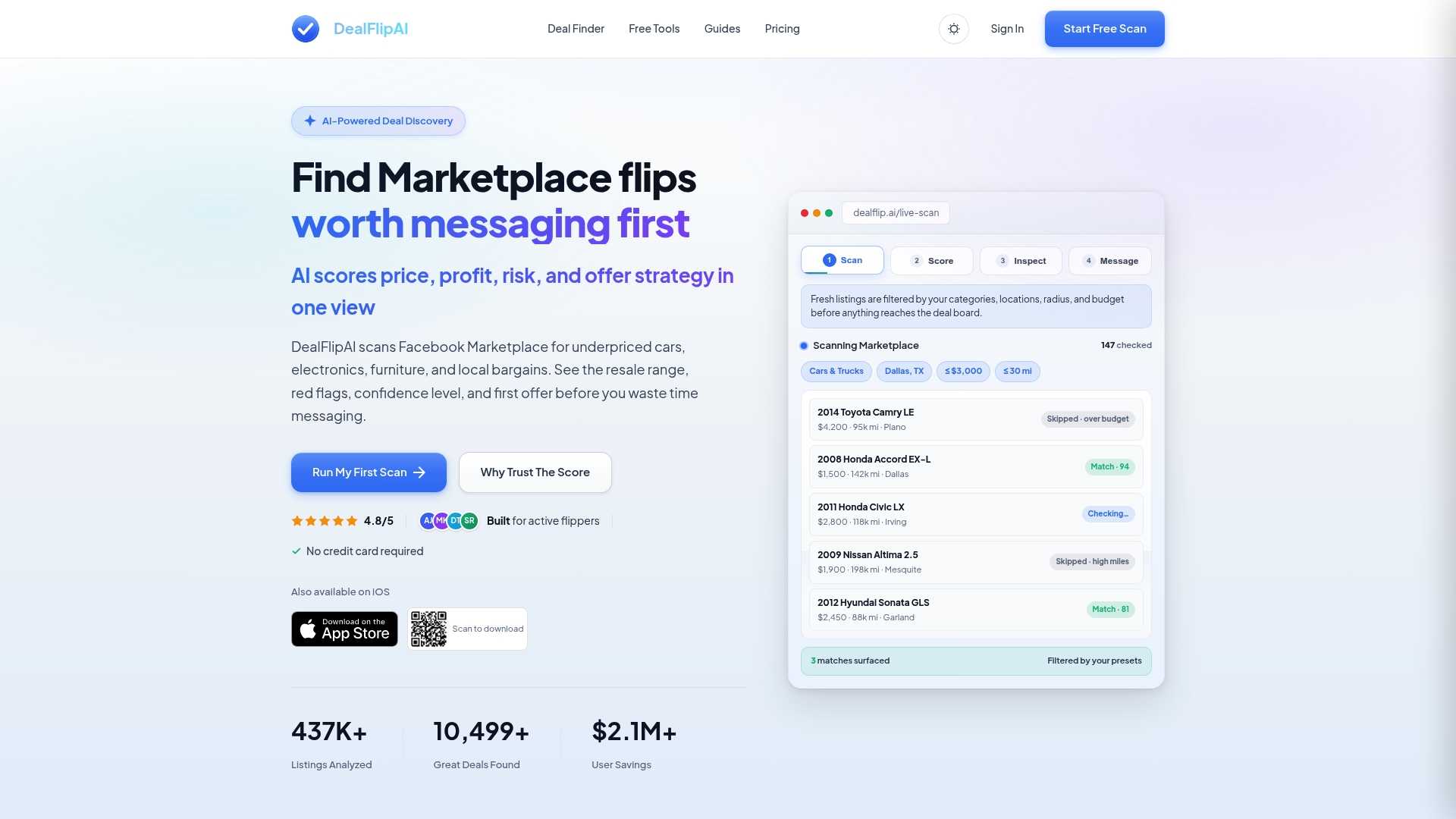
The platform scores Facebook Marketplace listings based on price, profit potential, and risk factors so you can evaluate demand viability in seconds. The listing analyzer tool reads demand signals and pricing trends directly from active listings, while deal alerts notify you the moment high-potential items appear before other resellers find them. You can also calculate true margins instantly using the shipping fee calculator, so you never mistake gross revenue for net profit. If you are ready to find profitable deals with demand data already built into the scoring, Dealflip AI gives you the edge to move first and price right.
FAQ
What is the role of market demand in reselling?
Market demand in reselling determines the price buyers will pay and the volume sellers can move profitably. Higher demand raises equilibrium prices and speeds inventory turnover, while falling demand compresses margins and slows sales.
How does demand influence resale pricing?
Demand shifts the equilibrium price up or down depending on buyer competition and available supply. When multiple buyers compete for limited inventory, prices rise above retail. When supply exceeds demand, prices fall and sellers must discount to move stock.
Why is high demand not always enough for a profitable flip?
Demand is only commercially usable if it sustains your margins after platform fees, shipping, and returns. Items with strong demand but thin margins or single-seller dominance often produce activity without real profit.
How do overstocks and returns affect resale market demand?
Reverse supply inflows, primarily overstocks at 70% and returns at 30%, increase competition and compress prices even when buyer demand stays strong. Tracking supply-side timing alongside demand signals protects your pricing strategy.
What is micro-local demand research and why does it matter?
Micro-local demand research maps buyer behavior and pricing variation by geographic zone, such as ZIP codes, allowing resellers to price higher in high-demand areas and route inventory where it sells fastest and at the best margin.