

Solid price research before buying secondhand means one thing: you look at what items actually sold for, not what sellers are asking. Active listings reflect seller optimism, not real market prices. Completed sales from the past 30–90 days tell you what buyers genuinely paid, and that's the number your flip lives or dies by.
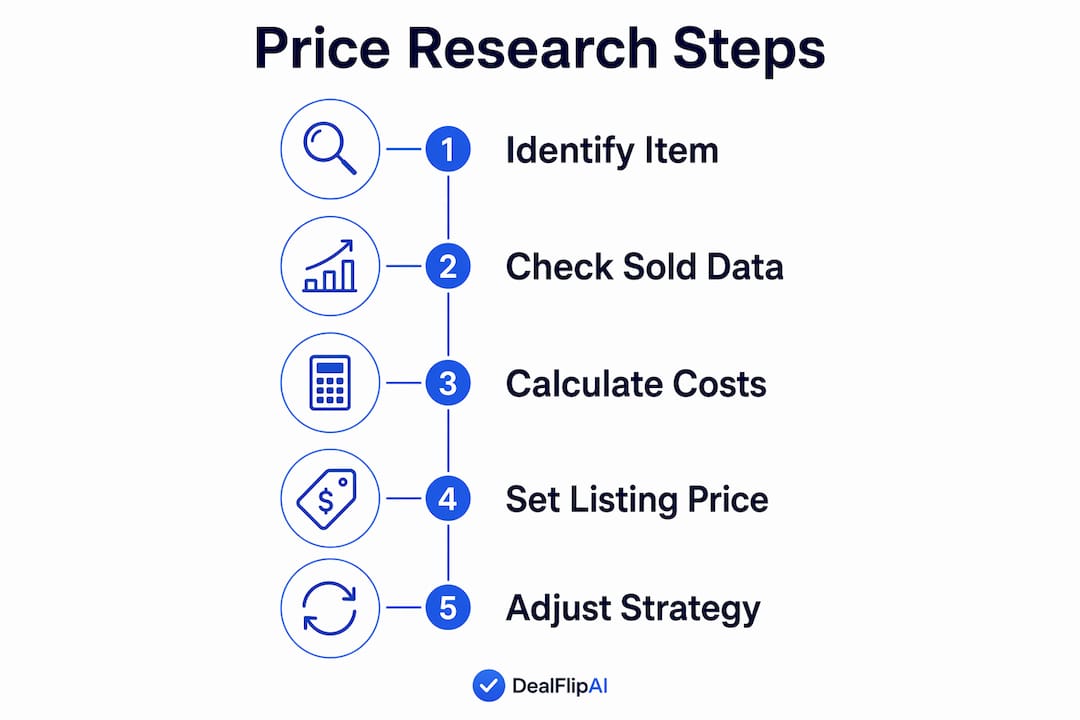
Here's what effective secondhand market research looks like in practice:
- Check sold listings first. Filter by "Sold" on eBay, Poshmark, or Mercari. Ignore active listings until you have a sold price baseline.
- Account for condition tiers. A like-new item and a "good condition" item are not the same product. Price them differently.
- Factor in every cost. Marketplace fees, shipping, packaging, and any repair work all eat into your margin before you see a dollar.
- Build in a negotiation buffer. Most Facebook Marketplace sellers expect offers below asking. Price your research accordingly.
- Use AI tools. Platforms like Dealflip AI score listings for profit potential and flag risk before you commit.
- Stay objective. What you paid for an item is irrelevant to what a buyer will pay. Market data is the only number that matters.
Pro Tip: Before you even message a seller, pull 5–10 comparable sold listings and calculate your median sale price. That number is your anchor for every decision that follows.
Table of Contents
- 1. How price varies by condition and item type
- 2. How to calculate true profitability beyond the purchase price
- 3. Data-driven pricing vs. emotional pricing mistakes
- 4. Volume pricing vs. premium pricing: choosing the right strategy
- 5. How Dealflip AI makes price research faster and more accurate
- Dealflip AI puts your price research on autopilot
- Key Takeaways
1. How price varies by condition and item type
Secondhand items follow a predictable pricing relationship to their original retail price, adjusted for condition. Understanding this relationship is the foundation of any reliable secondhand price comparison.
Here's a practical condition-to-value framework:
- New with tags: a majority of retail value
- Like new / Excellent: close to half or more of retail
- Very good: about one-third to half of retail
- Good: roughly one-quarter to two-fifths of retail
- Fair: a lower fraction of retail value
- For parts: a small fraction of retail value
Brand desirability shifts these numbers significantly. A Nike Air Jordan in very good condition might hold 70% of retail because demand is high. A generic fast-fashion jacket in the same condition might fetch 15–20% because supply far exceeds demand. Category matters too: electronics depreciate faster than collectibles, and seasonal clothing loses value quickly outside its selling window.
When you search, be specific. "Nike hoodie" returns noise. "Nike Tech Fleece Full Zip Hoodie Black Large" returns actionable sold data you can actually use. Geographic demand also plays a role, so check listings in your local market before assuming national averages apply.
2. How to calculate true profitability beyond the purchase price
The purchase price is just the starting point. Resellers must account for all costs before they can know whether a flip is actually worth it.
Your full cost stack typically includes:
- Marketplace selling fees: eBay charges roughly 13.25% plus $0.30 per transaction. Poshmark takes 20% on sales over $15. Facebook Marketplace shipped sales run 10%. Use a fee calculator to get exact figures before you buy.
- Payment processing: PayPal and similar processors add another layer of fees on top of platform costs.
- Shipping and packaging: Labels, boxes, tape, and bubble wrap add up fast, especially on heavier items.
- Insurance and signature confirmation: Worth it on high-value flips, but it costs money.
- Repair or refurbishment: A cracked screen or missing accessory can wipe out your margin entirely if you didn't price it in.
- Negotiation buffer: If you plan to list at $80 and accept $65, your research needs to support that $65 floor, not the $80 ceiling.
The formula is straightforward: Target listing price = desired net + expected fees + shipping + negotiation buffer. Pre-calculating your walk-away price before you make an offer is what separates disciplined flippers from buyers who overpay on emotion. Use Dealflip AI's cross-listing profit calculator to run these numbers across eBay, Mercari, and Poshmark simultaneously.
3. Data-driven pricing vs. emotional pricing mistakes
The biggest mistake resellers make is pricing based on what they paid, not what the market will bear. Emotional pricing or cost-basis pricing is one of the most common and costly errors in reselling. "I paid $80 for this, so I want $60" is not a pricing strategy. It's wishful thinking.

Successful flipping is closer to a science. You pull recent transaction data, calculate the median sold price, and price from there. The market doesn't care about your purchase history. It responds to supply, demand, condition, and timing.
Emotional pricing shows up in two ways: overpricing (because you're attached to what you paid) and underpricing (because you just want it gone). Both hurt your bottom line. Sold listings from the past 30–90 days give you the real number. Active listings give you seller hope, nothing more.
Pro Tip: When you catch yourself thinking "but I paid X for it," stop. Open your sold listings filter and let the data reset your expectations. Your cost basis is a sunk cost, not a pricing anchor.
4. Volume pricing vs. premium pricing: choosing the right strategy
Not every flip deserves the same approach. Your strategy should match the item, the market, and your goals.
Volume pricing targets faster turnover by pricing below the market median. This works well for commodity items with steady demand, like common electronics, basic clothing brands, or everyday household goods. The goal is quick cash flow and high inventory turnover, not maximum margin per item.
Premium pricing targets higher margins on rare, seasonal, or collectible goods. Think limited-edition sneakers, vintage clothing from desirable eras, or discontinued electronics with active demand. You list at the top of the market range and wait for the right buyer.
A few factors that guide the choice:
- Sale velocity: If comparable items sell within days, the market supports competitive pricing. If they sit for weeks, you need to be sharper on price.
- Scarcity: Discontinued items or limited releases justify premium positioning. Commodity items do not.
- Seasonality: Winter coats sell faster in October than in April. Timing your listings to demand cycles improves both speed and price.
- Negotiation room: On platforms like Facebook Marketplace, build 10–15% above your target into your asking price. On fixed-price platforms like Vinted, list at your actual target.
Adjust weekly if an item isn't moving. A 10–15% price reduction after a quiet week is standard practice, not a failure.
5. How Dealflip AI makes price research faster and more accurate
Manual research works, but it takes time and leaves room for human error. Dealflip AI was built specifically for Facebook Marketplace resellers who want data-driven decisions without spending an hour on every listing.
Here's what the platform does:
- Deal scoring: Every listing gets a score based on price, profit potential, and market data. You see at a glance whether a deal is worth pursuing.
- Risk analysis: Dealflip AI flags listings with elevated scam signals, suspicious pricing patterns, or red flags in the seller's history.
- Scam detection: Real-time alerts surface issues that manual review often misses, especially on high-volume days.
- Optimal offer suggestions: Rather than guessing at a first offer, you get a calculated starting point based on market data and seller signals.
- Real-time alerts: Fresh listings hit your feed before most buyers even see them, giving you a genuine first-mover advantage.
Active resellers using AI-powered deal scoring report meaningful improvements in both savings and profit margins compared to manual research alone. The platform aggregates data across multiple marketplace sources to produce valuations that reflect current market conditions, not outdated asking prices.
Combining Dealflip AI's scoring with your own sold-listing research gives you the strongest possible foundation. AI handles the volume and speed; your market knowledge handles the nuance. For a deeper look at how the scoring methodology works, the Dealflip AI methodology page breaks down valuation confidence and alert logic in plain terms.
For resellers who want to understand AI-driven revenue optimization beyond a single platform, the principles of automated pricing and risk scoring apply across the broader secondhand market.
Pro Tip: Set Dealflip AI alerts for your highest-margin categories. The resellers who consistently find the best deals aren't searching harder. They're getting notified first.
Dealflip AI puts your price research on autopilot
Most resellers leave money on the table because manual price research is slow, inconsistent, and easy to skip when you're moving fast. Dealflip AI solves that directly.
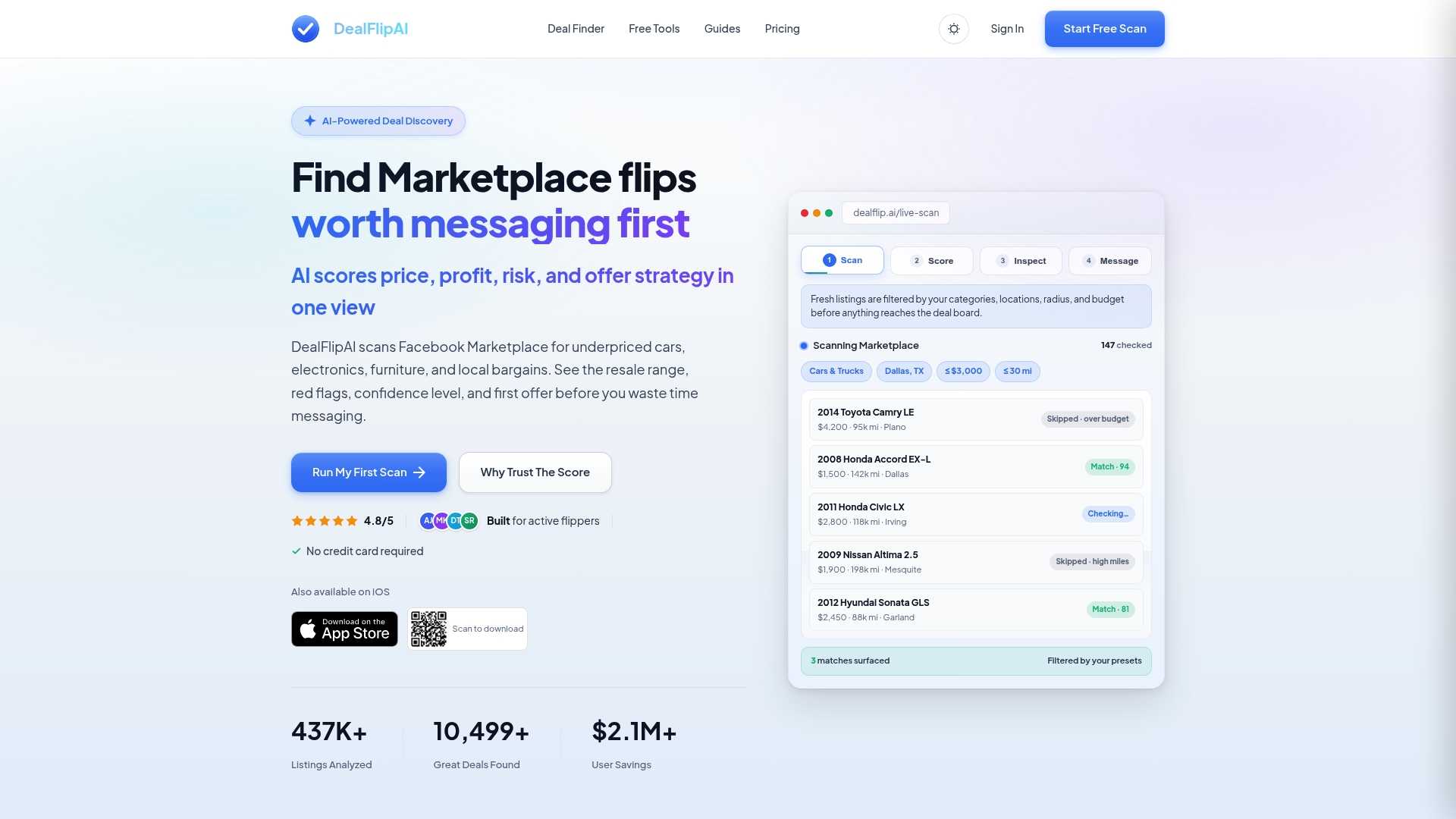
You get AI-scored listings with profit potential, risk flags, and suggested first offers, all pulled from real Facebook Marketplace data in real time. No more guessing whether a deal is worth it. No more missing a great flip because someone else saw it first. The platform was built for active flippers who want to make faster, smarter buying decisions without doing hours of manual research on every item.
Ready to see it in action? Run your next potential flip through the Dealflip AI listing analyzer and get an instant read on price, profit, and risk before you make an offer.
Key Takeaways
Effective price research before buying secondhand requires sold listing data, full cost accounting, and objective market-based pricing to consistently flip for profit.
| Point | Details |
|---|---|
| Use sold listings, not active ones | Completed sales from the past 30–90 days show what buyers actually paid, not what sellers hope to get. |
| Condition drives value | Like-new items can fetch 60–80% of retail; fair-condition items typically land at 15–25% of retail. |
| Calculate all costs before buying | Fees, shipping, packaging, repairs, and negotiation buffers all reduce your net profit from the listed sale price. |
| Avoid cost-basis pricing | Your purchase price is irrelevant to market value; price from sold data, not from what you paid. |
| Dealflip AI automates the research | Deal scoring, scam detection, and real-time alerts help resellers find and evaluate Facebook Marketplace flips faster. |