

Identifying overpriced secondhand listings means comparing what sellers ask against what buyers actually pay, then factoring in item condition and seller reliability. Active asking prices are frequently 40–60% higher than real completed sale prices. That gap is the single most important number you need to know before making any offer on Facebook Marketplace. Sellers set prices based on hope, not data. You can protect your money by learning to read the signals that separate a fair deal from an inflated one.
How to identify overpriced secondhand listings using sold price data
The most reliable way to detect inflated secondhand prices is to stop looking at active listings and start looking at completed sales. Active asking prices are set by hopeful sellers without close attention to real transaction data. That optimism creates a distorted picture of what an item is actually worth.
Completed sales, also called "sold listings," show you what real buyers paid in real transactions. On platforms like eBay, you can filter search results to show only sold items. On Facebook Marketplace, you can cross-reference eBay sold data to validate any local listing price. This cross-platform check takes less than five minutes and can save you a significant amount of money.

When you pull sold listing data, use the median price rather than the average. The median excludes extreme outliers, such as a rare collector variant that sold for triple the normal price, and gives you the true middle of the market. Ignoring the top and bottom 10% of prices removes skew caused by damaged items or unusual editions.
A practical benchmark to keep in mind:
- Fair price for clean used items: roughly 60–70% of original retail
- Mint condition with original packaging: up to 70–80% of retail
- Red flag threshold: prices above 80% of retail without documented rarity or proof of limited availability
- Obvious overprice: asking price at or above retail for a used item
Pro Tip: Rare collector variants can skew sold listing data dramatically. When you see one outlier sale at triple the median, exclude it from your calculation. Base your benchmark on the three to five most recent, most comparable sales.
What condition factors tell you about fair secondhand pricing
Item condition is the second variable in any pricing equation. A listing price that looks reasonable for a mint item is a red flag for a worn one. Expert pricing models apply condition multipliers to adjust base price estimates, and you should do the same mentally before making an offer.
Condition tiers generally break down like this:
- New with tags or sealed in box: commands the highest percentage of retail, often 75–80%
- Like new, no visible wear: 65–75% of retail is reasonable
- Good condition, minor wear: 50–65% of retail is fair
- Well-loved, visible wear or missing parts: 30–50% of retail, depending on severity
- Damaged or incomplete: price should drop significantly, sometimes below 30%
Missing accessories matter more than most buyers realize. A laptop without its charger, a camera without its lens cap, or a game console without its original controller all represent real replacement costs. Calculate those costs before you evaluate the asking price. If a seller lists a "good condition" item at 75% of retail but the box is missing and the cable is a third-party replacement, the listing is overpriced by definition.
Buyers who ignore condition differences consistently overpay. A seller who photographs an item in dim lighting or from one angle is often hiding wear. Always ask for photos in natural light from multiple angles before committing.
What seller and listing red flags signal an inflated price
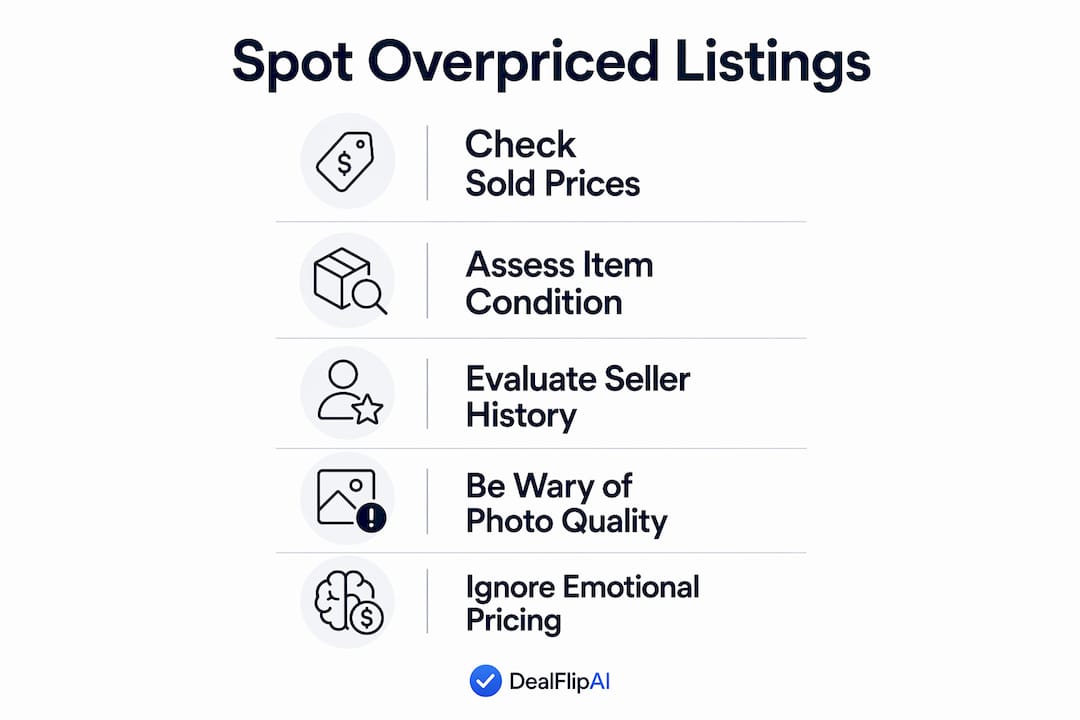
Seller behavior tells you as much as the price itself. Vague descriptions, frequent "RARE" claims on common items, and suspicious photos are the clearest behavioral signals of a predatory or overpriced listing. Recognizing these patterns protects both your money and your time.
Watch for these specific red flags:
- Rarity claims on mass-produced items. If a seller calls a standard model "rare" or "hard to find" when it sold millions of units, that claim is a pricing tactic, not a fact.
- Low-quality or heavily edited photos. Blurry images, heavy filters, or stock photos instead of actual product shots hide condition issues.
- Refusal to negotiate. Most secondhand sellers expect some negotiation. A seller who refuses any discussion on price is often anchored to an unrealistic number.
- Listings that sit unsold for weeks. Listings that remain unsold without price reductions signal a seller ignoring market feedback. The market has already voted on that price.
- Sentimental pricing. Sellers sometimes add value for personal attachment. "My grandmother bought this" is not a pricing factor you should pay for.
Marketplace experts warn that optimistic pricing based on sentiment rather than data is common. Your job is to rely on objective benchmarks, not seller claims.
Pro Tip: Prioritize sellers with a visible transaction history and positive reviews. A seller with 50 completed sales and consistent feedback is far less likely to waste your time than a new account with no history.
What tools help you verify fair market value efficiently
Technology makes it faster to assess secondhand item value without spending an hour on manual research. AI-powered price estimation tools and sold listing filters reduce manual workload and improve accuracy compared to eyeballing a price and guessing.
Dealflip AI is built specifically for Facebook Marketplace shoppers and resellers. It scores listings based on price, profit potential, and risk factors, then suggests an optimal first offer based on real market data. The Facebook Marketplace value estimator from Dealflip AI gives you a data-driven price benchmark in seconds, so you spend less time researching and more time acting on good deals.
Beyond dedicated tools, a few manual methods still work well:
| Method | What it does | Best for |
|---|---|---|
| eBay sold listing filter | Shows completed sale prices | Benchmarking any category |
| Median price calculation | Removes outliers from your estimate | Accurate fair value |
| Multi-platform comparison | Checks prices across marketplaces | Spotting local inflation |
| Seller review check | Confirms transaction history | Reducing scam risk |
| AI deal scoring | Rates listings by price and risk | Fast, high-volume research |
Understanding market demand timing also sharpens your negotiation. Accurately priced, high-quality listings sell within hours. If a listing has been up for two weeks with no price drop, you have real leverage to negotiate down. Use that information.
For comparing prices across platforms, including retail benchmarks, a structured approach to price gap analysis helps you spot when a local seller is charging retail prices for a used item. That gap is your negotiating room.
Dealflip AI also includes a scam detection feature and real-time deal alerts, so you see fresh listings before other buyers do. Speed matters on Facebook Marketplace. The best deals disappear fast.
Key Takeaways
Spotting overpriced secondhand listings requires comparing sold prices to asking prices, applying condition-adjusted benchmarks, and reading seller behavior before you commit.
| Point | Details |
|---|---|
| Use sold listings, not asking prices | Completed sales show real market value; asking prices run 40–60% above actual sale prices. |
| Apply condition-adjusted benchmarks | Fair used prices range from 60–70% of retail; mint with packaging may reach 80%. |
| Watch for seller red flags | Rarity claims on common items, poor photos, and stale listings all signal inflated pricing. |
| Use the median, not the average | Median sold prices exclude outliers and reflect true market value more accurately. |
| Use tools to speed up research | AI pricing tools and sold listing filters cut research time and improve accuracy. |
Why patience is the real skill in secondhand shopping
I've watched buyers make the same mistake repeatedly: they fall in love with an item, skip the research, and pay whatever the seller asks. I've done it myself early on. You see a listing, it looks good, and you convince yourself the price is "probably fine." It rarely is.
The buyers who consistently get fair deals share one habit. They treat every listing as a negotiation that starts before they ever message the seller. They check sold comps first, assess condition honestly, and only then decide if the price makes sense. That sequence takes ten minutes. It saves real money.
One thing most articles won't tell you: a slightly higher price from a trustworthy seller is often the better deal. Paying a bit more to a trusted seller is safer than chasing a suspiciously low price from an account with no history. I've seen buyers "save" $30 on a purchase and then lose the full amount to a scam or a broken item with no recourse.
The red flags covered here are not theoretical. Stale listings, rarity claims on common items, and refusal to negotiate are patterns I see weekly on Facebook Marketplace. Once you recognize them, you cannot unsee them. That awareness is worth more than any single deal.
Use tools like Dealflip AI to speed up the research. But the underlying skill is patience. Research before you message. Negotiate based on data. Walk away when the numbers don't work. The next good listing is always coming.
— Walsh Pex
Dealflip AI makes finding fair deals faster
Knowing what to look for is half the work. Acting on it quickly is the other half. Dealflip AI gives Facebook Marketplace shoppers both.
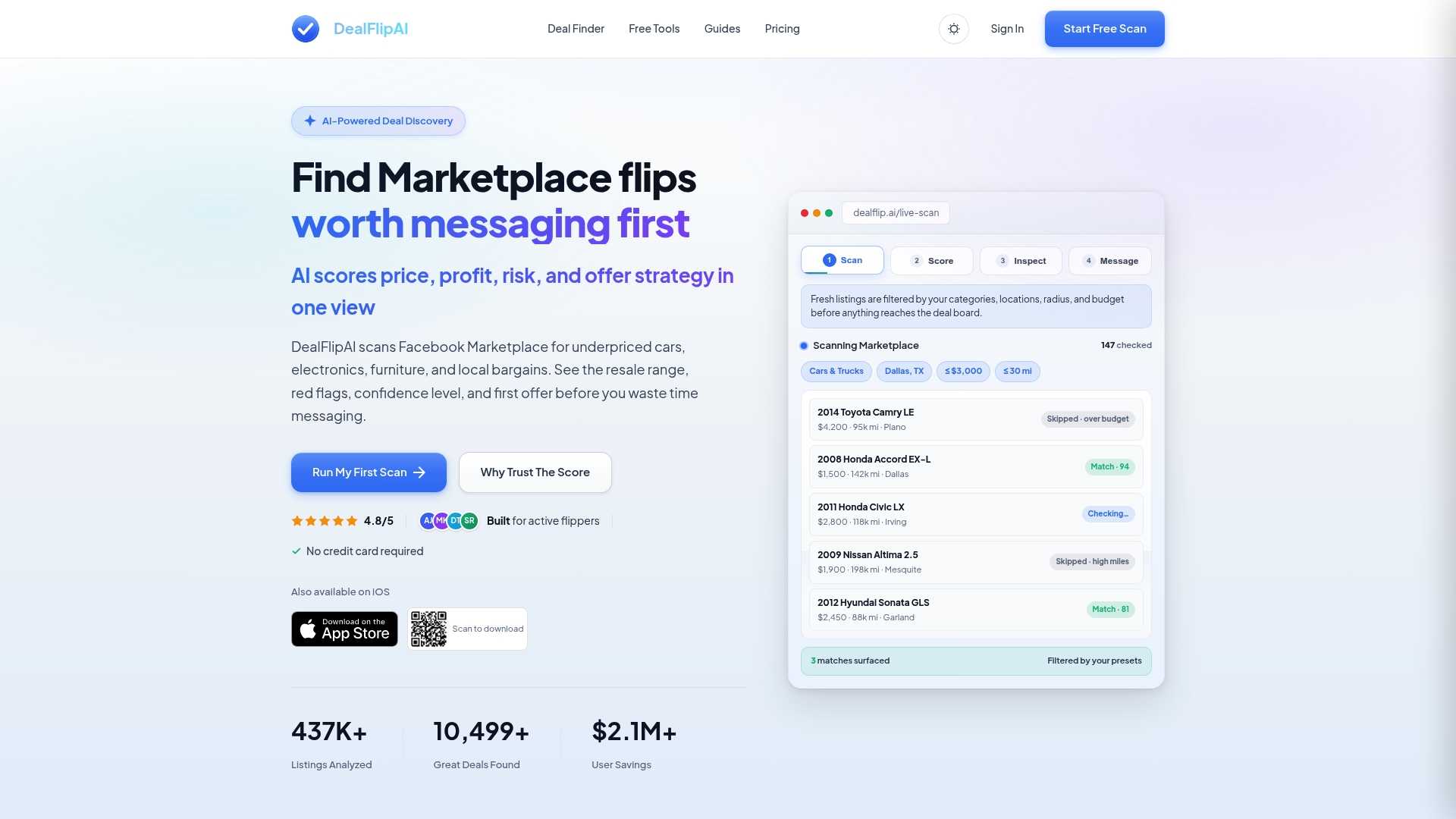
The platform scores listings by price, condition signals, and seller risk, then tells you what to offer and why. The deal finder tool surfaces underpriced listings in real time, so you see them before the competition does. If you want a full walkthrough of how to put these strategies into practice, the Facebook Marketplace deals guide from Dealflip AI walks you through every step. You can also use the free reseller calculators to run the numbers on any listing before you commit.
FAQ
What is a fair price for a used item on Facebook Marketplace?
A fair price for a clean used item is typically 60–70% of its original retail price. Mint condition items with original packaging may reasonably reach 70–80% of retail.
How do I know if a secondhand listing is overpriced?
Compare the asking price to recent sold listings for the same item on eBay or similar platforms. If the asking price is more than 80% of retail without documented rarity, the listing is likely overpriced.
Why should I use median sold prices instead of average prices?
The median excludes extreme outliers like rare variants or damaged items, giving you a more accurate picture of what most buyers actually paid. Averages can be pulled up or down by a single unusual sale.
What are the biggest red flags in a secondhand listing?
Vague descriptions, "RARE" claims on common items, low-quality photos, refusal to negotiate, and listings that have sat unsold for weeks without a price drop are the clearest warning signs of an inflated price.
How long do fairly priced listings stay active on Facebook Marketplace?
High-quality, accurately priced listings typically sell within hours. A listing that has been active for weeks without a price reduction almost always signals an overpriced item with an unmotivated seller.