

A comparable market analysis (CMA) is a pricing method that estimates an item's or property's value by comparing it to recent sales of similar items in the same market. For resellers, flippers, and investors, understanding what is comparable market analysis in reselling means the difference between overpaying for inventory and locking in a profitable deal before anyone else does. The CMA approach gives you a data-backed price range, not a guess, so every offer you make is grounded in what the market has actually paid.
What is comparable market analysis in reselling?
A CMA provides an estimated value or price range rather than a single fixed number, using multiple comparable sales (comps) as its foundation. That distinction matters for resellers. You are not looking for one magic number. You are building a range that tells you the floor, the ceiling, and the sweet spot for your offer or listing price.
The core idea is simple: find items or properties that are as close as possible to what you are buying or selling, look at what they actually sold for recently, and use that data to anchor your pricing decision. In real estate flipping, this means pulling sold listings in the same neighborhood. In product reselling on platforms like Facebook Marketplace or eBay, this means searching completed and sold listings for the same make, model, and condition.

CMA is not a formal appraisal. It is a market opinion tool that resellers use to price competitively and negotiate confidently. The importance of comparable market analysis lies in its flexibility. It shapes your offer strategy and negotiation position, not just a sticker price.
What are the key components of a reseller CMA?
A strong CMA is built on specific, well-chosen data points. Skipping any of these weakens your analysis and puts your profit margin at risk.
- Number of comps: Use at least 3 recently sold comps, and aim for 6 to 10 when the market is active. More comps reduce the chance that one outlier skews your entire valuation.
- Recency: Use transaction data within three months, and never older than six months. Stale comps reflect a market that no longer exists.
- Condition and features: A used iPhone 14 in excellent condition is not comparable to one with a cracked screen. Adjust your comp values up or down based on meaningful differences in condition, age, accessories, or features.
- Sold vs. active listings: Sold comps anchor your value estimate. Active and pending listings show you what competitors are asking right now, which is useful for pricing strategy but not for valuation.
- Location or platform context: In real estate, neighborhood matters. In product reselling, the platform matters. A sold price on eBay may differ from the same item on Facebook Marketplace because of buyer demographics and fee structures.
- Price adjustments: Adjust comp prices based on differences in features, size, or condition to create true apples-to-apples comparisons. If your comp sold with extras your item lacks, subtract that value.
Pro Tip: When you pull comps, always filter by "sold" or "completed" listings, not just active ones. A $300 asking price means nothing if the item consistently sells for $200.
The goal of comp selection is not just surface-level similarity. It is creating a quality comparison by factoring in every characteristic that a buyer would actually pay more or less for.
How does a CMA differ from appraisals and automated pricing tools?
Understanding the differences helps you use each method correctly and avoid costly mistakes.
| Method | Who uses it | Purpose | Output |
|---|---|---|---|
| CMA | Resellers, agents, flippers | Pricing strategy and negotiation | Price range |
| Formal appraisal | Licensed appraisers | Lender requirements, legal valuation | Single certified value |
| Automated pricing tool | Platforms, algorithms | Quick estimate from data patterns | Estimated price point |
A CMA is an informal market opinion tool, not a regulated valuation. A licensed appraiser follows strict methodology and produces a certified value used by banks and courts. A CMA is something you can run yourself in 20 minutes using sold listing data.
Automated pricing tools, like the pricing suggestions on eBay or algorithmic estimates on Zillow, pull from large data sets but often miss condition nuances, local demand shifts, or platform-specific buyer behavior. They are a useful starting point, not a final answer. A CMA you build yourself incorporates judgment calls that no algorithm makes automatically.
CMA outputs give you pricing and offer strategy recommendations rather than exact values. That flexibility is a feature, not a flaw. It means you can set a buy box, a maximum offer price, and a target resale range all from the same analysis.
Pro Tip: Use automated tools to gather raw comp data quickly, then apply your own CMA adjustments for condition and platform context. The combination beats either method alone.
How to perform a market analysis for reselling, step by step
Follow this process every time you evaluate a deal, whether you are flipping furniture, electronics, or investment properties.
-
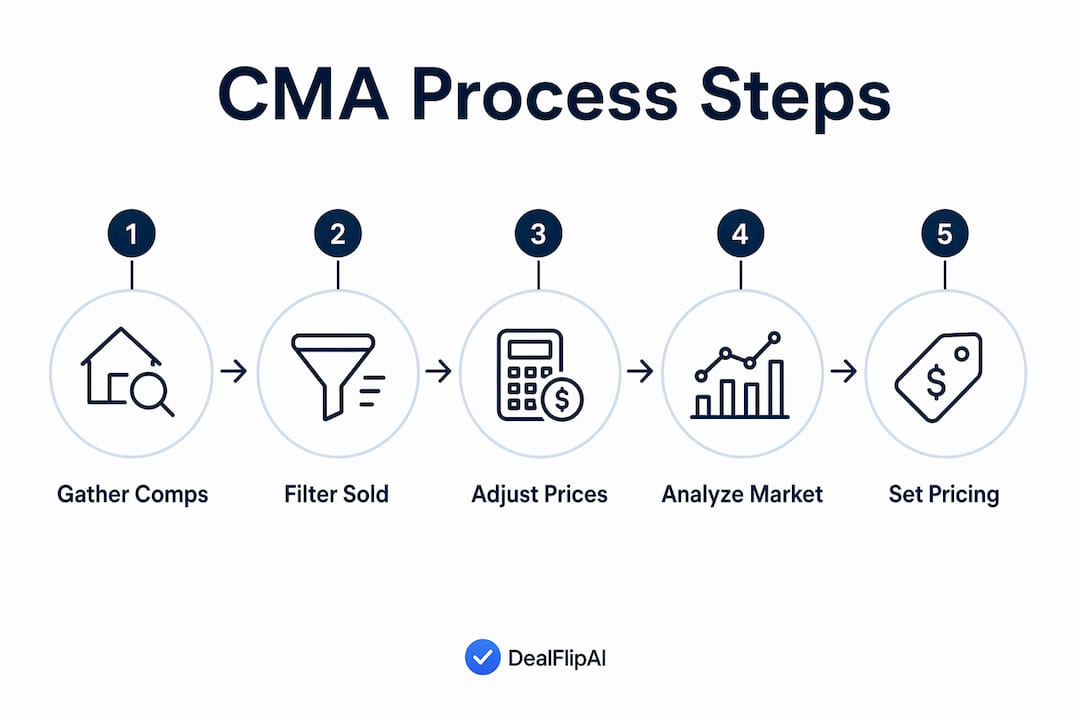
Define your subject item clearly. Write down the exact make, model, condition, and any features that affect value. The more specific you are, the better your comps will match.
-
Collect more comps than you need. Over-collecting comps reduces the risk of skewed valuations from limited or unrepresentative data. Start with 10 to 15 candidates, then narrow down.
-
Filter for recency. Remove any comp older than three to six months. Markets move fast, especially for electronics and seasonal goods. A market price comparison guide for local listings can help you track how quickly prices shift in your category.
-
Separate sold comps from active listings. Put sold prices in one column and active asking prices in another. Sold prices tell you what buyers actually paid. Active prices tell you what your competition is charging right now.
-
Adjust for differences. If a sold comp had original packaging and yours does not, subtract an estimated value for that difference. If your item is in better condition, add a small premium. Keep adjustments realistic and consistent.
-
Reconcile to a price range. Drop the outliers at the top and bottom. The remaining cluster gives you a defensible value range. For example, if five adjusted comps land between $180 and $220, your market value range is roughly $185 to $215.
-
Set your buy box and offer strategy. Convert your value range into a buy-box decision by comparing it against your total costs, fees, and target margin. If your all-in cost must stay below $150 to hit a 30% margin on a $210 sale, that is your maximum allowable offer.
-
Check active listings as a sanity check. If five sellers are actively listing the same item at $160, your $210 ceiling may be optimistic. Use active comps to pressure-test your range, not to set it.
Pro Tip: When reselling on multiple platforms, run a separate CMA for each one. eBay buyers and Facebook Marketplace buyers often have very different price expectations for the same item.
Common pitfalls and reselling market analysis tips to protect your margins
Even experienced flippers make CMA mistakes that quietly eat into profits. Here are the most common ones and how to avoid them.
- Using too few comps. One or two sales can be outliers. Three is the minimum. Six to ten gives you a real picture of the market.
- Ignoring condition differences. Condition is the single biggest variable in resale pricing. A "good" condition rating on eBay versus "like new" can mean a 20 to 40 percent price difference depending on the category.
- Anchoring to stale data. Using outdated comps weakens CMA accuracy and leads to pricing decisions based on a market that no longer exists. Always check the sale date before including a comp.
- Confusing asking prices with sold prices. Active listings are aspirational. Sold prices are reality. Never build your valuation on what sellers hope to get.
- Skipping platform-specific adjustments. Fees on eBay, Poshmark, and Mercari vary significantly. A $200 sale on eBay nets less than the same sale on Facebook Marketplace after fees. Factor this into your CMA when comparing cross-platform comps.
Pro Tip: Track your own sales history as a personal comp database. If you have sold 10 similar items over the past six months, that data is more relevant to your specific selling style and platform than any external source.
Learning how to read marketplace price trends is a skill that compounds over time. The more deals you analyze, the faster and more accurate your CMA process becomes.
Key takeaways
A CMA built on recent sold comps, honest condition adjustments, and platform-specific context is the most reliable pricing tool available to resellers and flippers.
| Point | Details |
|---|---|
| Use sold comps for valuation | Sold prices anchor your value range; active listings only provide competitive context. |
| Prioritize recency | Comps older than six months reflect a market that may no longer exist. |
| Adjust for real differences | Condition, features, and platform all affect value; adjust each comp accordingly. |
| Over-collect, then narrow | Start with 10 to 15 comps and cut outliers to reduce bias in your final range. |
| Convert range to a buy box | Pair your CMA range with total costs to set a maximum offer and protect your margin. |
Why CMA discipline separates profitable flippers from the rest
I have reviewed hundreds of resale deals, and the pattern is consistent. Flippers who lose money almost always made one of two mistakes: they relied on a single comp, or they used data that was six months out of date. Both errors feel harmless in the moment. They are not.
The real power of a CMA is not the price range it produces. It is the discipline it forces. When you commit to pulling at least six recent sold comps, adjusting for condition, and separating sold data from active listings, you are building a repeatable process. That process protects you from emotional buying, from seller anchoring, and from the optimism bias that kills margins on otherwise good deals.
I also want to push back on one common assumption: that CMA is only for real estate. The same logic applies to any resale category where comparable sales exist. Vintage sneakers, power tools, gaming consoles, and collectibles all have enough transaction volume on platforms like eBay and Facebook Marketplace to support a proper comp-based analysis. The Facebook Marketplace value estimator approach is essentially CMA applied to consumer goods, and it works.
The hardest part is not the analysis itself. It is resisting the urge to skip it when a deal looks obviously good. Those are exactly the moments when a quick CMA saves you from an expensive mistake.
— Apex
Put your CMA into action with Dealflip
Dealflip takes the manual work out of comp research for Facebook Marketplace resellers. The listing analyzer tool scores deals based on price, profit potential, and risk factors, so you get a data-backed read on any listing in seconds.

If you are reselling across multiple platforms, the cross-listing profit calculator lets you compare net profits on eBay, Mercari, and Poshmark side by side, so your CMA range translates into the right asking price on every channel. You can also use the flip profit calculator to plug in your CMA value range and instantly see whether a deal hits your margin target. These tools do not replace your CMA judgment. They make it faster and more precise.
FAQ
What is a comparable market analysis in reselling?
A comparable market analysis in reselling is a pricing method that estimates an item's value by comparing it to recent sold listings of similar items on the same platform or in the same market. It produces a price range rather than a single fixed number.
How many comps do you need for a reliable CMA?
Use at least 3 recently sold comps as a minimum, and aim for 6 to 10 for a more accurate picture. More comps reduce the impact of outliers on your final value range.
How old can comps be in a reseller CMA?
Comps should be no older than three to six months. Older sales reflect market conditions that may no longer apply, especially in fast-moving categories like electronics or seasonal goods.
What is the difference between a CMA and a formal appraisal?
A CMA is an informal pricing tool used by resellers and agents to guide strategy and negotiation. A formal appraisal is conducted by a licensed professional and produces a certified value required by lenders or legal processes.
Can you use active listings as comps in a CMA?
Active listings show what sellers are asking, not what buyers are paying. Use sold comps to anchor your value estimate and active listings only to understand current competition and price positioning.