

Use this deal evaluation criteria checklist to get a buy or pass decision in under 90 seconds. Score eight items on a 0–10 scale, add them up, and apply the rule: 70+ = buy, 50–69 = consider, under 50 = pass.
The eight items:
- Comps (expected sale price vs. listing price)
- Listing price vs. your maximum buy price
- Fees and net profit after all costs
- Repair and refurb cost estimate
- Transport and pickup time cost
- Demand and sell-through velocity
- Item condition and inspection result
- Scam and risk indicators, scored qualitatively
Quick example: A $40 listing on a dresser you expect to sell for $120, with $15 in fees, $10 in transport, and no repairs needed scores roughly 74. That's a buy.
Key Takeaways
A repeatable deal evaluation criteria checklist with a numeric score and clear thresholds is the fastest way to turn Facebook Marketplace scanning into consistent profit.
| Point | Details |
|---|---|
| Score eight items, 0–10 each | Total 70+ is a buy; 50–69 is negotiate; under 50 is pass. |
| Use both margin and dollar minimums | Require 40% margin AND at least $15 net profit for small items; $50+ for bulky ones. |
| Local pickup beats shipped listings | Facebook charges 0% fees on local sales, making in-person flips the highest-margin channel. |
| Two or more scam flags = automatic pass | No score overrides confirmed scam signals; walk away regardless of the price. |
| Dealflip AI automates the checklist | The listing analyzer, deal finder, and flip profit calculator run the eight scoring items for you. |
Table of Contents
- How to score each item on your deal evaluation criteria checklist
- Copyable math templates and two worked examples
- Go/no-go rules and how to prioritize multiple deals
- 30-second and 90-second field checks that save you time
- How Dealflip AI's scoring methodology works
- Your one-page checklist, ready to screenshot
- Dealflip AI makes the checklist automatic
- What experienced flippers learn the hard way
- Sources
How to score each item on your deal evaluation criteria checklist
Each item scores 0–10; you can also use tools like Baywall's car loan analyzer to help make informed finance decisions on big-ticket deals. Here's exactly what to measure and where to get the number.
Comps: what's the realistic sale price?
Search eBay sold listings for the exact model, then check Facebook Marketplace active listings in your area. Pull the low, mid, and high sold prices, then use the Facebook Marketplace Value Estimator to cross-reference cross-platform sold data. Take the conservative mid-point as your expected sale price, not the high. A detailed walkthrough of how to benchmark item market value covers the exact comp-selection steps. Score 10 if comps are plentiful and consistent; score 0 if you can't find a single sold comp.
Listing price vs. your maximum buy price
Your maximum buy price = expected sale price minus fees minus repair costs minus your target profit. If the listing price is at or below that number, score 8–10.
Fees and net profit
Facebook local pickup sales carry 0% platform fees, which makes in-person flips the most profitable channel. Shipped items add payment processing fees. The full formula: Profit = (Sale price + buyer-paid shipping) − platform fees − shipping cost − cost of goods sold − repair − travel/time. Run it at three price points: list price, your likely accepted offer, and your lowest acceptable price. The FlipCalc profit guide explains why modeling all three scenarios prevents costly surprises. Score 10 if net profit clears your minimum; score 0 if it doesn't.
Repair and refurb cost
Ask yourself three quick questions: Does it power on? Are parts available on Amazon or eBay for under $20? Can you fix it in under an hour? If all three are yes, score 7–10. One no drops you to 4–6. Two or more nos, score 0–3. For electronics, check the electronics deal finder for category-specific repair-risk flags.

Transport and pickup time cost
Assign yourself an hourly rate (many flippers use $15–$20/hour). Add drive time, wait time, and any storage days. A 30-minute round trip at $15/hour costs $7.50 in time. Add gas.
Demand and sell-through velocity
Count how many of the same item sold on eBay in the last 30 days. Sold-count velocity tells you how fast your capital comes back. Thirty-plus sold in 30 days scores 8–10. Ten to 29 scores 5–7. Under 10, score 0–4. Seasonal items (patio furniture in November, holiday decor in January) score lower unless you can hold inventory.
Condition and inspection specifics
Check these points before you commit:
- Powers on and all functions work
- No missing parts, remotes, or accessories
- No odors (smoke, mildew, pet)
- Serial number matches the label and isn't scratched off
- No structural cracks, water damage, or frame damage
Each confirmed defect drops your score by 1–2 points. A missing power cord on a $200 TV is a $15 Amazon fix; a cracked frame on a dresser is a $40+ repair or a deal-killer.
Scam and risk indicators
Red flags that drop your score immediately: vague or stock photos, price far below every comp, seller account under 30 days old, requests for payment via Zelle or gift card, and details that don't match across photos. The 2026 red flags guide lists specific verification steps. Each confirmed flag drops your score by 2 points. Two or more flags = automatic pass.
Scoring scale:
| Score band | Label | Action |
|---|---|---|
| 70–80 | High confidence | Buy at or near listing price |
| 50–69 | Medium confidence | Negotiate hard or pass |
| Under 50 | Low confidence | Pass |
Pro Tip: For electronics, always ask for the serial number before you drive out. Run it through the manufacturer's website to check for activation locks or stolen-device reports.
Copyable math templates and two worked examples
Use this formula in your phone's notes app:
- Expected sale price: $___
- Minus marketplace fee (%): $___
- Minus shipping (if applicable): $___
- Minus cost of goods (your offer): $___
- Minus repair cost: $___
- Minus travel/time cost: $___
- = Net profit: $___
- Margin = Net profit ÷ Expected sale price
For bulky items, set a minimum of $50 net profit to justify the extra logistics. You need both thresholds, not just one.
Example A: Quick-ship clothing item
Passes both filters. Score this deal.
Example B: Bulky dresser with minor repair
Strong buy.
Always test your math at the offer price you plan to make, not the listing price.
Go/no-go rules and how to prioritize multiple deals
Absolute pass triggers (override any score):
- Activation lock confirmed on a device
- Seller requests gift card or wire payment
- Serial number is scratched off or missing
- Structural damage that doubles your repair estimate
- Two or more scam flags from the scam checker
When you have two or more deals that both score 70+, rank them by: (1) highest net profit in dollars, (2) fastest estimated time to sell, (3) lowest capital tied up. A $95 profit dresser that sells in 7 days beats a $110 profit item that sits for 45 days if you're working with limited cash.
Use the AI offer suggestion tool to get a data-backed opening offer.
Raise your score threshold to 75+ during slow seasons (January, August) when sell-through slows. Drop it to 65+ during peak demand periods (September through November for electronics, March through May for furniture).
30-second and 90-second field checks that save you time
30-second check (photos only):
- Photos show the actual item (not stock images)
- Price is at least 30% below your quick comp estimate
- No obvious damage visible
- Seller account looks active
90-second check (adds research):
- Pull one eBay sold comp to confirm expected sale price
- Estimate repair cost from visible condition
- Run the one-line profit formula
- Check seller profile age and review count
For message templates, keep it short. To ask for more photos: "Hi, could you send a few more photos of [specific part]? Interested if condition checks out." To confirm condition before pickup: "Does it power on and are all parts included? Happy to come today if so."
Wait when: photos are vague, price seems too good, or seller pushes for fast payment.
Pro Tip: Sellers who list at odd prices like $47 or $83 (instead of $50 or $80) often set prices based on what they actually need, not what they think the item is worth. That's a motivated seller signal worth acting on.
A quick comp check combined with the scoring formula takes under 90 seconds once you've done it a dozen times. Speed comes from repetition, not shortcuts that skip the math.
How Dealflip AI's scoring methodology works
Dealflip AI scores each Facebook Marketplace listing using transparent inputs: price vs. comps, fee modeling, repair-risk flags, transport and time estimates, and scam-detection signals. Every score shows you which inputs drove it, so you're never guessing why a deal ranked the way it did.
The valuation confidence indicator tells you how reliable the score is. High confidence means strong comp data and consistent listing details. Low confidence means thin comp data or conflicting signals.
Override the automated score when: you have refurb skills that cut the repair cost in half, you know local demand is stronger than national comps suggest, or the item has provenance (original packaging, receipts) that lifts resale value above the comp range.
Trust signals to look for in any automated scoring tool:
- Inputs are listed, not hidden
- Sample calculations are shown
- Confidence bands are defined
- Scam flags are specific, not generic
- Comps come from actual sold data, not active listings
Your one-page checklist, ready to screenshot
Filled example (dresser from Example B):
Save this as a screenshot or paste it into your phone notes. When you're scanning multiple listings, fill one row per deal and compare totals before you message anyone.
Pro Tip: Always verify the serial number against the manufacturer's database before you hand over cash. Activation-locked phones and tablets are the single most common costly mistake new flippers make.
Dealflip AI makes the checklist automatic
Running eight scoring items manually on every listing takes discipline. Dealflip AI does it for you in seconds.

The platform scans Facebook Marketplace listings, scores each one on profit potential, price vs. comps, and risk factors, then surfaces the deals worth your time. The Facebook Marketplace deal finder alerts you to fresh listings before other buyers see them. The listing analyzer runs a full deal breakdown on any URL you paste in. The flip profit calculator handles the math from the templates above. Scam detection flags suspicious listings automatically, and the valuation confidence indicator tells you when to trust the score and when to dig deeper. Start with a free scan and see how many deals in your area you've been walking past.
What experienced flippers learn the hard way
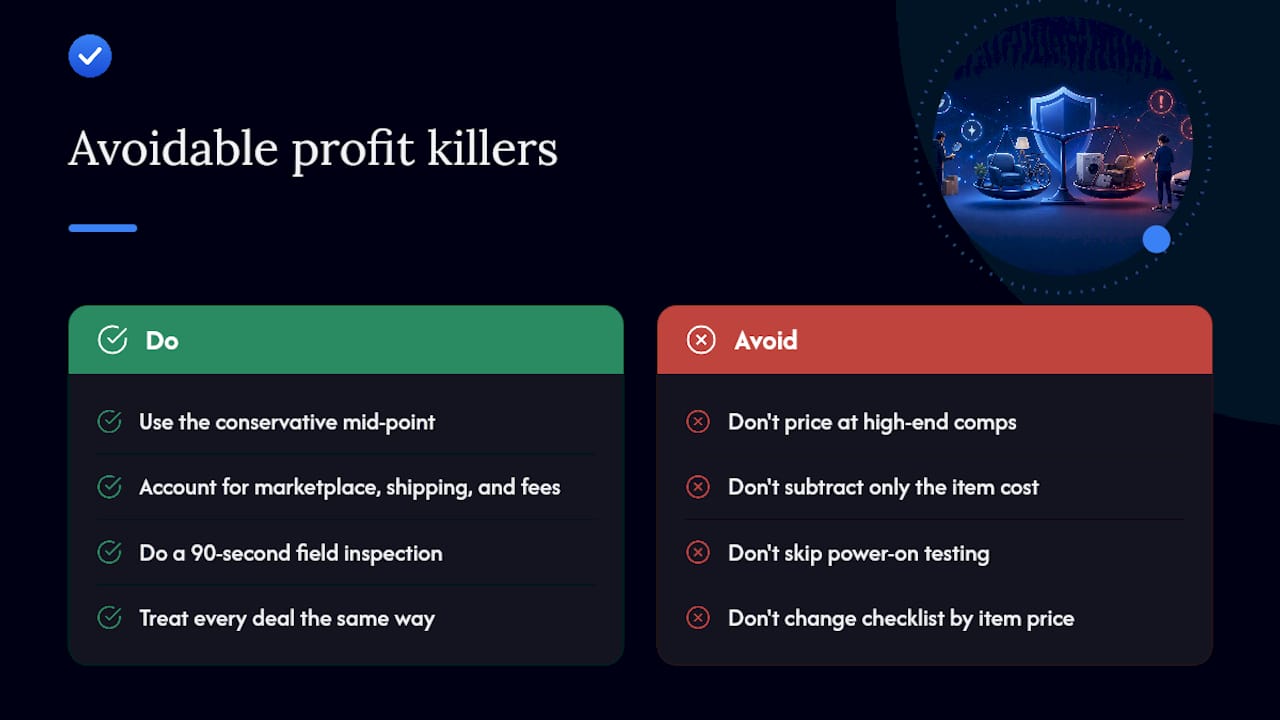
The most common profit killers aren't bad deals. They're avoidable mistakes made on decent deals.
Overestimating comps is the biggest one. Flippers look at the high end of sold listings and price their flip there, then sit on inventory for 60 days. Use the conservative mid-point, always.
Ignoring fees is the second. Many beginners subtract only the item cost and call the rest profit. Marketplace fees, shipping supplies, PayPal processing, and even the gas to pick up the item add up fast. A deal that looks like $40 profit can shrink to $9 after a full accounting.
Weak inspection is the third. Skipping the power-on test or missing a cracked hinge because you were in a hurry costs real money. The 90-second field check exists precisely because those two minutes protect your margin.
One pattern shows up repeatedly among flippers who build consistent income: they treat every deal the same way, whether it's a $15 shirt or a $300 power tool. The checklist doesn't change. The math doesn't change. That consistency is what separates a profitable month from a break-even one.
Sources
- How to Calculate Seller Profit on Any Marketplace - FlipCalc