

Fake marketplace listings are fraudulent ads designed to steal money or personal data from buyers and resellers, and they are more common than most people realize. Facebook Marketplace is the leading source of rental fraud, accounting for 50% of all reported rental scam cases in a 12-month period ending june 2025. That figure represents tens of thousands of victims who trusted what looked like a normal listing. Spotting the red flags in fake marketplace listings before you send a single dollar is the most reliable way to protect yourself, whether you are a casual buyer or an active reseller.
What are the most common red flags that indicate a fake listing?
Fraudulent listings share a predictable set of warning signs. Scammers recycle the same tactics because they work, and recognizing them is your first line of defense.
- Price is 30–40% below market value. Prices this far below market are a deliberate lure. Scammers create urgency by making the deal feel too good to pass up.
- Seller pushes communication off-platform. Any request to move to WhatsApp, Telegram, or personal email is a major warning sign. All secure transactions stay within the platform's messaging system.
- Profile was created recently. A seller account with no history, few friends, and no reviews is a classic indicator of a throwaway account built for fraud.
- Photos look professional but generic. Stock images or photos lifted from legitimate listings are common. Scammers copy photos and descriptions from reputable sites to create convincing fake ads.
- Seller refuses to meet in person or do a video call. The excuse is almost always the same: they are "out of town" or "traveling for work." This is a scripted deflection, not a coincidence.
- Description is vague or copy-pasted. Legitimate sellers describe their item with specific details. Fake listings use generic language that could apply to any product.
- Requests for payment before any meeting. Asking for a deposit or full payment upfront, before you have seen the item, is a near-certain sign of fraud.
Pro Tip: Search the listing's title or description in quotes on Google. If the exact text appears on multiple sites or in listings from different cities, the ad is almost certainly a clone.
How can you verify a listing before committing to a purchase?
Verification is the buyer's responsibility because platforms like Facebook Marketplace do not verify seller identities or ownership claims. That means you need a personal checklist before you hand over any money.
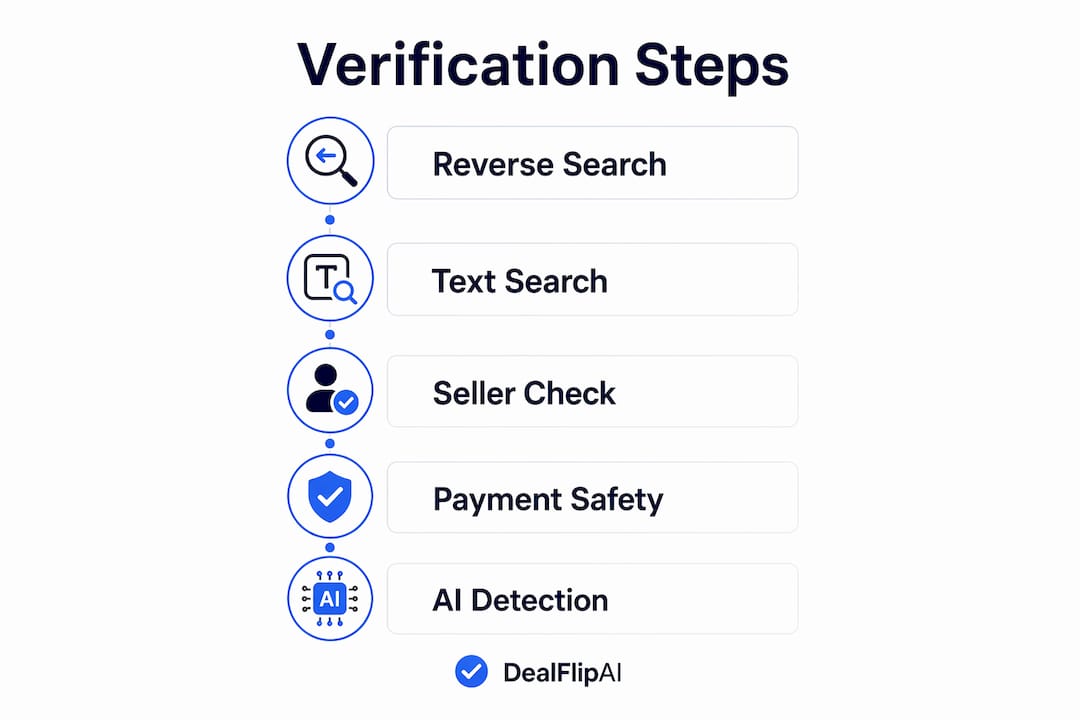
- Run a reverse image search. Right-click any listing photo and search it on Google Images or TinEye. If the photo appears on a real estate site, a stock photo library, or another marketplace, the listing is stolen.
- Search the address or description in quotes. Paste the exact listing text into a search engine with quotation marks around it. Duplicate results across multiple cities confirm a hijacked listing.
- Check the seller's profile thoroughly. Look at account age, tagged photos, and post history. Profiles that appear aged with many friends can still be fake because scammers buy established accounts. Inconsistencies in activity and tagged photos are the real tell.
- Look up public records for property listings. County assessor websites list actual property ownership. If the seller's name does not match the owner of record, walk away.
- Read low-star reviews across platforms. Check seller feedback on every platform where they have a presence. A pattern of complaints about non-delivery or misrepresentation is definitive.
- Use an AI-powered listing analyzer. Tools like Dealflip AI's listing analyzer tool score listings for price accuracy, risk signals, and seller credibility automatically.
| Verification method | What it catches |
|---|---|
| Reverse image search | Stolen or stock photos |
| Quoted text search | Cloned or hijacked descriptions |
| Public records lookup | False ownership claims |
| Profile activity review | Fake or purchased accounts |
| AI listing analysis | Price anomalies and risk clusters |
Pro Tip: AI tools that flag suspicious listings are now using the same generative AI techniques scammers use. Learning how AI filters bad listings gives you a real advantage over manual checks alone.
What behavioral patterns signal a scam more than any single red flag?
No single warning sign guarantees fraud. The real danger signal is a cluster of suspicious behaviors appearing together. Experts recommend looking for clusters rather than relying on one standalone sign, because scammers have learned to make individual red flags look plausible.
- New profile + off-platform payment request + refusal to meet. This combination is the most predictive cluster for fraud. Each element alone might have an innocent explanation. All three together do not.
- Generic AI-generated description + pressure to decide quickly. Generative AI produces polished but vague listings that lack item-level detail. When that description comes with a "this deal won't last" message, the scammer is using urgency to override your judgment.
- Multiple identical listings from one seller. A legitimate seller rarely posts the same item in five cities at once. Duplicate listings across locations are a mass-fraud tactic.
- Rapid rapport-building followed by a payment request. Scammers invest time in friendly conversation to create a false sense of trust. The warmth disappears the moment you question the payment method.
- Insistence on a private or unusual meeting location. If a seller refuses a public place like a police station parking lot or a busy coffee shop, that is a personal safety concern on top of a financial one.
The pattern recognition principle here is straightforward. One red flag means stay alert. Two red flags mean slow down and verify. Three or more red flags mean walk away entirely.
What payment and communication tactics do scammers use most often?
Payment fraud is where most victims lose actual money. Scammers use specific methods that are hard to reverse and easy to fake.
- Gift cards as payment. No legitimate seller asks for payment in iTunes or Google Play gift cards. This is exclusively a scam tactic.
- Wire transfers and cryptocurrency. Both are irreversible once sent. Scammers prefer them for exactly that reason.
- Zelle and Venmo before meeting. Peer-to-peer apps offer little buyer protection. Sending money before an in-person exchange gives you no recourse if the seller disappears.
- Fake payment confirmation screenshots. Screenshots of transactions are frequently forged. Always confirm any incoming payment through your own banking app, not through an image a stranger sends you.
- Overpayment refund scams. A scammer sends a fake check or payment for more than the asking price, then asks you to refund the difference. The original payment bounces days later, and you are out the refund amount.
Never send a deposit or full payment before physically inspecting an item or verifying a property in person. No legitimate seller requires payment before a meeting, and no real deal disappears because you asked to verify it first.
Staying on the platform's official messaging system is your best protection against communication-based fraud. Off-platform communication removes the seller from any moderation or reporting system the marketplace provides. When a seller insists on texting or emailing directly, they are removing the only safety net you have. Modern AI-driven fraud prevention works by monitoring transaction patterns in real time, which is exactly why scammers want to move you off the platform.
Key Takeaways
Spotting fake marketplace listings requires recognizing clusters of red flags, verifying seller identity independently, and never sending payment before a confirmed in-person meeting.
| Point | Details |
|---|---|
| Price is the first signal | Listings priced 30–40% below market value are designed to create urgency and bypass your judgment. |
| Clusters matter most | Two or more red flags together, such as a new profile plus off-platform payment, strongly predict fraud. |
| Verification is your job | Platforms do not verify sellers, so reverse image searches and public records checks are your responsibility. |
| Screenshots prove nothing | Fake payment confirmations are common; always verify transactions through your own banking app. |
| Stay on the platform | Keeping all communication and payment on the official platform is the single most effective safety measure. |
Why I think most buyers underestimate how sophisticated scams have become
Walsh Pex here. After years of watching the reselling space, the shift I find most alarming is not the volume of scams. It is the quality. Generative AI now produces polished, convincing listings in seconds. Visual polish used to be a reliable sign of legitimacy. That is no longer true in 2026.
The buyers who get burned are not naive. They are careful people who checked one or two things and felt satisfied. What they missed was the cluster. A professionally written description does not cancel out a two-week-old profile. A friendly seller does not cancel out a Zelle-only payment policy. You need to treat every signal as one data point in a larger picture.
My practical advice is to build a personal checklist and run through it on every transaction above $50. Reverse image search, quoted text search, profile age check, payment method review. It takes four minutes. That four minutes has saved people thousands of dollars. Community reports on local buy-and-sell groups are also underused. Other buyers in your area have often already encountered the same scammer under a different name.
Personal safety matters as much as financial safety. Always meet in a public place, bring someone with you for high-value transactions, and trust your instincts. If something feels off after all your checks, it probably is.
— Walsh Pex
How Dealflip AI helps you spot fake listings before they cost you money
Resellers who use Facebook Marketplace regularly need more than a checklist. They need a tool that works at the speed of the feed.

Dealflip AI's free scam checker analyzes listings in real time, flagging suspicious pricing, seller signals, and risk clusters before you make contact. The listing analyzer goes further, scoring each deal on price accuracy, profit potential, and fraud indicators so you can decide in seconds whether a listing is worth your time. For resellers who flip regularly, the flip profit calculator helps you confirm whether a deal's numbers actually make sense before you commit. Dealflip AI puts the verification work on autopilot so you can focus on finding real deals, not avoiding fake ones.
FAQ
What is the biggest red flag in a fake marketplace listing?
A price 30–40% below market value combined with a request to pay off-platform is the strongest predictor of fraud. Either signal alone warrants caution; both together mean the listing is almost certainly a scam.
How do I verify if a marketplace listing is real?
Run a reverse image search on the photos and paste the listing description in quotes into a search engine. Duplicate results across multiple cities or sites confirm the listing is cloned or stolen.
Are fake seller profiles easy to spot?
Not always. Scammers buy aged accounts with established friend lists, so account age alone is not reliable. Look for inconsistencies in post history, tagged photos, and activity patterns instead.
What payment methods are safest for marketplace transactions?
Cash at an in-person meeting or a platform's built-in payment system offers the most protection. Avoid wire transfers, gift cards, and peer-to-peer apps like Zelle for transactions with strangers, since these payments are irreversible.
Can AI-generated listings be identified as fake?
Generative AI produces polished but generic descriptions that lack specific item details. If a listing reads well but tells you nothing concrete about the item's condition, history, or unique features, treat it as a warning sign and verify independently.