

Score every Facebook Marketplace listing on a 0–100 scale, and buy only when it hits 65 or higher. That single rule, applied consistently, will save you more money than any amount of scrolling instinct. The score combines five weighted inputs: price gap versus resale value, fees and shipping, condition and repair cost, demand speed, and seller trustworthiness.
Here's the quick formula you can run in your head or a notes app: Score = (Profit Margin × 0.35) + (Demand Speed × 0.25) + (Condition/Confidence × 0.20) + (Seller Reliability × 0.10) + (Logistics × 0.10), each sub-score normalized to 0–100 before you multiply.
Your first offer should land below the seller's asking price by roughly the gap between their price and your target margin. If a couch is listed at $200 and your math says you need it at $140 to hit a healthy 30–50% margin after fees and time, offer $125 and leave room to move up.
- Buy now (score 80–100): message immediately with a firm, fair offer.
- Negotiate (score 60–79): send a conservative first offer and wait.
- Pass or investigate (below 60): ask questions first, or walk away.
Pro Tip: Keep your cutoff at 65, not 50. Marginal deals between 50 and 65 are where most flippers lose money on hidden repair costs and slow turnover they didn't see coming. Tools like DealFlipAI's listing analyzer automate this exact scoring so you're not doing mental math mid-scroll.
Key Takeaways
A transparent deal scoring system that weights profit, fees, condition, demand, and seller reliability lets flippers decide in seconds instead of guesswork.
| Point | Details |
|---|---|
| Use the 65 cutoff | Buy at score 65 or above; negotiate between 60 and 79; pass below 60. |
| Count fees every time | Local pickup is free, but shipped checkout costs 10% plus an $0.80 minimum. |
| Factor in your time | Even modest hourly rates can turn a "good deal" into a break-even item. |
| Track outcomes monthly | Review margin, days-to-sell, and win rate to recalibrate your weights. |
| Automate with DealFlipAI | The platform applies this exact rubric and fee logic to score listings instantly. |
Table of Contents
- Deal Scoring Criteria Examples Every Flipper Should Track
- How to Weight Factors and Build a 0–100 Deal Score
- Three Worked Examples With Full Fee Math
- Turning Your Score Into a First Offer and Negotiation Plan
- Testing and Calibrating Your Scoring System Over Time
- A Copy/Paste Scoring Template and Mobile Cheat Sheet
- Using Scores in Real Hunting Sessions
- How DealFlipAI Turns This Rubric Into an Instant Score
- Sourced Reading and Tools for Deeper Learning
- Frequently Asked Questions
- Sources
Deal Scoring Criteria Examples Every Flipper Should Track
A deal scoring system is only as good as the inputs you feed it. Below are the ten criteria that actually move the needle on profit, each with a fast, practical way to check it in under two minutes.
- Price vs. estimated resale value: Check three recent sold listings on eBay or Mercari for the same item. If the asking price sits 40% or more below that median, the gap is worth pursuing.
- Fees and shipping: Local pickup on Facebook Marketplace costs 0%, while shipped checkout carries a 10% fee on item plus shipping, with an $0.80 minimum. That difference alone can flip a "yes" into a "no" for bulky items.
- Repair or parts cost: Estimate replacement parts and your own labor time. A cracked phone screen might cost $40 in parts but two hours of your evening.
- Time overhead: Count driving, cleaning, photographing, and listing time. Even 90 minutes at a $20 hourly rate erases $30 of profit before you've shipped anything.
- Item condition: Look for close-up photos, not just wide shots. Vague descriptions like "works great" without proof are a yellow flag.
- Demand and turnover: Search "sold" listings for the category. If similar items sell within a week, days-to-sell risk is low.
- Brand and obsolescence: Recognizable brands hold value longer. Research on secondhand smartphones found strong brands can add roughly 12.5 months to an item's resale life compared to generic alternatives.
- Listing quality and accessories: Original boxes, chargers, and manuals boost buyer confidence and price. Clear listing quality also affects what shoppers are willing to pay for used versus remanufactured goods.
- Seller reliability and scam signals: New accounts, no profile photo, or refusal to meet publicly are red flags worth a lower confidence score.
- Proximity and logistics: A 45-minute drive for a $15 profit item isn't worth it. Factor mileage and time into every pickup decision.
Pro Tip: If a category's days-to-sell average exceeds three weeks in your local search, downgrade your demand sub-score even if the price gap looks great. Slow-moving inventory ties up cash and garage space.
How to Weight Factors and Build a 0–100 Deal Score
Every criterion gets normalized to the same 0–20 scale before you combine them, which keeps a $5 price gap from accidentally outweighing a major scam signal. Profit potential should carry the most weight because it's the reason you're flipping in the first place, while risk factors act as a brake on otherwise attractive numbers.
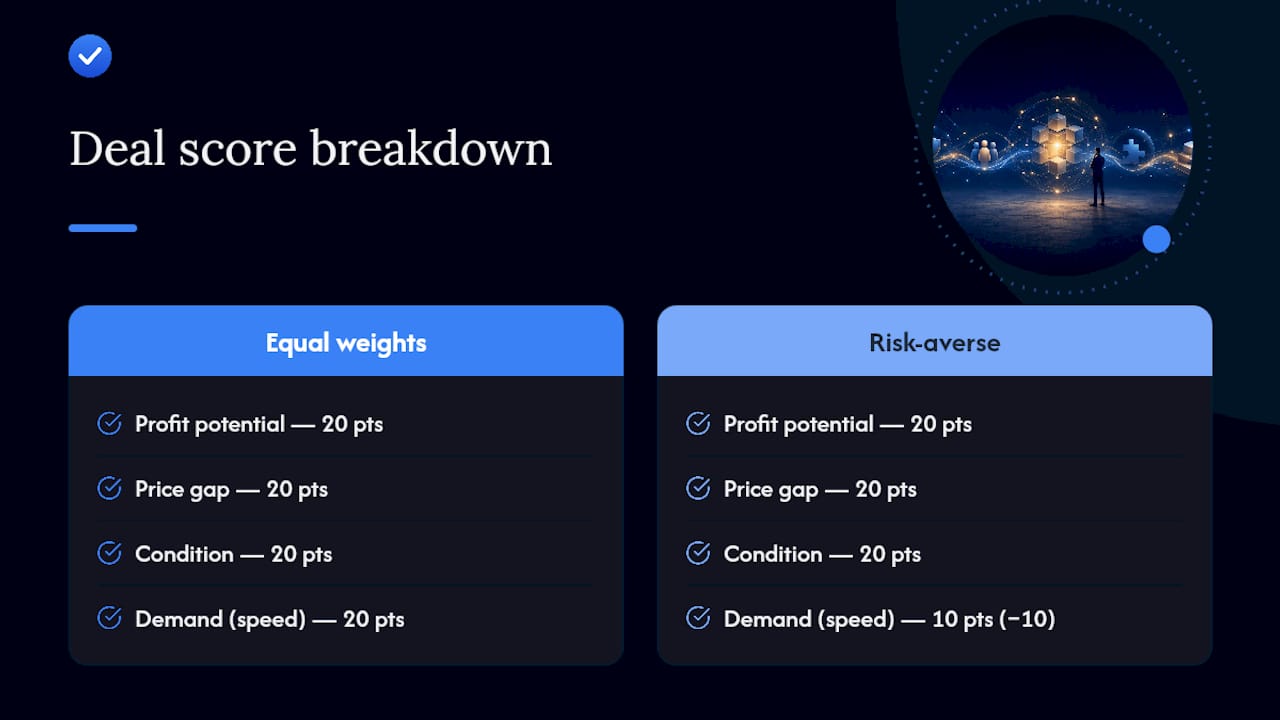
Someone prioritizing low risk over speed might shift 10 points from demand into seller reliability instead.
Add the five sub-scores for a raw total out of 100, then apply your weight percentages if you want a more profit-heavy calculation. A quick mental version: if profit margin, demand, and condition all score 15 or higher, and seller reliability isn't a red flag, you're almost always above the 65 buy threshold.
Three Worked Examples With Full Fee Math
Numbers make this rubric real. Here are three scenarios that show exactly how fees, repairs, and time change the final call.
Example 1: Bulky sectional sofa, local pickup only.
- Purchase price: $150
- Estimated resale: $400
- Platform fee: $0 (local pickup)
- Repairs: none needed
- Time (pickup, cleaning, listing, delivery): 3 hours at $20/hour = $60
- Net profit: $400 minus $150 minus $60 = $190
- Score: 88 (buy now, offer $130 to build in extra margin)
Example 2: Smartphone shipped, cracked screen repair needed.
- Purchase price: $80
- Estimated resale: $220
- Platform fee (shipped checkout): 10% of item plus shipping ($220 + $12 shipping = $232), so $23.20, with the $0.80 minimum not applying here since the calculated fee exceeds it
- Repair cost (screen part): $45
- Shipping and supplies: $12
- Time: 2 hours at $20/hour = $40
- Net profit: $220 minus $80 minus $23.20 minus $45 minus $12 minus $40 = $19.80
- Score: 42 (pass, or offer no more than $40 if you can source the part cheaper)
Example 3: Branded power tool, easy local sale, no shipping.
- Purchase price: $60
- Estimated resale: $135
- Platform fee: $0 (local pickup)
- Repairs: none
- Time: 45 minutes at $20/hour = $15
- Net profit: $135 minus $60 minus $15 = $60
- Score: 76 (negotiate, first offer around $45 to $50)
Notice how the shipped phone example nearly disappears once you count the 10% shipped-checkout fee and repair labor. That's the gap most beginners miss when they eyeball "sticker profit" instead of running real numbers.
Turning Your Score Into a First Offer and Negotiation Plan
Your score isn't just a filter, it's a negotiation tool. Once you know where a listing lands, the right move becomes obvious instead of a guessing game.
- Score 80–100: Buy now or send a firm offer close to asking price. These deals move fast, and hesitation costs you the item.
- Score 60–79: Send a conservative first offer, typically 15% to 25% below asking, and be ready to meet in the middle.
- Below 60: Ask clarifying questions about condition or accessories before offering anything, or pass entirely.
A simple message script for the 60–79 range: "Hi, is this still available? I can do $X cash, pick up today." Keep it short. Sellers respond faster to concrete numbers than vague lowball questions.
Pro Tip: Listings posted within the last hour, using words like "moving" or "must sell," carry more negotiation leverage because the seller wants speed over top dollar. Watch for inconsistent photos too. Stock images mixed with real ones often signal a reseller flipping the same item, which means less room to negotiate.

Testing and Calibrating Your Scoring System Over Time
A rubric is only useful if you check whether it actually predicts profit. Track these numbers every month:
- Deals evaluated (total listings scored)
- Deals purchased (how many crossed your buy threshold)
- Average days-to-sell across purchased items
- Average net margin after all costs
- Win rate on first offers (offers accepted versus sent)
- Mean time invested per item, from scouting to sale
Change one weight at a time, then track results for 30 to 90 days before drawing conclusions. If your average net margin drifts more than 10 percentage points from your target range, that's your signal to recalibrate rather than chase every dip.
A Copy/Paste Scoring Template and Mobile Cheat Sheet
Paste this structure into a spreadsheet or a phone notes app before your next scanning session:
Template columns: Criterion, Weight (%), Raw Value, Normalized Score (0–20), Subtotal
Fill in one row per criterion (price gap, fees, condition, demand, seller reliability, logistics), multiply normalized score by weight, and sum the subtotals for your final number out of 100.
For scanning listings on the go, keep this cheat sheet handy:
- Asking price and quick resale estimate (search sold listings)
- Local pickup or shipped? (determines fee impact)
- Condition from photos and description
- Repair or parts needed?
- Seller profile age and responsiveness
- Distance from you
- Accessories or original packaging included?
- Days similar items take to sell in your area
Pro Tip: Save this cheat sheet as a pinned note on your phone home screen. The two extra seconds it takes to open it beats the ten minutes you'll spend regretting an impulse buy. Specialists who focus on two or three categories tend to score faster because they've already memorized typical resale ranges.
Using Scores in Real Hunting Sessions
Speed matters more than perfection when you're scanning fifty listings during a lunch break. Run the quick mental version first: price gap, fees, and condition. Save the full weighted rubric for anything that clears an initial gut check above 60.
Some items break the rubric on purpose. A rare collectible with thin sold-listing data might score low on demand confidence but still be worth buying because scarcity itself protects resale value. Local pickup logistics can also override the math. A $30 profit item three minutes from your house beats a $60 profit item forty-five minutes away once you count your time honestly.
Treat every score as an experiment, not a verdict. Track what you bought, what you passed on, and what actually sold for. The rubric gets sharper every month you feed it real outcomes instead of guesses.
How DealFlipAI Turns This Rubric Into an Instant Score
Running this math manually on fifty listings a day is exhausting, which is exactly the gap DealFlipAI closes. The platform scans Facebook Marketplace listings and applies the same weighted criteria covered here: price gap, fees, condition, demand, and seller reliability, then returns a transparent score and a suggested first offer in seconds.

DealFlipAI accounts for Facebook's fee structure automatically, factoring local pickup versus shipped checkout into every profit estimate so you're not left doing the $0.80 minimum math by hand. It also flags scam signals and seller inconsistencies before you waste a drive on a dead-end listing, and sends real-time alerts the moment a fresh, high-scoring item hits your search radius.
If you've been running these numbers on paper or in your head, try the listing analyzer on your next scroll session and see how your manual score compares to an automated one. It's the fastest way to know whether your rubric and your instincts actually agree.
Sourced Reading and Tools for Deeper Learning
The fee rules and margin benchmarks referenced throughout this guide come from a few key places worth bookmarking:
- Facebook Help — Selling on Facebook Marketplace for the official local pickup versus shipped-checkout fee rules used in every worked example.
- A free reselling profit calculator for the 30–50% healthy margin benchmark and real-profit math.
- What Affects the Secondhand Value of Smartphones: Evidence from eBay for the brand-driven resale lifespan data used in the criteria section.
- Used item value guide for depreciation patterns across categories.
- BuyBackBear's pre-shipping checklist for a practical device condition checklist useful in scoring repair risk.
- DealFlipAI's free tools and calculators for automating the fee and profit math shown in the worked examples.
Frequently Asked Questions
What is a good deal scoring criteria examples framework for beginners? Start simple: score price gap, fees, condition, and demand on a 0–20 scale each, then add them up. Once you're comfortable, add seller reliability and logistics for a fuller picture.
How do deal scoring metrics differ from just checking profit margin? Profit margin alone ignores risk. A high-margin item from an unreliable seller or with slow local demand can still lose money once you factor in scams, returns, or months of unsold inventory.
What are the best practices for deal scoring on Facebook Marketplace specifically? Always separate local pickup from shipped-checkout math since the fee difference is significant, and weight seller reliability heavily since Marketplace has less built-in buyer protection than dedicated resale platforms.
How often should I recalibrate my deal scoring framework? Review your numbers monthly. If average net margin drifts more than 10 percentage points from your target, adjust one weight at a time and retest for another 30 to 90 days before changing anything else.
Does deal scoring transparency actually save time, or is it extra work? Once you've built the template, scoring a listing takes under two minutes and prevents the much larger time cost of driving to inspect a bad deal or negotiating without a clear offer number in mind.
Sources
- Facebook Help — Selling on Facebook Marketplace
- What Affects the Secondhand Value of Smartphones: Evidence from eBay
- Consumers’ willingness-to-pay for remanufactured vs used vs new products (iPods study)
- A free reselling profit calculator (real profit, not sticker profit)
- Used item value guide: what depreciates fast and what holds resale price