
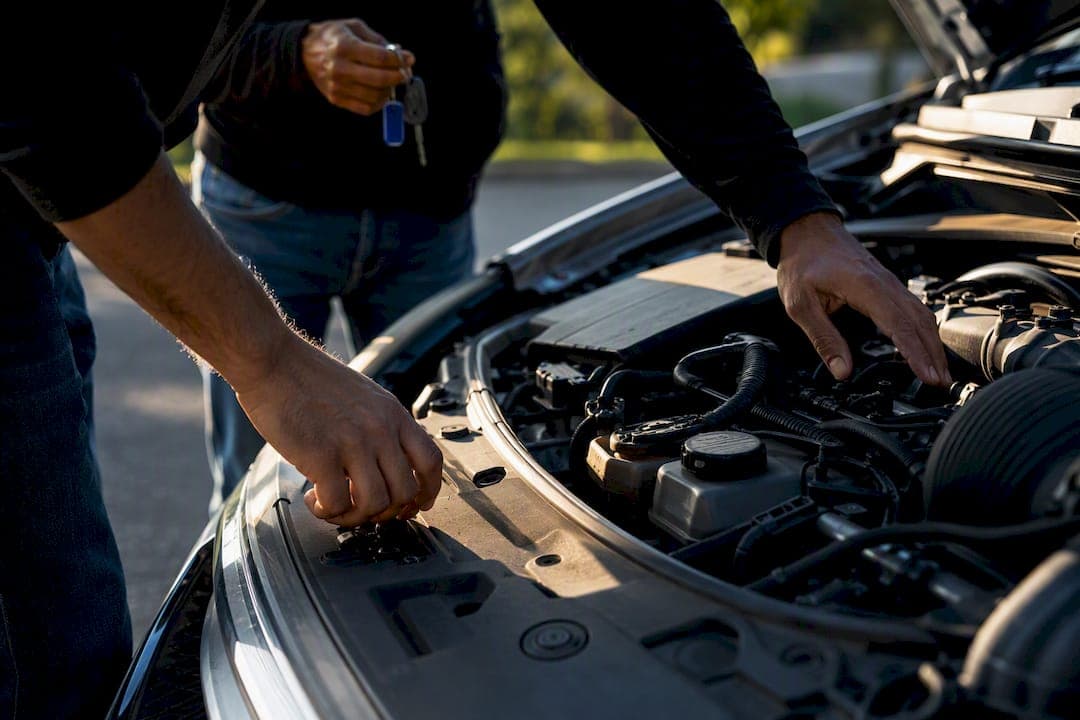
Yes, Facebook Marketplace is a reliable, high-volume source for profitable car flips when you pair a disciplined buy-price rule with a fast sourcing routine. Your first move today: set up saved searches with alerts in three to five zip codes around you, and write down a maximum offer before you ever message a seller. Expect modest, steady margins, not overnight windfalls.
TL;DR:
- Using saved searches with alerts in multiple zip codes and focusing on motivated-seller keywords helps secure underpriced vehicles faster than competitors.
- Running VIN history reports and scanning for codes via OBD2 before purchase reduces the risk of hidden issues affecting flip profitability.
- Negotiating after inspection and adjusting offers based on visible repairs and cosmetic issues can capture additional profit margins.
- Budgeting for repairs should not exceed 40% of the expected resale value, with safety and tires prioritized to ensure a quick sale.
- Utilizing tools like listing analyzers and profit calculators streamlines sourcing, pricing, and risk assessment, accelerating your flip cycle.
Table of Contents
- What Is Car Flipping on Facebook Marketplace, and How Does It Work?
- How Do You Vet a Seller and Inspect a Car Before Buying?
- What's the Best Way to Negotiate and Close the Deal?
- How Should You Budget for Repairs Without Killing Your Margin?
- How Do You Price and List a Car to Sell Fast?
- How Do You Spot and Avoid Facebook Marketplace Scams?
- How Long Does a Flip Take, and What's the Realistic Profit?
- How Can Tools Like DealFlipAI Speed Up Sourcing and Reduce Risk?
- What Are the Ongoing Holding Costs While You Own a Flip?
- How Do You Market a Car for Maximum Visibility on Marketplace?
- How I Approach Every Flip Without Burning Out or Overextending
- Ready to Move Faster on Your Next Flip?
- Sources
What Is Car Flipping on Facebook Marketplace, and How Does It Work?
Car flipping on Facebook Marketplace means buying an underpriced private-seller vehicle, making targeted repairs, and reselling it for a profit, usually within two to four weeks. It works because Marketplace listings are tied to real Facebook profiles, which gives you more context on a seller than an anonymous Craigslist post ever will, and because the sheer volume of listings creates constant turnover of underpriced cars from motivated sellers.
Why the sourcing setup matters more than luck
Getting first crack at underpriced listings is a matter of routine, not chance. Facebook Marketplace's profile-linked listings and higher inventory volume give flippers an edge over platforms like Craigslist or OfferUp, but only if you're checking at the right times with the right filters.
Build your search system like this:
- Save searches for your target makes/models across at least three to five zip codes, since sellers often list under a nearby city's radius rather than their own.
- Check listings early on weekday mornings and again in the evening, when new posts from people selling before a move or a payday spike tend to appear.
- Try common misspellings ("Camry" as "Camary," "Tacoma" as "Tacaoma") since misspelled listings get less traffic and less competition.
- Use motivated-seller keywords like "must sell," "moving," or "need gone" to surface people who will accept lower offers.
- Set your price filter roughly 15 to 25% below average market value, based on tactics documented in AutoHunter's sourcing research, so your feed only shows genuine candidates.
Pro Tip: Turn on push notifications for your saved searches instead of relying on email. The gap between "notified in 2 minutes" and "checked my inbox at lunch" is often the difference between winning a deal and losing it to a faster buyer.
How Do You Vet a Seller and Inspect a Car Before Buying?
Before you drive anywhere, ask the seller for the VIN, clear photos of the title, and any service records. Cross-reference their profile: an account created last week with zero mutual friends and a string of "for sale" posts is a different risk level than a five-year-old profile with a normal social history.
Run this checklist once you're in front of the car:
- Pull a VIN history report to confirm no salvage title, flood damage, or mismatched odometer readings.
- Start the engine cold if possible; a rough cold start can reveal issues a warm engine hides.
- Plug in an OBD2 scanner and check for stored codes, even if the check-engine light isn't currently on.
- Test drive on both surface streets and, if you can, a short highway stretch to catch vibrations or transmission slip.
- Check underneath for fluid leaks, rust on the frame, and uneven tire wear that hints at alignment problems.
- Confirm the VIN on the dash, door jamb, and title all match exactly.
Roughly one in five used vehicles carries an undisclosed issue significant enough to affect resale value, which is exactly why the OBD2 scan and VIN check aren't optional steps, they're the two cheapest insurance policies you have against a bad flip.
What's the Best Way to Negotiate and Close the Deal?
Skip "Is this still available?" That opener signals you're one of fifty people asking the same question. Instead, try something like: "Hi, I'm interested in the [year/model]. I'm local and can come look at it today if it's still available, is the price firm or open to offers?"
Save your real negotiating for after the inspection, not before. Once you've found actual problems, you have leverage instead of guesswork.
- Bald tires or worn brakes: knock off $150 to $400 depending on tire size and pad/rotor condition.
- A check-engine light with a stored code: ask for $200 to $600 off depending on the code's severity.
- Cosmetic dents or faded paint: $100 to $300, since these rarely affect drivability but do affect resale.
- Missing maintenance records: a smaller ask, $50 to $150, as a hedge against unknown deferred service.
Meet in a public, well-lit location, ideally a bank parking lot where you can also get a cashier's check if needed. Confirm the seller's ID matches the name on the title before any money changes hands.
How Should You Budget for Repairs Without Killing Your Margin?
Sort every issue into one of four buckets: safety and driveability, tires and brakes, cosmetics, and detailing. Safety items are non-negotiable and go first. Tires and brakes come next because buyers notice them immediately on a test drive. Cosmetics and detailing matter most for perceived value, a $60 detail job routinely adds more to your sale price than it costs.
Get quick quotes from two independent shops before you commit to a repair number, and treat DIY repairs (brake pads, cabin filters, headlight restoration) as fair game if you own basic tools, but leave anything involving the transmission or electrical system to a mechanic.
- Set your total budget at purchase price plus repairs plus a 15% margin buffer for surprises.
- Walk away if estimated repairs exceed 40% of the car's post-repair resale value.
- Buy as-is only when the flaw is cosmetic and clearly priced into your offer.
Pro Tip: Run your numbers through a flip profit calculator before you make an offer, not after. Backing into your budget from a target profit, instead of hoping the math works out, is what separates repeatable flips from one-off luck.
How Do You Price and List a Car to Sell Fast?
Photos sell cars before your description does. Shoot at least 20 images: all four exterior angles, wheels, dashboard, odometer, engine bay, trunk, undercarriage if it's clean, and any existing damage disclosed upfront. A $15 microfiber detail kit and an hour of vacuuming routinely add hundreds of dollars to your final sale price.
Price the listing 5 to 10%-in-2025) above your actual target and mark it "OBO" (or best offer), which gives buyers room to negotiate down to the number you actually wanted while feeling like they won something.
- List engine size, mileage, accident history, and recent maintenance directly in the description to cut down on repetitive messages.
- Post in the evening on weekdays or Saturday morning, when buyer browsing traffic peaks.
- Use a private listing for maximum price, but consider a quick-sale cash buyer or dealer trade-in if you need capital freed up fast for the next flip.
How Do You Spot and Avoid Facebook Marketplace Scams?
Shipping-only sellers who refuse a local viewing, buyers who ask you to use a fake escrow service, and anyone requesting a deposit before you've seen the car in person are the three scams that show up most often on Marketplace. Legitimate sellers don't ask you to wire money sight unseen.
- Walk away immediately if a seller won't share the VIN or refuses an in-person meeting.
- Refuse any deal that routes payment through a third-party "protection" link, that's never how real title transfers work.
- Cross-check the seller's profile against the common scam-listing patterns flippers report most often, brand-new accounts, stock photos, and prices dramatically below market.
Roughly one in five vehicle listings hides a meaningful mechanical or title issue, which is a strong argument for treating every "too good to be true" price as a red flag first, a deal second.
How Long Does a Flip Take, and What's the Realistic Profit?
Most flips run two to four weeks start to finish: a few days sourcing and negotiating, one to seven days on repairs depending on parts availability, and one to two weeks to sell at your target price. Experienced flippers report average profits often in the low-thousands per vehicle, with margins improving as you get faster at spotting real deals versus time-wasters.
- Budget $3,000 to $8,000 in working capital per flip to cover purchase price and repairs comfortably.
- Reinvest early profits rather than pulling cash out, this compounds your ability to run two or three flips simultaneously.
- Once you're consistently flipping, auction channels like Copart or IAA become worth exploring for wholesale and salvage inventory beyond private listings.
How Can Tools Like DealFlipAI Speed Up Sourcing and Reduce Risk?
A practical workflow looks like this: run your saved searches, then run promising listings through a Facebook Marketplace listing analyzer to score price, profit potential, and scam risk before you ever message the seller. Pre-check the VIN, then inspect in person, then negotiate using what you found. DealFlipAI's real-time alerts and scam detection help you triage faster, but no scoring tool replaces a hands-on inspection and a cold-start engine check.
What Are the Ongoing Holding Costs While You Own a Flip?
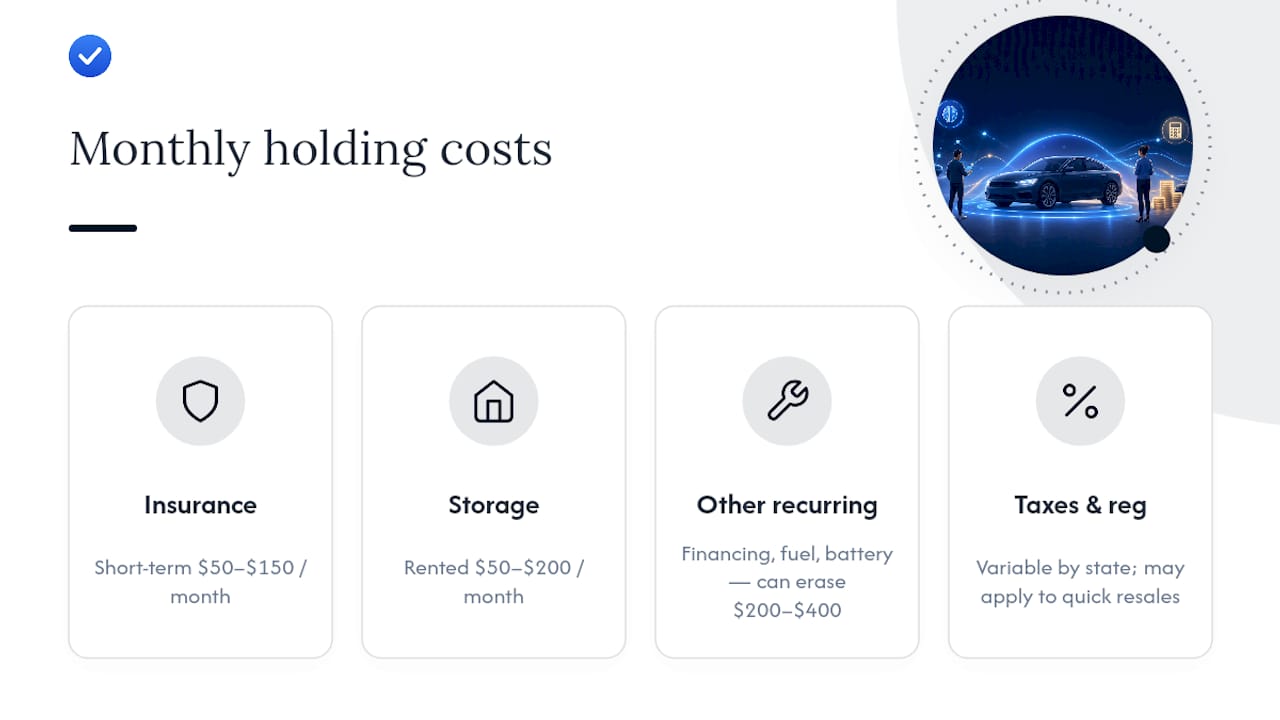
Every day you hold a car costs money, even if it's parked in your driveway. Insurance is the biggest recurring line item: most states require at least liability coverage the moment the title is in your name, and a short-term policy for a flip car typically runs $50 to $150 per month depending on the vehicle's value and your driving record.
Storage matters if you don't have driveway or garage space. Street parking is free but risky for theft and weather damage; a rented space or storage lot commonly runs $50 to $200 per month depending on your area. If you're flipping multiple cars at once, this adds up fast and eats into margin on slower-moving inventory.
Sales tax and registration fees vary significantly by state, and some states charge tax on the purchase price even for a car you're reselling within weeks, so check your state's rules before assuming you'll recoup that cost at resale. A handful of states offer dealer or reseller exemptions, but those typically require a dealer license, which most part-time flippers don't have.
Don't forget the smaller recurring costs: a monthly loan payment if you financed the purchase, gas for test drives and buyer meetups, and minor maintenance like a battery charge if the car sits for more than a week or two. None of these individually breaks a flip's math, but stacked together over a slow-selling month, they can quietly erase $200 to $400 of profit. Build a holding-cost estimate into your budget the same way you budget for repairs, and price your exit timeline accordingly.
How Do You Market a Car for Maximum Visibility on Marketplace?
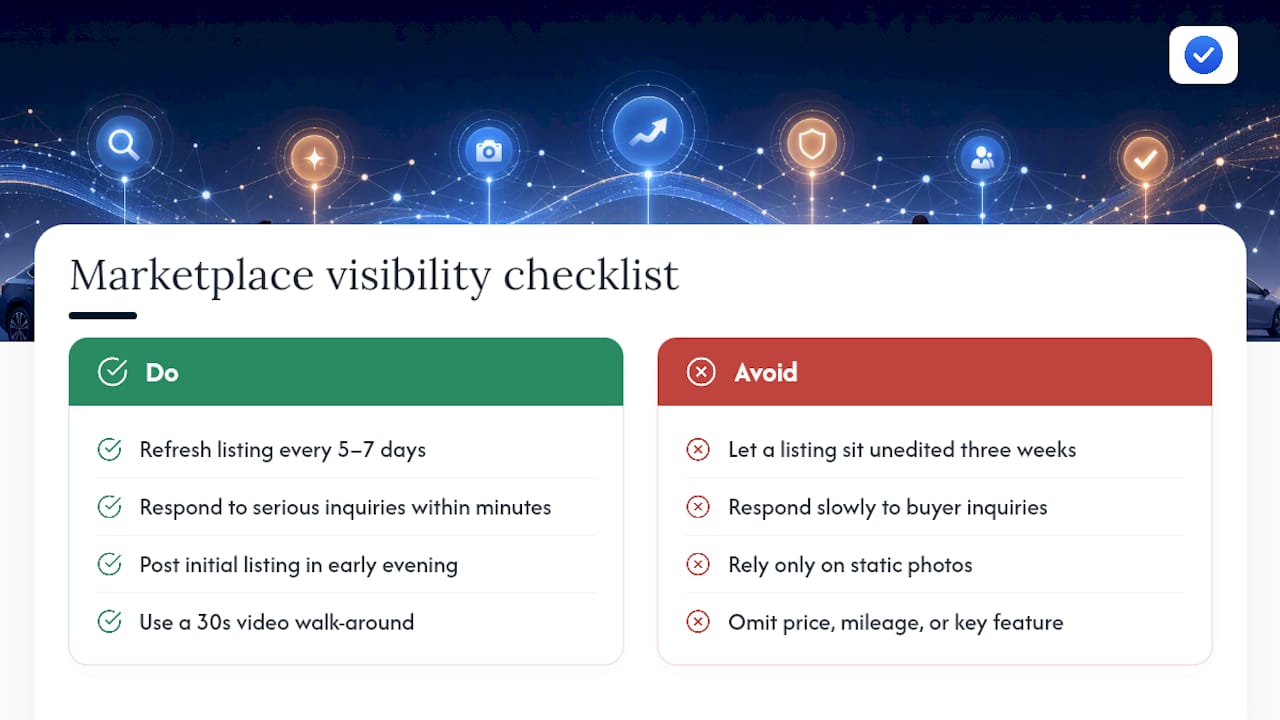
Getting seen matters as much as pricing right. Facebook's algorithm favors fresh listings and active engagement, so a car that's been sitting unedited for three weeks quietly loses visibility compared to a newly posted one.
Refresh your listing every five to seven days by adjusting the price slightly or adding a new photo, which can bump it back toward the top of local search results. Respond to every serious inquiry within minutes if you can; Marketplace's ranking rewards sellers who engage quickly, and slow responses push your listing down in relevance.
Cross-post to relevant local buy-sell-trade groups on Facebook in addition to Marketplace itself, since group members often check listings there before searching the main feed. Include your asking price, mileage, and one standout feature directly in the post text (not just the listing fields), since group posts display differently and buyers skim fast.
Video walk-arounds outperform static photo sets for engagement, even a 30-second phone video showing the car starting, idling, and a quick exterior walk builds more buyer trust than another photo. Timing your listing's initial post for early evening, when browsing traffic peaks, gives you the best shot at that first wave of inquiries that keeps the algorithm favoring your post.
How I Approach Every Flip Without Burning Out or Overextending
Treat sourcing like a job you show up for daily, not a hobby you check when bored. Log every deal you look at, even the ones you pass on, because the pattern of what you skip teaches you as much as what you buy. Keep your risk posture conservative: document every conversation, save every VIN report, and photograph the odometer at pickup.
Set a real red line for walking away, whether that's a failed cold start, a seller who won't meet in public, or numbers that only work if everything goes perfectly. Small losses are tuition. Chasing a deal past your own rules is how tuition turns into real damage.
— Walsh Pex
Ready to Move Faster on Your Next Flip?
Sourcing good deals fast is the hardest part of flipping, and it's the part most flippers waste the most time on, scrolling endless listings hoping something jumps out. Some tools close that gap by scoring Facebook Marketplace listings on price, profit potential, and risk the moment they post, so you're spending your time on cars worth inspecting instead of cars worth skipping.
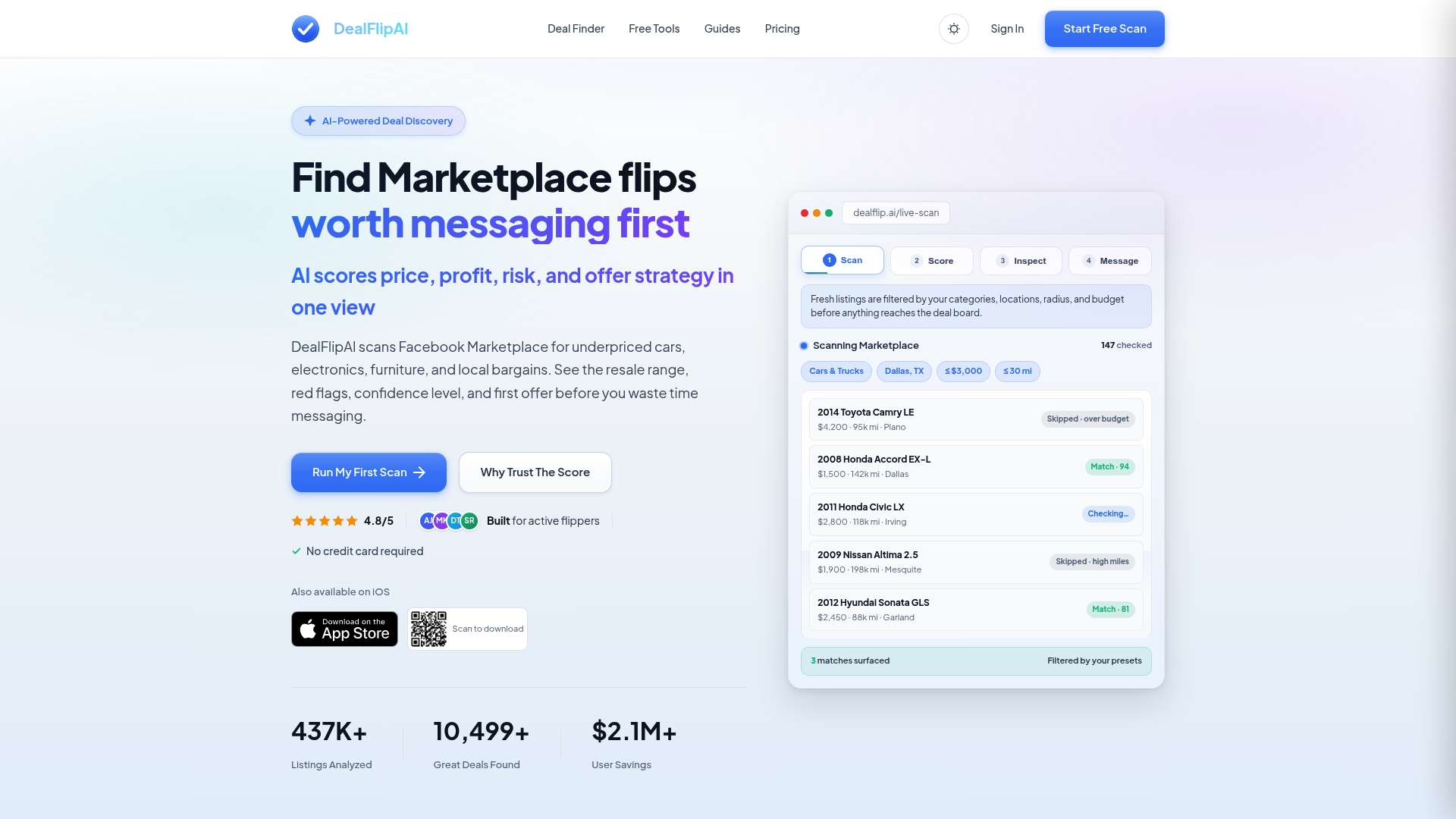
Run a listing you're eyeing through the listing analyzer to get a transparent valuation breakdown and a suggested opening offer before you message the seller. Once you've got a candidate car and a repair estimate, plug the numbers into the flip profit calculator to see your real margin before you commit capital. Neither tool replaces the test drive and the OBD2 scan, but both help you decide which cars deserve that drive in the first place.
Sources
For deeper sourcing tactics and inspection checklists, the AutoHunter Marketplace flipping guide covers documented margin and timeline data. If you're ready to scale past private listings, Copart and IAA both run online salvage and wholesale auctions worth exploring once you understand salvage-title workflows and DIY repairs get easier with the right kit, Teng Tools has a practical rundown of what a car project actually needs in a toolbox.
- Facebook Marketplace Sourcing Guide 2025: Find Flip-Worthy Cars Before Anyone Else | AutoHunter | AutoHunter Blog
- Online Car Auctions | Repairable & Used Cars - Copart
- Online Salvage Car Auctions: Used & Repairable Vehicles | IAA