

Set precise deal-score alerts and run a three-point pre-trip check before you ever leave the house. That single habit eliminates most pointless drives and unprofitable buys. Right now, do three things: activate keyword alerts for your niche, run any listing through the Dealflip AI listing analyzer for a free score, and verify the seller's profile age before you respond.
Key Takeaways
Stopping wasted trips and bad purchases comes down to one discipline: score the listing before you drive, verify the seller before you respond, and apply all-in math before you commit.
| Point | Details |
|---|---|
| Score before you drive | Run every listing through an AI deal score to filter low-margin and high-risk pickups before leaving home. |
| Apply all-in profit math | Add travel cost, time at your hourly rate, fees, and repairs before deciding; a 40-mile trip can cut margin by more than half. |
| Three red flags means walk | If a listing shows three or more scam signals, skip it regardless of the price. |
| Inspect before you pay | Power up electronics, test appliances, photograph everything, and verify serial numbers on-site. |
| Dealflip AI listing analyzer | Use the free listing analyzer as your first step on any listing you're considering. |
Table of Contents
- How to reduce wasted trips and bad purchases: your pre-trip checklist
- How to calculate your true all-in cost and profit per trip
- What scam signals tell you to skip a listing immediately
- On-site inspection: what to test before you hand over cash
- Buy, reserve, or walk away: simple thresholds for fast decisions
- How AI deal-scoring and real-time alerts cut wasted drives
- Exact filters, alert rules, and offer templates you can copy now
- Why the scoring is reliable: signals, transparency, and user evidence
- Verify the seller's location before you drive anywhere
- A habit that changed how I think about flipping
- Dealflip AI: built for flippers who want fewer bad trips
- Sources
How to reduce wasted trips and bad purchases: your pre-trip checklist
A three-minute check before you leave catches most problems. Work through this list in Messenger before you commit to driving anywhere.
Listing authenticity:
- Profile age under 30 days with no photos or posts is a strong warning sign
- Look for identical listings posted across multiple cities or ZIP codes
- Check whether the seller has mutual friends or any listing history
Price sanity:
- Pull sold comps on eBay (filter "Sold Items") and compare to the asking price
- A price well below market on a high-demand item warrants extra scrutiny
- Listings priced suspiciously low for iPhones, power tools, or gaming consoles are common scam setups
Logistics:
- Confirm the exact pickup address and whether parking is available
- Ask for a specific pickup window, not just "anytime"
- Prefer sellers who will meet at a public spot or a police-station exchange zone
Communication red flags per ProPublica's Marketplace scam reporting: any request to move to WhatsApp or text, demands for a gift-card deposit, or refusal to allow in-person inspection before payment.
Three messages to send before you drive:
- "Is this still available and can I pick up today at [time]?"
- "Can you confirm the address and send a photo of the item next to today's newspaper or your hand?"
- "I'll pay cash on pickup. Are you okay with me testing it before I hand over money?"
Pro Tip: Keep all communication inside Facebook Messenger. If a seller pushes you off-platform, that alone is reason to pass.
How to calculate your true all-in cost and profit per trip
Profit math is simple once you account for every cost. Use this formula before every pickup:
All-in cost = purchase price + travel cost + repair/cleaning + selling fees + storage

Travel cost can be calculated using mileage and your hourly value for time. For example, if you value your time and travel duration accordingly, you can estimate the cost of a trip.
Use the Dealflip AI flip profit calculator to run this math in seconds. The key input fields: purchase price, estimated resale price, platform fees, travel distance, and repair estimate.
Two quick scenarios:
Long-distance flips reduce your margin significantly compared to local flips. That's why distance is a first-order filter, not an afterthought.
Platform fee differences matter for cross-listing. A local cash pickup has zero selling fees. Use the cross-listing profit calculator to compare net profit across channels before you decide where to list.
- Enter your purchase price and estimated resale
- Add travel distance and your hourly rate
- Add any repair or cleaning cost
- Select your selling platform to apply the correct fee rate
- Read the net margin and decide: buy, negotiate, or skip
Pro Tip: If net profit after all costs is under $25, the listing needs to be negotiated down or skipped. Your time has a real cost.
What scam signals tell you to skip a listing immediately
Most scams share the same fingerprints. Spot them before you drive.
Account signals:
- Profile created within the last 30 days with no activity
- No profile photo, no posts, no friends visible
- Same listing text appearing in multiple cities
Behavioral signals:
- Pressure to decide immediately ("I have three other buyers coming")
- Request to move communication to Google Voice, WhatsApp, or email
- Asks for a deposit via Zelle, Venmo, or gift card before you see the item
Listing signals:
- Stock photos instead of actual item photos
- Description that doesn't match the photos (wrong color, different model)
- Price far below market for high-demand items like AirPods, PS5s, or Milwaukee tools
Two scams to know specifically: The Google Voice verification trick asks you to "confirm you're real" by sharing a code texted to your phone. That code hands over your Google Voice number. Fake payment screenshots show a Zelle or PayPal confirmation that never actually processed.
A five-step verification routine from StoryCheck covers listing, contact, and meetup verification and catches most fraudulent listings before you travel. For a deeper red-flag breakdown, the fake listing patterns guide covers suspicious listing categories by type.
Scam signal: If a seller refuses to meet in person and insists on shipping only for a local listing, treat it as a near-certain scam. ProPublica's investigation found this pattern in the majority of reported Marketplace fraud cases.
Pro Tip: Run a reverse image search on the listing photos using Google Lens. Stock images or photos lifted from another listing appear instantly.
On-site inspection: what to test before you hand over cash
Arriving prepared saves you from buying something you can't resell.
- Bring the right gear. Charger or power cable, measuring tape, flashlight, and a helper for anything heavy.
- Power up electronics immediately. Check that it turns on, runs its main functions, and holds a charge. Verify the serial number against the manufacturer's lookup tool (Apple's coverage checker, Samsung's IMEI checker).
- Check furniture and appliances physically. Sit on it, open every drawer, run the washer through a cycle, check fridge temperature with a thermometer app. Smell for mold or smoke.
- Compare the item to listing photos. Look for damage not shown, missing parts, or a different model number.
- Photograph everything before you pay. Front, back, serial number plate, any damage. This protects you if a dispute arises later.
- Confirm transport logistics. Can it fit in your vehicle? Will the seller help load it? If they won't assist and you can't manage it alone, that's a practical reason to walk.
Pro Tip: Ask the seller to demonstrate the item's main function in front of you. A seller who hesitates to do a basic demo is telling you something.
Buy, reserve, or walk away: simple thresholds for fast decisions
You need a rule, not a feeling. Apply these thresholds in under 10 seconds.
- Drive threshold: Only drive if net profit after all-in cost exceeds your minimum (suggested: $40 for a 30-minute round trip, scaling up with distance)
- Profit multiplier: Target at least 2x your all-in cost on common items (furniture, tools, small appliances); specialty or collectible items warrant a higher multiplier to cover slower turnover
- Red-flag count: Three or more red flags from the scam list above means walk away, no exceptions
- Reserve rule: Only leave a deposit if the seller accepts a refundable amount under $20 and you have confirmed the item exists via video call; never deposit on faith alone
- Buy-on-sight rule: If the score is high, travel cost is low, and the item passes the pre-trip checklist, commit on arrival rather than losing it to another buyer
Pro Tip: Check the negotiation red flags checklist before any price conversation. Knowing when a seller is stalling versus genuinely flexible saves you from bad deals.
How AI deal-scoring and real-time alerts cut wasted drives
The practical workflow that active flippers use looks like this:
- Create targeted search presets by niche, radius, and price ceiling (more on exact presets below)
- Set score and risk thresholds so only listings above your minimum deal score trigger an alert
- Receive instant alerts within seconds to minutes of a fresh listing going live
- Run a quick comp lookup directly from the alert to confirm resale value
- Accept or pass based on score, travel cost, and seller signals combined
A deal score combines three signals: price gap versus comparable sold listings, resale confidence (how liquid the item is in your market), and risk indicators from the seller's account and listing behavior. Dealflip AI's methodology documents exactly how these signals combine into a single actionable score.
Speed matters more than most flippers realize. Flippers who switch from manual refreshes to instant alerts materially increase their hit rate and spend far fewer hours scanning listings manually.
Alert triage when you're on the road: prioritize high-score alerts with low travel cost first. Keep a saved Messenger message ready to send the moment an alert fires. Responding within two minutes of a listing going live puts you ahead of most buyers.
Pro Tip: Set deal alerts for off-peak hours too. Many sellers post late at night or early morning, and competition is lowest then.
Exact filters, alert rules, and offer templates you can copy now
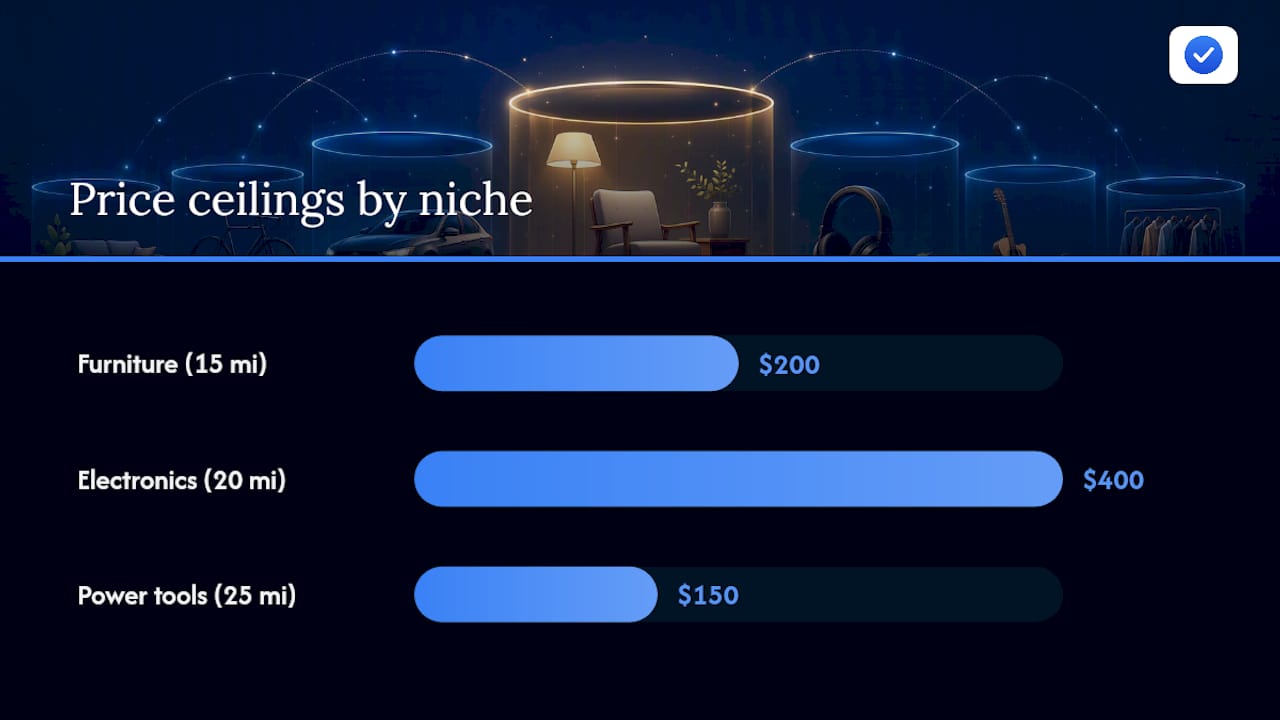
Narrow searches outperform broad ones every time. Here are ready-to-use presets for three common niches:
Furniture (within 15 miles):
- Keywords: "mid-century," "solid wood," "sectional," "dresser"
- Price ceiling: $200
- Negatives: "IKEA," "particle board," "as-is," "needs repair"
Electronics (within 20 miles):
- Keywords: "MacBook," "iPad," "Sony," "Bose," "unlocked"
- Price ceiling: $400
- Negatives: "cracked," "for parts," "broken," "no charger"
Power tools (within 25 miles):
- Keywords: "Milwaukee," "DeWalt," "Makita," "combo kit"
- Price ceiling: $150
- Negatives: "corded," "no battery," "as-is"
Saved Messenger templates:
- Availability check: "Hi, is this still available? I can pick up today."
- Condition confirm: "Can you send a photo showing [specific part] up close?"
- Inspection request: "I'll pay cash on pickup after testing. Does that work?"
Offer rule of thumb: Start your first offer at around two-thirds to three-quarters of the asking price when the deal score is high and travel cost is low, adjusting lower as travel cost increases. For cross-listing compliance and consistent listing practices across platforms, SpareDollar's listing compliance guide covers category consistency and documentation standards.
Pro Tip: Layer three to five narrow searches instead of one broad search. You get cleaner signals, fewer junk listings, and faster response times.
Why the scoring is reliable: signals, transparency, and user evidence
Dealflip AI's scoring draws on six signal categories:
- Price vs. comps: Listing price compared to recent sold data for the same item
- Listing freshness: How recently the listing was posted and whether it has been reposted
- Seller account signals: Profile age, activity history, and consistency
- Message behavior: Response patterns and any off-platform push
- Location consistency: Whether the listed location matches the seller's profile location
- Historical sold data: Category-level liquidity and typical days-to-sell
These signals combine into a single score that tells you: is this priced below market, is the seller credible, and how fast will this item move? The AI filtering methodology explains how each signal layer contributes to the final output.
You can validate any score manually: check sold comps on eBay, verify the seller's profile age, and confirm the pickup address on Google Maps. The AI runs those same checks in seconds and weights them together. That's the efficiency gain.
Verify the seller's location before you drive anywhere
A confirmed address prevents no-shows and wasted drives to the wrong neighborhood.
- Ask the seller to confirm the full street address in Messenger, not just the general area shown in the listing
- Cross-check the address on Google Maps Street View before you leave. If the listed location is a vacant lot, storage facility, or doesn't match the item type, ask for clarification
- For high-value items, request a short video call showing the item in the space where you'll pick it up. The background often confirms the location type
- If the seller changes the address after you've confirmed, treat it as a red flag and re-verify before driving
- Use the ghost seller avoidance guide to spot reused listings and sellers who never actually show up
Safe pickup guidance from GoGedit recommends preferring police-station exchange zones for high-value pickups and always bringing a friend when meeting an unknown seller.
A habit that changed how I think about flipping
Walsh Pex — Every Sunday evening, I spend 15 minutes auditing my active alerts: kill the ones that haven't fired a quality lead in two weeks, tighten the radius on anything generating too many low-score hits, and add one new negative keyword based on the junk I saw that week. Then I batch all pickups for Tuesday and Thursday. That's it.
The flippers who burn out are the ones chasing every alert the moment it fires, driving across town for a $30 margin, and never building a system. The ones who scale treat their alert stack like a living document and their pickup days like a delivery route. One audit per week, two pickup days per week. That rhythm alone cuts wasted trips by more than any single tool.
Dealflip AI: built for flippers who want fewer bad trips
Fewer wasted drives and higher profit per pickup are exactly what Dealflip AI is built to deliver for active U.S. Marketplace resellers.
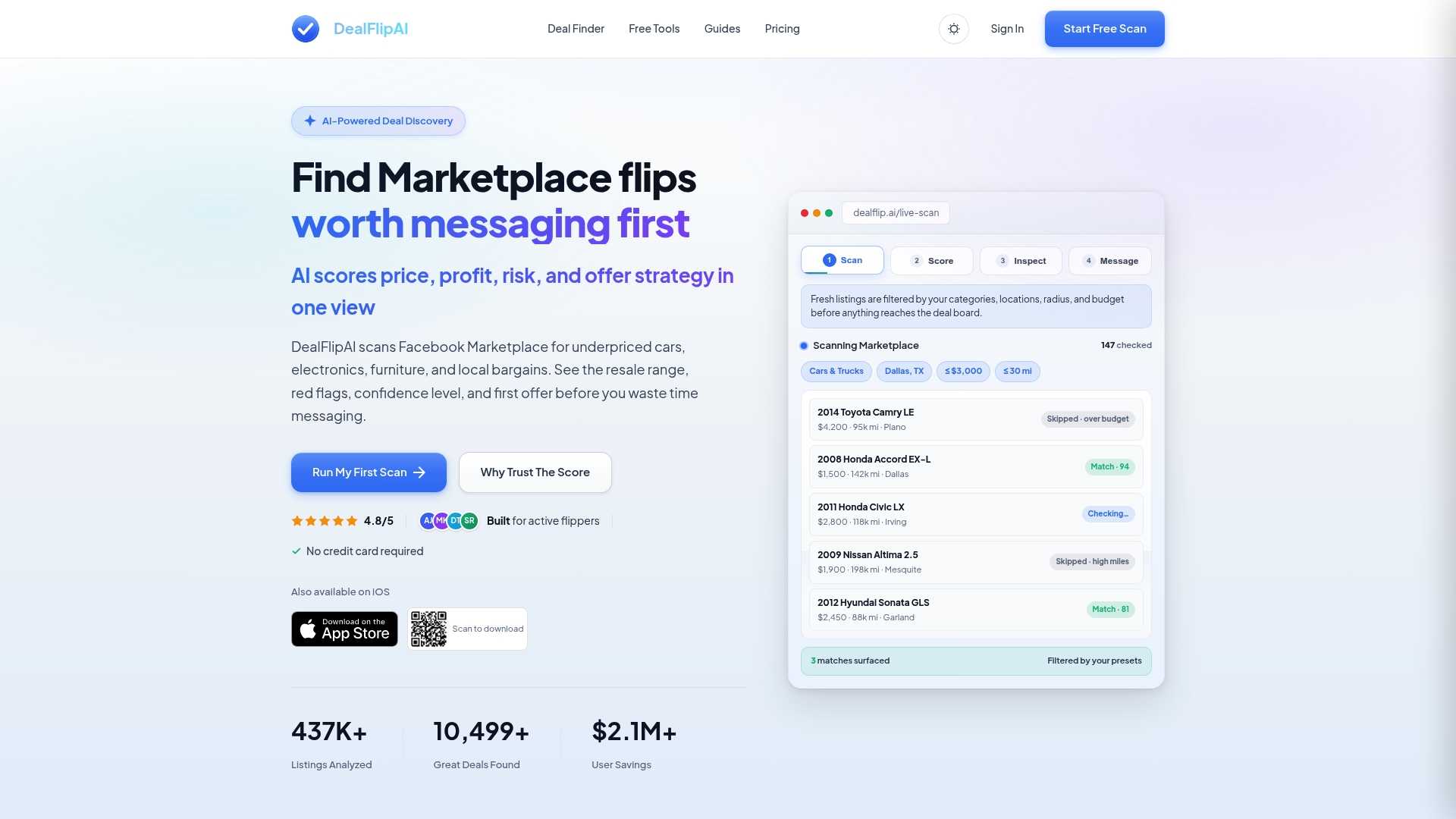
Every listing you're considering gets scored on price gap, resale confidence, and seller risk before you spend a minute on it. The listing analyzer surfaces those signals in a transparent breakdown, the flip profit calculator runs your all-in math instantly, and real-time alerts fire within seconds of a fresh listing going live in your preset categories. Scam detection flags account and behavioral signals automatically, so you're not doing that work manually on every listing.
There's a free plan with limited scans to start. No commitment required. Run your next listing through the analyzer now at Dealflip and see the score before you decide whether to drive.
Pro Tip: Set up your first three alert presets on the free plan before you pay anything. If the alerts surface quality leads in your niche within the first week, upgrading pays for itself on the first flip.
Sources
- How to avoid being scammed on Facebook Marketplace · ProPublica
- Safe Marketplace Pickup Tips | GoGedit Blog
- Marketplace Scams: How to Avoid Getting Ripped Off · StoryCheck