

Listing quality filtering is the practice of rapidly identifying and removing unprofitable or risky posts before you spend time evaluating them. For resellers on Facebook Marketplace, the ability to filter low-quality marketplace listings fast is the difference between a profitable flipping operation and hours of wasted browsing. Automated filtering tools use user-defined thresholds, price ranges, keywords, and seller signals to pre-screen listings and remove duplicates or suspicious posts before you ever see them. Dealflip AI applies this same logic with deal scoring, scam detection, and seller trust indicators built specifically for Facebook Marketplace flippers.
How to filter low-quality marketplace listings fast
The fastest way to eliminate poor listings starts with knowing exactly what makes a listing low quality. Resellers who can spot red flags in seconds skip the noise and focus only on deals worth pursuing. Three core dimensions define listing quality: pricing accuracy, seller credibility, and listing completeness.
Pricing accuracy means the asking price reflects real market value. A listing priced 60% below comparable sold items on eBay is either a great deal or a scam. You need data to tell the difference, not guesswork.

Seller credibility covers profile age, rating history, badge status, and response behavior. A seller with zero reviews, no profile photo, and a three-day-old account is a higher risk than one with 50 positive ratings and a verified badge.
Listing completeness refers to image count, condition disclosure, and description detail. Amazon's Listing Quality Dashboard grades listings across image quality, shopper engagement, and attribute completeness, flagging low-quality items for suppression. The same logic applies on Facebook Marketplace: thin listings with one blurry photo and a two-word description almost always signal a problem.
Here are the top red flags to scan for when you want to quickly sort marketplace listings:
- Reposted or duplicate listings with identical photos and descriptions
- Stock images used instead of real product photos
- Vague or missing condition details (no mention of scratches, wear, or defects)
- Prices that are suspiciously low with no explanation
- New seller accounts with no ratings or badges
- Listings with no location or a mismatched location
- Descriptions copied from retail product pages
Pro Tip: Sort by "newest first" and scan the first 10 listings. If more than three share the same photo or description pattern, you are looking at a repost cluster. Skip the whole batch.
What automated tools do to accelerate listing filtering
Automation is the fastest way to remove low-quality listings before they reach your screen. Tools like DealScout use a 3-layer scam detection engine and pull price data from Google Shopping and eBay APIs to score deals on a 1–10 scale, prioritizing listings for manual inspection. That scoring approach means you spend your time on the top 20% of listings, not the bottom 80%.
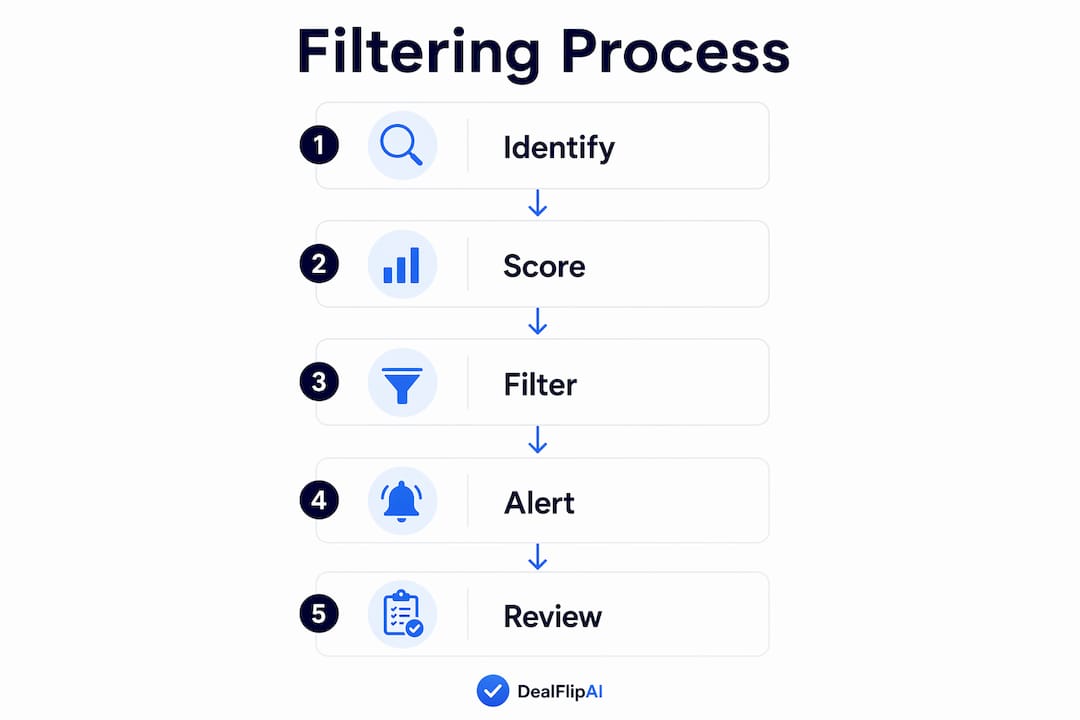
Dealflip AI applies a similar method for Facebook Marketplace specifically. It scores each listing based on price, profit potential, and risk factors, then surfaces only the deals worth your attention. The listing analyzer tool breaks down each post with data-driven metrics so you can make a call in seconds rather than minutes.
The table below shows the key filtering feature categories to look for when evaluating any automated filtering setup:
| Feature category | What it does | Why it matters |
|---|---|---|
| Price filtering | Compares asking price to market data from multiple sources | Catches undervalued deals and overpriced traps |
| Seller trust scoring | Rates sellers by account age, ratings, and badges | Reduces scam exposure before you engage |
| Duplicate detection | Flags reposted or copied listings | Saves time by removing noise automatically |
| Keyword filtering | Blocks or surfaces listings by specific terms | Keeps your feed focused on your niche |
| Posting recency filter | Sorts by time posted | Gets you to fresh listings before other buyers |
Multi-source price filtering with AI fills gaps when retail or transaction data is missing, giving the most reliable deal scores for resellers. A single data source like eBay alone can miss regional pricing differences or category-specific trends.
Pro Tip: Set your price threshold at 30–40% below average sold price on eBay for your category. That range catches real deals without triggering too many false positives from broken or incomplete items.
Manual filtering techniques that complement automation
Automation handles the bulk of the work, but manual checks catch what algorithms miss. Facebook Marketplace has built-in filters that most resellers underuse. Stacking them correctly cuts your browsing time significantly.
Start with these steps every time you open a search:
- Set location radius. Use the tightest radius that still gives you enough volume. Local pickup only removes shipping risk entirely.
- Filter by condition. Select "Good" or "Like New" to remove listings where condition is unknown or listed as "For parts."
- Sort by newest first. Fresh listings have the most negotiation room and the least competition from other buyers.
- Apply a price ceiling. Set a maximum price based on your target resale margin. If you need 40% margin, cap your buy price accordingly.
- Check seller profile before messaging. Look at join date, number of listings, and past reviews. A seller with 30 active listings and good ratings is a different risk profile than a one-listing account.
- Read the full description. Look for condition disclosures, original purchase date, and reason for selling. Missing details are a signal, not an oversight.
- Reverse image search the photos. Paste the listing image into Google Images. Stock photos or images pulled from retail sites confirm a low-quality or fraudulent post.
Stacking multiple controls by combining sort orders, category-specific filters, and trust indicators pushes the highest-quality listings to the top of your results. Sorting by price alone is the most common mistake resellers make, and it consistently surfaces junk.
Common filtering mistakes that cost you deals
Over-filtering is as damaging as under-filtering. Misconfigurations or aggressive filter settings can exclude profitable listings, and successful filter settings require ongoing calibration based on your goals and market changes. Resellers who set filters once and never revisit them gradually miss more deals as the marketplace evolves.
The most common mistakes include:
- Using price as the only quality signal. A low price does not mean a good deal. A $10 item with $50 in repair costs is a loss.
- Blocking all new sellers. Filtering out new sellers removes many scams but also hides valuable private sellers clearing out estates or moving. You lose real arbitrage opportunities.
- Setting keyword filters too broadly. Blocking the word "broken" removes legitimate "broken in" or "barely broken" descriptions for items in great shape.
- Ignoring listing age. A listing posted six weeks ago and never updated is either overpriced or problematic. Freshness is a quality signal.
- Skipping the seller check when the price looks great. A great price from a suspicious seller is the oldest scam pattern on any marketplace.
Pro Tip: Run two parallel filtered queues. One for trusted sellers with ratings above 4.5 and more than 10 reviews. A second for new sellers with prices 50% or more below market. Inspect the second queue with more scrutiny, but do not skip it entirely.
How to improve your filtering strategy over time
Filtering is not a one-time setup. The best resellers treat their filter criteria like a living document, updating it as categories shift, scam patterns evolve, and their own niche focus changes.
Track your results weekly. Note how many listings you reviewed, how many you pursued, and how many turned into profitable flips. If your conversion rate from "listings reviewed" to "deals made" drops below your baseline, your filters are either too loose or too tight.
Top marketplace filters work best when price, keyword, seller trust, and posting recency all stack together. Removing any one layer degrades the whole system. Review each layer monthly and ask whether it is still catching the right signals for your current categories.
Dealflip AI provides listing quality scoring and real-time alerts for fresh listings, which means your filter criteria get tested against live data continuously. That feedback loop is faster than any manual review process. Use the deal finder tool to see which listings score highest in your target categories, then reverse-engineer what those listings have in common. That pattern becomes your next filter refinement.
Saved searches and organized watchlists also reduce friction. When you return to Facebook Marketplace after a break, a saved search with your stacked filters loads your criteria instantly. You spend zero time reconfiguring and go straight to evaluation.
Key takeaways
Fast, accurate listing filtering requires layered criteria across price, seller trust, listing completeness, and posting recency applied consistently and updated regularly.
| Point | Details |
|---|---|
| Spot red flags immediately | Duplicate photos, stock images, and vague descriptions signal low-quality listings every time. |
| Stack your filters | Combining price, seller trust, condition, and recency filters outperforms any single filter alone. |
| Automate the first pass | AI scoring tools pre-screen listings so you only evaluate the top deals manually. |
| Run parallel queues | Separate trusted sellers from new sellers to balance scam protection with deal discovery. |
| Calibrate regularly | Review and adjust filter settings weekly to stay accurate as marketplace patterns shift. |
The real trade-off nobody talks about
Resellers obsess over finding deals fast. What they underestimate is how much time bad filtering costs them on the back end. I have watched flippers spend 20 minutes evaluating a listing that a 10-second seller check would have eliminated. Speed at the front of the process only matters if your criteria are sharp enough to catch the right things.
The shift toward automated listing enforcement has genuinely changed the workflow. A few years ago, manual browsing was the only option. Now, AI scoring and scam detection handle the noise, and your job is to set the right thresholds and review the shortlist. That is a better use of your time, but it requires you to trust the system enough to let it filter aggressively.
The hardest lesson I learned on Facebook Marketplace is that the best deals often look slightly wrong at first glance. An odd photo angle, a seller with only two reviews, a price that seems too good. The filtering instinct is to skip those. The profitable instinct is to check one more layer before deciding. Automation handles the obvious junk. Your judgment handles the edge cases. Both are necessary, and neither replaces the other.
Experiment with your niche. Electronics filtering looks nothing like furniture filtering. The red flags, the price benchmarks, the seller patterns, all of it is category-specific. Build your criteria around what you actually flip, not a generic template.
— Walsh Pex
Dealflip AI makes fast filtering practical for real flippers
Dealflip AI is built for resellers who need to move quickly on Facebook Marketplace without sacrificing deal quality. It scores listings on price, profit potential, and risk, then flags scams and surfaces seller trust signals before you spend a minute evaluating a bad post.
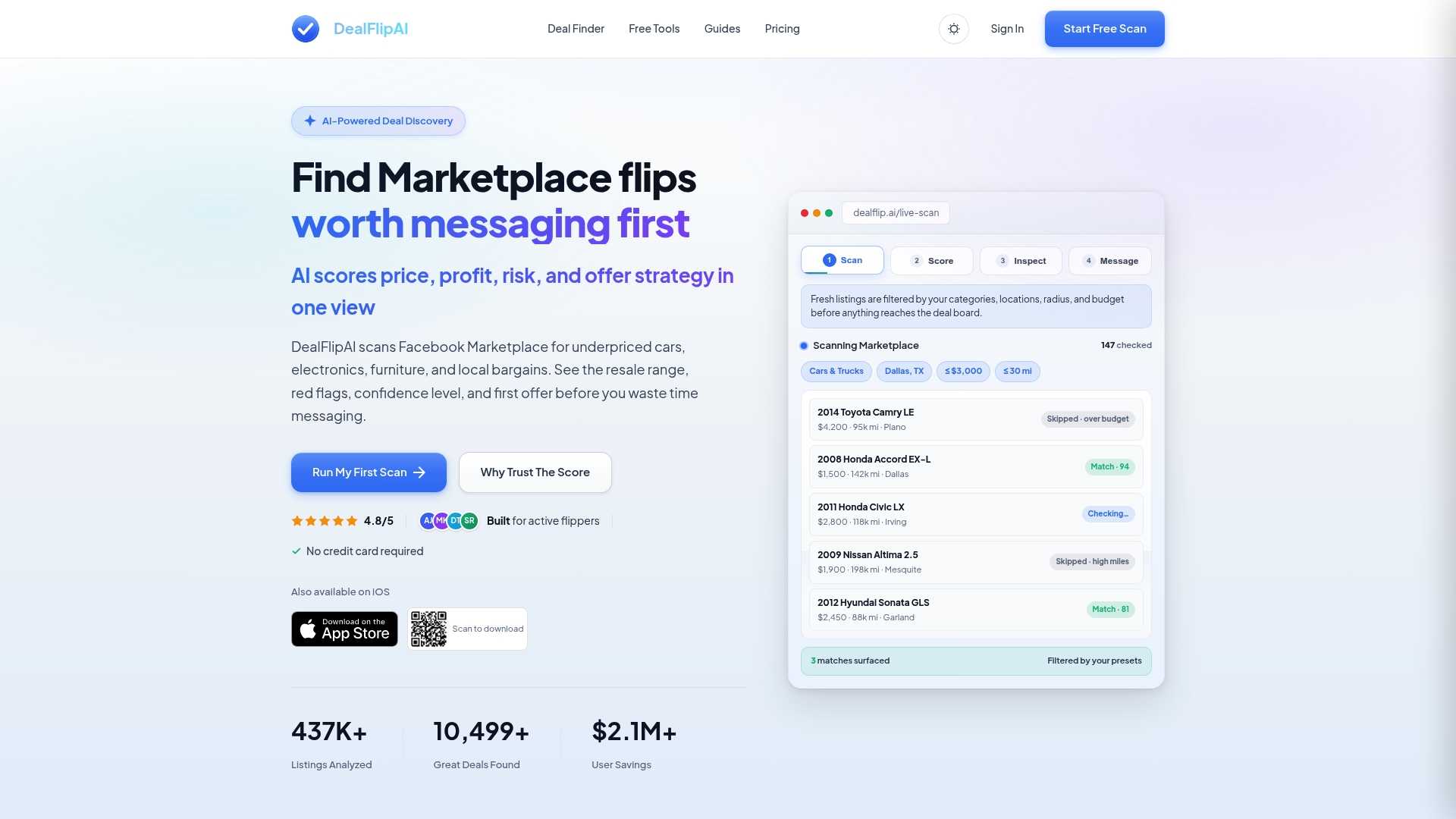
The Facebook Marketplace Deal Finder pulls fresh listings and ranks them by deal score so you see the best opportunities first. The listing analyzer gives you a full quality breakdown on any post in seconds. Dealflip AI also offers free reseller calculators, including a flip profit calculator to confirm your margin before you commit. If you want to spend less time filtering and more time flipping, Dealflip AI is the practical next step.
FAQ
What does "filter low-quality marketplace listings fast" mean?
It means using automated tools and stacked filter criteria to remove unprofitable, suspicious, or incomplete listings before you manually evaluate them. The goal is to spend your time only on listings with real deal potential.
What are the biggest red flags in a Facebook Marketplace listing?
Stock images, vague condition descriptions, new seller accounts with no ratings, and prices far below market value without explanation are the clearest signals of a low-quality or risky listing.
How do automated filtering tools reduce manual browsing time?
Automated systems filter scams, duplicates, and low-quality posts before listings reach you, using pattern recognition, pricing logic, and seller trust signals to pre-screen at scale.
Should I filter out new sellers completely?
No. Filtering out new sellers removes many scams but also hides legitimate private sellers with valuable items. Run a separate queue for new sellers and apply extra scrutiny rather than excluding them entirely.
How often should I update my filter settings?
Review your filter criteria at least once a week. Adjusting filters regularly improves filtering accuracy and deal discovery as marketplace patterns and scam tactics evolve over time.