

The optimal listing price is the price point that balances recent market data, item condition, platform costs, and your profit goals to sell quickly and profitably. Knowing how sellers identify optimal listing price separates resellers who move inventory fast from those who sit on stale listings for weeks. The core method relies on three pillars: sold comparable sales (comps), condition-based adjustments, and a net profit calculation that accounts for all fees. Get all three right, and you price with confidence every single time.
How sellers identify optimal listing price using comparable sales
Sold listings are the only reliable pricing data you have. Active listings show what sellers hope to get. Sold listings show what buyers actually paid. That distinction matters more than most new sellers realize.
Experienced resellers use only sold listings from the past 30–90 days for pricing, never active ones. Relying on active listings causes you to anchor your price to seller expectations, not real buyer behavior. The result is overpriced inventory that sits.
Here is how to build a solid comp set:
- Pull 5–10 sold comps from the past 30–90 days. Fewer than five comps gives you too small a sample to trust.
- Match condition closely. A "like-new" comp does not apply to a "gently used" item. Filter by condition whenever the platform allows.
- Remove outliers. One sale at twice the average price skews your range. Drop the top and bottom extremes, then work from the middle.
- Target the 40th–60th percentile of your comp range. Pricing in this middle band balances competitiveness with profitability.
- Check recency. A comp from 90 days ago carries less weight than one from last week, especially for electronics or seasonal goods.
Pro Tip: When you search sold listings on a platform, sort by "recently sold" and filter to your item's category and condition. Screenshot your top 10 results before you list. This gives you a reference point you can revisit if the listing stalls.
The local market comparison guide from Dealflip AI walks through this process specifically for Facebook Marketplace, where local demand can shift prices significantly from national averages.
What factors affect listing price beyond raw comps
Comps give you a range. Condition, brand, and seasonality tell you where inside that range to land.
Condition-based pricing benchmarks
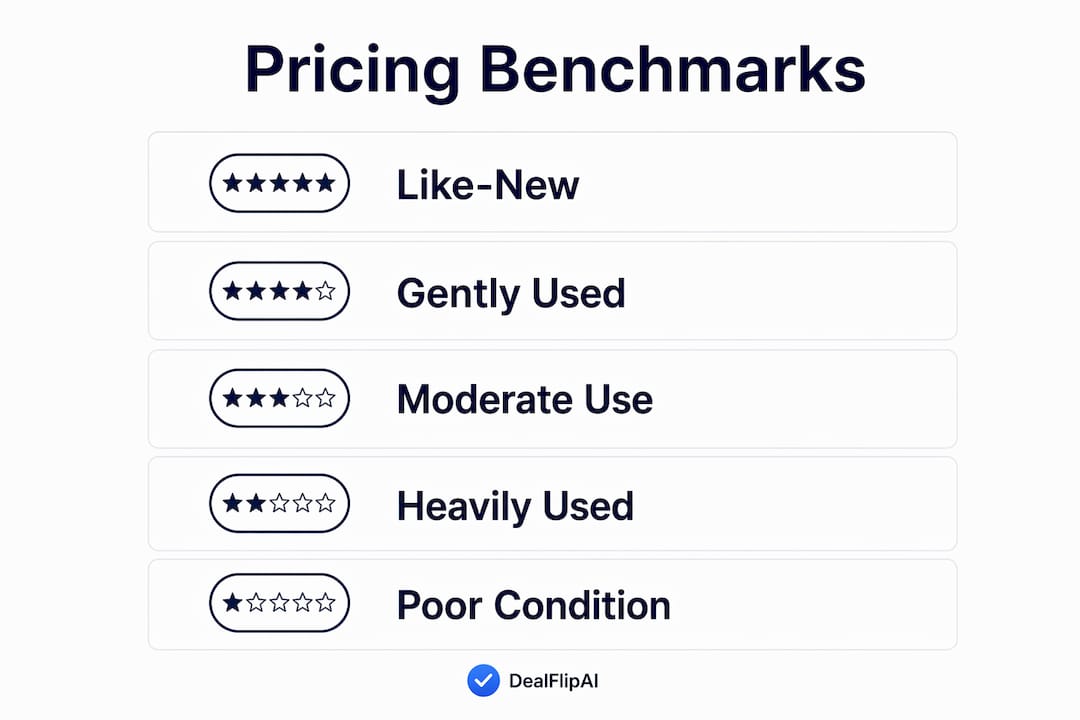
Baseline pricing for used items follows a reliable rule of thumb: like-new items sell at roughly 50% of retail, gently used items at around 30%, and well-worn items at approximately 10%. These percentages give you a starting floor before any other adjustments.

| Condition | Retail Price % | Example: $200 retail item |
|---|---|---|
| Like-new | ~50% | $100 |
| Gently used | ~30% | $60 |
| Well-worn | ~10% | $20 |
Brand reputation moves these numbers up or down. A gently used Nike hoodie commands more than a gently used store-brand hoodie at the same condition level. Buyers pay a premium for recognized names because resale value is predictable and quality is trusted.
Seasonality shifts demand fast. A space heater listed in july will sit. The same heater listed in october can sell within hours at a higher price. Outdoor furniture, winter coats, holiday décor, and lawn equipment all follow seasonal demand curves. Listing at the right time is part of pricing strategy, not just luck.
Local demand adds another layer. A city with a large college population will move cheap furniture fast at the start of each semester. A rural area may have lower demand for the same items. Check your local sold comps separately from national data whenever possible.
How to calculate net profit before you set a final price
Pricing without a net profit calculation is guessing. You need to know your floor before you pick a number.
Here is a straightforward process:
- Start with your cost of goods. What did you pay for the item? Include any repair or cleaning costs.
- Add platform fees. Facebook Marketplace charges fees on shipped sales. Net profit calculation must account for platform fees of roughly 13%, plus shipping and packaging costs where applicable.
- Set your minimum acceptable price (MAP). This is the lowest price you will accept and still make money. Add up your costs, then add your desired profit margin on top.
- Add your negotiation buffer. More on this in the next section, but your listed price should sit above your MAP.
- Verify the math before you publish. A $50 sale with $6.50 in fees, $8 shipping, and a $20 cost of goods leaves you with $15.50. That is your actual profit, not $50.
Pro Tip: Use the Flip Profit Calculator from Dealflip AI to run this math in seconds. Enter your cost, fees, and target price, and it shows your exact margin before you commit to a listing.
Ignoring fees and costs is the most common reason sellers price items unprofitably. The fix is simple: calculate net margin before you set any price, not after.
Pricing strategies that accelerate sales and leave room to negotiate
Setting the right number is only part of the equation. How you frame and position that number affects how fast it sells.
Price padding for negotiation room
Adding 10–30% above your minimum acceptable price gives you room to negotiate without losing profit. If your MAP is $40, list at $48–$52. When a buyer offers $45, you accept and both sides feel good. Without that buffer, every offer cuts into your actual margin.
Charm pricing and conversion rates
Prices ending in .99 or .97 consistently outperform round numbers. Charm pricing can increase sales conversion by up to 24% compared to round-number pricing. That is a meaningful lift for no extra effort. List at $49.99 instead of $50. List at $97 instead of $100.
Reading engagement signals to adjust your price
Your listing's performance data tells you whether your price is right.
- High views, zero offers: Your price is likely above what buyers expect to pay. Lower it by 10–15% or improve your photos and description first.
- Immediate offers below your MAP: You priced too low. Buyers sense a deal and move fast. Adjust upward on your next similar listing.
- Steady views and one or two offers near your asking price: You are in the right range. Hold firm or accept the best offer.
High views with no sales signal that your price sits above market value or perceived item value. Lower the price or upgrade your listing quality. Both levers work.
When to price high vs. price low
Effective pricing is a tiered strategy based on your goals. Price high when you have time and a desirable item with limited supply. Price low when you need fast cash, are clearing space, or have multiple similar items competing in your local market. Neither approach is wrong. The mistake is applying one strategy to every situation.
Using the "Best Offer" feature with an auto-decline threshold protects your time. Setting auto-decline thresholds filters out lowball offers automatically, so you only respond to buyers who are close to your price. This keeps listings active and attractive without wasting hours on bad-faith negotiations.
Listing quality also affects how your price is perceived. Items with compelling visuals outperform cheaper listings with poor photos. A well-lit photo, a clear description, and accurate condition notes make your price feel justified. Buyers pay more when they trust what they are buying. AI-powered listing tools, including those discussed on e-commerce optimization blogs, increasingly show that listing quality and price work together as a system, not independently.
Key Takeaways
Sellers who price with data, adjust for condition and costs, and leave room to negotiate consistently outperform those who guess or copy active listings.
| Point | Details |
|---|---|
| Use sold comps only | Pull 5–10 sold listings from the past 30–90 days to find real buyer prices. |
| Apply condition benchmarks | Price like-new at ~50% of retail, gently used at ~30%, well-worn at ~10%. |
| Calculate net profit first | Subtract all fees, shipping, and cost of goods before setting your final price. |
| Add a negotiation buffer | List 10–30% above your minimum acceptable price to protect your margin. |
| Read engagement signals | High views with no offers mean your price is too high. Adjust by 10–15%. |
Pricing is data first, instinct second
I have watched sellers make the same mistake for years: they look at what other people are asking and call it research. It is not. Active listings are wishes. Sold listings are facts. Every pricing decision I trust starts with sold comps, full stop.
That said, data alone does not close deals. I have seen perfectly priced listings sit for two weeks because the photos were dark and the description was vague. Buyers do not just evaluate price. They evaluate trust. A clean, well-documented listing at a fair price beats a bargain-priced listing with one blurry photo almost every time.
The sellers who price best are the ones who treat it as a feedback loop. They list, watch the engagement numbers, and adjust within 48–72 hours if the signals are off. They do not wait two weeks and wonder why nothing sold. Price is a hypothesis. Your listing's performance data is the test result.
One more thing: do not skip the fee math. I have seen sellers celebrate a $60 sale on a $40 item, not realizing fees and shipping turned their $20 profit into $6. Run the numbers before you list, not after. Tools like the Flip Profit Calculator make this a 30-second habit, not a chore.
— Walsh Pex
Dealflip AI tools that sharpen your pricing accuracy
Pricing well on Facebook Marketplace takes solid data and fast analysis. Dealflip AI brings both together in one place.
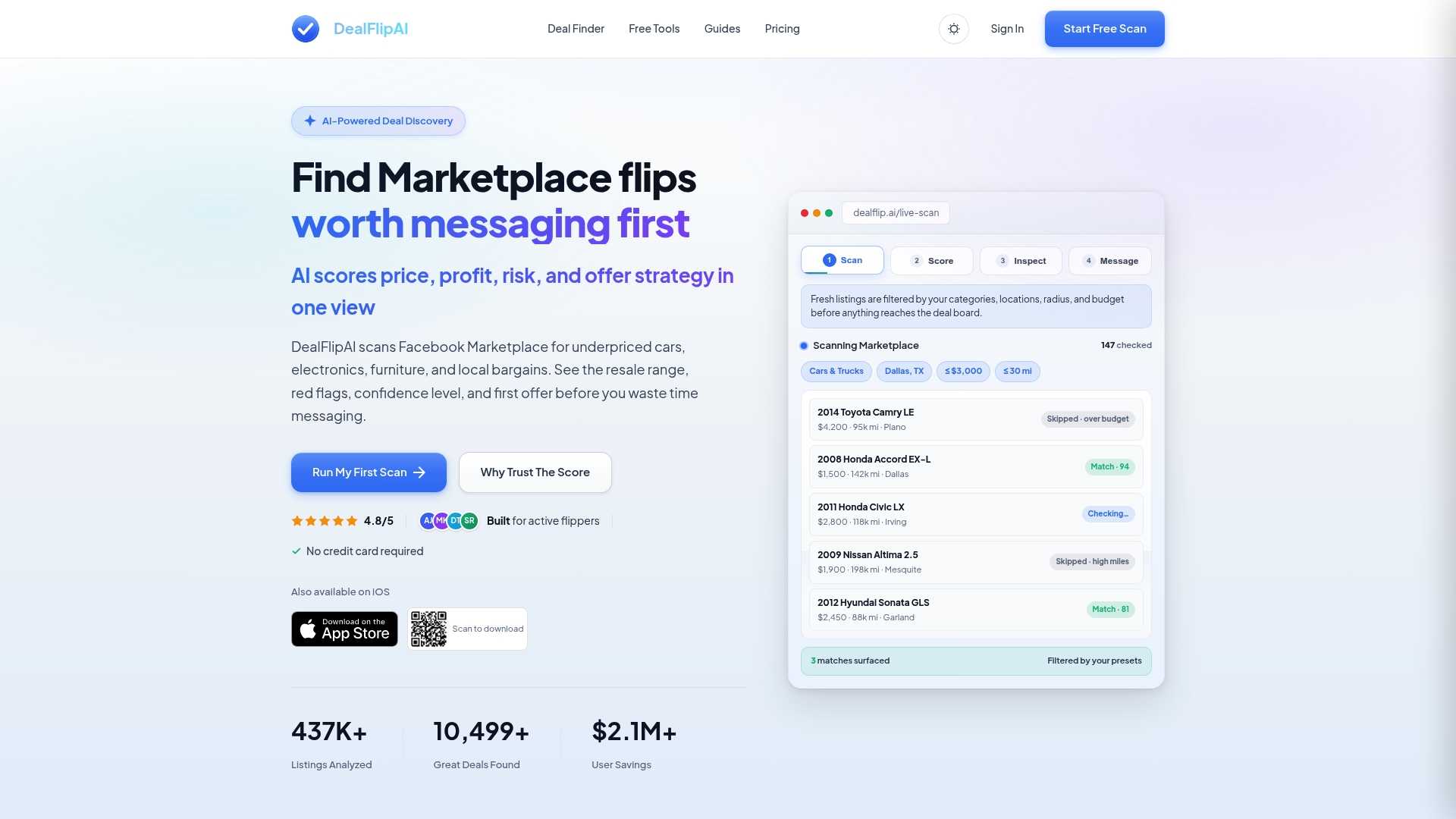
The Facebook Marketplace Value Estimator analyzes recent market data to give you a realistic price range for any item before you list. The Listing Analyzer tracks your listing's views and engagement signals, so you know exactly when to adjust your price and why. For sellers who want to find undervalued items and price them for maximum profit, the full guide on finding good deals on Facebook Marketplace covers the complete process from sourcing to sale. Dealflip AI turns pricing from guesswork into a repeatable system.
FAQ
What is the best way to determine listing price on Facebook Marketplace?
Research 5–10 sold comparable items from the past 30–90 days and price within the 40th–60th percentile of that range. Adjust for your item's condition, then add a 10–30% negotiation buffer above your minimum acceptable price.
How do platform fees affect my optimal listing price?
Facebook Marketplace charges fees on shipped sales, typically around 13%, plus shipping and packaging costs. Subtract all fees and your cost of goods from your target sale price to confirm your actual profit before listing.
What does charm pricing do for sellers?
Charm pricing, which means ending your price in .99 or .97, can increase sales conversion by up to 24% compared to round numbers. It is a simple adjustment that meaningfully improves how often buyers click and commit.
How do I know if my listing price is too high?
High view counts with zero offers or messages are the clearest signal that your price exceeds what buyers will pay. Lower your price by 10–15% or improve your listing photos and description, then monitor results over the next 48 hours.
Should I price differently for quick cash vs. higher margins?
Yes. Price lower when you need fast turnover or have competing local inventory. Price higher when your item is in strong demand, supply is limited, or you have time to wait for the right buyer. Matching your price to your goal is a core part of any pricing strategy for sellers.