

Ghost sellers are fraudulent or unreliable sellers who collect payment and then disappear without delivering the item. They operate across Facebook Marketplace, eBay, and Mercari, using stolen photos, fake profiles, and pressure tactics to rush buyers into paying before they can verify anything. Knowing how to avoid ghost sellers on an online marketplace protects your money and your time. The good news is that a few simple checks, including reverse image search, account age verification, and price comparison against Amazon or official retailer prices, catch the vast majority of fraudulent listings before you ever send a dollar.
What are the most effective seller verification techniques to avoid ghost sellers?
Seller verification is the first line of defense against fraudulent listings. Multiple consistent checks are much harder to fake than a single positive signal, so running several quick checks together gives you a far more reliable picture of a seller.
Start with account age. Seller accounts younger than 60 days selling high-value items are flagged as higher risk by consumer protection experts. Most platforms like Facebook Marketplace and eBay display a "joined" date directly on the seller profile. A brand-new account selling a $600 gaming console is a warning sign worth acting on.

Next, run a reverse image search on every listing photo. Paste the image into Google Images or TinEye and check whether the same photo appears on other listings, stock photo sites, or previous scam reports. Ghost sellers routinely recycle photos from legitimate listings or pull images directly from manufacturer websites. This single step catches a large share of fake listings.
Then compare the asking price against Amazon, eBay sold listings, and official retailer prices. A price 40% or more below verified market value on a non-protected platform is a major fraud red flag. A deal that looks too good almost always is.
- Check account age: Look for the "joined" date on the seller profile. Flag accounts under 60 days old selling items worth more than $100.
- Run a reverse image search: Use Google Images or TinEye on every listing photo before messaging the seller.
- Search the seller's username and name online: Paste both into Google to check for scam reports on forums like Reddit or Scammer.info.
- Compare prices: Check Amazon, eBay sold listings, and the brand's official site to establish real market value.
- Request proof of possession: Ask the seller to send a short video of the item next to a handwritten note with today's date.
- Insist on platform payments only: Never agree to pay outside the marketplace's built-in payment system.
These verification checks take between 5 and 30 minutes total. That small time investment catches most fraudulent listings before any money changes hands.
Pro Tip: Search the seller's phone number in Google along with the word "scam." Fraudsters often reuse the same contact details across multiple fake listings, and community scam reports surface quickly in search results.
How can communication behaviors and transaction terms reveal ghost sellers?
A seller's communication style tells you almost as much as their profile does. Ghost sellers follow scripts. They give vague, copy-paste answers that never directly address your specific questions about the item's condition, history, or location.
Watch for these red flags in order of severity:
- Urgency pressure. Phrases like "must sell today" or "another buyer is coming tonight" are psychological tactics scammers use to bypass your logical thinking. Legitimate sellers do not panic-sell.
- Refusal to video call. A real seller with a real item can do a 60-second live video call. A live video showing the item with a dated paper is the gold standard for confirming the seller actually has the product.
- Evasive answers. Ask a specific question like "Can you show me the serial number?" If the seller deflects or changes the subject, treat it as a hard stop.
- Requests for deposits. Asking for a partial payment before you have verified the item or the seller's identity is a classic ghost seller move.
- Off-platform payment demands. Legitimate sellers do not insist on gift cards, wire transfers, crypto, or Zelle for marketplace transactions. These payment methods remove all buyer recourse the moment you send money.
"The payment method often is the fraud vector. Refusing to move payments out of the platform's verified system is critical to prevent loss." — Consumer verification experts
One behavior buyers often overlook: replying to a suspicious seller, even just to say "no thanks," is a mistake. Responding to suspected fraud accounts confirms your account is active and increases the volume of follow-up scam attempts you receive. Block and report without engaging.
What practical tools and routines can buyers use to consistently spot fake sellers?
Building a consistent pre-purchase routine is the most reliable way to protect yourself across every transaction. The goal is to make verification automatic, not optional.
Here is a practical checklist you can run before responding to any listing:
- Check the seller's profile join date and review history.
- Run listing photos through Google Images and TinEye.
- Search the seller's name and username on Google with "scam" appended.
- Compare the asking price against Amazon and eBay sold listings.
- Review the seller's written communication for scripted or evasive language.
- Confirm the seller will accept platform-based payment only.
The table below maps each verification step to a free tool you can use right now.
| Verification step | Tool | Time required |
|---|---|---|
| Reverse image search | Google Images, TinEye | 2–5 minutes |
| Seller identity search | Google, Lullar.com | 5–10 minutes |
| Price comparison | Amazon, eBay sold listings | 5–10 minutes |
| Scam report lookup | Reddit, Scammer.info | 3–5 minutes |
| Listing risk analysis | Dealflip AI listing analyzer | Under 2 minutes |
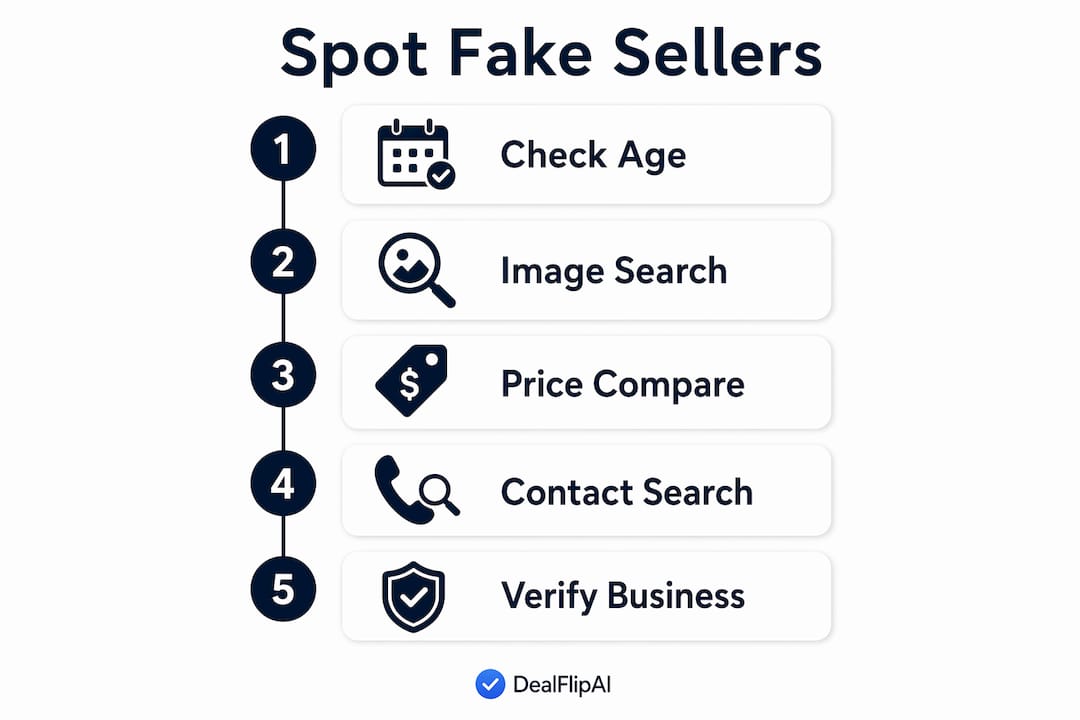
Vetting multiple data points including external business registries can surface ghost or shell operations disguised as legitimate sellers. For sellers claiming to represent a business, cross-reference the business name against your state's official business registry or the Better Business Bureau.
Dealflip AI's Facebook Marketplace Scam Checker automates several of these steps by analyzing listing price, seller signals, and risk factors in one pass. It is especially useful when you are evaluating multiple listings quickly and want a consistent risk score without running every check manually.
Pro Tip: Save your verification checklist as a note on your phone. Before you message any seller, run through the list top to bottom. Skipping even one step is where most buyers get caught.
How to handle a suspected ghost seller if you encounter one
Encountering a suspicious seller does not have to cost you anything if you act quickly and correctly.
- Stop all communication immediately. Do not send money, personal information, or additional photos of yourself.
- Do not engage to decline. Replying even once confirms your account is active and signals scammers to increase contact attempts.
- Report the listing to the platform. Facebook Marketplace, eBay, and Mercari all have in-app reporting tools. Use them. Platforms use report volume to prioritize account reviews.
- Use marketplace buyer protection. If you already paid through the platform's official payment system, contact support immediately and open a dispute. eBay's Money Back Guarantee and Facebook's Purchase Protection both cover eligible transactions.
- Protect your personal information. If you shared your phone number or address with a suspicious seller, be alert to follow-up phishing attempts by text or email.
- Leave a detailed review. Star ratings alone are unreliable. A specific written review describing the seller's behavior warns other buyers far more effectively than a one-star score.
The FTC recommends reading specific negative reviews rather than relying on aggregate scores when evaluating any online seller. One detailed negative review describing a ghost seller pattern carries more weight than a hundred generic five-star ratings.
Key Takeaways
Avoiding ghost sellers requires layering multiple verification checks because no single signal is reliable enough on its own.
| Point | Details |
|---|---|
| Check account age first | Accounts under 60 days old selling high-value items carry significantly higher fraud risk. |
| Run reverse image searches | Google Images and TinEye catch stolen or recycled listing photos in under five minutes. |
| Compare prices to market | A price 40% or more below Amazon or eBay market value is a major fraud red flag. |
| Demand platform payments | Off-platform payment requests via gift cards, Zelle, or crypto remove all buyer protection. |
| Report without engaging | Block and report suspicious sellers without replying, since any response confirms your account is active. |
What I've learned after years of watching buyers get burned
Walsh Pex here. The single most common mistake I see buyers make is treating verification as optional when a deal looks really good. That is exactly backwards. The more attractive a listing looks, the harder you should verify it. Ghost sellers know that a great price lowers your guard, and they price accordingly.
I have watched buyers skip the reverse image search because they were "pretty sure" the photos looked real. In almost every case where that shortcut led to a loss, a 90-second Google Images check would have shown the same photos on a scam report from three months earlier. The tools exist. The friction is minimal. The only thing stopping most buyers is the false belief that their instincts are good enough.
The other thing I want to push back on is the idea that being vigilant means being paranoid. You do not need to treat every seller like a criminal. You need a consistent process that you run on every transaction, good or bad. A zero-trust mindset means verifying before trusting, not refusing to trust at all. Most sellers are legitimate. The process just protects you from the ones who are not.
Scam tactics evolve fast. The ghost seller playbook in 2026 includes AI-generated listing photos and synthetic reviews that look far more convincing than anything from two years ago. Staying current means following community threads on Reddit's r/Scams and checking resources like the FTC's consumer guidance regularly. Share what you find. Community knowledge is the fastest-updating fraud database available.
— Walsh Pex
Dealflip AI makes safer marketplace buying faster
Manually running every verification check on every listing takes time. Dealflip AI automates the most critical steps so you can evaluate listings in seconds instead of minutes.

The Facebook Marketplace Scam Checker analyzes seller signals, pricing against real market data, and listing risk factors in one pass. The listing analyzer tool goes deeper, scoring deal quality and flagging the specific risk factors that match known ghost seller patterns. Both tools are free to use and built for buyers who want confidence before they commit. If you are buying on Facebook Marketplace regularly, running listings through Dealflip AI before you message a seller is the fastest way to separate real deals from fraudulent ones.
FAQ
What is a ghost seller on an online marketplace?
A ghost seller is a fraudulent seller who collects payment and then disappears without delivering the item. They typically use stolen photos, fake profiles, and off-platform payment requests to avoid accountability.
How do I spot fake sellers before paying?
Check the seller's account age, run listing photos through Google Images or TinEye, compare the price against Amazon and eBay, and verify the seller will accept platform-based payment only. These steps take under 30 minutes combined.
What payment methods do ghost sellers use?
Ghost sellers push buyers toward gift cards, wire transfers, cryptocurrency, and Zelle because these methods remove buyer recourse entirely once the money is sent. Always pay through the marketplace's official payment system.
Should I reply to a suspicious seller to say no?
No. Replying to suspected scam accounts confirms your account is active and increases follow-up scam attempts. Block and report the seller without responding.
How can I report a ghost seller on Facebook Marketplace or eBay?
Use the in-app "Report" button on the listing or seller profile. Both Facebook Marketplace and eBay review flagged accounts and remove listings that violate their policies. Filing a report also creates a record that supports any buyer protection dispute you open.