

A ghost listing marketplace is a platform where fake, unauthorized, or nonexistent product and service listings are posted to deceive buyers, often resulting in financial loss, data theft, or wasted time. The term covers everything from phantom rental ads on real estate sites to fake storefronts impersonating local businesses. Understanding the ghost listing definition matters whether you buy furniture on Facebook Marketplace, search for rentals on Zillow, or apply for jobs on LinkedIn. Ghost listings are not always outright scams. Some are platform artifacts. But the ones that are fraud can cost you real money.
What is a ghost listing marketplace and how does it work?
A ghost listing, in its simplest form, is any listing that misrepresents what is actually available for sale, rent, or hire. No universal definition exists across platforms, but the core pattern is consistent: a poster creates or copies a listing for something they do not own, cannot sell, or have no intention of delivering. The ghost listing explanation varies by context, but the deception is the constant.
Ghost listings exploit information asymmetry. Buyers judge legitimacy by how a listing looks, not by whether the seller has actual authority to sell. A listing with professional photos, a detailed description, and a competitive price reads as trustworthy. That appearance is exactly what fraudsters manufacture. Buyers infer legitimacy from presentation alone, which is the gap scammers exploit.

Ghost listings appear across real estate, ecommerce, and job boards. In real estate, they show up as rental ads for apartments that are already leased or never existed. In ecommerce, they appear as product listings for items that will never ship. In job markets, up to 27% of online job listings are posted by real companies with no immediate hiring intent, wasting applicants' time without technically committing fraud. That last category is worth noting because it shows the ghost listing concept covers a spectrum from honest inefficiency to deliberate crime.
What types of ghost listings exist across marketplaces?
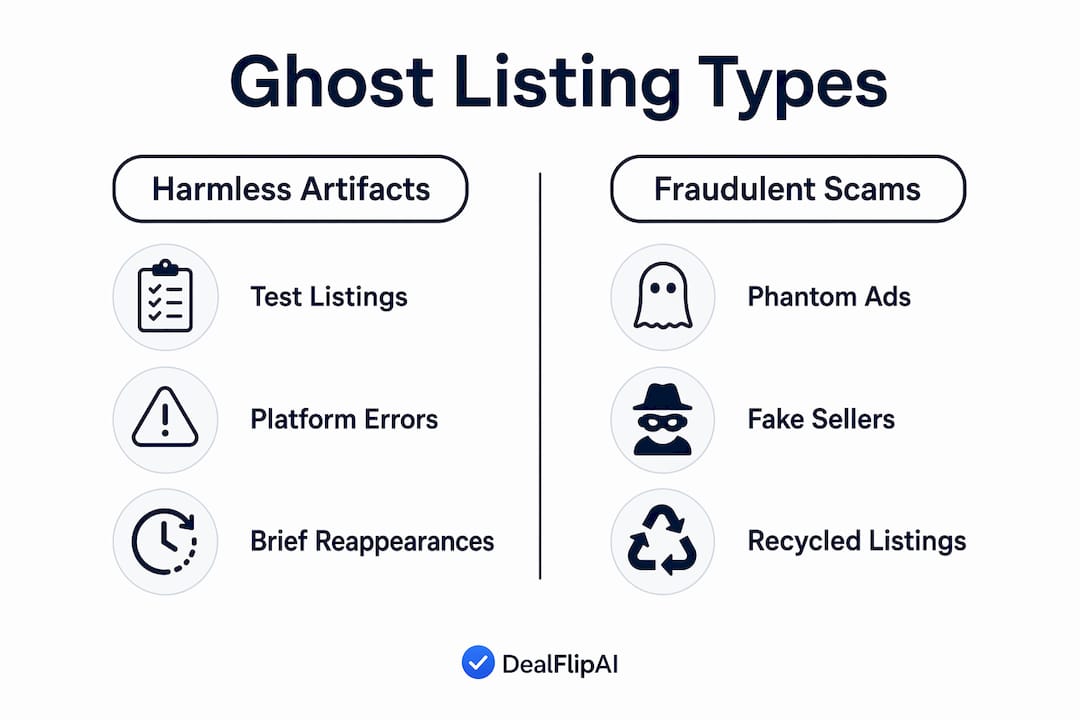
Ghost listings in ecommerce and other markets fall into four main categories. Knowing the type helps you decide how seriously to treat a suspicious post.
- Phantom listings are ads for items or properties that simply do not exist. The seller fabricates the listing entirely to collect deposits or personal information before disappearing.
- Hijacked ads copy legitimate listing content, including photos and descriptions, and repost it without authorization. Hijacked ads copy legitimate listing content so convincingly that buyers cannot tell the difference from visuals alone.
- Ghost stores impersonate real local businesses online. Australia's ACCC has specifically warned consumers about stores that use drop-shipping, fake backstories, and misleading "closing down" sales to collect payments for goods that never arrive or are far below advertised quality.
- Ghost jobs are listings posted by legitimate companies with no current hiring intent. They exist to build candidate pipelines or signal growth to investors. They waste time rather than steal money, but they still mislead.
A fifth and increasingly common type is the large-scale scam network. Silent Push exposed a campaign called GhostVendors that used 4,000+ fake marketplace domains and Facebook ads impersonating major brands to steal money and data at scale. GhostVendors cycled through storefronts rapidly, launching and stopping ads to erase evidence and maximize quick payouts before detection.
Pro Tip: If a listing reappears repeatedly under slightly different titles or seller accounts, that recycling pattern is a strong signal of a phantom or hijacked ad. Legitimate sellers rarely need to repost the same item multiple times.
What risks and impacts do ghost listings pose to buyers and sellers?
The risks of ghost listings go well beyond inconvenience. For buyers, the consequences range from losing a deposit to having payment credentials stolen. For sellers, ghost listings that copy their legitimate ads can damage their reputation and divert their customers to fraudsters.
Here is what buyers face most often:
- Direct financial loss. Buyers pay deposits or full purchase prices for items that never arrive. Phantom rental listings are a common vehicle for this, with victims wiring money before ever seeing a property in person.
- Personal data theft. Fake checkout pages on ghost stores collect credit card numbers, addresses, and login credentials. The purchase never completes, but the data is already gone.
- No recourse on returns. Ghost stores often fail to honor returns and deliver poor quality products at inflated prices. By the time you realize the store is fake, the storefront may have already vanished.
- Marketplace trust erosion. When buyers get burned, they lose confidence in entire platforms. This harms legitimate sellers who depend on those same platforms for their income.
"Regulators view ghost stores as misrepresenting legitimacy and harming consumers by not delivering or honoring returns, treating the issue as a consumer protection failure rather than a technical glitch." — ACCC, 2026
Not every suspicious listing is fraud, though. Research on housing platforms shows about 37% of listings briefly appear then disappear before reaching public search results, and many of these are platform artifacts such as test posts or moderation removals, not scams. Treating every vanished listing as fraud leads to misdirected action. The skill is learning to separate platform noise from genuine threats.
How to spot ghost listings: signs and red flags
Spotting a ghost listing before you pay requires looking past the photos and reading the signals around the listing itself. Here are the most reliable red flags, in order of importance:
- The listing is absent from official sources. Search the seller's name, business address, or property address on Google Maps, the company's official website, or a business directory. Ghost stores and phantom listings rarely have a verifiable footprint outside the marketplace where they appear.
- The description is vague or copied. Phantom listings often use generic language that could apply to any item. Hijacked ads copy descriptions word for word from legitimate sources. A reverse image search on the listing photos can reveal whether they were stolen from another post.
- The listing age is unusually long without updates. A real seller motivated to sell updates their listing, adjusts the price, or takes it down. Listing age without updates is a behavioral signal worth tracking. Stale listings that never close are often placeholders or abandoned fraud attempts.
- Contact information is missing or suspicious. Legitimate sellers provide a way to verify their identity. Ghost listings often push communication off-platform to messaging apps where there is no transaction protection.
- The return policy is nonexistent or vague. Ghost stores frequently post policies that sound reasonable but include clauses making returns impossible in practice.
Pro Tip: Always verify seller authority, not just seller identity. A seller can prove who they are without proving they have the right to sell the item. For real estate, ask for proof of listing authorization. For products, check that the seller's profile history matches the item category.
Here is a quick comparison to help you classify what you are looking at:
| Signal | Platform artifact | Fraudulent ghost listing |
|---|---|---|
| Listing disappears quickly | Common, often moderation | Possible, but less common |
| No contact info provided | Rare | Very common |
| Photos stolen from other listings | Unlikely | Frequent |
| Seller pushes off-platform payment | Never | Almost always |
| Business unverifiable on Google | N/A | Standard pattern |
Best practices to avoid ghost listings and protect yourself
Protecting yourself from ghost listings comes down to a few habits practiced consistently. You do not need to be an expert to stay safe. You need to be systematic.
- Cross-reference every listing with an official source. Before paying anything, search the seller's business name, address, or product on Google. A legitimate seller leaves a trail. A ghost store or phantom listing usually does not.
- Never pay a deposit before verification. Defensive strategies must focus on pre-action hygiene like avoiding off-platform payments and verifying domains before any money changes hands. This single habit eliminates most ghost listing fraud.
- Use trusted platforms and listing analysis tools. Dealflip's scam checker tool analyzes Facebook Marketplace listings for fraud signals before you engage. Running a listing through a tool like this takes seconds and can save you hundreds of dollars.
- Report suspicious listings immediately. Every platform has a reporting mechanism. Using it helps protect other buyers and gives the platform data to remove fraudulent posts faster.
- Watch for phishing in messages. Ghost listing scammers often follow up with messages containing links to fake payment pages or requests for personal information. If a seller sends you a link outside the platform, do not click it.
- Verify price against market value. Listings priced far below market value are a classic ghost listing signal. Use a value estimator tool to check whether a price is realistic before you get excited about a deal.
Learning how to spot scam listings on Facebook Marketplace specifically is worth your time if you buy or sell there regularly. The platform's scale makes it one of the most targeted environments for ghost listing fraud.
Key takeaways
Ghost listings are deceptive or unauthorized marketplace posts that range from harmless platform artifacts to organized fraud networks stealing money and data.
| Point | Details |
|---|---|
| Ghost listing definition | Any listing misrepresenting availability, ownership, or intent to sell across any marketplace. |
| Four main types | Phantom listings, hijacked ads, ghost stores, and ghost jobs each require different verification responses. |
| Biggest buyer risk | Financial loss and data theft, especially when payments move off-platform before verification. |
| Key detection signal | Absence from official sources and off-platform payment pressure are the two strongest fraud indicators. |
| Best protection habit | Verify seller authority and cross-reference listings before any money or personal data changes hands. |
Ghost listings are getting harder to ignore in 2026
I have watched ghost listing tactics grow more sophisticated every year, and 2026 is no exception. What used to be obvious scams with broken English and stolen stock photos have become polished operations with AI-generated images, credible backstories, and professional-looking storefronts that pass a casual inspection.
The GhostVendors campaign is the clearest example of where this is heading. Thousands of fake domains, coordinated Facebook ad buys, and rapid teardown cycles that erase evidence before investigators can act. This is not a lone scammer. It is an organized operation with real infrastructure. Most buyers have no idea they are dealing with something at that scale.
What frustrates me most is that the tools to catch these listings exist. Reverse image search has been free for years. Business verification takes two minutes on Google Maps. Yet buyers skip these steps because the listing looks good and the price is right. The emotional pull of a great deal overrides the rational check.
My honest recommendation: treat every marketplace listing as unverified until you have done at least one external check. That is not paranoia. That is the minimum standard for buying safely in 2026. The platforms are improving their detection, but they will never catch everything before you see it. Your own verification habits are your first and most reliable defense.
— Apex
Stay safe on Facebook Marketplace with Dealflip
If you buy or resell on Facebook Marketplace, ghost listings are a real threat to your time and money. Dealflip is built to help you tell the difference between a legitimate deal and a fraud attempt before you commit.

Dealflip's AI-powered tools analyze listings for price accuracy, fraud signals, and seller behavior in real time. The Facebook Marketplace deal finder surfaces verified opportunities while filtering out suspicious posts. The scam checker flags listings that match known fraud patterns. And the listing analyzer gives you a detailed breakdown of any listing you are considering. Start finding good deals safely on Facebook Marketplace today with tools that do the verification work for you.
FAQ
What is a ghost listing in simple terms?
A ghost listing is a fake or unauthorized marketplace post for an item, property, or job that does not exist, is unavailable, or will never be delivered. The goal is usually to collect money or personal data from buyers who believe the listing is real.
Are all ghost listings scams?
No. Some ghost listings are platform artifacts such as test posts or listings removed by moderation that briefly appear in search results. About 37% of listings on some housing platforms fall into this category. The key is distinguishing these from listings designed to commit fraud.
How do ghost listings work on Facebook Marketplace?
Scammers post phantom listings or copy legitimate ads, then pressure buyers to pay off-platform via wire transfer or gift cards. Once payment is made, the seller disappears and the listing is removed. Campaigns like GhostVendors have used thousands of fake domains and Facebook ads to run this at scale.
What is the fastest way to spot a ghost listing?
Search the seller's business name or listing address on Google. If nothing verifiable comes up outside the marketplace itself, treat the listing as unverified. Off-platform payment requests are the single strongest fraud signal.
Do ghost jobs count as ghost listings?
Yes, in the broader sense. Ghost jobs are listings posted by real companies with no current hiring intent, wasting applicants' time without committing financial fraud. They share the core ghost listing trait: the post misrepresents actual availability.