

Location accuracy in listings is defined as the use of verified geocoordinates and consistent location metadata to ensure a listing appears in the right geographic searches. The role of location accuracy in listings goes far beyond entering a zip code correctly. For resellers and investors on platforms like Facebook Marketplace, a misplaced map pin or inconsistent address data can erase a listing from local search results entirely. AI-powered marketplaces now rank listings partly on the quality of their location signals, which means location precision directly affects how many buyers find your offer and how quickly deals close.
How does location accuracy affect listing visibility and buyer trust?
Location accuracy is the single biggest factor determining whether your listing surfaces in map-based and proximity searches. AI-powered search engines downgrade listings with inconsistent location data, reducing confidence scores and limiting visibility to protect users from irrelevant results. That means a listing with a slightly wrong pin can rank below a less detailed listing that has clean, verified coordinates.
Multiple consistent location signals reinforce each other. When your geocoordinates, address text, and map pin all agree, the algorithm treats your listing as high-confidence and surfaces it more often. When those signals conflict, the system hedges and shows your listing less frequently.
Buyer trust follows the same logic. A buyer who clicks your listing and sees a map pin placed in the middle of a parking lot will hesitate. Accurate location data reduces that friction by giving buyers reliable directions and a clear sense of where the pickup or transaction will happen.
"Location data accuracy has shifted from a hygiene task to a strategic growth lever. Inconsistencies lower AI confidence and decrease visibility, while verified, structured data differentiates listings in crowded marketplaces." — Local Data Exchange
The impact of location data on conversion is real. 94.7% of local brand searches use the brand or listing name directly, which means buyers already know what they want. Your job is to make sure your listing appears when they search. Verified location data is what gets you there.
- Geocoordinate accuracy: Your latitude and longitude must match your actual pickup address, not a nearby intersection or parcel centroid.
- Address consistency: The address you type must match the pin placement exactly across every platform where you list.
- Neighborhood context: Including nearby landmarks or transit stops in your description gives AI systems additional signals to match your listing to conversational queries.
- Map pin placement: The pin should sit at the correct entrance point, not the center of a building or lot.
What are the technical pitfalls of location precision in listings?
Accuracy and precision are not the same thing, and confusing them costs resellers real money. Accuracy means your location is correct. Precision means your measurements are consistent. High precision with low accuracy misleads automated tools because the system trusts a consistently wrong location. The result is exclusion from the right searches even though your data looks clean.
The most common technical pitfalls follow a predictable pattern. Knowing them puts you ahead of most resellers who never think about this layer of their listings.
- Default map pin at parcel centroid. Many listing platforms drop the pin at the geographic center of a property parcel, not the entrance. This is almost never where a buyer should go.
- Urban GPS signal degradation. Buildings over 20 meters tall and terrain elevation between 20 and 40 meters correlate with increased GPS error, making automated coordinate capture unreliable in dense cities.
- Inconsistent data across platforms. If your address reads "123 Main St" on one platform and "123 Main Street" on another, AI systems treat these as different locations and reduce confidence in both.
- Browser geolocation inaccuracy. Browser-based location signals vary widely because they rely on cell tower triangulation and Wi-Fi data. These signals are preliminary at best and require manual confirmation.
- Trusting automated GPS quality indicators. Traditional GPS signal metrics have an R-squared value of 0.020 for predicting actual positioning error in urban settings. That number means standard signal indicators are nearly useless for confirming accuracy.
Pro Tip: Before activating any listing, open the map view in your platform's listing editor and manually drag the pin to the exact entrance point. Do not trust the auto-placed pin, especially in urban areas or multi-unit buildings.
Multi-device averaging can improve GPS positioning accuracy by 7.52% in high-density urban environments. That improvement is meaningful when a few meters of error can push your pin into a neighboring property's parcel and exclude you from searches.

How does location data influence AI-driven filtering and ad relevance?
AI systems on marketplace platforms do not just read your address. They parse structured geocoordinates, proximity to points of interest, transit accessibility, and neighborhood context to decide whether your listing matches a buyer's query. Structured location data determines whether an ad gets surfaced, where it appears, and what it costs per conversion.
Missing or inconsistent location metadata reduces your AI relevance score. A lower relevance score means fewer impressions and higher cost per click when you run paid promotions. Verified, complete location attributes push that score up and bring your cost down.
The cold-start phase is where location data matters most. When a listing is new and has no behavioral history, the AI has almost no signals to work with. Geographical data improves targeting performance by nearly 20% for users with minimal behavioral history. That means a new listing with clean location data outperforms an older listing with messy data during the critical first hours of visibility.
As Brent van der Heiden notes, AI ad platforms rank listings primarily on structured location data quality rather than keyword bids. That is a fundamental shift from how older search systems worked. Winning on these platforms now requires treating location metadata as a core asset, not an afterthought.
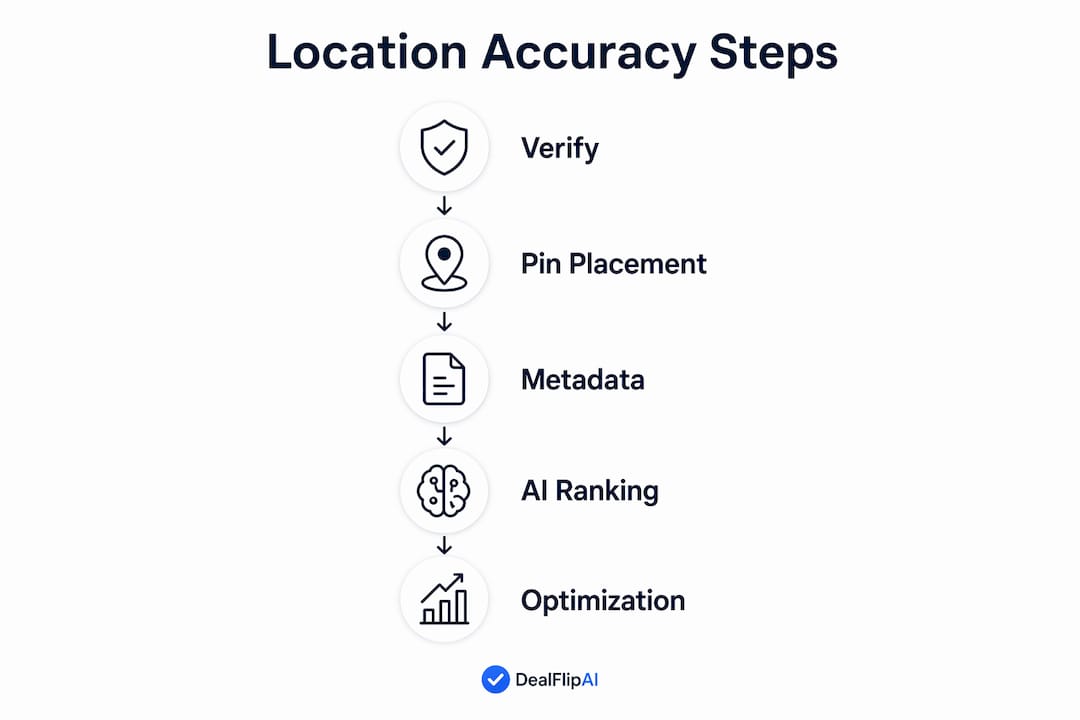
Winning listings also include machine-readable metadata about neighborhood character and transit access. This gives the AI enough context to match your listing to specific conversational queries like "furniture pickup near downtown" or "electronics seller close to transit." Generic listings without this context simply do not match those queries.
Pro Tip: Add one or two nearby landmarks or transit stops to your listing description. Write them naturally, not as a keyword list. This gives AI systems the neighborhood context they need to surface your listing for proximity-based searches.
Best practices for resellers to maintain location accuracy
Getting location accuracy right is a repeatable process. These steps apply whether you list one item a week or run a high-volume reselling operation.
- Manually verify your map pin before every listing goes live. Do not rely on the platform's auto-placement. Open the map editor, zoom in, and confirm the pin sits at the correct entrance. This single step prevents the most common cause of search exclusion.
- Standardize your address format across all platforms. Pick one format and use it everywhere. "Street" versus "St" is enough to create a data mismatch that AI systems flag as inconsistency.
- Include structured local context in your description. Mention the nearest major intersection, a recognizable landmark, or a transit stop. This supports AI match rates and helps buyers find you without confusion.
- Monitor early performance signals. If a listing gets very few views in the first 24 hours, location data is one of the first things to check. Low early impressions often signal that the AI has low confidence in your listing's location.
- Cross-check your listing on a map search. After publishing, search for your listing using a map view. If it does not appear where you expect, your pin or address data needs correction.
- Use Dealflip AI to score and analyze your listings. The Listing Analyzer tool flags location accuracy gaps alongside price and risk signals, giving you a complete picture of a deal's quality before you commit time or money.
Pro Tip: If you flip items across multiple neighborhoods, keep a simple spreadsheet with the exact address format and geocoordinates for each regular pickup location. Paste from that sheet instead of retyping each time. Consistency across listings builds AI confidence over time.
Understanding why local items outperform online inventory starts with location accuracy. Buyers trust listings they can map to a real, reachable place.
Key Takeaways
Location accuracy is a direct revenue lever for resellers: verified geocoordinates, consistent address data, and correct map pin placement determine whether AI systems surface your listing or bury it.
| Point | Details |
|---|---|
| Map pin placement is critical | A misplaced pin excludes listings from map-based searches even when the address text is correct. |
| AI confidence depends on consistency | Matching geocoordinates, address text, and pin placement across platforms raises your AI relevance score. |
| Cold-start listings need clean location data | Geographical data improves targeting performance by nearly 20% when behavioral history is minimal. |
| Urban GPS signals require manual verification | Standard GPS quality indicators have near-zero predictive accuracy in dense cities; always verify manually. |
| Structured local context boosts match rates | Adding nearby landmarks and transit info helps AI match your listing to conversational buyer queries. |
Location accuracy is the edge most resellers overlook
I have reviewed thousands of marketplace listings, and the pattern is consistent. Resellers spend hours writing descriptions and photographing items, then lose visibility because a map pin sits 200 feet from the actual pickup spot. That is not a minor technical detail. It is a deal-killer that operates silently.
What changed in the past two years is that AI-driven filtering made this problem much harder to ignore. Older keyword-based search would surface your listing anyway. Modern AI systems treat location inconsistency as a trust signal failure and reduce your reach accordingly. The resellers who understand this are pulling ahead of those who do not.
The other thing I want to be direct about: automation helps but does not solve this. Multi-device GPS averaging and geocoding APIs improve accuracy, but they do not replace a human checking the map before a listing goes live. I have seen automated tools place pins confidently in the wrong building. Human verification is the final check that no algorithm currently replaces.
Resellers who treat location data as a growth lever rather than a setup checkbox will see better visibility, faster sales, and fewer wasted conversations with buyers who cannot find them. The investment is five minutes per listing. The return is compounding over every deal you close.
— Walsh Pex
How Dealflip AI helps you get location accuracy right
Resellers who want to stop losing deals to invisible location errors have a direct path forward with Dealflip AI. The platform's tools analyze listings for the signals that actually drive deal quality, including location accuracy gaps that most resellers miss entirely.

The Listing Analyzer flags location-related risk factors alongside price and profit potential, so you know before you reach out whether a deal is worth your time. The Value Estimator factors in location-driven market demand, giving you a realistic picture of what an item will actually sell for in your area. If you are serious about finding good deals on Facebook Marketplace, these tools cut the guesswork and put verified data behind every decision you make.
FAQ
Why does a map pin matter if my address is correct?
A correct address and a correct map pin are two separate data points. An incorrect map pin removes your listing from map-based searches regardless of what the address field says.
How does location accuracy affect AI ad relevance?
AI platforms rank listings on structured location data quality, not just keyword relevance. Verified location attributes raise your relevance score, increase impressions, and lower your cost per conversion.
What is the difference between location accuracy and location precision?
Accuracy means your location is correct. Precision means your measurements are consistent. High precision with low accuracy still misleads AI systems and causes listing exclusions.
How can I improve GPS accuracy for listings in dense urban areas?
Multi-device data averaging improves GPS positioning by 7.52% in high-density urban environments. Manual pin verification remains the most reliable final step.
How does location data help new listings with no search history?
Geographical data improves AI targeting performance by nearly 20% for listings with minimal behavioral history, making clean location data especially valuable when a listing first goes live.