

Local items beat online inventory because they deliver higher quality, personalized service, and direct economic benefits that no algorithm can replicate. When you buy from a neighborhood store, roughly $68 to $73 of every $100 stays in your community. That number alone reframes what "a good deal" actually means. Online platforms win on selection and speed, but local shopping wins on quality, freshness, and community strength. If you are a reseller or a value-focused shopper, understanding why local items hold an edge changes how you find and evaluate products.
Why local items beat online inventory: the economic case
Local spending creates a multiplier effect that online purchases simply cannot match. Local retailers retain approximately 289% more revenue for the local economy than national chain stores. That means every dollar you spend at a neighborhood shop circulates through local payrolls, suppliers, and services before it leaves the area.
The job creation numbers are equally striking. Small independent businesses create about three times as many jobs per dollar as national online retailers. They also contribute up to 136% more in charitable donations per employee. Those two facts together show that local spending builds community infrastructure, not just individual businesses.
The community multiplier effect works like this: a local bookstore pays a local accountant, who buys lunch at a local diner, which orders produce from a local farm. Each transaction stays in the neighborhood. Online purchases skip most of those steps entirely, sending revenue to distant fulfillment centers and corporate headquarters.
- Local businesses retain 67–73 cents of every dollar spent locally
- Independent retailers create three times more jobs per dollar than national chains
- Local businesses donate up to 136% more per employee to local charities
- 70% of suburban Americans cite supporting the local economy as their primary reason for shopping local
Pro Tip: When you buy a resale item locally, you are not just saving on shipping. You are putting money into a community ecosystem that supports more local deals down the road.
Does local inventory actually offer better quality?
Local business owners curate their stock based on direct customer feedback, not mass-market algorithms. Local owners curate unique and niche products not commonly found on national e-commerce platforms. That curation process filters out generic, low-quality goods that flood sites like Amazon or eBay.
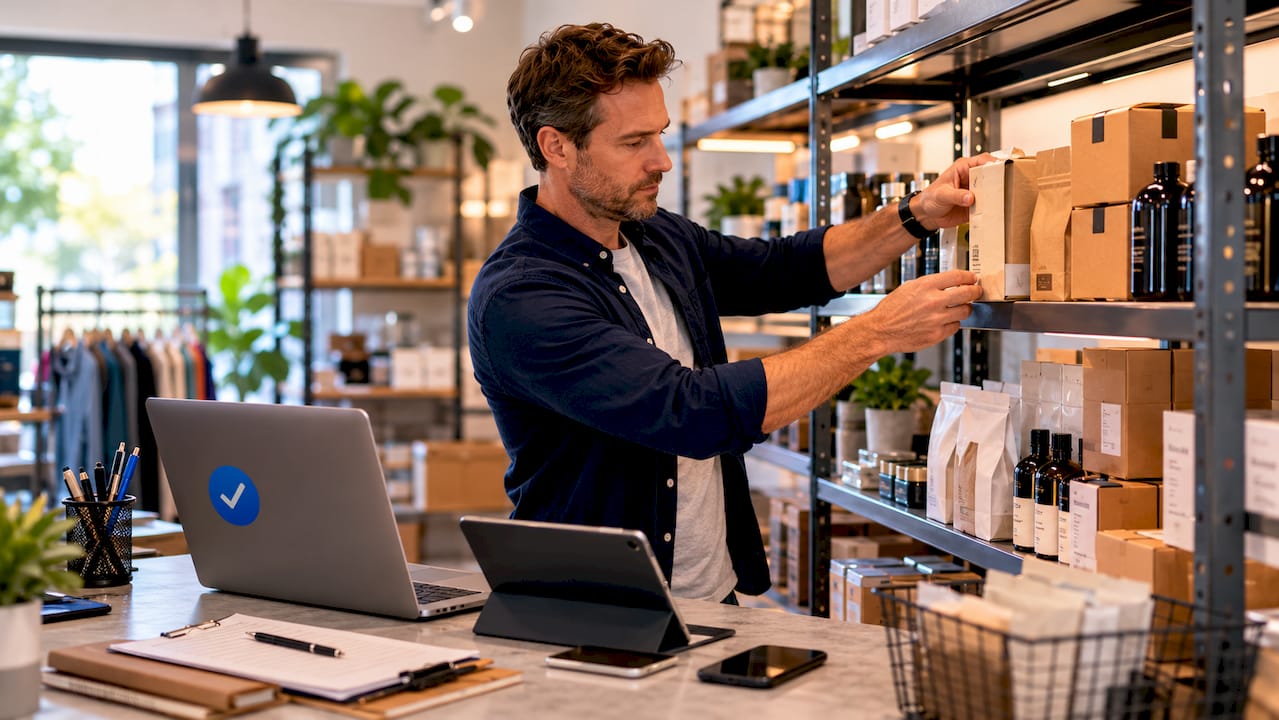
Physical access is the other major quality advantage. You can test a drawer glide, check fabric weight, or hold a tool before you buy. Physical stores allow tactile verification under realistic conditions that online images cannot replicate. That hands-on check reduces returns and eliminates the frustration of receiving something that looked different in photos.
Here are four specific quality advantages local inventory holds over online listings:
- Tactile inspection. You feel the material, test the mechanism, and check the color under natural light before committing.
- Irregular inventory. Floor samples and overstock items are aggressively priced in-store and almost never appear on national e-commerce sites.
- Freshness. Local sourcing delivers superior quality control and faster lead times, especially for food and fast-moving goods.
- Specialized selection. Local shops stock items that reflect community tastes, not what a national algorithm predicts will sell at scale.
Pro Tip: Ask local store owners about floor models or end-of-season overstock. These items are often deeply discounted and in excellent condition, but they never make it to any online listing.
How does personalized service change the shopping experience?
Local retailers build relationships with repeat customers in a way that no chatbot or recommendation engine can replicate. A hardware store owner who knows you are renovating a 1960s kitchen will point you toward the right hinge size without you having to search through 400 listings. That kind of knowledge saves time and prevents costly mistakes.
The service advantages go beyond product recommendations:
- Immediate answers. You can ask questions and get real responses from someone who has handled the product.
- Product testing. You try before you buy, which is impossible with most online purchases.
- Quick problem resolution. Returns and exchanges happen in person, with no shipping delays or restocking fees.
- Community responsiveness. Local businesses adjust their inventory based on what their neighbors actually need, not national trend data.
Local retailers also act as micro-fulfillment centers with buy online, pick up in store (BOPIS) options. BOPIS gives you the convenience of online browsing with the speed and certainty of local pickup. 60% of consumers are more likely to purchase online when in-store returns are available. That statistic shows that the hybrid model, combining online discovery with local service, is what most shoppers actually want.
Pro Tip: Use local store websites or Facebook Marketplace to browse inventory first, then visit in person to inspect and pick up. You get the best of both worlds without paying for shipping or waiting days for delivery.
Local vs. online: environmental and logistical benefits
Local shopping reduces your carbon footprint in ways that are easy to overlook. Communities with dense local business ecosystems drive 25–26% fewer miles, which directly cuts transportation emissions. Compare that to the complex logistics chain behind a single online order: warehouse, regional hub, delivery truck, and often a return shipment.
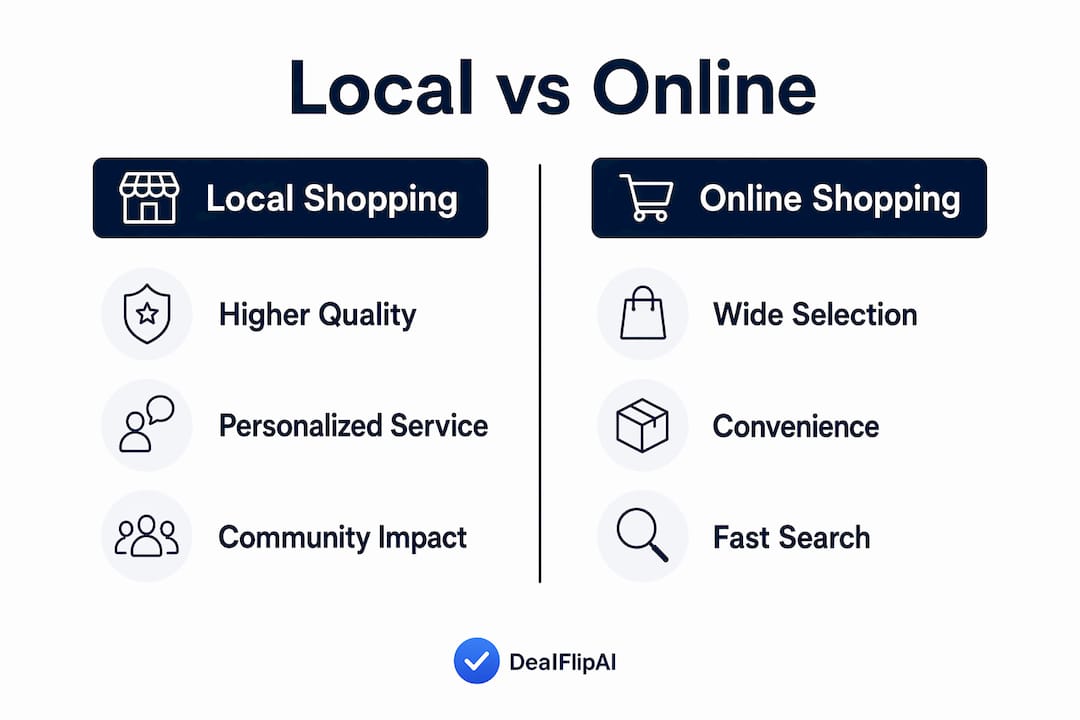
Local sourcing also cuts packaging waste. A product you carry home in a reusable bag skips the cardboard box, plastic filler, and tape that every online shipment requires. For resellers, fewer returns and less packaging also mean lower overhead costs per item.
| Factor | Local shopping | Online shopping |
|---|---|---|
| Delivery time | 30 minutes to 4 hours | 1–2 days minimum |
| Packaging waste | Minimal | High (boxes, filler, tape) |
| Carbon footprint | Low (short local trip) | High (multi-leg logistics) |
| Return process | In-person, same day | Shipping required, 5–10 days |
| Miles driven | 25–26% fewer in local-dense areas | Varies, often higher overall |
Local marketplaces typically deliver in 30 minutes to 4 hours, compared to 1–2 days for national platforms. That speed advantage matters most when you need an item urgently or want to inspect it before committing to a resale purchase. For resellers specifically, local pickup also eliminates shipping risk entirely, which is one of the biggest sources of lost margin on flipped items.
Local items vs. online inventory: a direct comparison
Local and online shopping each have clear strengths. The right choice depends on what you are buying and why.
| Factor | Local items | Online inventory |
|---|---|---|
| Product quality | High, tactile verification possible | Variable, depends on seller |
| Unique inventory | High, curated and niche | Low, algorithm-driven mass market |
| Price | Competitive, especially overstock | Often lower on commodities |
| Community impact | High, 67–73% revenue stays local | Low, revenue leaves community |
| Selection breadth | Limited to local stock | Vast, global reach |
| Service quality | Personalized, relationship-based | Automated, impersonal |
| Environmental impact | Lower emissions and packaging | Higher due to logistics chain |
| Speed of acquisition | Immediate | 1–5 days typically |
Local shopping wins on quality, uniqueness, service, and community impact. Online shopping wins on selection and commodity pricing. The practical takeaway is straightforward: buy commodities online, buy quality and unique items locally. For resellers, local price comparisons often reveal margins that online listings simply cannot match because the best local deals never appear on national platforms.
Key Takeaways
Local items beat online inventory because they combine superior quality, community economic retention, and personalized service that no national platform can replicate at scale.
| Point | Details |
|---|---|
| Economic retention | Local spending keeps 67–73 cents of every dollar circulating in your community. |
| Quality advantage | Tactile inspection and curated inventory reduce returns and reveal deals never listed online. |
| Service edge | Local retailers offer personalized recommendations and same-day BOPIS returns. |
| Environmental benefit | Local-dense communities drive 25–26% fewer miles, cutting emissions and packaging waste. |
| Reseller opportunity | Floor samples and overstock items are priced aggressively in-store but absent from online listings. |
Local shopping is underrated, and resellers know it
I have spent years watching resellers chase online listings while the best deals sat in local stores, completely off the radar. The floor model furniture, the overstock electronics, the end-of-season tools priced to move. None of those items show up in a Google Shopping search. They exist in a parallel inventory that only local shoppers ever see.
The economic argument for buying local is real, but I think the quality argument is even stronger. When you hold a product, you know things that no listing photo can tell you. You feel whether the build is solid. You see the actual color. You catch the scratch that the seller conveniently cropped out of the image. That information is worth more than any price comparison tool.
What surprises most people is how competitive local pricing gets on irregular inventory. A retailer with three floor models taking up floor space will price them to sell fast. That urgency creates deals that online sellers, who have no storage pressure, never offer. Resellers who understand local pickup advantages consistently find better margins than those who shop exclusively online.
The hybrid model is where things get interesting. Buying locally and listing online is one of the most reliable reselling strategies available right now. You get the quality and price advantage of local sourcing, and you sell into the broad audience that online platforms provide. That combination is hard to beat.
— Walsh Pex
How Dealflip AI helps you find and flip local deals
Local inventory holds real profit potential, but finding the right deals before other resellers do takes speed and analysis. Dealflip AI scores Facebook Marketplace listings by price, profit potential, and risk factors so you know exactly which local items are worth pursuing.
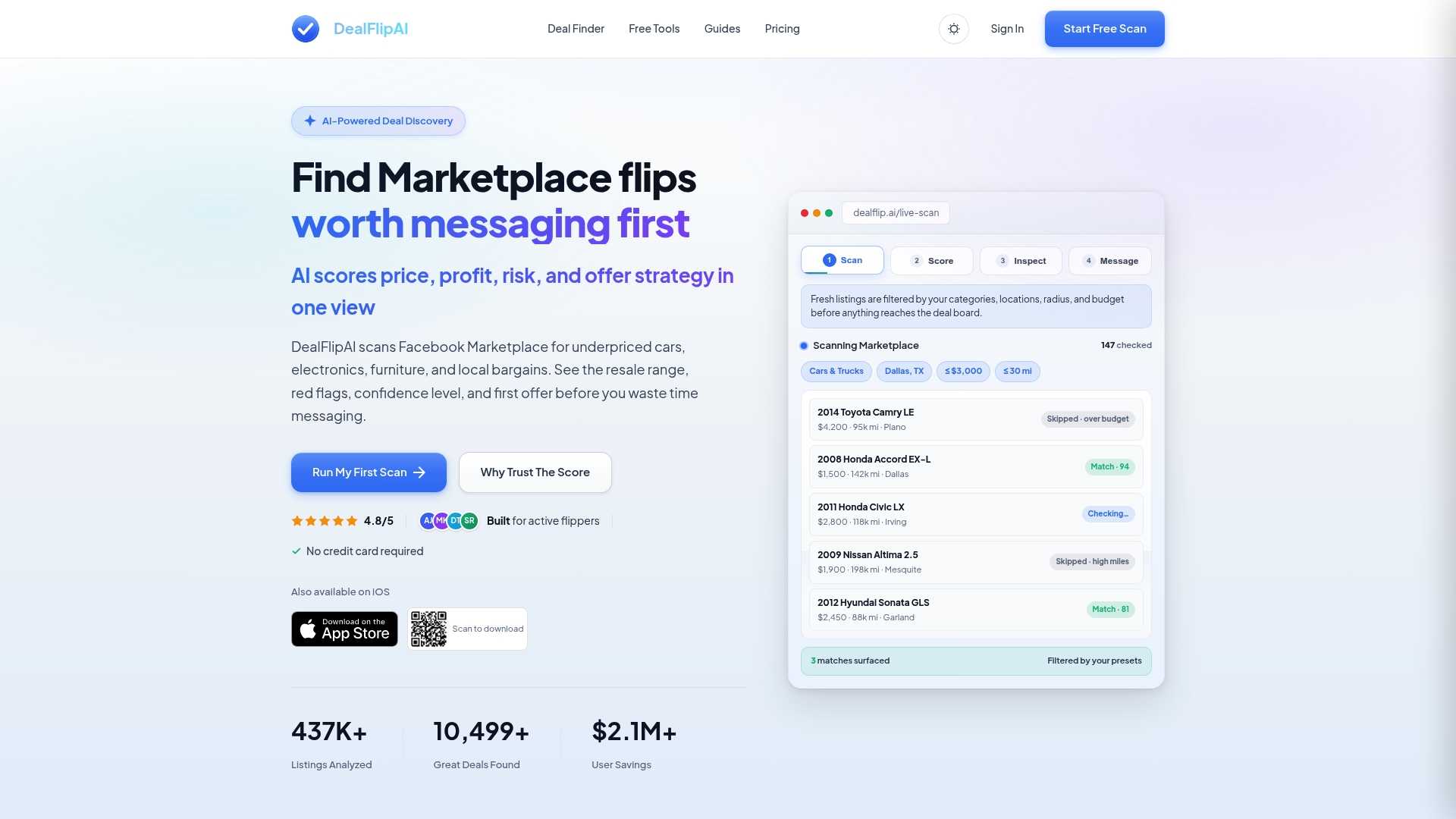
The Facebook Marketplace deal finder sends real-time alerts the moment a high-value local listing goes live. You can also run any listing through the listing analyzer tool to get a full deal score before you drive across town. Once you have the item, the cross-listing profit calculator shows you exactly how much you will net after fees on eBay, Mercari, or Poshmark. Dealflip AI turns local inventory advantages into measurable profit.
FAQ
Why do local items often have better quality than online products?
Local store owners curate their inventory based on direct customer relationships, not mass-market algorithms. Physical inspection also lets you verify quality before buying, which online listings cannot offer.
How much of my local spending actually stays in the community?
Roughly $68 to $73 of every $100 spent at local independent businesses remains in the local economy. That retention rate is approximately 289% higher than what national chain stores deliver.
Are local deals really cheaper than online prices?
Local deals on irregular inventory like floor samples and overstock are often priced more aggressively than online listings. Retailers need to clear floor space, which creates discounts that online sellers with no storage pressure rarely match.
What is BOPIS and why does it matter for local shopping?
BOPIS stands for buy online, pick up in store. It combines the convenience of online browsing with same-day local pickup and easy in-person returns, giving you the best features of both shopping methods.
Does shopping locally actually reduce environmental impact?
Communities with dense local business ecosystems drive 25–26% fewer miles than those dominated by national chains. Fewer miles means lower emissions, and local purchases also eliminate the multi-layer packaging that every online shipment requires.