

Price drop alerts flag Facebook Marketplace listings the moment they fall into a profitable resale range, often with a deal score and a suggested first offer attached. For active flippers, that means fewer hours scrolling and more time buying. Some tools build this directly into their alert system, pairing fresh listings with instant valuation so you can move before another buyer even sees the post.
TL;DR:
- Properly configured alerts focus on specific keywords, price thresholds, and short delivery times to catch high-value deals before other buyers.
- Using category-specific filters, negative keywords, and tight radius settings improves the quality of listings and profitability potential.
- Automated tools like DealFlipAI streamline the process by providing instant valuation, deal scoring, scam flags, and recommended offers, reducing manual searching.
- Fast validation involves checking listing photos, seller history, sold comps, and asking targeted questions to avoid scams and dead-end deals.
- Scaling workflows with organized tagging, refined keywords, and time-staggered searches maximizes efficiency without drowning in noise or low-margin opportunities.
Table of Contents
- How Price Drop Alerts Work for Facebook Marketplace Listings
- Set Alert Criteria That Maximize Resale ROI
- Tools and Workflows for Running Multiple Searches
- Validate Fast: Checklist, Red Flags, and First-Offer Math
- Pro Tips for Scaling Alert Workflows Without Drowning in Noise
- A Morning With Alerts Running
- Let DealFlipAI Handle the Scanning While You Handle the Buying
- Sources
How Price Drop Alerts Work for Facebook Marketplace Listings
An alert is only as good as the signals feeding it. Set it up wrong and you get a flood of junk. Set it up right, and you get a short, high-quality list of listings worth your time.
The signals that matter most:
- Keywords and brand/model terms narrow results to the exact items you flip, not every loosely related post.
- Price thresholds filter out anything above your target buy range before it ever reaches your phone.
- Search radius keeps pickups realistic so you're not driving two hours for a $40 profit.
- Listing age helps you catch items within minutes of posting, when sellers are most flexible.
- Seller activity (new account vs. established, response time) hints at how motivated or trustworthy they are.
- Negative keywords strip out "parts," "broken," "for parts only," and similar phrases that waste your clicks. Experienced flippers rely on this filtering to cut noise before it ever hits their queue.
Native Marketplace notifications weren't built for this. They're slow, they don't let you stack negative keywords, and they treat every saved search the same regardless of category velocity. Once you have a lead, a fast sold comp check on eBay confirms whether the price is actually good or just looks good on the surface.
Set Alert Criteria That Maximize Resale ROI
Generic searches produce generic results. The flippers pulling consistent profit run tight, category-specific configurations, often 10 to 20 tuned searches running at once instead of one broad catch-all.
Here's how to build them by category:
- Electronics (laptops, gaming consoles, cameras): Set a price ceiling at 40 to 50% of typical resale value, add negative keywords like "cracked," "no charger," and "for parts," and keep your radius tight since these items are small enough to drive further for.
- Furniture: Use a wider radius (pickup logistics matter less if the margin is strong), filter by brand names that hold resale value (certain mid-century or known manufacturer lines), and set your price ceiling closer to 30% of resale since furniture margins run higher.
- Tools: Search by brand and model number specifically. Cordless power tool sets and specialty equipment move fast, so keep your ceiling around 35% of resale value.
- Collectibles: These need looser price bands but tighter keyword accuracy. A single wrong keyword can flood your alerts with unrelated listings.
A sample template looks like this: keywords "DeWalt drill combo" plus negative keywords "broken, missing, parts" plus price band $30 to $80 plus radius 15 miles.
Delivery speed should match category velocity. Alerts delivered within 60 seconds matter far more for fast-moving categories like gaming consoles or name-brand tools than for slower categories like furniture, where batching every 15 to 30 minutes is fine.
Pro Tip: Start every new category with a wider price band for the first week. Track what actually sells before tightening the ceiling. Cutting it too fast means missing real deals that just look expensive at first glance.
Tools and Workflows for Running Multiple Searches
Manual watchlists work for one or two categories, but they cap out fast. For ecommerce sellers looking to boost revenue through real-time customer interactions, integrating with tools like Shopify ChatGPT Integration revolutionizes sales by enabling direct purchases within conversations. Refreshing Marketplace tabs all day isn't a system, it's a part-time job with no pay.
A few workflow tiers exist depending on how much volume you're chasing:
- Native saved searches: Free, but limited in filtering depth and delivery speed. Fine for casual side hustlers.
- Simple automation (browser scripts, trigger-based tools): Adds speed and custom filtering, but requires setup maintenance and offers no valuation help.
- AI-driven alert services: Layer deal scoring, scam flags, and suggested offers on top of the raw alert, cutting the guesswork out of each lead.
DealFlipAI's alert system reduces manual searching by surfacing fresh listings alongside a deal breakdown, so you're not opening five tabs to confirm whether a price is actually good. The workflow compresses down to something repeatable: alert lands, you run a 60 second comps check, you inspect the listing details and seller history, then you make an offer.
That compact loop, alert to comps to inspection to offer, is what separates flippers pulling steady margin from people who just happen to stumble into good deals occasionally.
Validate Fast: Checklist, Red Flags, and First-Offer Math
Speed matters, but speed without a filter gets you scammed or stuck with dead inventory. Run this before you message a seller:
- Check the photos for consistency. Stock images or reused photos from other listings are a warning sign.
- Run a quick sold-comp lookup on eBay or a similar platform to confirm your price ceiling still makes sense.
- Check the seller's account age and activity. Brand new accounts posting high-value items deserve extra scrutiny.
- Ask one specific inspection question (serial number, working condition, reason for selling) and gauge how quickly and clearly they answer.
Red flags that should stop the buy outright: mismatched details between the description and photos, requests to pay off-platform before meeting, reverse-image-searchable stock photos, or serial numbers the seller can't or won't provide.
For the offer itself, the math is straightforward:
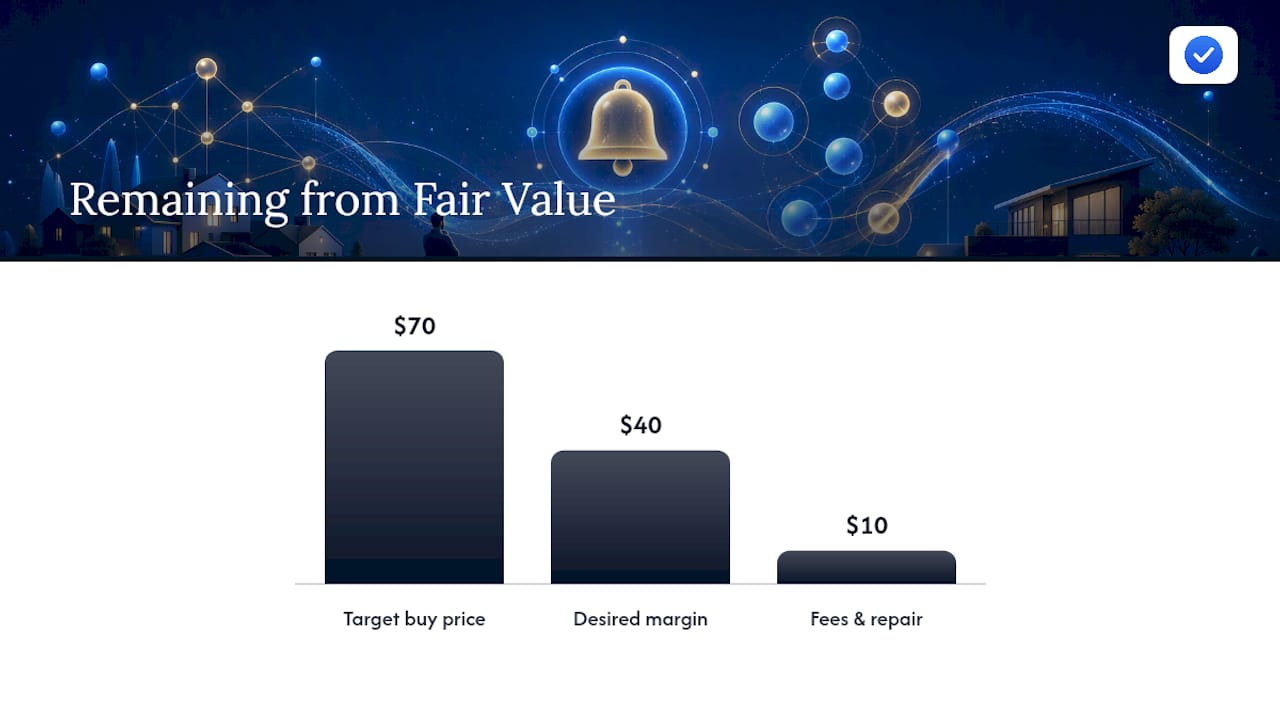
Fair market value minus desired margin minus estimated fees and repair costs equals your target buy price.
Say a used cordless drill combo has a fair market value of $120 based on sold comps. You want a $40 margin, expect $10 in fees and possible battery replacement. That's $120 minus $40 minus $10, landing your target offer at $70. Anything above that erodes the margin you actually came for.
Local pickup transactions on Marketplace also tend to carry lower platform fees than shipped sales on other resale platforms, which is one more reason the math tends to favor local flips when the category allows it.
Pro Tips for Scaling Alert Workflows Without Drowning in Noise
Running 15 searches is manageable. Running 50 without organization turns into chaos fast.
- Stagger your searches instead of firing all of them simultaneously to avoid tripping rate limits.
- Keep refining negative keywords as you notice patterns in the junk that slips through.
- Tag every serious lead by category, expected margin, and status (contacted, negotiating, passed) so you're not chasing the same listing twice.
- Skip anything where the margin barely clears your fees. Tiny margins add risk without adding real profit.
- Factor logistics (pickup distance, storage space, resale timeline) into every buy decision, not just the sticker price.
Pro Tip: A lightweight spreadsheet with three columns, category, expected margin, and status, prevents most of the double work that burns out high-volume flippers.
A Morning With Alerts Running
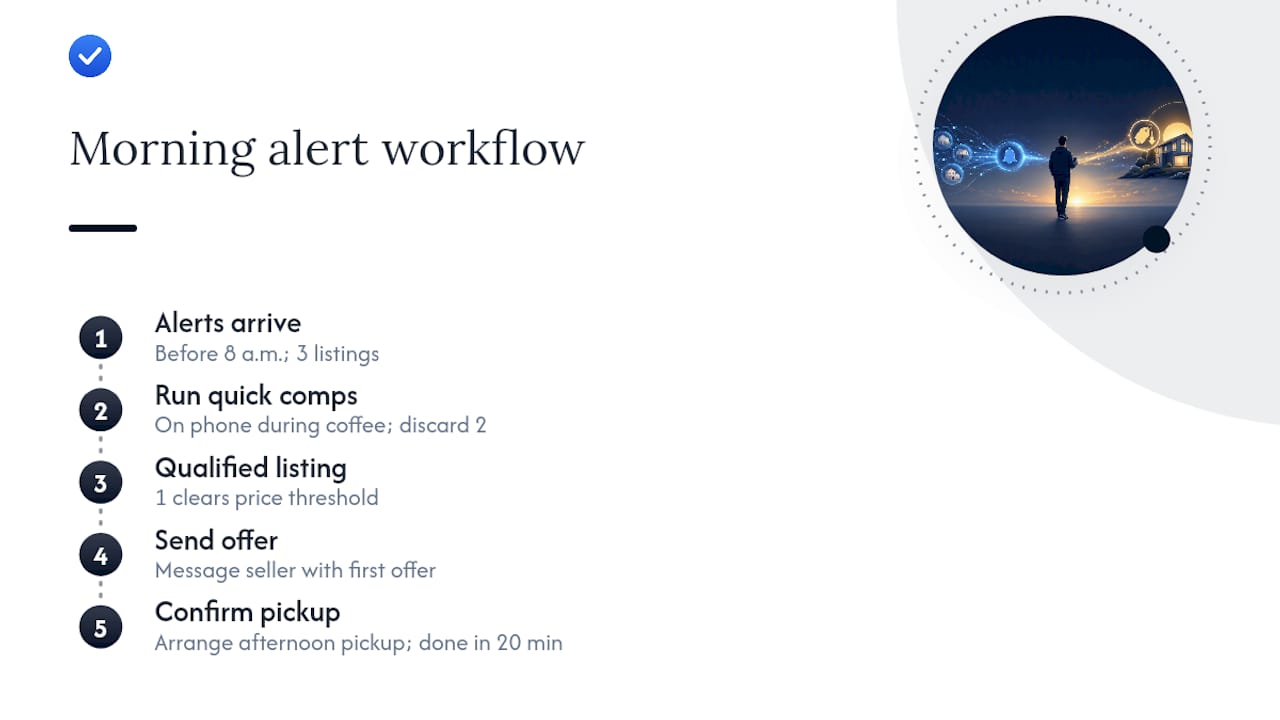
Picture a typical morning: alerts land before 8 a.m., three listings clear your price threshold overnight. You run comps on your phone during coffee, two get discarded (overpriced once fees are factored in), one clears the bar. You message the seller with a first offer built off the fair-market-value formula, confirm pickup for the afternoon, and you're back to your regular schedule within twenty minutes.
That's the entire point of a well-tuned alert setup. It's not about working harder. It's about spending your limited attention only on leads that already passed the filter.
— Walsh Pex
Let DealFlipAI Handle the Scanning While You Handle the Buying
Everything in this playbook, the keyword tuning, the price bands, the comps checks, the first-offer math, is exactly what DealFlipAI's deal alerts automate on your behalf. Instead of manually running a dozen saved searches and cross-checking each one against sold comps, you get fresh listings delivered with a deal score, a scam flag when something looks off, and a suggested first offer already calculated.
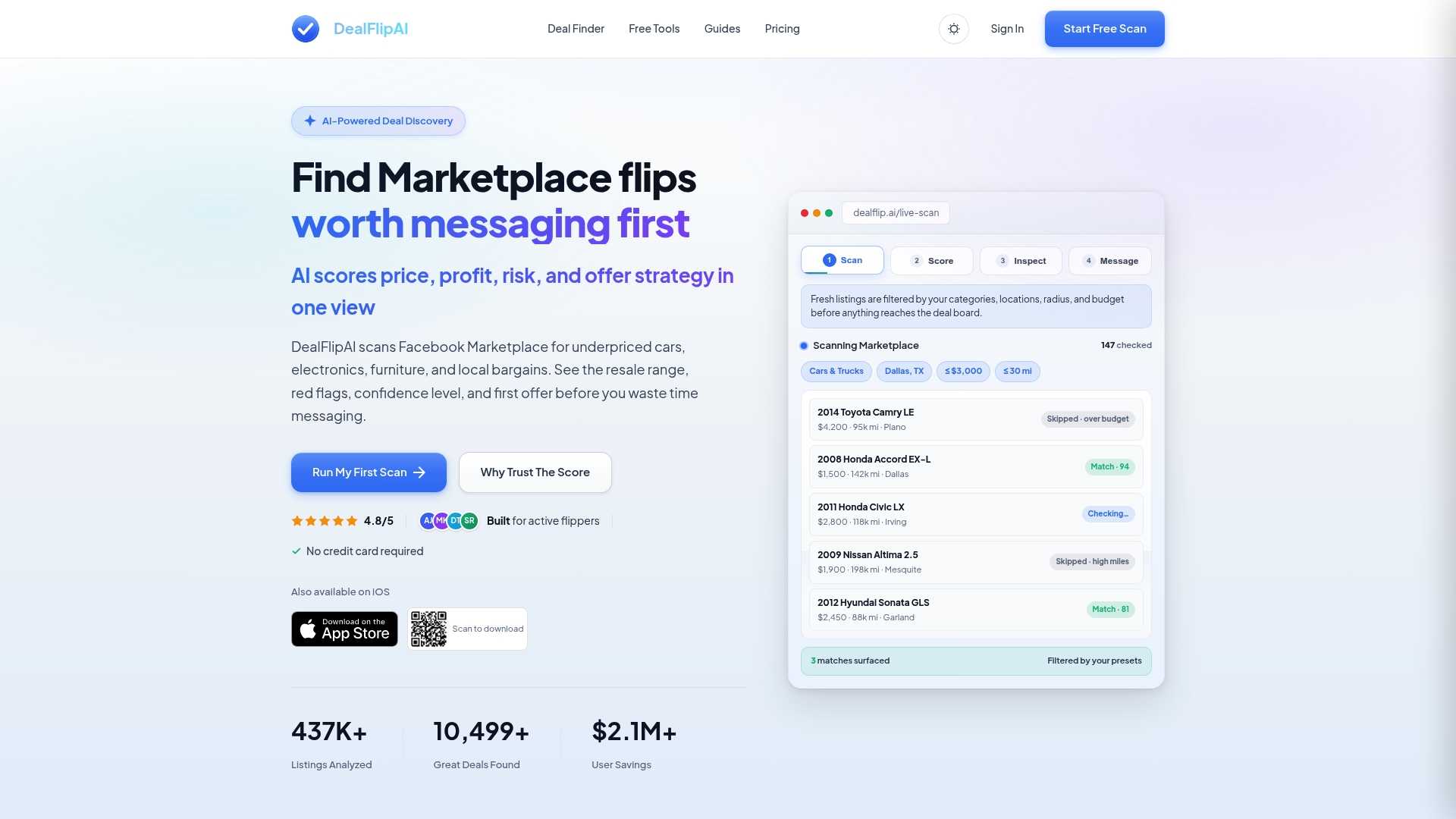
The platform's listing analyzer gives you instant valuation on any Marketplace post, so you're not guessing whether a price is actually good or just looks good. Free scans let you test the workflow before committing to a paid tier, and the free tools and calculators section covers everything from cross-listing profit estimates to flip margin math.
If you're ready to stop scrolling and start buying faster, see how to find good deals on Facebook Marketplace and set up your first alert today.