

See a promising Facebook Marketplace listing? Run it through a deal score, calculate your buy ceiling, verify the seller, then make your first offer, all before someone else beats you to it. An AI-powered platform automates the scoring, alerts, and offer math so you spend your time buying instead of calculating. The rest of this guide breaks that workflow into steps you can run from your phone in under two minutes.
TL;DR:
- Listings with vague descriptions, stock photos, or no verified model details should be avoided, as they often indicate unreliable sellers or scam risks.
- Focus on sold comps that match the exact model and condition to accurately calculate your buy ceiling and avoid overpaying.
- Verify seller credibility by checking account age, profile completeness, reviews, and requesting live videos before visiting or paying.
- Local pickup transactions offer a natural margin advantage due to zero marketplace fees, allowing for higher offers without hurting profit margins.
- Using AI tools to score deals and flag scams reduces reaction time and prevents costly mistakes, especially in categories with tight margins like electronics and furniture.
Table of Contents
- Checklist: What to Scan on a Facebook Marketplace Listing in 60 to 90 Seconds
- How to Calculate a Buy Ceiling and Projected Profit
- Scam Detection and Verification: 6 Checks Before You Drive or Pay
- Speed and Workflow: Tuning Alerts to Win Perishable Listings
- Why AI Scoring Helps and How Dealflip AI Maps to This Workflow
- Step-by-Step Guide for Listing the Same Item on eBay and Facebook Marketplace
- Best Practices for Descriptions and Photos That Work on Both Platforms
- Inventory and Order Management Across Multiple Platforms
- Legal and Policy Considerations for Selling on Both Platforms
- Tips for Keeping Pricing and Promotions Consistent Across Platforms
- Practitioner Perspective: Common Flipper Mistakes and Quick Fixes
- Dealflip AI: The Faster Way to Score, Verify, and Offer
- Sources
- FAQ
Checklist: What to Scan on a Facebook Marketplace Listing in 60 to 90 Seconds
Most listings deserve less than two minutes of your attention before you decide to dig deeper or move on. Speed here isn't about being careless. It's about not wasting your best hours on items that were never going to pencil out.
Run through this order every time:
- Title and photos first. Does the title include the exact model or part number, and do the photos match it? A generic title ("nice couch, good condition") on an otherwise valuable piece is often a sign the seller doesn't know what they have, which can mean an opportunity.
- Price versus obvious comps. Pull up two or three recent sold listings in your head (or in DealFlipAI's listing analyzer) before you get emotionally attached to the deal.
- Seller profile signals. Account age, Facebook verification badges, and whether they have a listing history all matter. A brand new profile with one listing at a jaw-dropping price deserves more scrutiny, not less excitement.
- Description red flags. Vague wear descriptions, missing dimensions, or photos that look copied from a manufacturer site instead of the seller's own space.
- Green signals worth weighting up. Exact model numbers, five or more photos from different angles, and accessories or original boxes bundled in.
If a listing clears this checklist, it moves to the next stage: figuring out what you can actually afford to pay.
How to Calculate a Buy Ceiling and Projected Profit
Your buy ceiling is the highest price you can pay and still hit your target margin after every real cost lands. Most flippers skip this step and instead negotiate off gut feeling, which is exactly why so many "deals" turn into break-even trades once shipping and fees eat the spread.
Step 1: Pull real sold comps, not active listings. Active asking prices tell you what sellers hope for. Sold comps tell you what buyers actually paid. Prioritize comps that match the exact model or part number, condition, and sale channel; a checklist recommended for eBay and marketplace flipping puts this identification step first for good reason. Ignore comps from a different region, a bundled lot, or a clearly damaged unit.
Step 2: List every real cost against the resale price. That means marketplace or payment fees if you're selling elsewhere, shipping and packing supplies if the item won't move locally, a returns buffer for anything electronic or mechanical, and the time you'll spend cleaning, photographing, and relisting.
Step 3: Apply the buy-ceiling formula.
- Estimate your realistic resale price from sold comps.
- Subtract fees, shipping, supplies, and a return buffer (often 5 to 10% of resale price for untested electronics).
- Subtract your target profit dollar amount for that item category.
- What's left is your buy ceiling. Do not pay above it, even if the negotiation feels close.
Worked example: A used mid-range gaming console lists at a certain price. Comps show it resold higher recently. Local pickup means no shipping cost, but you budget amounts for cleaning supplies and a controller cable, plus a return buffer since the seller says it's "untested." Your target profit is set accordingly, landing your buy ceiling at a calculated amount.
Margin bands vary by category. Furniture often runs on tighter percentage margins but higher dollar profit per item because of size and low fees for local pickup. Electronics need wider dollar buffers because failure rates are higher, even when sellers swear the item works. Facebook Marketplace's fee structure charges 0% on local pickup transactions, which is exactly the kind of cost difference that should shift your buy ceiling up compared to a shippable item headed to a fee-based platform.
Statistic callout: Local pickup categories with no listing fees create a structural margin advantage over shipped-and-fee-based sales, according to comparative analysis of eBay and Facebook Marketplace for flippers. That's real money you can bake into a higher offer and still hit your number.
A tool like Dealflip AI's flip profit calculator runs this exact formula against live comps so you're not doing the subtraction by hand at the curb.
Scam Detection and Verification: 6 Checks Before You Drive or Pay
Wasted trips cost you time you could spend on the next listing, and outright scams cost you cash. Both are preventable with a short verification routine before you commit to anything.
Watch for these red flags first:
- A brand new profile with no other listings or reviews.
- A price so far below comps that it reads as bait rather than a genuine underprice.
- Any request to pay off-platform through gift cards, wire transfer, or a payment app before you've seen the item in person.
- Refusal to do a quick video call or send additional photos on request.
- Stock photos that don't match the claimed condition or location.
- Urgency pressure ("three other people want this, need to sell tonight") paired with a request for a deposit.
Before you drive anywhere, ask for a short live video showing the item powered on, the serial number, and any wear points the photos didn't cover. Sellers with nothing to hide almost always comply within minutes. Serial numbers matter more than people think: a mismatched or missing serial on supposedly new electronics is one of the clearest signs the item is stolen or a return-fraud unit.
For anything described as "untested," treat the listed price as a starting point for a much lower offer, not a fair-value baseline. Untested usually means broken, and you should price accordingly or walk.
Pro Tip: Ask the seller to place a coin or a piece of paper with today's date next to the item in one final photo. It costs them nothing and instantly kills stock-photo scams and stale listings being reposted for the tenth time.
Dealflip AI's scam checker flags many of these signals automatically, scoring seller risk before you ever send a message.
Speed and Workflow: Tuning Alerts to Win Perishable Listings
Underpriced listings are perishable. Guidance on catching underpriced listings fast makes clear that the edge goes to whoever has a faster, repeatable process, not whoever happens to guess the right search term at the right hour.
Build your workflow around three moves:
- Separate your alerts by confidence. High-confidence, exact-match searches (specific model numbers, specific brands) should hit your phone immediately. Exploratory lot or category searches ("furniture," "electronics bundle") can batch into a daily digest instead of interrupting you constantly.
- Set decision rules in advance, not in the moment. Define an auto-buy price for items you know cold, a "vet then buy" tier for anything needing verification, and an ignore threshold below your acceptable margin.
- Route high-confidence alerts to the fastest channel you check. A push notification beats an email digest every time speed decides whether you get the item.
Keep a simple log for every purchase: cost, comps used, condition at pickup, days to sell, and realized margin. Tracking these fields over time reveals which categories and searches actually make you money, instead of just feeling productive.
Why AI Scoring Helps and How Dealflip AI Maps to This Workflow
Every step above can be done manually, and plenty of flippers do exactly that. It's slow, and it's easy to talk yourself into a bad price when you're doing the math under pressure at a stranger's driveway.
An AI-powered deal scoring platform maps directly onto the workflow you just read:
- The scanner pulls fair-value estimates from sold comps, replacing manual math.
- The deal score translates risk factors, price-to-value spread, and seller signals into a single number for quick triage.
- Real-time alerts deliver high-confidence matches fast.
- Calculators apply the buy-ceiling formula automatically, factoring in fees, shipping, and target margins.
When you get a score, treat a high valuation confidence rating as a green light to move fast, and a low one as a signal to verify manually before offering. Suggested first offers serve as a negotiation starting point, not a number to accept blindly.
Getting started costs nothing: Dealflip AI's free scans let you test scoring accuracy against a handful of real listings before you commit to a paid plan.
Step-by-Step Guide for Listing the Same Item on eBay and Facebook Marketplace
Once you've bought an item using the workflow above, getting it back on the market fast matters just as much as the purchase price did. Here's the order that keeps you organized instead of scrambling.
- Photograph once, use everywhere. Shoot in natural light against a plain background, capturing the item from at least five angles plus any flaws or included accessories.
- Write the eBay listing first. eBay rewards detailed titles with brand, model, size, and condition keywords, plus a description that reads like a spec sheet. This becomes your source text.
- Adapt, don't copy, for Facebook Marketplace. Facebook buyers skim. Shorten your eBay description to the essentials: what it is, condition, price, and pickup or shipping terms.
- List on eBay first if the item is shippable, branded, or collectible. Comparative research on flipping platforms shows eBay tends to win for items with a national buyer pool. List on Facebook Marketplace first for bulky, local-pickup items where shipping isn't realistic.
- Remove or mark "pending" immediately on both platforms once you get a serious offer. Nothing damages your reputation faster than a buyer showing up for an item that already sold elsewhere.
- Track which platform actually converts for each category so you stop wasting time listing furniture nationally or electronics locally-only when the other channel performs better.
This sequence keeps your listings consistent without forcing you to write everything twice from scratch.
Best Practices for Descriptions and Photos That Work on Both Platforms
The biggest mistake sellers make when running listings on both eBay and Facebook Marketplace is treating one platform's copy as good enough for the other. Buyer behavior differs enough that a straight copy-paste job costs you sales.
For photos, shoot everything as if it's going on eBay: bright, even lighting, a clean background, and close-ups of any wear, model numbers, or manufacturer tags. That photo set works on Facebook Marketplace too, but Facebook buyers respond especially well to lifestyle-style shots, an item staged in a room rather than against a blank wall, since that platform's audience is browsing casually rather than searching with intent.
For descriptions, eBay rewards keyword density: brand, model number, dimensions, and condition terms all belong up front because eBay's search algorithm weighs them heavily. Facebook Marketplace buyers rarely read a wall of text. Lead with price and condition in the first line, then keep the rest to three or four short sentences covering pickup logistics and any flaws.
One habit worth building: always disclose flaws in both descriptions, even minor ones. It cuts down on wasted messages from buyers who show up expecting mint condition, and it protects your seller rating on both platforms. A missing scratch disclosure that leads to a return or a bad review costs you far more than the sale was worth.
Inventory and Order Management Across Multiple Platforms
Selling the same physical inventory across eBay and Facebook Marketplace creates one unavoidable risk: double-selling an item that's already gone. A buyer who drives across town for a "still available" item that sold on eBay that morning is a reputation problem you don't want.
The simplest fix that doesn't require software is a habit: the moment an item sells anywhere, mark it "pending" or delete the listing on every other platform within minutes, not at the end of the day. If you're flipping more than a handful of items a week, that manual habit starts to break down under volume.
For higher volume, a spreadsheet with one row per item, tracking purchase date, cost, platforms listed, and sale status, gives you a single source of truth to check before confirming any sale. Some resellers graduate to dedicated fulfillment and inventory integration tools once they're running enough SKUs that a spreadsheet can't keep pace, syncing stock counts across storefronts automatically.
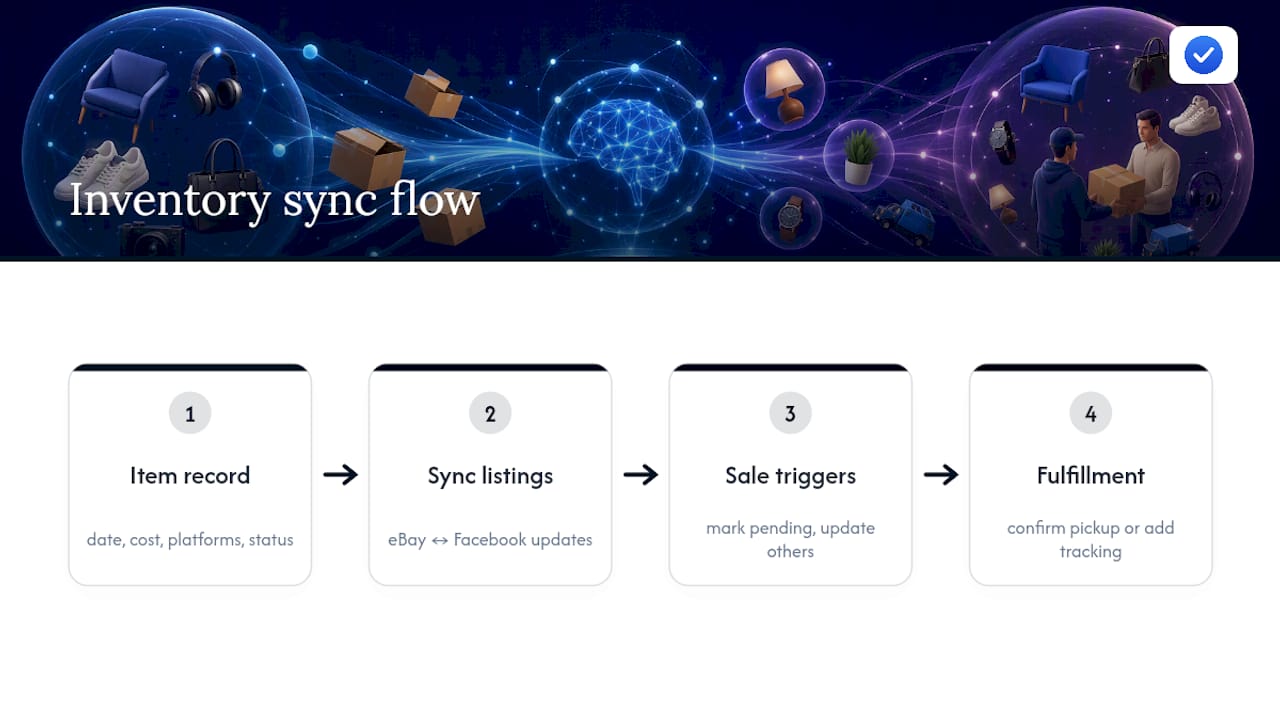
Order management matters just as much on the fulfillment side. Local Facebook Marketplace pickups need a simple confirmation message with time and location locked in before the buyer leaves home. Shipped eBay sales need tracking numbers logged the same day, since slow shipping is one of the fastest ways to rack up negative feedback that hurts future sales on that account.
Legal and Policy Considerations for Selling on Both Platforms
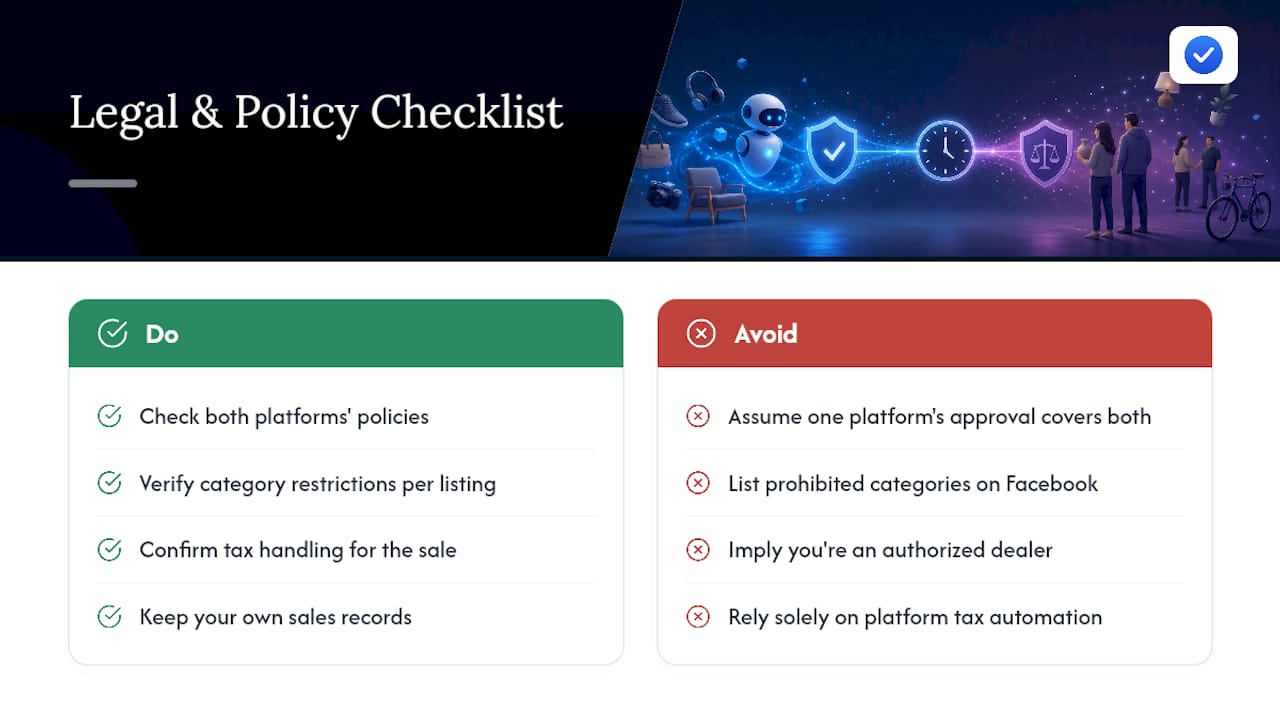
Both eBay and Facebook Marketplace have their own seller policies, and running the same inventory across both means following both rulebooks at once, not whichever one is more convenient.
Facebook's Commerce Policies prohibit certain categories outright, including weapons, recalled items, and some health products, even when eBay allows a narrower version of that same category under stricter listing rules. Always check current category restrictions on each platform before listing rather than assuming a green light on one means clearance on the other.
Sales tax is another area where the platforms differ in how they handle collection. eBay collects and remits sales tax automatically in most states as a marketplace facilitator, while Facebook Marketplace payment transactions may have different tax handling depending on how the sale is structured (payment through the platform versus cash for local pickup). Keep your own records regardless of what either platform automates, since you're responsible for accurate income reporting either way.
If you're reselling branded goods, be careful with descriptions and photos that imply an authorized dealer relationship you don't have. Both platforms can suspend accounts for policy violations tied to counterfeit claims or misleading brand language, and a suspension on one account doesn't just cost that sale, it can cost your entire selling history and feedback score built up over time.
Tips for Keeping Pricing and Promotions Consistent Across Platforms
Running different prices for the same item on eBay and Facebook Marketplace isn't inherently wrong, and often it's the smarter move given how differently the platforms charge fees and attract buyers. The mistake is letting prices drift out of sync without a reason behind the gap.
Since Facebook Marketplace charges nothing for local pickup while eBay sales carry marketplace fees plus payment processing, your Facebook price can often sit lower than your eBay price for the identical item and still net you a similar profit. Build that fee difference into your pricing from the start rather than listing the same number everywhere and wondering why one platform performs worse.
When you run a discount or price drop, update both listings within the same day. Buyers comparison shop across platforms more than sellers assume, and a stale higher price on one platform makes you look disorganized at best, and gives a savvy buyer leverage to lowball you at worst.
A cross-listing profit calculator that compares net proceeds across platforms after fees takes the guesswork out of setting two different prices that both hit your target margin.
Practitioner Perspective: Common Flipper Mistakes and Quick Fixes
The mistake I see most often isn't a bad purchase. It's over-relying on a single comp because it confirmed what the buyer already wanted to believe. The fix is simple: never act on one data point, pull at least three sold comps before you trust a number.
The second mistake is skipping verification because the deal feels too good to slow down for. Speed and diligence aren't actually opposites; a 90-second video request costs you almost nothing and kills most fraud before it costs you a wasted drive.
The third is showing up without decision rules and negotiating from emotion instead of math. Set your buy ceiling before you message the seller, not while you're standing in their driveway.
— Walsh Pex
Dealflip AI: The Faster Way to Score, Verify, and Offer
This kind of AI-driven tool is an alternative to guessing at comps and doing fee math by hand while a good listing slips away to a faster buyer. Such platforms can score listings on price versus fair value, flag scam risk, and provide suggested first offers quickly.

That matters most for furniture and electronics categories, where margins depend on catching a listing within the first hour it's posted, not the first day. The platform's Furniture Deal Finder and Scam Checker apply the same checklist logic from this guide automatically, so your triage time drops from two minutes to a glance at a score.
If you're flipping as a side hustle or full time, start with a free scan on your usual categories and compare the suggested buy ceiling against what you'd have offered on gut feel. Most flippers find the gap is where their margin was quietly leaking.
Sources
For deeper reading on sourcing and comps, see the buy-ceiling checklist for flipping and guidance on catching underpriced listings fast. For hands-on tools, try Dealflip AI's free calculators or the in-depth listing analysis guide.
- Find Hidden Gems to Flip on eBay | Items to Flip
- Automatedsearches
- eBay vs Facebook Marketplace for Flippers (2026)
- Reselling Side Hustle: How to Flip Items for Profit on eBay and Facebook | SideHustlr Blog
FAQ
How Long Does It Typically Take to Resell a Flipped Item?
Time-to-sell depends heavily on category and pricing accuracy, but items priced at or near verified sold comps typically move faster than items priced from gut feeling. Furniture and local-pickup categories tend to sell faster on Facebook Marketplace, while shippable branded goods often sell faster on eBay due to a larger buyer pool.
Does Crossposting Between eBay and Facebook Marketplace Increase Fees?
Fees depend on the platform and sale type, not on whether you crosspost. Facebook Marketplace charges 0% on local pickup transactions, while eBay applies marketplace and payment processing fees on every sale, so your total fee exposure depends on which platform the final sale happens on.
How Does AI Detect Scam Listings on Facebook Marketplace?
AI scoring tools like Dealflip AI flag risk by combining seller profile signals (account age, verification, listing history) with pricing anomalies and description inconsistencies, similar to the manual checklist covered in this guide's verification section.
Should I Always Ship Items Instead of Requiring Local Pickup?
No. Bulky, low-ticket, or fragile items usually perform better with local pickup because shipping costs and packaging risk cut into margin, while shippable, branded, or collectible items often do better listed nationally on a platform like eBay.
What's the Fastest Way to Calculate a Buy Ceiling Without a Spreadsheet?
Subtract your estimated fees, shipping, supplies, and return buffer from the resold comp price, then subtract your target profit; the result is your buy ceiling. Tools like Dealflip AI's flip profit calculator run this formula automatically against live comps.