

That's how days listed impacts offer power, and it's the single biggest lever you have before you even think about condition or brand.
Two data points back this up. Sellers who use Facebook's "make an offer" feature close deals more often because it signals a serious buyer, and listings older than two weeks routinely become fair targets for that 15 to 20% cut. DealFlipAI exists to run this exact math for you, scoring each listing's age and flagging when to push harder.
Pro Tip: A specific offer with a real pickup time usually beats a slightly higher, vaguer one. Certainty wins negotiations more often than the top dollar figure.
- Fresh listing (0-3 days): offer close to asking price
- Steady listing (4-13 days): offer a modest discount below asking
- Stale listing (14+ days): offer a larger discount below asking
Key Takeaways
The strongest first offer combines your listing's days-on-market tier with real signals like price drops, relists, and pickup certainty rather than a single flat discount rule.
| Point | Details |
|---|---|
| Match offer to age tier | Offer 95-100% for 0-3 days, 90-95% for 4-13 days, and 80-85% for 14+ days listed. |
| Certainty beats a higher number | A firm pickup window and clear price often win over a vaguer, slightly higher offer. |
| Watch for disguised age | Relisted photos and repeated seller listings can mask how old an item really is. |
| Let rarity override the tier | Rare, underpriced, or brand-name items can justify a near-asking offer at any listing age. |
| Automate the screening | DealFlipAI's listing analyzer scores age, flags relists, and suggests offer ranges at scale. |
Table of Contents
- Quick Reference: Offer Ranges By Days Listed
- Why Does Listing Age Change Seller Motivation?
- How Do You Combine Days Listed With Other Buying Factors?
- How Do You Spot Listing History and Relists Fast?
- What Red Flags Should Make You Walk Away?
- Sample First-Offer Scripts And The Math Behind Them
- What Do You Do If The Seller Ignores Or Counters?
- What Resellers Get Wrong About Listing Age
- When Should You Let A Tool Handle The Days-Listed Math?
- Sources
Quick Reference: Offer Ranges By Days Listed
You don't need to guess exact percentages every time. Here's a general guideline broken into three tiers that you can adjust based on the item and situation.
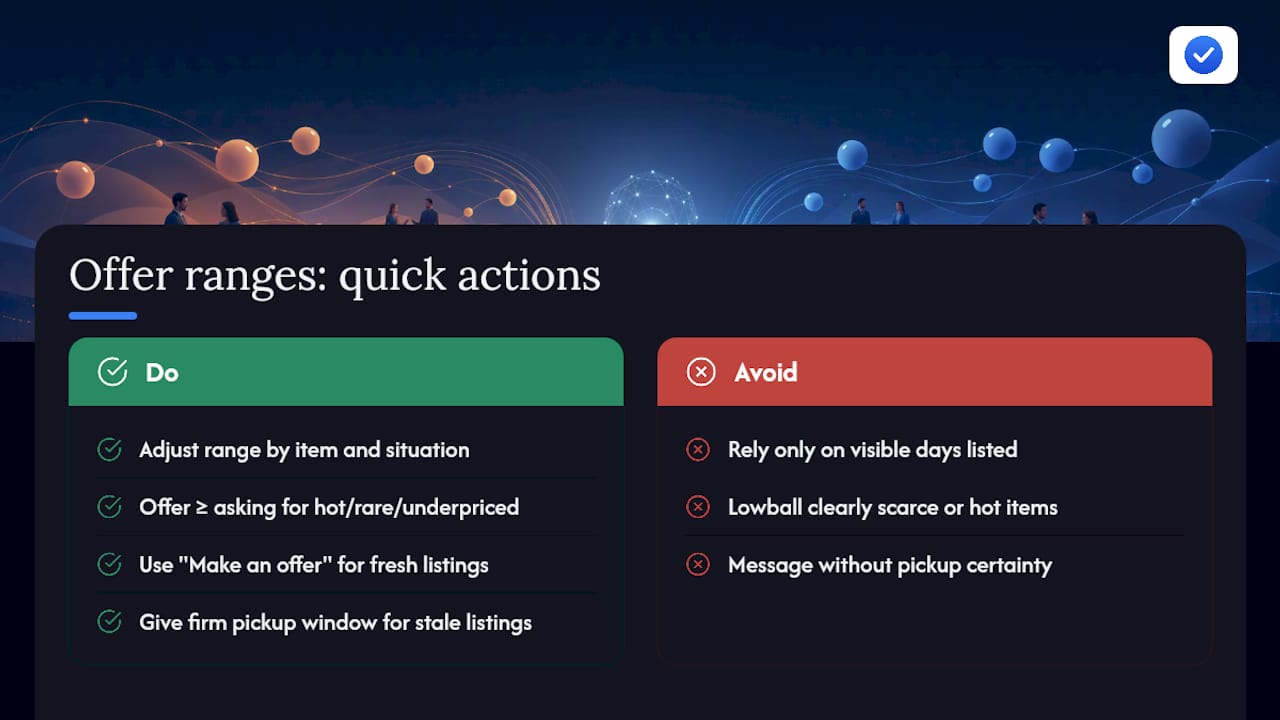
These ranges shift under a few common conditions. Hot items in high demand, rare or vintage pieces, and anything clearly underpriced deserve an offer at or above asking regardless of age, since more-than-half-off retail pricing is already a strong signal you shouldn't risk losing. Multiple active listings from the same seller, or a listing that's been relisted recently, mean you should treat the visible "days listed" number with suspicion until you confirm it another way.
For fresh listings, skip the back and forth and use Facebook's built-in "make an offer" button. It signals seriousness and tends to get faster responses than a plain message. For steady and stale listings, a direct message with a firm pickup window works better because it gives you room to explain your number. Offering same-day or next-day pickup certainty is often worth more to a seller than an extra $10 or $20, especially once a listing has been sitting for a while.
Why Does Listing Age Change Seller Motivation?
Listing age isn't just a clock. It's a proxy for how a seller is feeling about their item right now, and that feeling drives what they'll accept.
Facebook's algorithm gives fresh listings a visibility boost, so a seller posting today expects a flood of interest and multiple offers within hours. That confidence means little room to negotiate. Once a week has passed, that initial spike has faded, the seller has fielded a few lowball offers already, and patience starts to thin. By the two-week mark, many sellers are dealing with space pressure, a move deadline, or simple fatigue with the back and forth. That's when your negotiating leverage improves the most.
Visible signals matter more than the raw day count, though. A price drop tells you the seller already tried the market and got no bites at the original number. A relist can mean the same thing, or it can mean a seller deliberately refreshing an old post to dodge savvy buyers who track listing age.
- Fresh listings: sellers expect competition, offer near asking
- One-week mark: early patience wearing thin, modest discount works
- Two-week-plus: exhaustion sets in, larger discounts often land
- Price drops and relists: treat as amplifiers on top of raw days listed
How Do You Combine Days Listed With Other Buying Factors?
Days listed is a starting point, not the whole decision. Four other factors regularly override it, and knowing which one wins keeps you from either overpaying or losing a good deal to an overly aggressive lowball.
- Item category and rarity: a rare brand-name tool or vintage piece can justify a near-asking offer even after three weeks listed.
- Condition and missing parts: any flaw the listing didn't mention gives you room to go below your planned discount, regardless of age.
- Transport and pickup cost: heavy furniture or anything requiring a truck rental pushes your offer lower because your total cost includes logistics, not just the sticker price.
- Local competing listings: three similar items nearby means the seller has less leverage, even if their listing just went up.
Here's a simple way to weigh it all:
- Start with your days-listed tier (worth roughly 40% of your decision).
- Adjust for rarity or brand value (worth roughly 30%, and it can override the tier entirely for genuinely rare finds).
- Adjust for condition and transport cost (worth roughly 30%, and it's the tiebreaker on common, bulky items).
When a modifier and the days-listed tier point in opposite directions, let the modifier with the bigger dollar impact win.
How Do You Spot Listing History and Relists Fast?
Facebook doesn't always make the true listing age obvious, so a few quick checks save you from misreading a disguised relist as a fresh post.
- Look for the platform's own age tag, like "listed over a week ago," directly on the post.
- Reverse-search or scroll the photos for signs they've been reused, since sellers sometimes relist to refresh visibility and dodge buyers who track age.
- Check the seller's profile for other current listings, which can reveal a pattern of relisting or moving inventory fast.
- Save the search or item to a watchlist so you get notified if the price drops or the post reappears under a new date.
- Photo timestamps that don't match the "posted" date are a red flag
- Identical images across two separate posts almost always mean a relist
- A seller with five nearly identical items is moving volume, not offloading one prized piece
If the age looks obscured, ask directly. A simple message like "Is this still available, and could you send a current photo?" usually resolves the ambiguity fast, and DealFlipAI's listing analyzer automates this exact check by flagging relists and price history before you ever message the seller.
What Red Flags Should Make You Walk Away?
A great price on a stale listing isn't worth much if the deal itself is a scam. A handful of checks take thirty seconds and save you from a wasted trip or worse.
- Empty or brand-new seller profile with no history or friends in common
- Photos that look stock-sourced or inconsistent with the item's supposed condition
- Requests for payment apps, gift cards, or full payment before you've seen the item
- Refusal to meet in a public place or share a real pickup address
Before you send any offer, confirm the pickup location, ask for one live photo taken that day, and never send full payment upfront outside a protected channel.
Pro Tip: If a stale listing suddenly comes with pressure for immediate payment, that combination is a warning sign, not a bargain. Genuine sellers with a two-week-old listing are usually relieved to finally sell, not rushing you.
Sample First-Offer Scripts And The Math Behind Them
Numbers only help if you can turn them into a message. Here are three scripts, one per tier, plus the arithmetic behind each.
- Fresh listing script: "Hi, is the [item] still available? I can offer $[95-100% of asking] and pick up this evening if that works."
- Steady listing script: "Hi, I'm interested in the [item]. Would you take $[90-95% of asking]? I have a truck and can grab it tomorrow between 2 and 5pm."
- Stale listing script: "Hi, saw this has been up a bit. I can do $[80-85% of asking] cash, and I'm flexible on pickup this week, whatever works best for you."
Run the math before you send anything:
- $50 item, steady tier: offer $45, resale target $75, margin after typical marketplace fees lands around $25 to $27.
- $200 item, stale tier: offer $165, resale target $260, margin after fees runs roughly $75 to $80.
- $800 item, fresh tier: offer $780, resale target $950, margin after fees comes to about $130 to $140.
Before hitting send, confirm the item's condition matches the photos, set your absolute maximum price in writing to yourself, and pick a pickup window you can actually keep. The flip profit calculator handles the fee math for you if you want the exact number before you commit to an offer.
What Do You Do If The Seller Ignores Or Counters?
Silence and counteroffers both need a plan, or you'll end up negotiating against yourself one message at a time.
- Wait roughly 24 hours for fresh listings, 48 hours for steady ones, and up to three days for stale listings before sending a polite follow-up.
- If countered, raise your offer once, using a round, specific number, then hold there. Don't drift upward in small increments; that pattern signals desperation.
- If the listing is still active a week after your first message, send a timed follow-up and consider a small bump tied to certainty, like offering same-day pickup instead of "sometime this weekend."
- Walk away at your predetermined maximum. A missed deal costs less than a bad-margin flip.
What Resellers Get Wrong About Listing Age
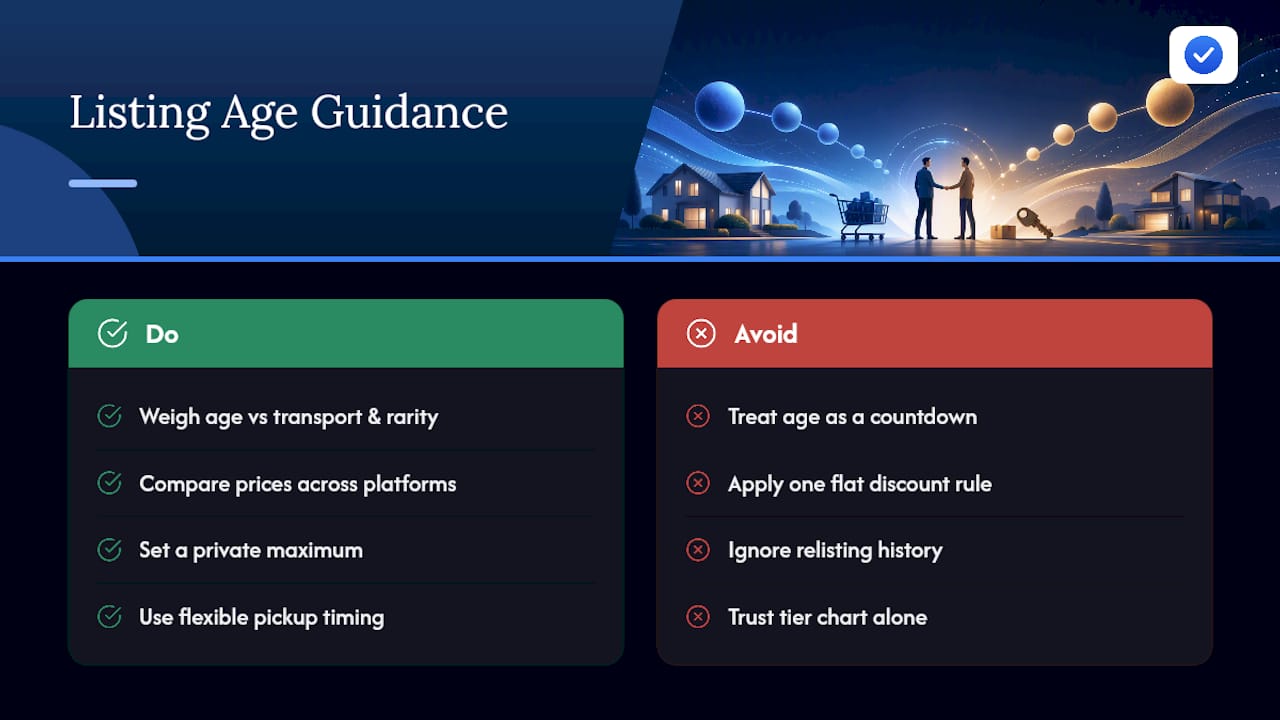
Most advice treats listing age like a countdown timer: wait long enough and the price drops itself. That's backwards. Age is a signal, not a guarantee, and treating it as the only variable is how resellers either overpay on day two or lowball themselves out of a great deal on day fifteen.
The bigger mistake is ignoring what the listing age is masking. A relisted item at "3 days" might actually be three weeks old and worth a stale-tier offer. A genuinely fresh listing on a rare, underpriced item deserves a near-asking offer even though the tier chart says otherwise, because comparing prices across platforms tells you the real story faster than the date stamp does.
What should you prioritize first? Weigh listing age against transport cost and brand rarity before you touch a percentage, then set a private maximum and use flexible pickup timing to close the gap. That approach, detailed further on seller history and offer strategy, consistently outperforms buyers who apply one flat discount rule to every category. The reader who wins deals isn't the one with the lowest offer. It's the one who reads the signals correctly and acts fast.
When Should You Let A Tool Handle The Days-Listed Math?
Running this heuristic by hand works fine for one or two listings a week. It falls apart once you're screening dozens of local posts across furniture, electronics, and tools every day, which is exactly where DealFlipAI is the alternative to manual spreadsheet tracking: it scores listing age, flags relists and price drops, and suggests a first-offer range automatically, so you spend your time messaging sellers instead of cross-checking photos.

The listing analyzer applies the days-listed tiers from this guide to any post you paste in, catching disguised relists before you waste a message on a seller who's already exhausted their patience with lowballers. It pairs with scam detection to flag empty profiles and inconsistent photos automatically, so you're not running the safety checklist by hand each time. When you're ready to check whether your planned offer actually protects your margin, run it through the flip profit calculator before you hit send.
Start by scanning a live listing analyzer report on a post you're already watching, and see what offer range it recommends against the one you had in mind.
Sources
- Aurascience
- How to Buy on Facebook Marketplace, According to a Top User | Apartment Therapy
- How to Negotiate on Facebook Marketplace (Nibble Technology blog)