

How seller history shapes your offer strategy when reselling
Seller history directly determines how much you should offer, how aggressively you should negotiate, and how much risk you are taking on. A seller with hundreds of positive reviews commands a different approach than one with a spotty record and a listing that has been sitting for two months. Getting this right is the difference between landing profitable flips and overpaying for headaches.
Here is what seller history signals and how it should shift your offers:
- High reputation, fresh listing: Expect less flexibility. Offer closer to asking price, around 80% of list price as a starting anchor, since the seller has options and knows it.
- Negative feedback history: Lower your offer and add contingencies. Negative feedback predicts higher risk of misrepresentation or deal failure.
- Long listing duration: The seller is likely motivated. Push harder on price and terms.
- Recent price drops: A clear signal the seller is adjusting expectations. Your offer has room to go lower.
- No prior sales history: Treat as higher risk. Start conservative and verify the item carefully.
Table of Contents
- How seller reputation affects pricing and your risk
- How listing history tells you when to push harder
- How Dealflip AI analyzes seller history to sharpen your offers
- Practical offer tactics based on what seller history tells you
- Why factoring seller history gives you a real edge in competitive offers
- Real-world scenarios where seller history changed the offer outcome
- Key Takeaways
How seller reputation affects pricing and your risk
Reputation is not just a trust badge. It is a pricing signal backed by research. Established sellers command price premiums because buyers are willing to pay more when they trust the transaction will go smoothly. That trust is earned through consistent positive feedback, fast shipping, and accurate descriptions.
The numbers behind reputation effects are striking. A 2010 study on eBay seller dynamics found that when a seller receives their first negative feedback, their weekly sales can swing by 13 percentage points, dropping from a positive 5% growth to negative 8%. Improving reputation by one grade can increase monthly revenue by 32%. Those figures tell you exactly how much weight buyers and the marketplace itself place on seller standing.
For you as a reseller making offers, this cuts both ways:
- Trusted sellers justify slightly higher offers because deal certainty is higher and the item is more likely to match its description.
- Low-reputation sellers carry adverse selection risk, meaning you cannot fully verify quality before buying. Price that risk in.
- Sudden spikes in negative feedback warn of potential deal hazards and warrant caution or a lower offer structure.
- Sellers with zero history are unknowns. Treat them like a first-time seller and verify everything you can before committing.
Pro Tip: Check the seller's feedback timeline, not just their overall score. A seller with many positive reviews but some negatives in recent days is a different risk profile than one with a clean recent record.
How listing history tells you when to push harder
Listing duration is one of the clearest signals of seller motivation. The longer an item sits, the more likely the seller is open to negotiating on price and terms. A listing posted yesterday gives you little leverage. One posted six weeks ago, with a price reduction along the way, tells you the seller is ready to deal.
What to look for in listing history:
- Days on market: More time listed usually means more flexibility. Use this to justify a lower opening offer.
- Price reductions: Each drop signals the seller has already adjusted expectations. Your offer can reflect that trend.
- Failed prior offers: If the listing notes previous offers fell through, research why. Inspection issues, unrealistic price expectations, or a difficult seller can all be factors.
- Relisted items: A listing that disappeared and came back often means a previous deal collapsed. The seller may be more motivated the second time around.
For fresh listings, the seller has not yet felt the pressure of time. Your offer needs to be more competitive on price to get attention. For older listings, you can lead with terms and flexibility, not just a lower number.
Pro Tip: On Facebook Marketplace, check if the listing has been edited recently. Frequent edits without price changes often mean the seller is actively monitoring interest but not getting offers. That is your opening.
How Dealflip AI analyzes seller history to sharpen your offers
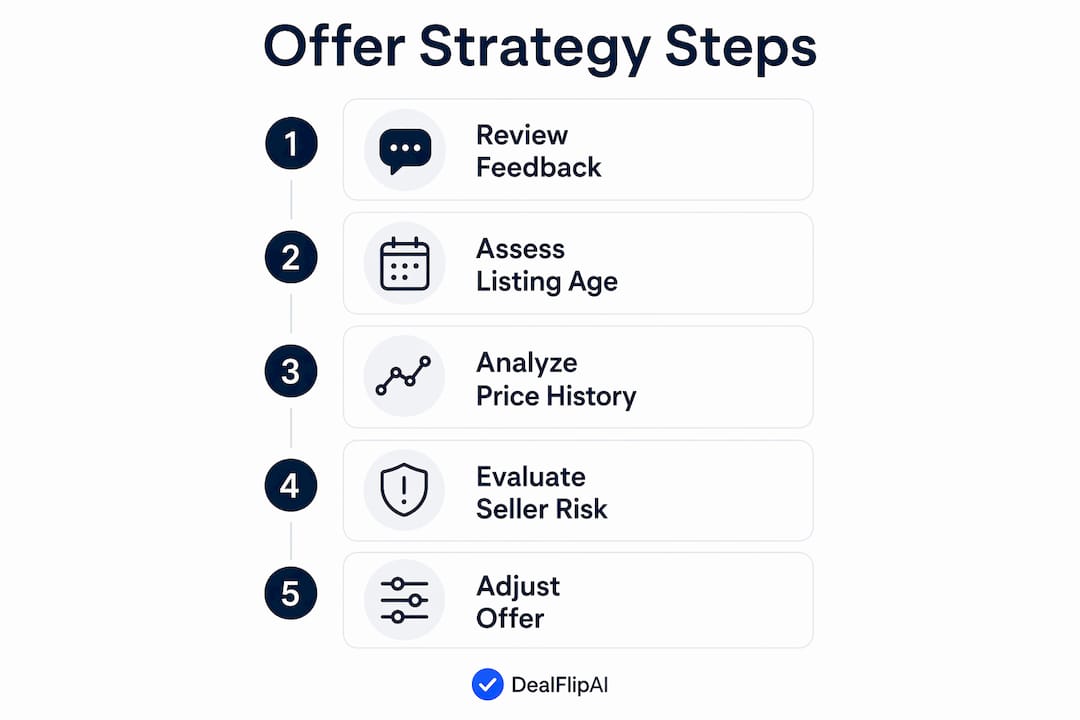
Dealflip AI pulls together seller reputation data, listing age, price history, and market comparables to score each listing and recommend an optimal first offer. Instead of guessing, you get a calculated starting point based on real signals.

Here is how AI-driven analysis translates seller history into offer decisions:
| Seller History Signal | What It Means | Offer Adjustment |
|---|---|---|
| High positive feedback, fresh listing | High trust, low urgency | Offer about eighty percent of list price |
| Mixed feedback, long listing duration | Moderate risk, some motivation | Offer about seventy to seventy-eight percent of list price |
| Negative feedback spike, any duration | Elevated risk, potential issues | Offer around sixty to seventy percent or pass |
| Zero feedback, new account | Unknown risk | Offer conservatively, verify item |
| Multiple price reductions, extended listing duration | High motivation to sell | Offer about sixty-five to seventy-five percent of list price |
Dealflip AI's listing analyzer tool applies this logic automatically, flagging scam risk, scoring profit potential, and suggesting your first offer number. You do not have to manually cross-reference feedback scores and listing age every time.
Key benefits of using AI to read seller history:
- Scam detection flags accounts with suspicious patterns before you engage.
- Deal scoring weights reputation, price, and listing age together into one actionable number.
- Real-time alerts surface fresh listings before other resellers see them, giving you first-mover advantage on motivated sellers.
- Offer transparency shows you exactly why a suggested price was calculated, so you can adjust with confidence.
Users report that Dealflip AI's offer suggestions have led to meaningful savings and stronger profit margins on Facebook Marketplace flips, particularly when the tool identifies listings where seller motivation is high but the price has not yet dropped to reflect it.
Practical offer tactics based on what seller history tells you
Knowing what seller history means is only useful if you act on it. Here is how to translate those signals into offers that win.
- For trusted, high-reputation sellers: Lead with a fair offer close to market value. These sellers get multiple inquiries and will not entertain lowball offers. Your edge is speed and clear communication, not price.
- For sellers with negative feedback: Build contingencies into your offer. Ask for more photos, request a meeting before finalizing, and price the risk into your number. Poor seller history predicts higher deal failure rates, so protect yourself.
- For long-listed items: Offer flexible closing terms alongside a lower price. Sellers who have been waiting often care as much about a clean, certain close as they do about the final number.
- For relisted or price-reduced items: Reference the listing history in your message. Acknowledging that the item has been available for a while signals you have done your research and are a serious buyer.
- On timing: Avoid submitting offers that expire over weekends or holidays when seller activity drops. Set expiration windows during weekday business hours to maximize response rates.
Reading seller feedback data and reputation scores goes beyond feedback scores. Pay attention to how quickly they respond to questions, how detailed their listing description is, and whether their photos look genuine. All of it feeds into your risk assessment.
Pro Tip: When messaging a motivated seller on a long-listed item, lead with your offer and a clear pickup or shipping plan. Sellers who have been waiting want certainty, not more back-and-forth.
Why factoring seller history gives you a real edge in competitive offers
Seller history affects every dimension of a successful offer: price, risk, timing, and deal certainty. Ignoring it means you are guessing. Using it means you are making calculated decisions that protect your margins and improve your closing rate.
The core reasons seller history belongs in every offer decision:
- Price accuracy: Reputation data and listing age tell you how much room exists to negotiate, so you are not leaving money on the table or insulting a seller with an unrealistic offer.
- Risk management: Negative feedback and sudden reputation drops are early warnings. Adjusting your offer structure or walking away protects your capital.
- Deal certainty: Sellers prioritize clean closes. Knowing a seller's history helps you structure an offer they will actually accept, not just the lowest number you can justify.
- Competitive advantage: Most resellers look at price and photos. You look at reputation trends, listing age, and price history. That extra layer is what separates consistent flippers from occasional ones.
Tools like Dealflip AI make this analysis fast and repeatable, turning what used to be manual research into a scored recommendation you can act on immediately.
Real-world scenarios where seller history changed the offer outcome
Scenario 1: The motivated long-lister. A reseller spots a gaming console listed for $280 on Facebook Marketplace. The listing is 47 days old with one price reduction from $320. The seller has 12 positive reviews and no negatives. The reseller offers $195, citing the listing age and price history in their message. The seller counters at $220. They close at $210. The reseller flips it for $310. Seller history made the negotiation possible.
Scenario 2: The red-flag account. A flipper finds a designer bag listed at $150, well below market. The seller has three reviews, two of which are negative from the past two weeks. The flipper uses Dealflip AI's scam checker and sees the account was created recently with inconsistent listing patterns. They pass. Two days later, the listing disappears and a buyer in a local reseller group reports being scammed. Seller history as a filter saved the flipper $150 and a bad experience.
Scenario 3: The premium seller worth paying for. A reseller finds a vintage camera from a seller with 340 positive reviews and a 99.4% rating. The listing is three days old at $400. Rather than lowballing, the reseller offers $360 with a fast pickup commitment. The seller accepts the same day. The reseller sells the camera for $520. Paying closer to asking price for a trusted seller was the right call because the deal certainty was high and the item matched its description exactly.
Key Takeaways
Seller history is the single most underused signal in competitive offer strategy, and resellers who read it consistently outperform those who focus on price alone.
| Point | Details |
|---|---|
| Reputation drives price premiums | Trusted sellers command higher prices; buyers pay more when deal certainty is high. |
| Negative feedback raises risk | A seller's first negative feedback drops weekly sales from +5% to -8%, signaling deal instability. |
| Listing age signals motivation | Longer time on market usually means the seller is open to negotiating on price and terms. |
| Offer timing affects acceptance | Avoid offers expiring on weekends or holidays when seller response rates drop. |
| AI tools sharpen every decision | Dealflip AI scores listings by reputation, price, and risk to recommend your optimal first offer. |