

An offer negotiation tactics checklist is a structured set of proven steps resellers use to negotiate better deals and increase profits on Facebook Marketplace. Without a checklist, most flippers "wing it" and leave money on the table. The best resellers treat every negotiation as a repeatable process, not a one-time gamble. This guide covers the core tactics, from preparation and anchoring to closing and avoiding costly mistakes, so you can walk into every deal with confidence and a clear plan.
1. What your offer negotiation tactics checklist must include first: preparation
Preparation accounts for 80% of successful negotiation outcomes. That single fact should change how you spend your time before sending any offer.
Most resellers skip straight to messaging a seller. The ones who consistently close profitable deals do the opposite. They research first, offer second.
Here is what your preparation checklist should cover:
- Define your target price. Know the maximum you will pay before you open a conversation. Use comparable listings to set a realistic range.
- Identify your BATNA. Your Best Alternative to a Negotiated Agreement is the next best deal you can walk away to. Knowing it removes desperation from your tone.
- Research the seller's position. Check how long the listing has been active. Older listings signal a motivated seller.
- Calculate your profit margin. Know your resale price, fees, and shipping costs before you negotiate the buy price.
- Use Dealflip AI. Dealflip AI scores listings by price, profit potential, and risk, so you enter every negotiation with data, not guesses.
Pro Tip: Spend at least 30 minutes on research before messaging a seller. Resellers who prepare thoroughly report stronger confidence and fewer impulsive decisions during the actual negotiation.
2. Anchoring, bolstering ranges, and first offers
Making the first offer sets the range of outcomes and typically yields better results for the party who moves first. This is called anchoring bias, and it works in your favor when you have solid data behind your number.

The key is to anchor low without insulting the seller. A first offer that is too extreme destroys rapport. A first offer grounded in market data feels reasonable even when it is aggressive.
Bolstering ranges are a proven way to signal flexibility while keeping your anchor strong. Instead of offering $80 on a $100 item, you offer a range of $80 to $95. Ranges spanning 5%–20% above your base price improve outcomes compared to single-number offers. The seller focuses on the top of your range, while your anchor stays at the bottom.
Use precise numbers instead of round ones. Offering $83 instead of $80 signals that you did your homework. Round numbers feel arbitrary. Precise numbers feel calculated and harder to argue with.
| Tactic | How to apply it | Why it works |
|---|---|---|
| First offer anchor | Open with your lowest acceptable price | Sets the negotiation ceiling in your favor |
| Bolstering range | Offer $80–$95 instead of $80 flat | Signals flexibility, keeps anchor low |
| Precise numbers | Use $83 instead of $80 | Implies research, reduces pushback |
| Walk-away price | Set it before you start | Prevents emotional overpaying |
Pro Tip: Present a range to signal flexibility without actually raising your anchor. The seller hears the top number. You stay committed to the bottom.
3. Tactical communication: calibrated questions, silence, and accusation audits
How you talk during a negotiation matters as much as what you offer. Three techniques consistently shift the dynamic in your favor: calibrated questions, silence, and accusation audits.
Calibrated questions shift the problem-solving burden to the other party. Instead of saying "I can only pay $80," ask "How am I supposed to make this work at that price?" The seller now has to justify their number or find a solution. Open-ended "What" and "How" questions unlock information and keep the conversation moving forward.
Silence after making an offer is one of the most underused tools in reseller negotiations. The person who speaks first after an offer is made often concedes ground. Send your offer, then wait. Resist the urge to fill the silence with justifications.
Accusation audits defuse objections before the seller raises them. You name the potential negatives yourself. For example: "I know this offer might seem low, but here is what the market data shows." Addressing concerns upfront builds credibility and reduces defensiveness.
- Mirroring: Repeat the last two or three words the seller says. It encourages them to keep talking and reveal more.
- Labeling: Name the seller's emotion. "It sounds like you have had a lot of lowball offers." This builds rapport fast.
- Script for Facebook Marketplace: "What would make this work for both of us?" is a simple calibrated question that opens doors without pressure.
Pro Tip: After sending your offer on Facebook Marketplace, close the app and wait. Checking every five minutes creates anxiety that leaks into your follow-up messages.
4. Managing counteroffers and closing the deal
Receiving a counteroffer is not a setback. It is a signal that the seller wants to deal. How you respond in the next 24–48 hours determines whether you close profitably or overpay.
Waiting 24–48 hours before responding to a counteroffer lets you analyze the new terms and respond from a position of calm rather than reaction. Impulsive counters almost always favor the seller. Resisting an immediate response is one of the most reliable ways to maintain negotiation leverage.
Use gradual, conditional concessions when you do move. Each concession should be smaller than the last and tied to something you get in return. For example: "I can go to $90 if you include the original box." This keeps momentum going without giving away margin.
Here is a closing checklist to follow:
- Respond to counteroffers in writing. Facebook Marketplace messages create a record.
- Make concessions smaller each round. Going from $80 to $88 to $91 signals you are near your limit.
- Avoid ultimatums unless you are ready to walk. Empty threats erode trust and reduce your chances of closing.
- Confirm final terms before meeting. Agree on price, condition, and pickup details in the chat.
- Use Dealflip AI's offer suggestion tool to validate whether the final price still makes sense for your margin.
Pro Tip: Keep your tone warm even when you are firm. Sellers on Facebook Marketplace are individuals, not corporations. A friendly message that holds a firm price closes more deals than an aggressive one.
5. Common mistakes to avoid in Facebook Marketplace negotiations
Even experienced flippers make errors that cost them deals or margin. Knowing the most common mistakes is the fastest way to stop making them.
- Impulsive counteroffers. Responding within seconds signals desperation. It tells the seller you want the item badly.
- Unrealistic anchors. Offering $20 on a $200 item does not anchor low. It ends the conversation.
- Revealing your walk-away price. Never say "I can go up to $100." The seller will hold out for exactly that number.
- Excessive concessions without reciprocity. If you keep dropping your price without getting anything back, you train the seller to keep pushing.
- Empty ultimatums. Saying "This is my final offer" three times destroys your credibility. Only say it when you mean it.
- Skipping the checklist. Resellers who skip preparation and rely on instinct consistently underperform those who prepare with a clear plan and data.
Use a written negotiation checklist template before every deal. It takes two minutes and prevents all six mistakes above.
Key takeaways
A structured offer negotiation tactics checklist, built on preparation, anchoring, calibrated communication, and disciplined counteroffer management, is the most reliable way to close profitable deals on Facebook Marketplace.
| Point | Details |
|---|---|
| Preparation drives outcomes | Spend at least 30 minutes researching comps, seller signals, and your profit margin before offering. |
| Anchor with a range | Use a 5%–20% bolstering range to signal flexibility while keeping your opening price low. |
| Use calibrated questions | Ask "What" and "How" questions to shift problem-solving to the seller and gather information. |
| Wait before countering | Hold 24–48 hours before responding to counteroffers to avoid impulsive, margin-eroding decisions. |
| Avoid empty ultimatums | Only say "final offer" when you are genuinely ready to walk away, or it will cost you credibility. |
What I have learned after years of watching resellers negotiate
I have seen resellers with great instincts lose deals they should have won. The pattern is almost always the same: they skipped preparation and relied on charm. Charm gets you into a conversation. Data gets you a profitable price.
The single biggest shift I have seen in resellers who go from occasional flippers to consistent earners is emotional discipline. They stop treating negotiation as a confrontation and start treating it as a problem to solve together. Trust and collaboration yield higher-value deals than aggressive demand strategies. That is not soft advice. It is what the research shows.
The most memorable deal I have watched unfold was a reseller who bought a vintage camera for $55 on Facebook Marketplace. The listing had been up for 19 days. The seller's original price was $120. The reseller did not lowball. They sent a precise offer of $57, asked one calibrated question about the lens condition, waited 36 hours, and closed at $60. The camera sold for $185 on another platform three days later.
What made that work was not luck. It was a checklist. The reseller knew their BATNA, their target price, and their walk-away number before they sent the first message. Tools like Dealflip AI make that kind of preparation faster by surfacing demand signals and scoring deal quality before you ever open a chat. If you are not using data to back your offers, you are leaving real money on the table every single week.
— Walsh Pex
Dealflip AI gives your negotiations a data edge
Every tactic in this guide works better when your numbers are solid before you start. Dealflip AI is built specifically for Facebook Marketplace resellers who want to stop guessing and start closing with confidence.
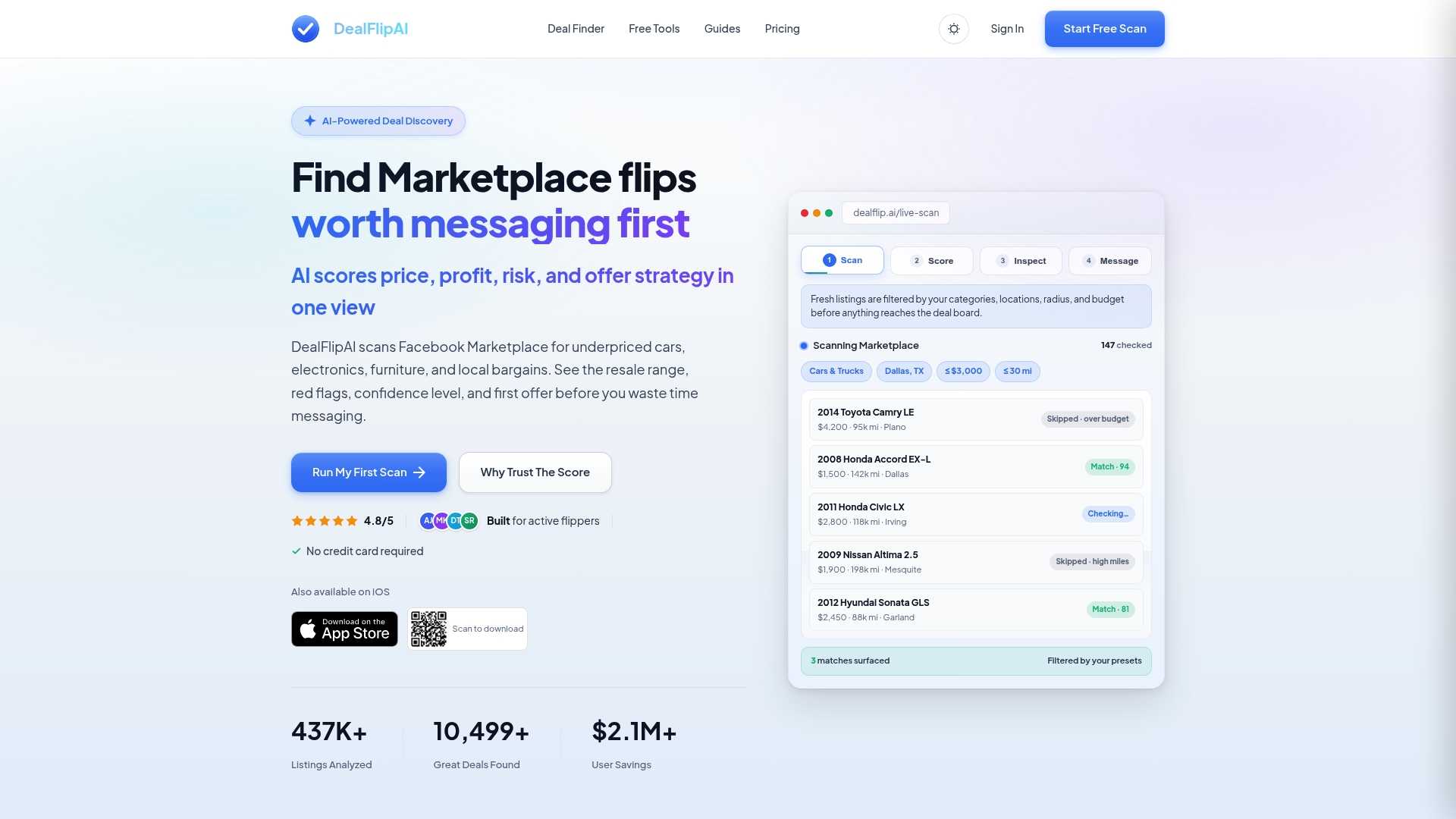
Dealflip AI's AI offer suggestion tool calculates your optimal first offer based on real market data and seller signals. The Flip Profit Calculator shows your exact margin before you commit to any price. Both tools are free to try and take seconds to use. You can also run a full listing analysis to check deal quality and scam risk before you ever message a seller. Better data means better anchors, stronger confidence, and more deals closed at the price you actually wanted.
FAQ
What is an offer negotiation tactics checklist?
An offer negotiation tactics checklist is a structured list of preparation steps, offer strategies, and communication techniques resellers follow to close deals at the best possible price.
Why does making the first offer matter in negotiations?
Making the first offer sets an anchor that influences every counteroffer and the final deal price. Resellers with solid market data benefit most from going first.
How do bolstering ranges work in practice?
A bolstering range presents a spread, such as $80 to $95, instead of a single number. The seller focuses on the top of the range while your anchor stays at the lower end, improving your final outcome.
When should you walk away from a Facebook Marketplace deal?
Walk away when the seller's final price exceeds your pre-set maximum or when your profit margin falls below your target. Knowing your walk-away price before negotiating prevents emotional overpaying.
How can Dealflip AI help with offer negotiation?
Dealflip AI scores listings by price, profit potential, and risk, and suggests optimal first offers based on market data. This gives resellers a data-backed starting point for every negotiation.