

Counter-offer negotiation in resale deals is the structured process of responding to buyer or seller proposals to secure better prices and terms on platforms like Facebook Marketplace. Most resellers leave money on the table because they treat every offer as a one-shot event rather than the opening move in a conversation. The resellers who consistently win use pricing buffers, seller psychology, and deal structure to control each negotiation from the first message. Tools like Dealflip AI give you the market data to back every counter with real numbers, not guesswork.
How to set pricing buffers for counter-offer negotiation resale deals
Pricing 10–30% above your bottom line is the single most reliable way to protect your profit margin before a negotiation even starts. Buyers on Facebook Marketplace typically open with offers 10–20% below your asking price. That behavior is predictable, and you can plan for it.
The table below shows how different buffer ranges interact with typical buyer behavior.
| Listing buffer above bottom line | Expected buyer opening offer | Your margin after negotiation |
|---|---|---|
| 10% above bottom line | 10–15% below ask | Near or at bottom line |
| 20% above bottom line | 10–20% below ask | 5–10% above bottom line |
| 30% above bottom line | 15–20% below ask | 10–15% above bottom line |
The 20–30% buffer range gives you the most room to close a deal while still hitting your target profit. A 10% buffer leaves almost no cushion if a buyer pushes hard.
Use local price comparison data to anchor your listing price to real market rates before you add the buffer. Pricing too far above market value kills interest before a negotiation can begin. The goal is a price that looks fair but gives you room to move.
Pro Tip: Dealflip AI's value estimator tool calculates a market-based price for any Facebook Marketplace listing, so you can set your buffer on top of a verified number rather than a guess.
What are the best timing and communication tactics for counter-offers?
Responding within 2 hours of receiving an offer dramatically increases your chance of closing the deal. Buyers on Facebook Marketplace message multiple sellers at once. A slow response hands the deal to someone else.

Cap your negotiations at two counter-offers per transaction. Going back and forth more than twice signals desperation and invites buyers to keep pushing lower. Two rounds is enough to find a fair price or walk away cleanly.
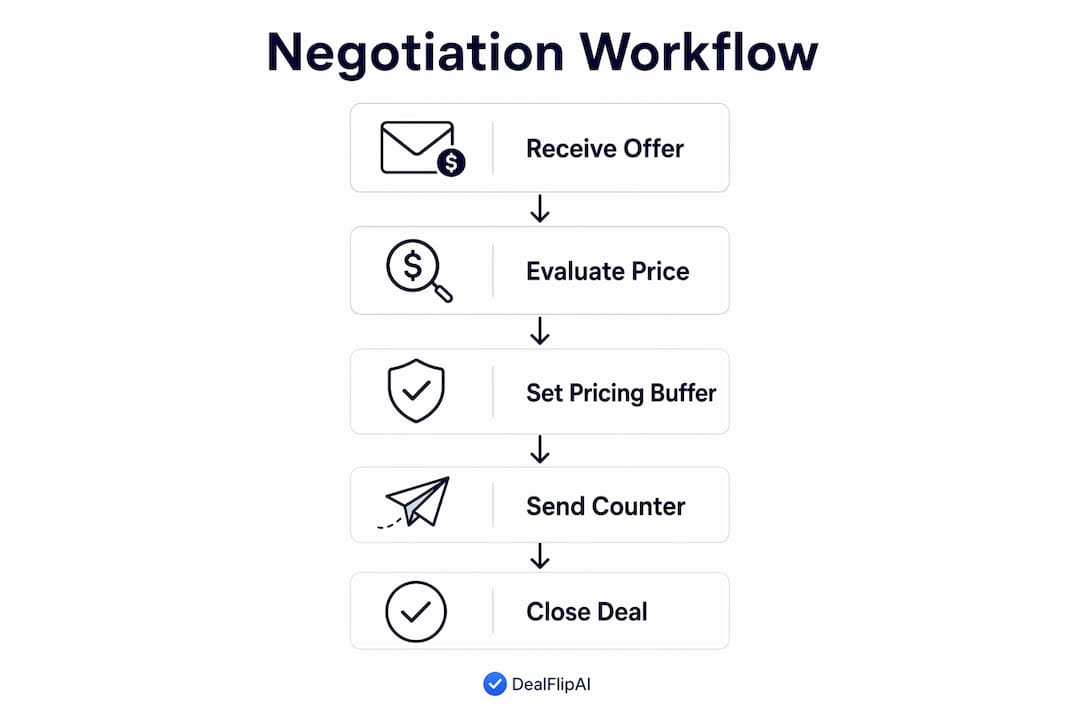
For offers below 55% of your asking price, decline or counter firmly without apologizing. A response like "I appreciate the offer, but the lowest I can go is $X" is professional and leaves the door open without rewarding a lowball.
Here is a quick list of communication dos and don'ts that experienced resellers follow:
- Do respond quickly and stay polite, even when the offer is insulting
- Do state your counter clearly with a specific number, not a range
- Do explain your price briefly with one supporting fact, such as condition or recent sales
- Don't accept the first offer unless it meets your bottom line
- Don't use emotional language or make the buyer feel judged
- Don't send multiple follow-up messages if a buyer goes quiet
Pro Tip: Presenting multiple simultaneous offers reveals what the buyer values most. Try offering three versions of the deal at different price and condition combinations to see which one they respond to first.
How does seller motivation affect negotiation flexibility?
Seller motivation is the single biggest variable in any resale agreement negotiation. A motivated seller, such as someone running an estate sale or relocating for work, offers 8–12% price flexibility. An unmotivated seller, someone who listed casually and has no urgency, offers 0–2% flexibility.
Identifying motivation early saves you time. Ask direct questions like "How long has this been listed?" or "Are you looking to sell quickly?" A seller who answers "I need this gone by the weekend" is telling you exactly how much room you have.
Listings older than 45 days signal flexibility. A seller who has not moved an item in six weeks is far more open to a real counter than someone who listed yesterday. Use listing age as a negotiation signal, not just a curiosity.
Estate sales and flea market operators are a special case. Operators at these venues are often pre-approved to accept 25–35% below sticker price. Asking "What is the best you can do?" is not rude. It is expected. The floor price is already set before you arrive.
What deal terms beyond price improve counter-offer acceptance?
Negotiations that address deal structure beyond price improve acceptance rates by 25% compared to price-only counters. That number reflects a simple truth: sellers care about more than the dollar amount. They care about speed, convenience, and certainty.
When you send a counter-offer, include terms that make the deal easier for the seller to say yes to. Offering to pick up same-day, pay cash, or skip contingencies removes friction that a higher price alone cannot fix.
| Deal element | Negotiation impact |
|---|---|
| Closing timeline | Faster pickup increases acceptance for motivated sellers |
| Payment method | Cash or instant transfer reduces seller hesitation |
| Contingencies | Removing inspection clauses speeds up agreement |
| Bulk purchase | Reduces per-item cost and clears seller inventory faster |
Bulk deals in resale inventory can reduce your per-item cost by 30–60% when you frame the offer as solving the seller's clearance problem. Instead of "I'll take three for less," say "I can clear all five today if the price works." That framing shifts the conversation from discount to solution.
Citing a competing offer in writing also strengthens your position. Verifiable competing offers significantly improve counter-offer acceptance rates because they give the seller a concrete reason to move.
Pro Tip: Frame your counter as a package, not a price cut. "I'll pay $X, pick up today, and take everything" is a stronger offer than "$X, take it or leave it," even if the dollar amount is identical.
Common mistakes that kill resale negotiation outcomes
The most common mistake resellers make is over-discounting out of anxiety. Dropping your price before the buyer even pushes back signals that your original price was inflated. Hold your number until you receive an actual counter.
Ignoring seller cues is the second major error. If a seller says "I'm not in a rush," that is not small talk. It tells you that urgency-based tactics will not work and that you need a different angle, such as convenience or bulk volume.
Watch out for these specific mistakes that stall or kill deals:
- Sending ultimatums without data to back them up
- Accepting a lowball offer and then feeling resentful, which affects future negotiations
- Failing to follow up after a stalled conversation with a simple, friendly message
- Letting silence from a buyer push you into unnecessary concessions
- Negotiating without knowing your actual bottom line before the conversation starts
Recovering from a stalled negotiation is straightforward. Send one follow-up message after 24–48 hours with a small, specific adjustment. "I can do $X if you're still interested" reopens the conversation without desperation. Negotiation is a problem-solving activity, not a confrontation. Keeping that mindset prevents most of the emotional mistakes that cost resellers money.
Key Takeaways
Effective counter-offer negotiation in resale deals requires pricing buffers, fast responses, seller motivation awareness, and deal structure thinking to consistently protect your profit margins.
| Point | Details |
|---|---|
| Set a pricing buffer | List 10–30% above your bottom line to absorb standard buyer discounts. |
| Respond within 2 hours | Fast replies prevent buyers from moving to the next seller. |
| Read seller motivation | Motivated sellers offer 8–12% flexibility; unmotivated sellers offer almost none. |
| Negotiate the full deal | Adding terms like pickup timing and bulk volume improves acceptance by 25%. |
| Cap counter-offers at two | More than two rounds signals desperation and invites further lowballing. |
Why I treat negotiation as a workflow, not a conversation
Most resellers approach negotiation as a live performance where they have to think on their feet. That mindset creates inconsistency. Some days you hold firm and win. Other days you fold too early because you are tired or distracted.
The shift that changed my results was treating every negotiation as a repeatable system. I set my bottom line before I list. I define the offer threshold where I counter versus decline. I use data-driven thresholds to automate those decisions so emotion never enters the equation. When an offer comes in below 55% of ask, I do not deliberate. I counter at a fixed number or decline. That consistency builds a reputation with repeat buyers and saves hours every week.
The resellers I see struggle the most are the ones who treat each deal as unique. Every deal shares the same structure: opening offer, counter, close or walk. Once you accept that structure, you stop improvising and start executing. Preparation, not personality, is what closes deals at the right price.
— Walsh Pex
Dealflip AI gives you the data to negotiate with confidence
Knowing your numbers before a negotiation starts is the difference between holding firm and folding under pressure. Dealflip AI is built specifically for Facebook Marketplace resellers who want data behind every offer they make or receive.
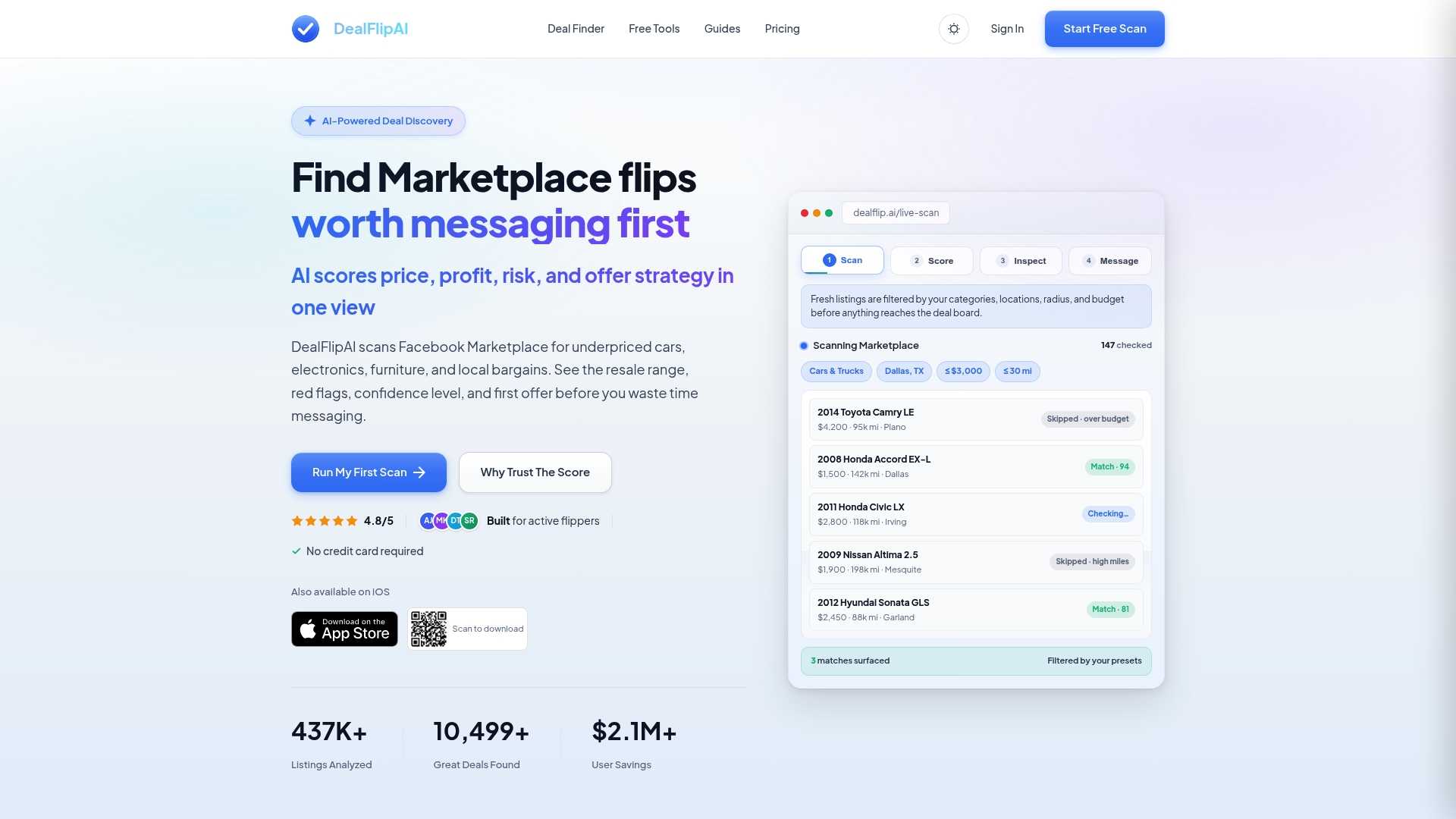
The listing analyzer tool scores any Facebook Marketplace listing for price, profit potential, and risk in seconds. The offer suggestion tool calculates your optimal opening offer based on market data and seller signals, so you never have to guess where to start. If you want to put all of this into practice on real deals, the Facebook Marketplace deal guide walks you through finding and negotiating high-potential listings from start to finish.
FAQ
What is counter-offer negotiation in resale deals?
Counter-offer negotiation in resale deals is the back-and-forth process of responding to buyer or seller price proposals to reach a mutually acceptable deal. It applies to any platform where prices are not fixed, including Facebook Marketplace, eBay, and estate sales.
How much should I price above my bottom line?
Price 10–30% above your bottom line to absorb standard buyer discounts of 10–20% without sacrificing profit. A 20–30% buffer gives you the most flexibility.
When should I decline a counter-offer outright?
Decline or counter firmly when an offer falls below 55% of your asking price. Accepting offers that low sets a bad precedent and signals that your prices are inflated.
How does listing age affect negotiation?
Listings older than 45 days signal that the seller is open to lower offers. Use listing age as a cue to push harder on price or propose a bulk deal.
Does negotiating beyond price really help close deals?
Yes. Counters that include terms like pickup timing, payment method, and bulk volume improve acceptance rates by 25% compared to price-only negotiations.