

An online resale value estimate gives you a data-backed price range and a confidence cue, not a promise. Treat the number as your starting point: check what the confidence score is telling you, run your VIN through a history check, and then compare that range against at least two real offers before you decide what to accept.
TL;DR:
- Online resale estimates rely on recent sold transaction data, regional demand, and VIN-based history flags, making the confidence score critical for trustworthiness.
- Mileage past common depreciation points, accident history, and mechanical condition significantly influence a vehicle's actual value, often more than cosmetic repairs.
- Trade-in values closely match dealer resale prices, private-party estimates are higher but require more effort, and market timing can impact the final offer.
- Variations due to local demand, climate, fuel prices, and dealer inventory mean national estimates should be cross-checked with regional sales data for accuracy.
- Combining multiple estimates with dealer offers and a history report yields the most reliable final price and helps avoid common valuation pitfalls.
Table of Contents
- How Online Resale Estimators Work
- What Factors Actually Move Your Vehicle's Value
- Trade-In, Private-Party, or Retail: What's the Difference?
- How Accurate Are These Estimates, Really?
- Your Step-by-Step Checklist Before You Sell
- Sell, Trade In, or Hold: A Quick Decision Rule
- How DealFlipAI Approaches Vehicle Valuation
- Common Mistakes People Make Estimating Resale Value
- Why Your Location Changes the Number
- Author Perspective: Set Your Expectations Right
- Put These Numbers to Work With DealFlipAI
- Resources Worth Checking Before You Sell
- Sources
How Online Resale Estimators Work
Every estimate you see is built from a mix of raw data. Most tools pull from sold transactions, auction results, current asking prices, dealer sales, and VIN-linked vehicle history feeds. The mix matters more than people realize.
Some services lean heavily on recency, giving far more weight to a sale from last week than one from three months ago, which keeps the estimate aligned with current resale value trends rather than stale market data. Geographic adjustments matter too. A truck that sells fast in a rural market can sit for weeks in a dense city where buyers want smaller vehicles.
Here's what typically feeds a solid estimate:
- Sold transaction records from dealers and auctions
- Recent private-party sale prices in your region
- VIN-based history flags for accidents or title issues
- A comparables count, which becomes the backbone of the confidence score
Estimates built on sold prices tend to run more realistic than those built on asking prices, since sellers routinely list higher than they eventually accept. A reseller's guide to automated valuation models breaks down how these scoring systems actually process comparables if you want the mechanics behind the number.
What Factors Actually Move Your Vehicle's Value
Mileage and age do the heaviest lifting, but not in a straight line. Depreciation accelerates past certain breakpoints, commonly 60,000 and 100,000 miles, where buyers start budgeting for major maintenance. A car at 58,000 miles and one at 62,000 miles can price closer together than you'd expect. Cross that 60,000 line, and the gap widens fast.
Here's the rough order of impact on most estimates:
- Mileage and age relative to typical breakpoints for the model
- Mechanical and cosmetic condition, including anything a dealer would need to recondition before resale
- Vehicle history, especially reported accidents or branded titles, which trigger automatic VIN-based penalties
- Trim level and options, since heated seats or a tow package hold value differently by region
- Local demand, which can swing a number more than a cosmetic flaw ever will
Pro Tip: Spend money on safety issues and glass before you spend a dollar on paint touch-ups. Buyers and dealers weight mechanical soundness far more heavily than minor cosmetic wear, and a cracked windshield can tank an offer more than a scuffed bumper ever would.
Trade-In, Private-Party, or Retail: What's the Difference?
Each estimate type assumes a different transaction, and confusing them is where most sellers get disappointed.
- Trade-in value tracks closely with auction and wholesale pricing, since dealers plan to recondition and resell the car at a markup.
- Private-party value usually lands higher than trade-in because you're cutting out the dealer's margin, though Consumer Reports notes it still sits below retail since you're not offering financing or a warranty.
- Retail/resale value reflects what a dealer charges a buyer, inflated by reconditioning costs, financing perks, and warranty coverage.
Pick trade-in when speed and simplicity matter more than every last dollar. Pick private-party when you have time to manage inquiries and want the higher number.
How Accurate Are These Estimates, Really?
A tight range, say a $1,200 spread, means the tool found plenty of recent, closely matching comparables. A wide range, closer to $4,000, usually signals thin data or a car with unusual mileage, trim, or damage history that doesn't match many recent sales.
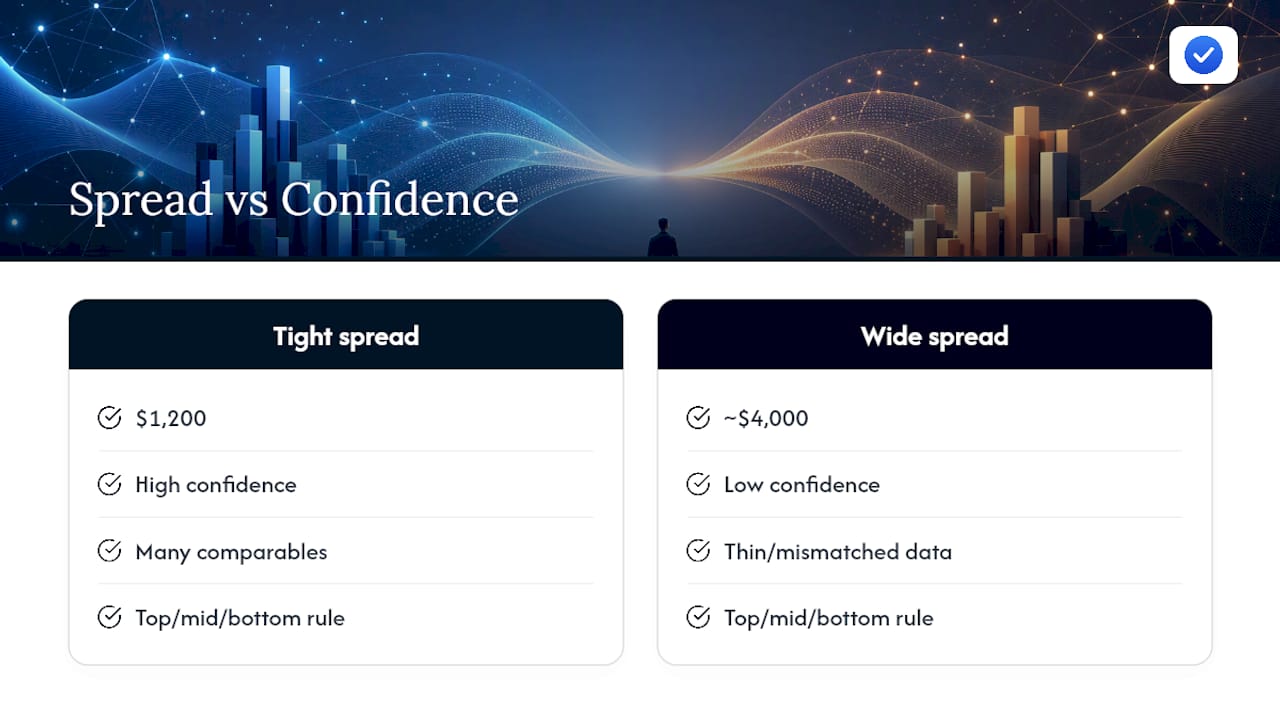
Confidence scoring exists specifically to flag this. Reliable valuation tools track comparable count and recency as the two biggest levers on how much you should trust a given number. A low-confidence estimate isn't wrong, it's just less anchored.
Estimators also miss things by design: unreported accident damage, hyperlocal demand spikes, or a market that moved in the two weeks since the last data refresh. A workable formula is to treat the top of a published range as your high offer, the midpoint as your realistic expectation, and the bottom as your floor if you need to sell fast.
The most reliable number you'll get isn't from any single source. It comes from stacking two or three independent estimates against actual dealer offers.
Your Step-by-Step Checklist Before You Sell
Getting a tighter estimate and a better final check comes down to sequencing. Do these in order:
- Gather your paperwork first. Pull your VIN, title status, service records, and exact current mileage. Every estimator needs these to avoid defaulting to rough averages.
- Run three separate estimates. Record each range and confidence score, then flag any outlier that doesn't match the other two.
- Fix only what pays back. A deep clean, safety repairs, and glass fixes tend to raise offers more than a full cosmetic overhaul with a weak payoff.
- Collect at least two dealer offers and one private-party price. Subtract your loan payoff and any transaction fees to see real net proceeds, not the headline number.
- Watch the calendar. Convertibles move in spring, trucks and SUVs move before winter. Listing at the wrong time can cost you hundreds even with a perfect estimate.
Pro Tip: Don't accept the first trade-in offer just because it matches your online estimate. Dealers adjust offers based on their current lot needs, and a model they're short on can fetch noticeably more than the baseline number suggests.
Sell, Trade In, or Hold: A Quick Decision Rule
Run the math before you commit to a route. A rough rule: if the gap between your best private-party offer and your best trade-in offer is smaller than the value of your time and hassle, taking the trade-in might make sense.
- Trade-in closes in a day, involves no listing effort, but nets the lowest number.
- Private-party sale usually nets several hundred to a few thousand dollars more, but costs you weeks of showings, negotiation, and payment risk.
- Holding makes sense only if your model's demand is trending up seasonally or your mileage breakpoint is still months away.
If your time is tight or your car has issues you don't want to disclose in a private sale, convenience wins. If you have weeks to spare and a clean history, the private-party math usually favors patience.
How DealFlipAI Approaches Vehicle Valuation
DealFlipAI was built around the same principle driving every section above: a number is only as useful as the confidence behind it. The platform scores listings using marketplace comparables, seller signals, and a risk model, then surfaces a transparent valuation with a suggested first offer instead of a flat number with no context.
That scoring layer also flags scam signals and pushes real-time alerts when a fresh listing matches your criteria, which matters just as much on the buying side of resale as the selling side. Users report meaningful savings when they act on a confidence-scored deal instead of a gut guess. If you've followed the checklist above, DealFlipAI functions as another independent data point to stack against your dealer and private-party offers, exactly the redundancy that tightens your final number.
Common Mistakes People Make Estimating Resale Value
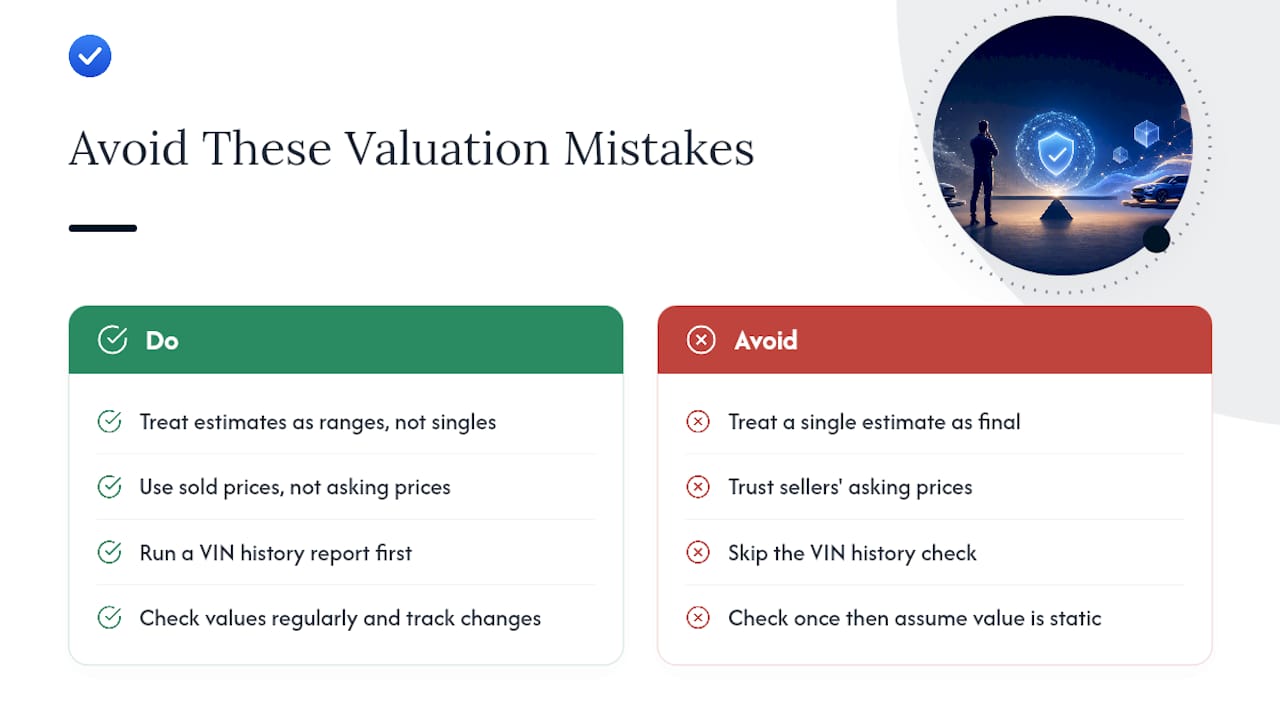
The biggest misconception is treating any single estimate as a final number. It's a statistical range built from comparable sales, and comparable doesn't mean identical. Two cars with the same year, make, and model can differ by thousands once you factor in accident history, regional demand, and reconditioning needs.
Another common mistake: trusting asking prices over sold prices. Browsing listings and averaging what sellers are asking gives you an inflated picture, since asking prices reflect hope, not history. Sold-data-backed estimates run lower and closer to reality for exactly this reason.
People also skip the VIN check, assuming a clean-looking car has a clean history. A single reported accident, even a minor one, can trigger an automatic markdown that no amount of detailing will reverse. Get the history report before you argue with an estimate.
There's also a timing trap: checking your car's value once and assuming it's static. Values shift weekly with fuel prices, seasonal demand, and regional inventory. A number pulled in January can be stale by April.
Finally, sellers frequently ignore confidence scores entirely, anchoring on the midpoint of a wide range as if it were guaranteed. A wide range with low confidence is a signal to gather more data, not a green light to negotiate from the middle.
Why Your Location Changes the Number
Two identical trucks, one in Phoenix and one in Minneapolis, can carry different values simply because of climate and demand. Four-wheel-drive trims command a premium in snow states and barely move the needle in the Southwest. Convertibles do the reverse.
Fuel prices play a role too. When gas spikes regionally, larger SUVs and trucks often see faster local depreciation than compact sedans, even if national averages haven't caught up yet. Rural markets also tend to value higher mileage more tolerably than dense urban markets, where buyers expect low mileage and public transit reduces overall demand for a second car.
Dealer inventory needs compound all of this. A dealer overstocked on sedans will lowball your trade-in even if the national estimate looks strong, while a dealer short on your exact trim might beat the estimate outright. This is why a national average from any tool should be read as a starting point, then cross-checked against what's actually moving in your zip code. Local Facebook Marketplace and classified listings, cross-referenced with sold-price data, often reveal these regional gaps faster than a national estimator can adjust.
Author Perspective: Set Your Expectations Right
Every estimate you read is a baseline built from history, not a forecast of your specific negotiation. The single best habit is comparing multiple sources and then testing the market with real offers, since no algorithm knows what a specific dealer needs on their lot this week. Numbers get you close. Live offers get you the actual price.
— Walsh Pex
Put These Numbers to Work With DealFlipAI
This platform turns the confidence-scoring habit this article recommends into something you can run in seconds instead of building manually across three browser tabs. Where a generic estimator gives you a range and stops, this platform adds a risk read and a suggested first offer, so you know not just what a listing is worth but what to actually say to the seller.
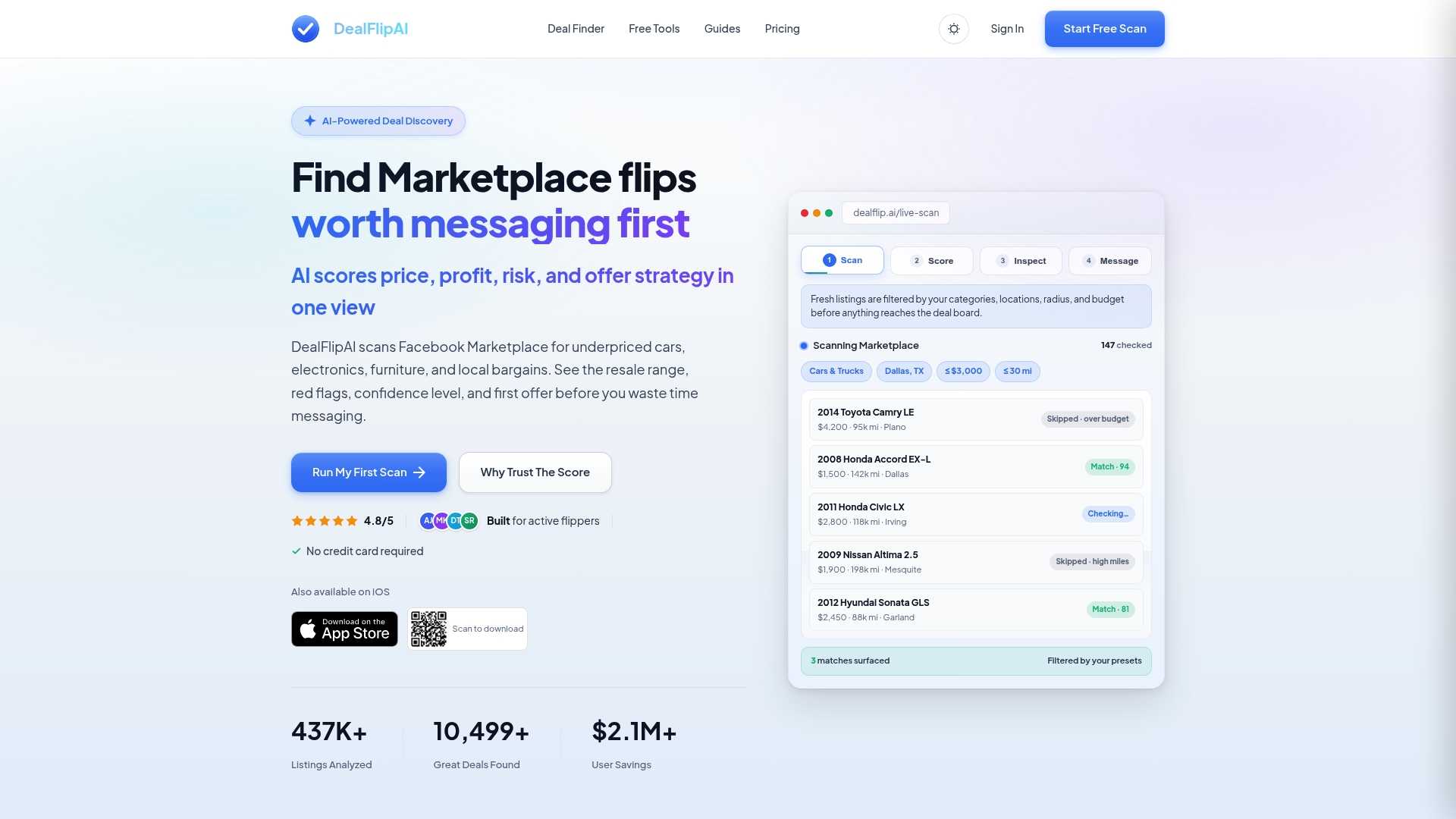
Say you spot a used pickup on Facebook Marketplace priced $2,000 under what your other estimates suggest. Instead of guessing whether that's a steal or a red flag, run it through the free listing analyzer to get a confidence-scored valuation and scam check in one pass. Pair that with the Facebook Marketplace value estimator and the broader tools hub for profit and fee math before you make an offer. Start with the listing analyzer on your next find and see where the number lands.
Resources Worth Checking Before You Sell
Cross-check any estimate against a vehicle history report to catch accident or title issues the price alone won't show. Consumer Reports' car value estimator is useful for understanding trade-in versus private-party gaps, and Dealflip AI's listing analyzer rounds out the picture with confidence-scored marketplace data for anything you're buying or reselling locally.
Sources
- What's my stuff worth? Current resale value | NestLedger
- Car Value Estimator | Trade In & Market Value - Consumer Reports