

An automated valuation model, or AVM, for resellers is software that scores a live listing on fair resale value, profit potential, and risk using its photos, text, price, and comparable sales. You run it before you message a seller, not after. It tells you in seconds whether an item is worth chasing, what a fair offer looks like, and whether the listing smells like a scam.
Use an AVM to triage a flood of low-effort listings, generate a first offer, and flag likely fakes before you waste a drive across town. Pause and check manually when you're looking at high-value items, vintage or collectible pieces, or anything the model flags with low confidence. DealFlipAI's scoring engine, for example, is built on the same principle that drives the best price-prediction research: a fine-tuned model on Hugging Face reports a Mean Absolute Error of $47 on product pricing, while hybrid systems that combine regression models with a language model layer have pushed SMAPE error down from about 82% to 67%.
Here's the quick version:
- What it estimates: fair market price, expected profit margin, and risk score for one specific listing.
- What it uses: the title, description, photos, condition notes, location, and recent comparable sales.
- When to trust it: high-confidence, common-category items (electronics, furniture, tools).
- When to slow down: vintage goods, bulk lots, or anything with thin or blurry photos.
Key Takeaways
A reseller AVM works by combining regression-based price prediction with a language-model logic layer that corrects semantic and quantity errors regression alone can't catch.
| Point | Details |
|---|---|
| Definition | A reseller AVM estimates fair value, profit potential, and risk for one listing using photos, text, comps, and location. |
| Trust the metrics | MAE and SMAPE tell you expected dollar and percent error; a fine-tuned model reported an MAE of $47. |
| Hybrid beats single-method | Pairing regression with an LLM logic layer cut SMAPE from 82% to 67% by fixing bulk-pricing errors. |
| Human check stays required | Vintage, high-value, and low-confidence listings still need manual verification before you offer. |
| DealFlipAI fit | DealFlipAI applies this scoring model to Facebook Marketplace, pairing profit scores with a documented methodology. |
Table of Contents
- What Is Automated Valuation Model Explained for Resellers?
- What Do MAE and SMAPE Actually Mean for Your Offer?
- How Do You Use an AVM in a Real Flipping Workflow?
- How Do You Judge Whether an AVM Tool Is Worth Trusting?
- Why DealFlipAI Fits the Way Resellers Actually Work
- What Ethical and Privacy Issues Come With AVM Pricing?
- How Do You Plug an AVM Into Your Existing Reseller Setup?
- How Do Seasons and Local Markets Throw Off AVM Prices?
- Where Has AVM Pricing Actually Worked in the Real World?
- Statistical, Machine Learning, or Hybrid: Which AVM Type Should You Trust?
- Try DealFlipAI on Your Next 30 Listings
- Frequently Asked Questions
- Sources
What Is Automated Valuation Model Explained for Resellers?
An automated valuation model, explained in plain terms for flipping, is a pricing engine trained to answer one question fast: is this listing underpriced, and by how much? Traditional AVMs, the kind lenders use for real estate, look nothing like this. A reseller AVM has to work off messy, inconsistent inputs from strangers posting couches and PlayStation 5s at 11 p.m., and it has to return an answer before someone else grabs the deal.
That difference in inputs and speed is why the architecture behind reseller AVMs looks more like modern e-commerce pricing research than a bank's appraisal tool.
The inputs that feed the model
A reseller AVM pulls signals from several places at once:
- Listing title and free-text description
- Photos (angle, lighting, visible damage, background clutter)
- Stated condition ("like new," "used," "for parts")
- Location and local market density
- Recent comparable sales in the same category
- Seller behavior signals (response time, price history, account age)
- Structured metadata like quantity, model year, or brand
Miss one of these and the estimate drifts. A listing with no interior photos of a couch, for instance, forces the model to guess wear it can't see.
How the architecture actually works
Most competitive systems today aren't a single algorithm. They're a stack. A gradient-boosted regressor like XGBoost handles the numeric heavy lifting, price magnitude, based on structured and comp data. Multimodal pipelines fuse that regression output with image embeddings and text features, and one open project using this approach reported an MAE of roughly 13.86 on its own dataset, a reminder that these figures are always dataset-specific.
Layered on top of the regressor is often a large language model acting as a logic checker, not a price generator. It classifies whether a listing is a single unit or a bulk lot, flags nonsensical outliers, and applies deterministic rules the regressor can't reason about on its own.
The numbers behind the hybrid approach: A system pairing XGBoost with an LLM logic layer cut SMAPE from about 82% down to 67% largely by fixing bulk-versus-single-unit mistakes that pure regression models kept making.
Pro Tip: Upload clear, well-lit photos and set the condition flag honestly before running any AVM check. Garbage inputs produce garbage price bands, no matter how good the model is.
What Do MAE and SMAPE Actually Mean for Your Offer?
Two metrics matter most when you're judging whether an AVM's number is worth trusting: Mean Absolute Error (MAE) and Symmetric Mean Absolute Percentage Error (SMAPE). MAE tells you the expected dollar miss. SMAPE tells you the expected percent miss, which matters more once you're comparing a $30 lamp to a $3,000 sectional. A confidence score puts a probability band around both, telling you how sure the model is on this specific listing rather than on average.
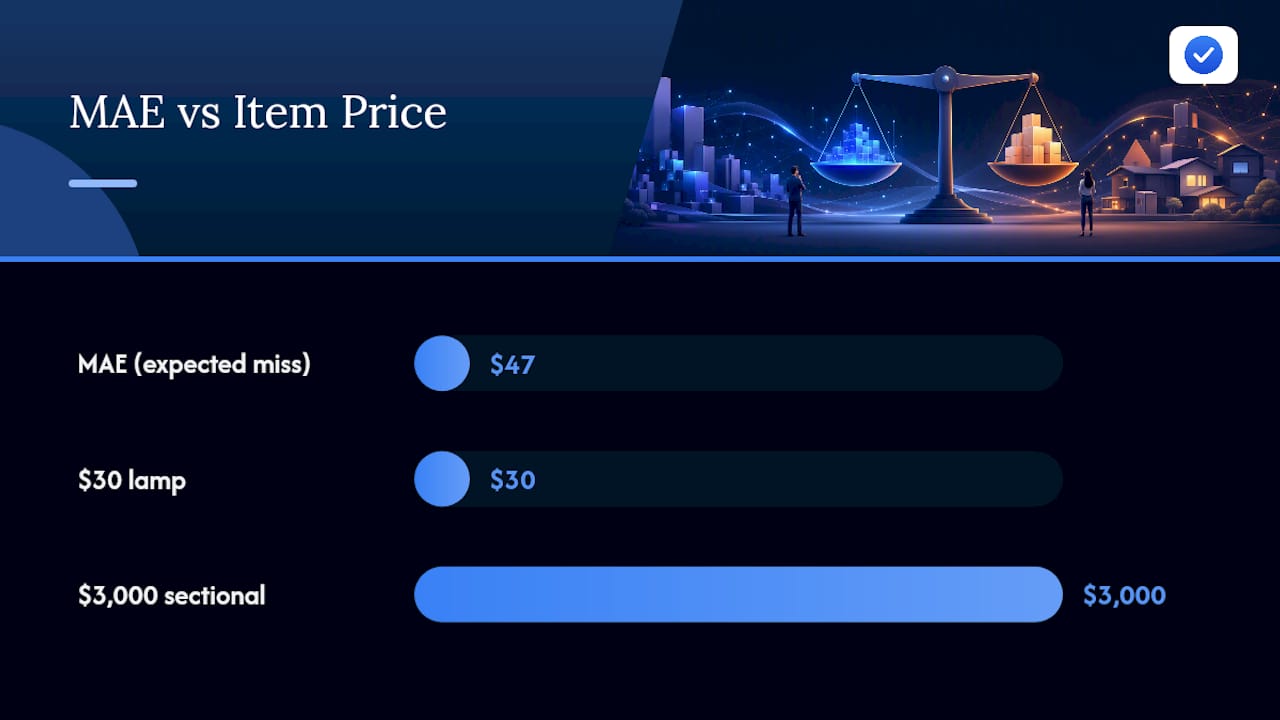
A fine-tuned Llama 3.1 model built for product price prediction reported an MAE of $47, a 38% improvement over GPT-4o Mini and a 51% improvement over traditional machine-learning baselines on the same task. On a $40 item, that error range is nearly worthless. On a $2,000 item, it's tight enough to build a real offer around.
Common failure modes to watch for:
- Bulk vs. single-unit confusion (pricing a 10-pack like it's one item)
- Rare or vintage pieces the model has few comps for
- Missing or dark photos that hide damage
- Mis-tagged condition ("new" that's clearly used)
- Regional and seasonal price swings the training data hasn't caught up to
- Fake or bait listings designed to lure a meeting
Industry reporting on recommerce backs this up: image recognition and automated pricing speed up triage, but platforms still lean on human verification for complex or high-value cases because full automation still lacks enough trust on its own.
Pro Tip: If a "single item" price looks way too good to be true, check the photo count. Multi-packs and pallet lots are the single biggest source of AVM overestimates.
How Do You Use an AVM in a Real Flipping Workflow?
Run this sequence every time a promising listing lands in front of you:
- AVM triage. Get the fair value range, profit score, and risk flag in one pass.
- Photo and detail audit. Zoom into the actual images. Does the condition match what's claimed?
- Margin calculation. Subtract marketplace fees, transport, and any repair cost from the AVM's fair value estimate.
- First-offer strategy. Use the model's suggested offer as a floor, not a final number.
- List or cross-list decision. Decide where the resale happens based on fee structure and demand.
Confidence bands do the real decision-making here. A high-confidence, tight price range means you can message the seller immediately. A wide band or low confidence score means you ask more questions or arrange an in-person look before committing cash.
Fold the AVM's number straight into your profit math using a flip profit calculator so fees and shipping don't quietly eat the margin the model promised. Comparing prices across regions before you commit also helps, especially with items where local demand swings hard; a market price comparison guide is worth a bookmark for exactly that reason.
Pro Tip: Set your own threshold. Auto-triage anything above 85% confidence straight into your buy queue, and route everything below that into a manual review pile. That single rule saves more time than any other workflow tweak.
How Do You Judge Whether an AVM Tool Is Worth Trusting?
Before you subscribe to anything, put it through a real test using listings you already know the outcome for.
- Ask for sample error metrics. A vendor that won't share an MAE or SMAPE range isn't confident in its own numbers.
- Check explainability. You want a feature breakdown showing why a price landed where it did, not a black-box number.
- Test data freshness. Comps from six months ago won't reflect this week's market.
- Confirm marketplace coverage. Facebook Marketplace-specific tuning matters more than a generic multi-platform model.
- Time the latency. A scan that takes two minutes defeats the purpose of catching a fresh listing first.
- Look for fraud and scam detection. Price accuracy without scam filtering leaves you exposed.
Run 50 to 100 listings you already sold or know the real outcome for, and compare predicted price to actual sale price. If the model's confidence score tracks with its actual accuracy, that's calibration working correctly. Watch how the vendor's pricing structure handles scan volume limits, and whether it exports to CSV for your own recordkeeping. If a tool can't tell you how it handles a 12-pack of phone cases versus one phone case, treat that as a warning sign rather than a footnote.
A rough scoring rule: fast pass if the sample MAE lines up with published benchmarks and explanations make sense; manual review if numbers look reasonable but explainability is thin; avoid if the vendor won't share either.
Why DealFlipAI Fits the Way Resellers Actually Work
DealFlipAI was built around the exact workflow above: scan Facebook Marketplace listings, score them on profit potential and risk, and hand back a suggested first offer instead of a bare price guess. The platform breaks down its valuation logic per listing so you can see which signals, comps, condition, seller behavior, drove the number, rather than trusting a black box.
- Fast scans across categories: electronics, furniture, tools, vehicles
- Risk and scam-signal detection built into every listing score
- Suggested opening offers based on comparable sales and seller signals
- Exportable deal breakdowns for tracking what you actually pursued
DealFlipAI's scoring methodology documents exactly how confidence and valuation figures get calculated, which matters if you're the type of reseller who checks the math before trusting the output.
Pro Tip: Start small. Run your last 30 sold items through the listing analyzer and compare its estimate against what you actually got. That one test tells you more than any spec sheet.
What Ethical and Privacy Issues Come With AVM Pricing?
Running an AVM on a stranger's listing means processing their photos, location, and often personal details buried in a description. That data gets stored, compared against other listings, and sometimes shared across a vendor's model training pipeline. As a reseller, you're not the one collecting that data directly, but you're relying on a system that does, and it's worth knowing how a vendor handles retention before you build a workflow around it.
There's a fairness question too. An AVM that consistently lowballs sellers in lower-income neighborhoods, because its training comps skew toward wealthier areas, can quietly bake in bias you'd never spot from the buyer's side. Resellers who lean entirely on a model's suggested offer without sanity-checking it risk applying that bias without realizing it.
Scam detection raises its own tension. Flagging a listing as "likely fraudulent" based on seller behavior patterns is useful, but it can misfire on legitimate sellers who are simply new to the platform or posting in an unfamiliar way. Treat a fraud flag as a prompt to look closer, not a verdict.
The practical stance: use AVM output as one input among several, keep a human check on anything the model treats as borderline, and favor tools that are upfront about what data they collect and how long they keep it. Transparency in the vendor's own methodology is a decent proxy for how seriously they take these questions.
How Do You Plug an AVM Into Your Existing Reseller Setup?
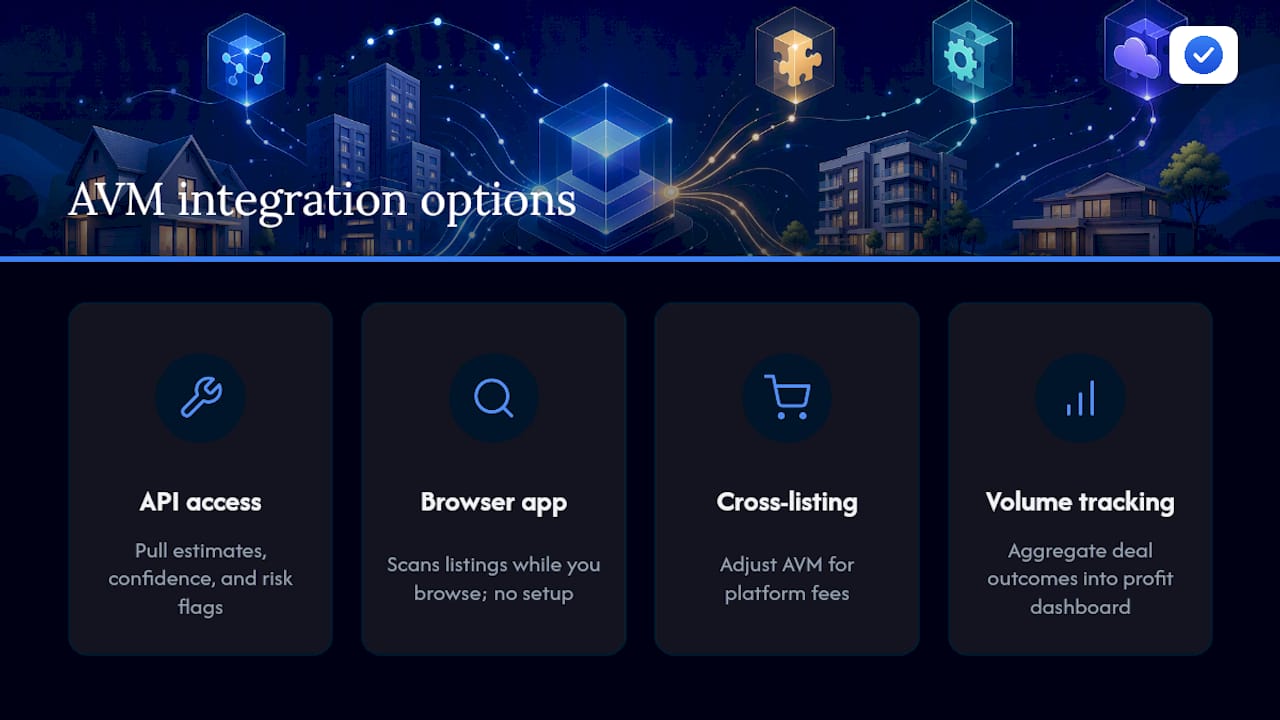
Most resellers don't want another disconnected app. The good ones integrate into whatever you're already doing, whether that's a spreadsheet, a cross-listing tool, or a browser extension you check between coffee and your first errand run.
API access is the cleanest path if you're pulling in listings programmatically or building your own tracking sheet. A vendor that exposes an API lets you pull price estimates, confidence scores, and risk flags directly into whatever dashboard you already use for tracking active deals. If you're less technical, a browser-based tool or app that scans listings as you browse gets you most of the same benefit without any setup.
Cross-listing platforms are where the friction usually shows up. If you're pricing an item to sell across eBay, Mercari, and Poshmark simultaneously, an AVM's single fair-value estimate needs adjusting for each platform's fee structure and buyer expectations. A cross-listing profit calculator handles that translation so the AVM's raw number doesn't mislead you into overpricing on a higher-fee platform.
For sellers managing genuine volume, tools focused on profit tracking across many simultaneous flips, like the dashboards built by Osellpa, pair well with an AVM's per-listing scoring by rolling individual deal outcomes into a broader view of what's actually working. The integration goal is simple: get the price estimate in front of you at the moment you're deciding, not three tabs later.
How Do Seasons and Local Markets Throw Off AVM Prices?
An AVM trained on last spring's comps will misprice a snowblower in July and a kiddie pool in December. Seasonal demand swings hit resale categories harder than most people expect, patio furniture, holiday decor, sporting goods tied to specific seasons, and a model that isn't refreshed regularly will keep quoting stale numbers long after the market has moved.
Local market density compounds the problem. A power tool that sells in three days in a suburb with a strong DIY culture might sit for three weeks in a dense urban market with fewer garages to fill. National average comps flatten these differences out, which is exactly why AVMs tuned to local listing behavior, rather than a nationwide blended dataset, tend to perform better for Facebook Marketplace specifically.
The fix isn't complicated: treat the AVM's confidence score as more trustworthy in categories with stable, year-round demand (electronics, tools) and lean more on manual comps for seasonal or geographically lumpy categories. Checking a local market benchmarking guide before committing to a big seasonal buy adds a manual sanity check the model can't fully replace on its own. When a category is swinging hard with the calendar, widen your acceptable margin rather than trusting the point estimate.
Where Has AVM Pricing Actually Worked in the Real World?
The resale industry's shift toward semantic, image-aware pricing shows up clearest in fashion resale, where style and era matter as much as brand name. Platforms using CLIP-style embeddings to search and price by visual attributes, rather than keyword matching alone, have improved pricing accuracy on vintage and style-driven pieces that pure text models used to miss entirely. That's a meaningful shift: a text-only system reading "vintage jacket, size M" has almost nothing to go on, while an image-aware model can compare the actual garment against thousands of visually similar past sales.
Reporting on this shift notes that AI's semantic understanding of style, embellishment, and model year has become a genuine driver of pricing accuracy for rare items, even as human review stays essential for final authentication.
Profit-optimization systems tell a parallel story outside fashion. Rather than stopping at a single price prediction, some pipelines simulate dozens of price points, model expected demand at each, and recommend the one that maximizes profit rather than just matching the market average. That approach treats pricing as a decision problem, not just an estimation problem, which is closer to how an experienced flipper actually thinks about a listing anyway. The common thread across every real success case: the model narrows the field fast, and a human closes the gap on the handful of listings that actually matter.
Statistical, Machine Learning, or Hybrid: Which AVM Type Should You Trust?
Three broad approaches dominate reseller-facing AVMs, and they trade off speed, accuracy, and interpretability differently.
Statistical models use straightforward regression against comparable sales, price per category adjusted for condition and age. They're fast, easy to explain, and reasonably accurate for common, high-volume categories where comps are plentiful. They struggle badly with anything unusual.
Machine learning models, particularly gradient-boosted regressors like XGBoost, handle far more input signals at once: condition flags, seller history, structured metadata, dozens of comp features simultaneously. They outperform simple statistical models on accuracy but produce less intuitive explanations for why a number landed where it did.
Hybrid approaches pair a regression model for price magnitude with a language-model logic layer that handles semantic judgment calls, classifying whether a listing is bulk or single-unit, catching nonsensical outliers, applying deterministic correction rules.
For most active resellers, a hybrid system is worth prioritizing over a pure statistical or pure ML tool, because the failure modes it corrects, bulk pricing errors, semantic misreads, are exactly the ones that cost real money on a bad offer.
A data-minded flipper's honest take
Running listings through an AVM instead of eyeballing every one cut my per-listing review time from about ten minutes to two. The one habit I never dropped: anything over $500 still gets a manual look before I message the seller.
Try DealFlipAI on Your Next 30 Listings
You've seen how the math behind fair-value estimates works, now the fastest way to trust it is to test it against listings you already understand. Run your next 30 Facebook Marketplace finds through DealFlipAI's listing analyzer and compare its suggested offer, profit score, and risk flag against your own gut read.

DealFlipAI gives you the profit breakdown and suggested first offer up front, so you're not reverse-engineering a fair price from a spreadsheet between showings. If you want the fastest path to your first tracked flip, start with the Facebook Marketplace deal-finding guide and run your first live scan today.
Frequently Asked Questions
What is an automated valuation model for resellers, explained simply? It's software that looks at a listing's photos, description, price, and comparable sales, then returns a fair-value estimate, a profit score, and a risk flag, all before you contact the seller.
How accurate is a typical reseller AVM? Accuracy depends on the model and category. Top-performing fine-tuned models report an MAE around $47 on product pricing tasks, while hybrid systems have pushed SMAPE down to roughly 67% from a much higher baseline. Accuracy tends to drop on vintage or bulk items.
Can an AVM replace manually checking a listing? No. AVMs work best as a triage layer that filters obvious deals and obvious scams, but high-value, vintage, or ambiguous listings still need a human look before you offer.
What's the difference between MAE and SMAPE? MAE gives you the average dollar error the model makes. SMAPE gives you a percentage error, which is more useful when comparing cheap items to expensive ones side by side.
How do I know if an AVM tool is worth paying for? Test it against 50 to 100 listings you already sold or know the outcome for, and compare its predicted price against what actually happened. If the confidence scores line up with real accuracy, the calibration is working.
Sources
- SHAH-MEER/llama-pricer · Hugging Face
- Image recognition technology drives automated pricing evolution in global recommerce markets · Secondary Market News