

Facebook Marketplace ranks listings by predicted buyer engagement, using a two-stage retrieval-and-ranking system that scores every item on how likely it is to generate a message, click, or save. If you want your listing to show up higher in someone's feed, the fastest path is improving the signals that predict contact: sharp photos, an honest price, a complete description, and a fast reply time.
TL;DR:
- Listings with high visual quality, complete descriptions, and accurate structured attributes are more likely to reach the ranking stage and be visible to buyers.
- Early engagement signals such as clicks, saves, and messages significantly boost ranking, while negative signals like hides or reports actively reduce visibility.
- Poor photo quality, misleading titles, or policy violations can prevent listings from passing automated filters before ranking, so compliance and clarity are essential.
- Personalization based on buyer behavior influences which listings appear, so deliberate engagement and accurate category tagging improve match relevance.
- Optimizing timing around seasonal demand and consistent response habits can help listings build early momentum and avoid suppression due to negative signals.
Table of Contents
- How the Facebook Marketplace Algorithm Actually Works
- What Signals Actually Drive Marketplace Search Ranking
- Listing Optimization Tactics That Actually Move the Needle
- Training Your Feed to Surface Better Matches
- Why Some Listings Get Filtered Before Ranking Even Starts
- How Buyer Behavior Quietly Reshapes Your Ranking
- Do Reviews and Feedback Actually Affect Visibility?
- How Marketplace Personalizes What Each Buyer Sees
- Do Seasonal Trends Change How the Algorithm Ranks Items?
- How Facebook's Policy Changes Ripple Into Ranking
- Why Engagement, Not Tricks, Is the Right Mental Model
- Score Listings and Find Deals Faster With DealFlipAI
- Where to Verify These Details Yourself
- Sources
- FAQ
How the Facebook Marketplace Algorithm Actually Works
Every time someone opens Marketplace, the system runs two separate jobs before you ever see a single listing. The first job, retrieval, is a fast sweep. It uses embedding-based models to scan the entire inventory of active listings and pull out a shortlist. Meta's own transparency documentation confirms this shortlist typically narrows down to roughly 1,000 candidate listings per search or feed refresh, filtered by location, category, and basic relevance.
The second job, ranking, is where the real competition happens. A heavier model scores each of those 1,000 candidates on predicted engagement: how likely you are to message the seller, click into the photos, or save the item. This is not a keyword-matching contest. Meta's engineering team has described how product indexing that combines images, text, and metadata nearly doubled buyer engagement after it was rolled out, which tells you the system cares far more about what a listing communicates than which words happen to appear in the title.
Here's the part sellers miss most often:
- A listing with blurry photos or a two-word description can get eliminated at the retrieval stage and never reach ranking at all.
- Multimodal retrieval research has shown that stronger content signals can increase buyer messages by nearly 27% in testing.
- Ranking favors predicted action over raw text overlap, so a technically "relevant" listing that nobody clicks will get buried fast.
If your item feels invisible, the problem usually starts before ranking even begins.
What Signals Actually Drive Marketplace Search Ranking
The Marketplace algorithm pulls from five categories of signal, and you have direct control over most of them.
- Visual and textual quality: photo count, resolution, and whether your title and description match structured attributes like brand, size, and category.
- Contextual fit: location and proximity to the buyer, how recently the item was listed, price relative to similar items, and stated condition.
- Engagement signals: clicks, saves, and messages the listing has already earned. Early engagement compounds.
- Negative signals: hides, reports, and "not interested" taps actively push a listing down.
- Seller-side history: response rate and response time act as multipliers, boosting listings from sellers who reply quickly and consistently.
Statistic to know: Meta's transparency page confirms location, recency, category, condition, and price are explicit inputs to the ranking model, not just background context.
A US patent covering Marketplace ranking describes this mathematically. It defines a product_score as a weighted combination of predicted probabilities across multiple interaction events, including clicks, messages, and purchases. In plain terms: the model isn't asking "does this match the search term?" It's asking "what's the chance this specific listing gets a response?" That distinction should reshape how you write every listing you post.
Listing Optimization Tactics That Actually Move the Needle
You don't need to guess at this. Here's the order of operations that actually affects where you land in search results.
- Fix your photos first. Use at least four images, shoot in daylight or bright indoor light, and lead with a straight-on shot that shows the whole item. Skip stock photos, screenshots, or single-angle shots.
- Structure your title like a spec sheet. A working formula is condition, then key spec, then a short modifier. Example: "Used, iPhone 13 Pro 256GB, unlocked, great condition."
- Write a description that answers questions before they're asked. Mention dimensions, flaws, reason for selling, and pickup logistics.
- Price it to move, not to test the ceiling. List near the median for comparable active and sold listings. If you get views but no messages after 48 to 72 hours, drop the price by 5% to 10%.
- Relist strategically instead of constantly. Editing a stale listing or relisting during high-traffic windows, like weekend evenings, gives it a freshness boost without looking desperate.
- Save your responses. Keep two or three message templates ready, one for availability questions, one for negotiation, one for pickup logistics, so your response time stays low no matter how many inquiries come in at once.
Pro Tip: Accept Marketplace's autosuggested category and price fields when they're accurate. Meta's own AI tools generate these suggestions from image analysis, and matching them signals a well-structured, easy-to-index listing.
If pricing strategy feels like a moving target, how listing price affects sale speed breaks down how small price moves change time-to-sale in practice.
Training Your Feed to Surface Better Matches
Marketplace doesn't just rank listings for sellers. It personalizes what buyers see, and that personalization runs on your own behavior. Every click, save, and message updates your user embedding, a running profile of what you tend to engage with. Meta's transparency materials confirm this loop is reactive by design: the more consistently you interact with a certain type of item, the more the feed leans into showing you similar ones.
For resellers sourcing deals, this matters more than most people realize. If you click into random items out of curiosity while you're supposed to be hunting for underpriced tools or electronics, you dilute your own feed. Use saved searches with tuned locations and categories instead of casual scrolling, and be deliberate about what you click during a sourcing session. Selective, consistent engagement trains the retrieval stage to keep surfacing exactly the kind of inventory you're trying to find.
Why Some Listings Get Filtered Before Ranking Even Starts
Not every listing makes it to the ranking stage, and it has nothing to do with quality in the usual sense. Marketplace runs automated computer-vision and text checks that flag listings before they're ever scored for engagement.
Common triggers include poor photo quality, inaccurate titles, or mismatched categories that violate Meta's commerce policies.
These filters exist to catch scam-adjacent or policy-violating listings before they waste buyer attention, and enforcement has gotten more automated, not less. Reading Meta's commerce policies before you list anything unusual, like used electronics or automotive parts, saves you from a suppressed listing you won't even know is suppressed. If your item vanishes from search with zero views, a policy flag is a more likely explanation than bad luck.
How Buyer Behavior Quietly Reshapes Your Ranking
Buyers influence your ranking more than most sellers assume, and it happens passively. Every time someone clicks into your listing, scrolls through your photos, or sends a message, that action gets logged as a positive engagement signal and feeds back into how the model scores your listing for the next buyer who searches.
The inverse is just as real. When someone hides your listing, marks it "not interested," or reports it, that's a negative signal that actively suppresses future visibility. A handful of hides early in a listing's life can meaningfully slow its climb, even if the item itself is priced fairly and photographed well.
This is why the first few hours after posting matter so much. Early clicks and messages compound, pushing a listing into a stronger position in the next round of ranking, while early neglect does the opposite. If you're relisting an item that got no traction the first time, small changes, a new lead photo, an adjusted price, a rewritten first line of the description, can be enough to reset how buyers respond and, in turn, how the algorithm treats it the second time around.
Do Reviews and Feedback Actually Affect Visibility?
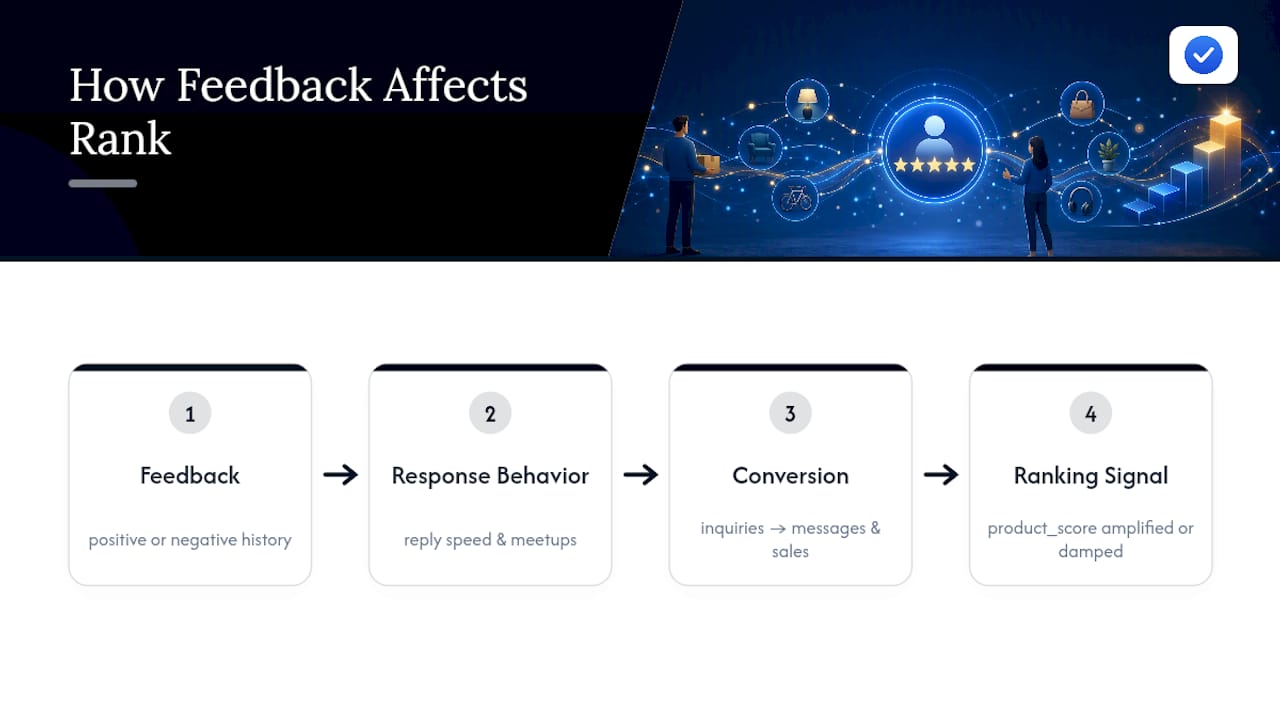
Seller ratings and buyer feedback don't directly plug into the ranking formula the way clicks and messages do, but they shape visibility indirectly through response behavior and repeat engagement. A seller with a strong track record of quick replies and completed transactions tends to convert more inquiries into messages and sales, and that conversion pattern is exactly what the ranking model is trying to predict for future listings.
Negative feedback works the other way. A pattern of unanswered messages, canceled meetups, or buyer complaints can slow your response-rate metric, which the underlying patent explicitly treats as a signal that amplifies or dampens a product_score. In practice, this means your reputation doesn't just affect whether a buyer trusts you. It affects whether your next listing gets a fair shot at reaching the ranking stage with a strong starting score.
If you're building a selling history from scratch, prioritize following through on every meetup and answering messages inside a few hours. That behavior builds the same response-rate signal the algorithm already tracks, well before you have dozens of completed sales to show for it.
How Marketplace Personalizes What Each Buyer Sees
Two people searching the same term in the same city can see completely different results, and that's by design. Personalization draws on a buyer's click history, saved searches, past purchases, and even how long they linger on certain categories, feeding all of it into the same user embedding that shapes their feed.
This means your best-performing listings aren't necessarily the ones with the most raw views. They're the ones that keep landing in front of buyers whose behavior already matches your item type. A vintage furniture listing might barely register for someone who only clicks on electronics, no matter how well it's priced or photographed, simply because their embedding doesn't point that direction.
For sellers, this cuts both ways. You can't force your way into a buyer's personalized feed just by optimizing the listing itself. But you can widen your reach by using accurate, complete category and attribute fields, since those structured tags are what let the retrieval stage match your item to buyers whose profiles suggest genuine interest, not just casual browsing.
Do Seasonal Trends Change How the Algorithm Ranks Items?
The core ranking mechanics stay the same year round, but the mix of what performs well shifts with demand. Categories like patio furniture, gardening tools, and bikes see engagement spikes heading into spring and summer, while categories like winter coats, space heaters, and holiday decor spike in the fall. The algorithm doesn't apply different rules seasonally. It simply responds to the surge in clicks and messages those categories receive, which naturally lifts well-optimized listings within them during their peak window.
Local events matter too. Back-to-school season drives searches for desks, dorm furniture, and laptops. Moving season, typically late spring through early fall in most US markets, drives a spike in furniture and appliance searches. If you're listing seasonal inventory, timing your post to land right before demand peaks, rather than during it, gives your listing time to build early engagement before the competition floods the category. Timing Marketplace listings around demand windows is worth understanding in more depth if you sell seasonal categories regularly.
How Facebook's Policy Changes Ripple Into Ranking
Marketplace's ranking model doesn't operate independently from Meta's broader commerce policies. When Meta tightens rules around prohibited categories, adds new integrity checks, or adjusts what counts as a misleading listing, those changes get built directly into the filters that run before ranking even starts.
This has a practical consequence for sellers: a listing style that worked fine last year can suddenly get suppressed if Meta has added a new enforcement rule around that category or listing pattern. Automotive parts, health-related items, and anything resembling a bulk or wholesale listing tend to face the most frequent policy adjustments, since these categories draw the highest volume of scam reports and integrity complaints.
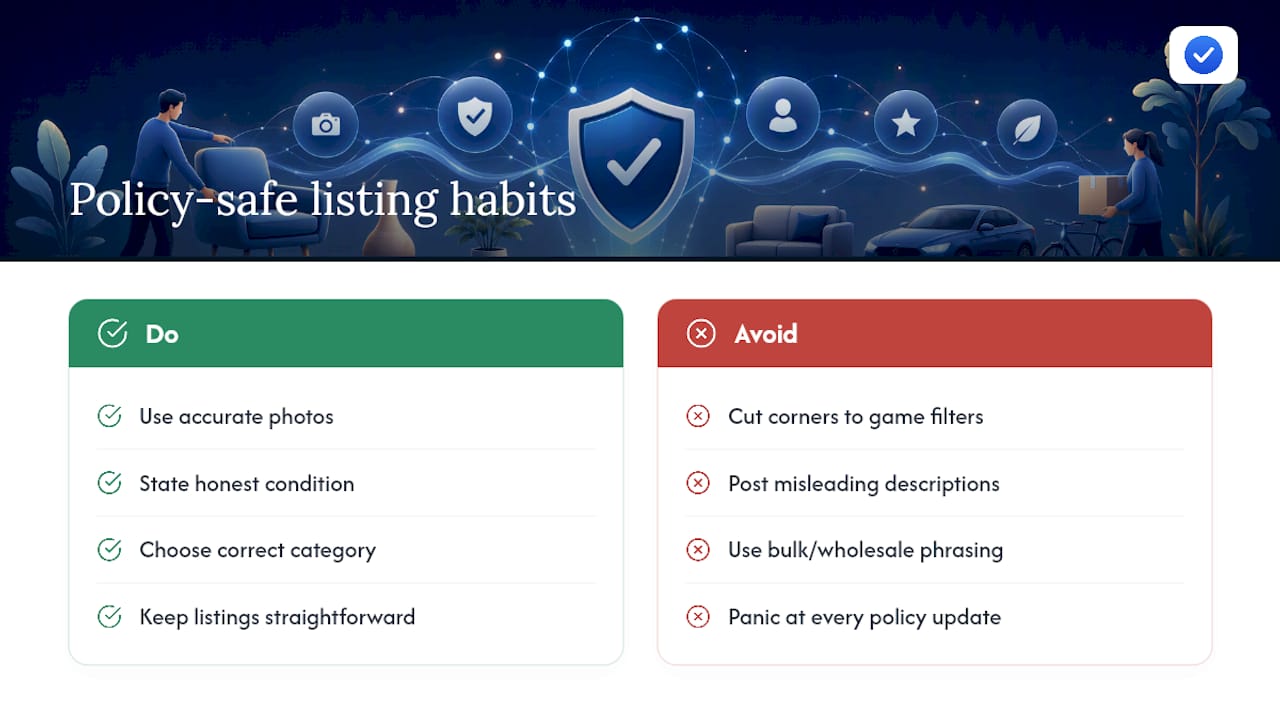
The practical fix isn't to memorize every policy update. It's to keep your listings straightforward: accurate photos, honest condition descriptions, and categories that match what you're actually selling. Listings built on that foundation rarely get caught by new enforcement, because policy changes almost always target manipulation, not accuracy. Sellers who treat every policy shift as a reason to panic are usually the ones who were cutting corners in the first place.
Why Engagement, Not Tricks, Is the Right Mental Model
Sellers who chase algorithm hacks usually lose to sellers who just answer messages fast and price things fairly. The ranking model is built to predict genuine contact, not reward keyword games, so small, honest improvements to photos, pricing, and response time compound over repeated listings in a way that shortcuts never do; for sellers looking to maximize impact, expert AI-run Facebook & Instagram ads that book meetings provide a powerful paid amplification alternative beyond organic Marketplace ranking. If you want that scoring done for you before you even hit post, a tool like DealFlipAI applies the same logic to sourcing deals.
— Walsh Pex
Score Listings and Find Deals Faster With DealFlipAI
Reading engagement signals manually across dozens of listings a day is slow, even once you know exactly what to look for. Some platforms apply signal analysis automatically, scoring listings on profit potential, price versus resale value, and scam risk so you can act before another buyer does.

The platform's listing analyzer breaks down any Marketplace item into a transparent deal score, flags overpriced or risky listings, and suggests a fair opening offer based on real market data instead of guesswork. Pair that with the deal finder's real-time alerts for freshly posted, underpriced inventory, and you're seeing strong deals within minutes of them going live instead of hours later, after a dozen other buyers already messaged the seller.
If you're actively flipping, start by running a live listing through the Facebook Marketplace Listing Analyzer to see how a deal score breaks down in practice, then set up alerts for the categories you source most.
Where to Verify These Details Yourself
- Meta's engineering blog on Marketplace AI: best for understanding the technical retrieval-and-ranking architecture.
- Meta's transparency ranking page: the clearest official explanation of ranking signals for everyday sellers.
- US Patent 10699320: the most technical source, useful for readers who want the exact scoring logic.
- The arXiv multimodal retrieval paper: supports the engagement-lift claims cited throughout this guide.
Sources
- Facebook Marketplace, powered by AI - Engineering at Meta
- Marketplace feed ranking — Meta Transparency
- Collaborative multi-modal deep learning for personalized product retrieval in Facebook Marketplace (arXiv)
- Marketplace feed ranking on online social networks (US Patent 10699320)
FAQ
How can I increase my views on Facebook Marketplace?
Improve photo quality, write a complete title and description, and price competitively against similar active listings, since these are the signals the ranking model weighs most heavily before a listing even reaches a buyer's feed.
How do I reset the Facebook Marketplace algorithm for my account?
There's no official reset button, but editing a stale listing significantly, new photos, a revised price, or reposting it as a fresh listing, can prompt the retrieval stage to re-evaluate it as a new candidate.
How can I beat the Facebook Marketplace algorithm?
You don't beat it, you feed it what it's already looking for: strong images, accurate categories, fast response times, and a price that matches real market value, all of which are the exact inputs behind the platform's product_score model.
What does a price like $123 mean on Facebook Marketplace?
An unusual, specific price like that is typically just the seller's asking price, sometimes chosen deliberately to look calculated and non-negotiable, or occasionally a leftover from a cross-listed price on another platform.
Can a tool tell me if a Marketplace listing is a good deal before I message the seller?
Yes. Tools like Dealflip AI's listing analyzer score a listing's profit potential and scam risk automatically, using the same price, condition, and market signals the ranking model itself relies on.