

Reading seller signals on marketplace listings is the process of analyzing key indicators such as pricing trends, seller credibility, listing details, and marketplace state to evaluate deal potential quickly and reliably. Resellers and investors who master this skill gain a measurable edge on Facebook Marketplace, where the best deals disappear fast. Marketplace shoppers spend only 10–20 seconds assessing a listing before deciding to engage or move on. That means your ability to read signals faster and more accurately than other buyers directly determines your profit margin.
What are the key seller signals to look for on Facebook Marketplace listings?
Seller signals are the observable data points in a listing that tell you whether a deal is worth pursuing. They fall into four categories: visual signals, seller credibility metrics, listing metrics, and marketplace state signals.

Visual signals
Original product photos outperform stock images in both trust and sale price. This is explained by warranting theory: authentic photos are harder to fake, so buyers assign them higher credibility. When you see blurry, inconsistent, or clearly stock images on a listing, treat it as a yellow flag. The seller may be hiding condition issues or, in the worst case, running a scam.
Seller credibility metrics
- Seller rating: Sellers with ratings above 95% attract more buyer trust and listing views. Anything below that threshold warrants extra scrutiny.
- Account age: A newer account selling high-value items is a risk signal. Established accounts with consistent review histories signal lower risk.
- Review patterns: Look for a steady flow of reviews over time. A sudden spike in reviews, especially positive ones, can indicate manipulation.
Listing metrics
- Price history: A listing that has dropped in price multiple times signals seller urgency. That urgency is your negotiating leverage.
- Price position vs. condition: A listing priced below market for its stated condition is worth investigating. A listing priced above market with no justification is not.
- Listing disappearance: A listing that vanishes and reappears is often relisted after failing to sell. That pattern signals weak demand or an overpriced item.
Marketplace state signals
- Seller location vs. marketplace locale: A seller located outside your area adds shipping cost and reduces trust. Always check whether the seller's location matches the marketplace locale you are browsing.
- Listing visibility vs. actual availability: Some listings appear active but are already sold. Verifying real-time availability before committing time to an inquiry saves you from wasted effort.
Pro Tip: Check the seller's other active listings. A seller offloading many items at once often has higher motivation to deal, which gives you room to negotiate a better price.
How can resellers decode these signals to assess deal value?
Decoding seller signals means converting raw observations into a clear buy, negotiate, or pass decision. The framework below maps each signal type to a specific action.
-
Map price history to seller urgency. Sustained price drops or sharp dips are actionable signals for deal timing. A listing that has dropped twice in two weeks tells you the seller is motivated. Open with a lower offer than you would on a stable-priced listing.
-
Use photo quality as a trust filter. Apply warranting theory as a quick screen. If the photos are original, detailed, and show wear honestly, the listing passes the visual trust check. If photos look pulled from a manufacturer website, pause and ask for real photos before proceeding.
-
Evaluate seller profile data systematically. Shoppers use a two-stage evaluation process: a quick credibility scan followed by a deeper functional proof check. Replicate this process. First, scan the rating and account age. If those pass, dig into the listing description, condition notes, and photo authenticity.
-
Separate metrics from signals. A high view count on a listing is a metric. A listing with high views and no price drops after two weeks is a signal of overpricing. Confusing raw metrics with actionable signals leads to poor decisions. Always ask what the metric implies about seller behavior, not just what it measures.
-
Cross-reference listing state with real-time availability. A listing that shows as active may already be sold. Checking the signs of already-sold listings before reaching out prevents wasted time and false deal counts in your pipeline.
Pro Tip: Build a simple scoring sheet. Rate each listing on photo quality, seller rating, price trend, and listing state. Any listing scoring below 3 out of 4 gets passed or heavily discounted in your offer.
Which criteria help validate and benchmark listing values based on seller signals?
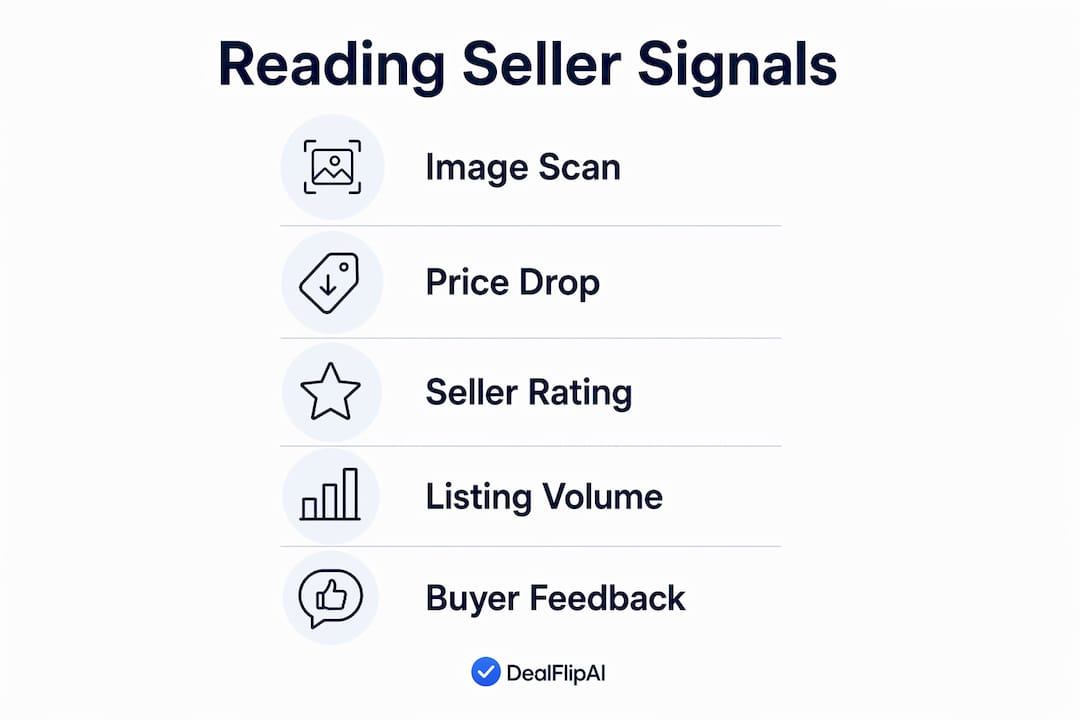
Validating a listing's value requires combining multiple signal categories into a single assessment. The table below outlines the core criteria categories and what to look for in each.
| Criteria category | What to assess | Signal strength |
|---|---|---|
| Price trend | Number of price drops, rate of decline | High: multiple drops indicate urgency |
| Seller score | Rating percentage, account age, review volume | High: below 95% rating increases risk |
| Photo authenticity | Original vs. stock images, condition visibility | Medium: stock photos reduce trust |
| Listing history | Relisting frequency, days active | Medium: frequent relisting signals weak demand |
| Marketplace state | Sold but visible, location vs. locale match | High: state inconsistencies signal bad data |
Marketplace listings are dynamic, and real-time validation is the only way to avoid acting on stale signals. A listing that looked perfect yesterday may already be sold or repriced today.
Dealflip AI addresses this directly. Its listing analyzer tool scores listings based on price, profit potential, and risk factors, pulling together the signal categories above into a single deal score. The platform also flags scam indicators automatically, which removes one of the most time-consuming manual checks from your workflow.
Velocity metrics add another layer. High seller count spikes combined with rapidly fluctuating prices signal oversaturation and elevated risk. Stable or declining seller counts with consistent price dips indicate healthy demand and manageable competition. Tracking these velocity patterns over time helps you identify the right buying window rather than chasing listings at peak competition.
Buyer feedback analysis rounds out the picture. Repeated complaints about a product category reveal unmet expectations that you can factor into your resale pricing and condition assessment. If buyers consistently report that a certain item type arrives with missing accessories, you know to verify completeness before buying.
You can also cross-reference your signal analysis against trusted marketplace sites to benchmark whether a listing's price aligns with broader market activity across platforms.
What are common mistakes when reading seller signals?
Most resellers lose money not because they missed a great deal, but because they misread a bad one. These are the most common errors.
- Ignoring marketplace state issues. Visible but already-sold listings are a persistent problem on Facebook Marketplace. Acting on a listing without confirming its current state wastes time and distorts your deal pipeline.
- Confusing metrics with signals. A listing with 200 views is a metric. What it signals depends on price history, days active, and seller response rate. Never make a buy decision based on a single number.
- Misreading seller location. Seller country often differs from the marketplace locale you are browsing. A listing that appears local may involve cross-border shipping, which changes your cost calculation and risk profile entirely.
- Overlooking sudden seller count spikes. A category that suddenly shows many new sellers at similar price points signals oversaturation. Buying into an oversaturated category reduces your resale margin significantly.
- Skipping scam detection. Suspiciously low prices, stock photos, and brand-new accounts are classic red flags. Use a dedicated scam detection tool before committing to any high-value purchase.
Marketplace signal interpretation requires combining multiple data points, including photos, price movement, seller credibility, and listing state, for reliable decision-making. Relying on any single signal in isolation produces false confidence and increases buying risk.
Step-by-step approach to reading seller signals on Facebook Marketplace
This workflow integrates all the signal categories above into a repeatable daily process.
-
Set up your tools. Open Dealflip AI's deal finder and configure alerts for your target categories. Real-time alerts surface fresh listings before other buyers see them.
-
Scan images first. Apply the warranting theory filter immediately. Original photos with visible wear pass. Stock images or suspiciously perfect photos trigger a deeper check.
-
Check seller rating and account age. If the rating is below 95% or the account is less than a few months old, apply a higher risk discount to your offer or pass entirely.
-
Analyze price history. Count the number of price drops and the rate of decline. Two or more drops in under three weeks signals strong seller urgency and a good negotiating position.
-
Verify listing state. Confirm the listing is still active and available. Cross-check against known signs of low-quality listings to filter out stale or misrepresented inventory.
-
Benchmark the value. Use Dealflip AI's value estimator to compare the listing price against current market data. This step replaces manual price research across multiple platforms.
-
Apply your signal threshold. Set a minimum deal score before making an offer. If the listing scores well on photos, seller credibility, price trend, and listing state, proceed with Dealflip AI's suggested first offer. If it fails two or more criteria, pass or negotiate aggressively.
| Step | Signal checked | Decision trigger |
|---|---|---|
| Image scan | Photo authenticity | Stock images = deeper check required |
| Seller profile | Rating, account age | Below 95% = apply risk discount |
| Price history | Drop frequency, rate | 2+ drops in 3 weeks = strong buy signal |
| Listing state | Active, sold, relisted | Sold or relisted = verify before proceeding |
| Value benchmark | Market price comparison | Below market = proceed; above market = pass |
Key Takeaways
Reading seller signals accurately requires combining photo quality, seller credibility, price history, and real-time listing state into a single, consistent evaluation process.
| Point | Details |
|---|---|
| Photo quality is a trust filter | Original photos signal authenticity; stock images require deeper verification before proceeding. |
| Seller rating above 95% reduces risk | Accounts with strong ratings and established history convert at higher rates and carry lower fraud risk. |
| Price drops signal seller urgency | Multiple price reductions in a short window create negotiating leverage and better buying windows. |
| Marketplace state must be verified | Sold-but-visible listings and relisted items distort your pipeline; always confirm real-time availability. |
| Combine signals, not single metrics | No single data point is reliable alone; decisions improve when photo, price, seller, and state signals align. |
What I've learned after years of reading marketplace listings
The biggest shift in my reselling practice came when I stopped treating seller signals as individual checkboxes and started reading them as a story. A listing with original photos, a motivated seller dropping the price every week, and a three-year-old account with 200 reviews tells a very different story than a listing with stock photos, a flat price, and a two-month-old account.
Technology changed how fast I can read that story. Tools like Dealflip AI cut the time I spend on manual price research and scam screening dramatically. But the judgment call at the end still requires pattern recognition that only comes from volume. The more listings you analyze, the faster you recognize when signals conflict and when they confirm each other.
One thing I see newer resellers get wrong consistently: they treat a high view count as a buy signal. Views measure attention. They do not measure deal quality. A listing with 500 views and no price movement after two weeks is telling you the market has already passed on it. That is a pass signal, not a buy signal.
My practical advice is to learn how to benchmark item value before you try to read signals at speed. You cannot recognize an underpriced listing if you do not know what fair market value looks like. Build that foundation first, then layer signal reading on top of it.
The resellers who consistently find profitable deals are not the ones with the most tools. They are the ones who have internalized a repeatable process and execute it without hesitation on every listing they evaluate.
— Walsh Pex
Dealflip AI puts seller signal analysis to work for you
Dealflip AI was built specifically for resellers who want to move faster and with more confidence on Facebook Marketplace. The platform scores listings based on price, profit potential, and risk factors, so you spend less time on manual checks and more time on deals worth pursuing.

The free reseller tools include a listing analyzer, a value estimator, a scam checker, and a shipping fee calculator that factors real costs into your profit math. Real-time alerts surface fresh listings before the competition sees them. If you want to apply everything covered in this guide without building a manual workflow from scratch, Dealflip AI gives you the infrastructure to do it at scale. Start with the deal finder and see what your current process has been missing.
FAQ
What are seller signals on marketplace listings?
Seller signals are observable indicators in a listing, such as photo quality, seller rating, price history, and account age, that help buyers assess deal quality and seller credibility quickly.
How do I spot a motivated seller on Facebook Marketplace?
A seller who has dropped their price two or more times in a short period is showing urgency. That pattern creates negotiating leverage and signals a better buying window.
Why does photo quality matter when analyzing listings?
Original photos signal authenticity through warranting theory, meaning they are harder to fake than stock images. Listings with real photos convert at higher rates and carry lower return risk.
What is the biggest mistake resellers make when reading seller signals?
The most common error is confusing raw metrics with actionable signals. A high view count is a metric; what it means depends on price history, days active, and seller behavior combined.
How can I tell if a Facebook Marketplace listing is a scam?
Look for stock photos, a brand-new seller account, prices far below market value, and vague item descriptions. Use a dedicated scam checker tool to screen high-value listings before committing to a purchase.