

Before you message a single seller, you need three things locked in: verified sold comps, a fee-adjusted margin calculation, and a first offer set below your max buy price. That sequence is the role of pricing data in flipping, and skipping any step turns every purchase into a guess.
The one rule that protects your money: Never set a buy price from what sellers are asking. Set it from what buyers have already paid, minus every fee and cost between you and that sale.
Your immediate checklist:
- Check sold comps on eBay (Sold/Completed filter), Mercari (completed listings), or Poshmark (Sold filter) before opening a conversation.
- Run the margin formula: Net = Median sold × fee multiplier − buy price − shipping − COGS.
- Set your first offer at 10–25% below your calculated max buy price to leave room to negotiate up without overpaying.
Key Takeaways
Pricing data is the foundation of every profitable flip: sold comps set your sale price estimate, the margin formula sets your buy ceiling, and time-based triggers protect your capital when a deal stalls.
| Point | Details |
|---|---|
| Sold comps only | Always price from completed/sold listings; active listings run 20–35% above real transaction prices. |
| Dollar floor, not just percent | Set an absolute-dollar net minimum per sale, not just a percentage target, to keep sourcing decisions business-grade. |
| 30% rule for buy ceiling | Net profit should equal at least 30% of your buy price; use the formula Net = Median sold × fee multiplier − buy − shipping − COGS. |
| 7–10 day reprice trigger | If no quality inquiry arrives within 7–10 days, drop price 10–15% rather than holding and losing capital velocity. |
| Dealflip AI for speed | Dealflip AI automates sold-comp aggregation, fee-adjusted net calculation, and first-offer suggestions so you act on deals before manual scrollers do. |
Table of Contents
- Why pricing data is your real competitive edge
- Sold prices are the only prices that matter
- Pricing guardrails and the metrics you must track
- Platform fees change the math before you buy
- How to calculate your max buy price and first offer
- How to use pricing tools and AI without losing judgment
- A 6-step workflow for sourcing and sending an offer in under 10 minutes
- When to drop the price, relist, or walk away
- Seasonal demand trends affect your buy price today
- The rules beat intuition every time
- Dealflip AI puts the guardrails to work automatically
- Sources
Why pricing data is your real competitive edge
Pricing data converts guesses into repeatable buy/sell decisions. Without it, you are reacting to a seller's wishful asking price instead of the market's actual verdict.
Active listing prices are aspirational, often sitting 20–35% above final transaction prices in sampled categories. That gap is where flippers lose money. You buy at a price that looks reasonable against active comps, then discover the real market ceiling is far lower when you try to sell.
Cashflow impact of mispricing: A $200 buy on an item that actually sells for $180 after a 13% eBay fee nets you $156.60 before shipping. You are already $43 underwater before you pack a box.
Micro-local demand adds another layer. The same used power tool can command a premium in a suburban neighborhood with active contractors and sell slowly in a dense urban zip code where buyers prefer new. Zone-level pricing signals let you assign a speed lane (move it fast at median) or a premium lane (hold for the right buyer) before you even make an offer.
Sold prices are the only prices that matter
Sold and completed listings are the authoritative price signal. Active listings tell you what sellers hope to get. Sold listings tell you what buyers actually paid.
Here is how to pull verified comps on the platforms resellers use most:
- eBay: Filter by "Sold Items" or "Completed Items" under the left-side search filters. For deeper history and category trends, use Terapeak inside Seller Hub (free with an eBay account).
- Mercari: Search the item, then filter by "Status: Sold." Look at the last 10–15 sales to build a realistic range.
- Poshmark: Search, then select "Sold" from the availability filter. Focus on listings with matching condition and size.
- StockX / BrickLink: For sneakers, trading cards, or LEGO sets, these platforms publish verified transaction histories that are more reliable than general marketplaces.
Facebook Marketplace has no native sold-price history, so you must triangulate across at least two of the sources above to build a credible sold-comp band. Once you have 8–10 sold comps, take the median (not the average, which skews toward outliers) and use that number as your sale price estimate.
When exact comps are scarce, find structurally similar items (same brand tier, same condition grade, same approximate age) and lean toward the lower end of the band.
Pro Tip: If you find fewer than five sold comps, treat the item as high-risk. Either demand a deeper discount or pass entirely until you can build a stronger comp set.
Pricing guardrails and the metrics you must track
Set your floor and target in dollars, not just percentages. A 30% margin on a $20 item is $6. That is not worth your time. A 30% margin on a $150 item is $45. Same rule, very different business.
The core formula: Net = Median sold × fee multiplier − buy price − shipping − COGS
Using eBay's roughly 13% fee as an example, your fee multiplier is 0.87. If the median sold comp is $120, your gross after fees is $104.40. Subtract $12 for shipping and $5 in supplies (COGS), and your net is $87.40.
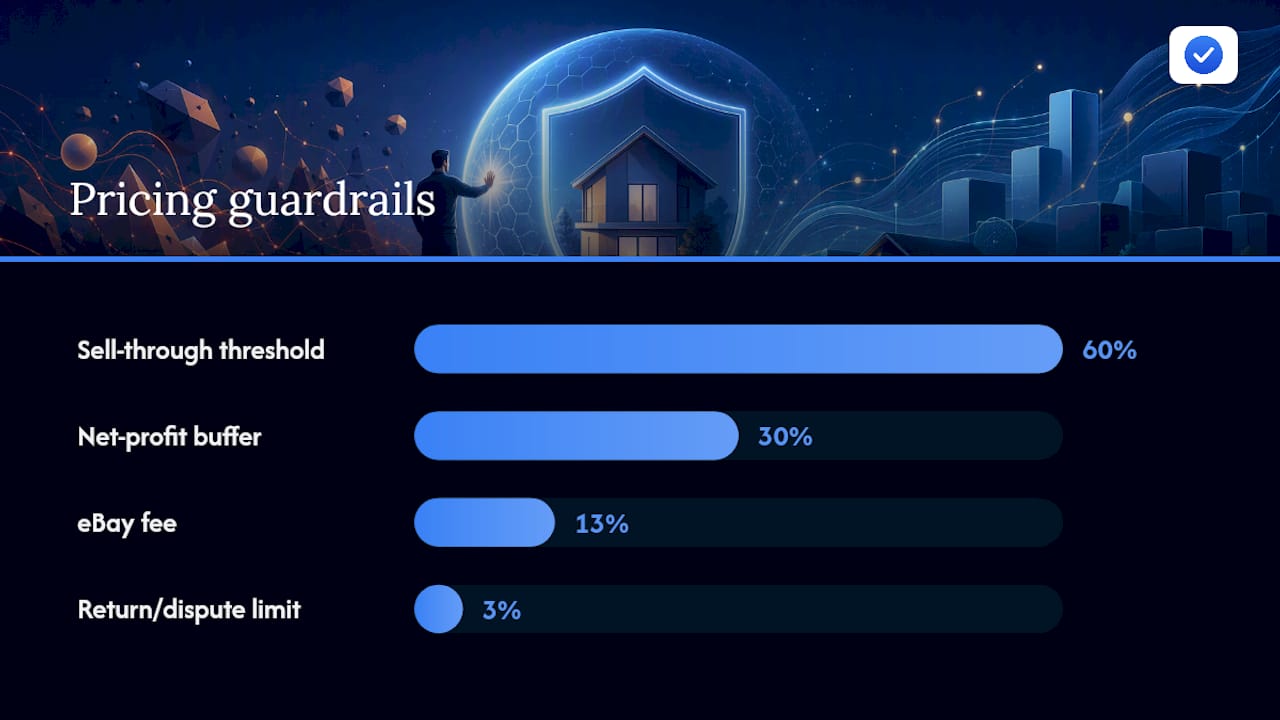
The 30% rule: Your projected net profit should equal at least 30% of your buy price. This buffer absorbs unexpected costs, slower-than-expected sales, and the occasional price drop needed to close a deal.
Tracking sell-through rate and average ticket by category keeps your sourcing decisions grounded in real performance data, not optimism.
| Metric | What it measures | Action threshold |
|---|---|---|
| Sell-through rate | % of sourced items sold within 30 days | Below 60%: pause sourcing that category |
| Average ticket | Avg net profit per sold item | Below your dollar floor: exit the category |
| Time-to-sell | Days from list to sale | No quality inquiry in 7–10 days: reprice |
| Return/dispute rate | % of sales reversed | Above 3%: review condition grading process |
Platform fees change the math before you buy
Pick your selling channel before you set a buy price. Fees and buyer expectations vary enough across platforms that the same item can have a different max buy price depending on where you plan to sell it.
- eBay: Roughly 13% total fee (final value + payment processing). Use a 0.87 multiplier on your median sold comp. Buyers expect condition accuracy; disputes are common on misgraded items.
- Poshmark: 20% on sales over $15; flat $2.95 on sales under $15. High-fee platform, but buyer traffic for clothing and accessories is strong. Buyers routinely send offers, so price your listing 15–20% above your target to absorb the negotiation.
- Mercari: Typically around 10% in fees (seller fee plus payment processing), though rates can vary. Lower fee floor means a slightly higher max buy price for the same item compared to eBay.
- Depop: Primarily fashion-focused with fees that vary by plan; confirm current rates on their site before calculating.
- Etsy: Best for vintage and handmade. Transaction fee plus listing fee plus payment processing adds up to roughly 10–15% depending on your volume.
- Facebook Marketplace (local pickup): No marketplace fee on local cash transactions. Your net is essentially the sale price minus your time and any minor prep costs, which means your max buy price is meaningfully higher than on any fee-based platform for the same item.
Use the cross-listing profit calculator to compare net profit across channels before committing to a selling venue.
How to calculate your max buy price and first offer
The buy ceiling is the highest price you can pay and still hit your absolute-dollar net floor after fees and shipping. Work backwards from the median sold comp, not forward from what you hope to make.
Worked example: used mid-range laptop
Negotiation script template: "Hi, I'm interested in your [item]. I've looked at recent sold prices and I can offer $142 cash, local pickup today. Does that work for you?" If the seller counters above your max buy of $167, walk away. What you paid is a sunk cost once you own it — never let that anchor your resale price.
How to use pricing tools and AI without losing judgment
Tools speed triage and surface verified comps, but you must validate high-ticket items manually. No algorithm replaces your eyes on condition, your knowledge of local demand, or your read on a seller's urgency.
Here is where automation genuinely helps:
- Multi-source comp aggregation: Pulling sold comps from eBay, Mercari, and Poshmark simultaneously cuts research time from several minutes to seconds per listing.
- Fee-adjusted net profit calculation: Pre-calculated net removes the mental math that causes errors under time pressure.
- Real-time alerts: Notifications when a new listing falls below the sold-comp band let you act before manual scrollers even see the deal.
- Scam signals: Pattern recognition on listing photos, pricing anomalies, and seller history flags high-risk listings before you engage.
Dealflip AI maps directly to these roles. Its listing analyzer surfaces verified comps, pre-calculates net profit, and generates a suggested first offer tied to the margin formula. The deal scoring methodology is transparent, so you can see exactly why a listing scores high or low.
Where AI earns its keep: Long-tail and common items with dozens of recent comps. Where you still need manual validation: niche collectibles, high-ticket electronics with condition-sensitive pricing, and any item where a single authoritative market (StockX, BrickLink) sets the price.
Pro Tip: Use AI-generated estimates to triage your alert queue fast. Then spend your manual research time only on the top-scored listings that clear your dollar floor.
A 6-step workflow for sourcing and sending an offer in under 10 minutes
A repeatable sequence lets you act faster than manual scrollers while keeping margin discipline.
- Scan your alert queue (0:10): Review new listings flagged below the sold-comp band. Dismiss anything outside your category presets.
- Pull sold comps (2:00): Check eBay Sold, Mercari completed, and Poshmark Sold. Record the median of 8–10 recent sales.
- Run the margin calculation (1:30): Apply the formula. Confirm the listing clears your 30% net-profit rule and your dollar floor.
- Set your first offer (0:30): Calculate 10–25% below your max buy price based on how much negotiation room the asking price suggests.
- Message the seller (0:30): Use the script template. State your offer, your payment method, and your availability. One message, no lowball theatrics.
- Log your decision (0:20): Record the item, asking price, your max buy, your offer, and the outcome. This data builds your category benchmarks over time.
If comps are thin (fewer than five sold), flag the item as high-risk and either demand a steeper discount or skip it. Never reveal your max buy price to a seller.
When to drop the price, relist, or walk away
Use time-and-metric-based triggers, not emotion, to protect your capital.
The holding-cost trap: Every day an item sits unsold, it costs you the opportunity to redeploy that capital into a faster flip. A 10% price drop that moves the item in three days beats holding at full price for three weeks.
A staged reprice approach protects margin while preventing long-term holding:
- 48 hours, no inquiry: Refresh the listing (new photos, revised title). Do not drop price yet.
- 7–10 days, no quality inquiry: Drop price 10–15%. Reassess your comp band; the market may have shifted.
- 30 days unsold: Route to a lower-fee channel (Facebook local pickup if currently listed online) or bundle with a complementary item.
- 90 days unsold: Batch liquidate. Recover capital and move on.
If a category's historical average ticket consistently falls below your dollar floor, stop sourcing it entirely. Absolute-dollar floor margins are what separate a business from a hobby.
Seasonal demand trends affect your buy price today
Seasonal pricing is not just about selling at the right time. It changes what you should pay when you source.

Buy winter gear in March when demand collapses and prices follow. Source back-to-school electronics in late July before the rush inflates asking prices. Outdoor furniture and power tools peak in April and May; buy them in October when sellers are motivated and buyers have disappeared.
The practical move: build a simple calendar of your top three categories and note the 60-day window before peak demand. That window is your best sourcing period. Prices are low, competition from other flippers is lighter, and you have time to list and optimize before buyers arrive.
Seasonal data also protects you from overpaying at peak. A used treadmill listed in January (New Year's resolution season) will carry an inflated asking price. The same treadmill in June is a motivated seller's problem. Know the cycle before you set your buy ceiling.
The rules beat intuition every time
Flippers who follow a consistent pricing framework outperform those who rely on gut feel, and the margin gap widens as volume increases. Intuition works on the first ten flips. At fifty items a month, you need rules that hold without your full attention on every decision.
The triangulated sold-comp approach has a specific, testable advantage: it removes the anchoring effect of the seller's asking price. When you walk into a negotiation knowing the median sold comp is $95 and the seller is asking $140, you are not negotiating against their number. You are negotiating from yours.
The flippers who struggle are almost always using active listings as their reference point, ignoring fees until after the purchase, and setting percentage targets without a dollar floor. Those three habits are fixable in a single sourcing session if you apply the framework in this guide.
Dealflip AI puts the guardrails to work automatically
Knowing the formula is one thing. Running it on every listing you see is another. Dealflip AI pre-calculates fee-adjusted net profit, surfaces verified sold comps from multiple sources, and delivers real-time alerts when a Facebook Marketplace listing falls below the sold-comp band — so your alert queue shows profit-ready deals, not raw listings you still have to research.

The platform's scam detection flags suspicious listings before you engage, and the built-in negotiation script generator ties directly to your calculated pricing strategy first offer. You stay in control of every decision; Dealflip AI just removes the research bottleneck that slows most flippers down.
For niche or high-ticket items, manual validation still applies — Dealflip AI is explicit about this in its deal scoring methodology. Use it to triage your queue fast and reserve your manual research time for the listings that actually clear your floor.
Run your next flip through the flip profit calculator and see your buy ceiling and suggested first offer in seconds.
Sources
- Facebook Marketplace Sold Listings: How to Verify Price With Real Comps (2026) — SuperFlip AI
- How to price items for resale — ILoveListing
- Top tips to price secondhand and consignment items — SimpleConsign
- Pricing strategy for resellers — Instica