

Urgency language is one of the strongest risk signals in a Facebook Marketplace listing, but it is not proof of a scam by itself. The single best thing you can do right now: pause before replying, then run a quick listing check before you type a single word back. Scammers use time pressure deliberately because it works. Research shows that time constraints in fraudulent messages significantly increase the probability of a target responding without thinking it through.
- Urgency is a strong risk signal, not automatic proof of fraud.
- Your first move: stop, do not reply, and verify the listing before engaging.
- Urgency works by triggering anxiety and shutting down deliberate thinking.
Table of Contents
- Why urgency language works against you psychologically
- Common urgency phrases and what they usually signal
- How urgency combines with other red flags to raise real risk
- 60–90 second verification checklist before you reply
- Scripts to neutralize urgency and test seller legitimacy
- How AI and Dealflip AI detect urgency-driven scams
- If it goes wrong: reporting and recovery steps for U.S. resellers
- Key Takeaways
- The part most resellers get wrong about urgency
- Dealflip AI flags urgency scams so you can flip with confidence
- Useful sources and further reading
Why urgency language works against you psychologically
Urgency exploits two cognitive shortcuts at once: loss aversion and System 1 thinking. When a seller says "must go today or I'm donating it," your brain registers a potential loss, not an opportunity. Loss-avoiding fraud triggers stronger susceptibility than profit-seeking fraud because the threat of missing out activates anxiety faster than the promise of gain activates excitement.
"Manufactured urgency produces the same cognitive load as a real emergency, causing System 2 to disengage." — Zoho eProtect
Your brain literally cannot tell the difference between a genuine deadline and a fake one. That is the attack surface scammers rely on. Once System 2 (your deliberate, analytical thinking) goes offline, you stop checking profile age, stop reverse-searching photos, and stop asking why someone needs payment through Zelle instead of cash at pickup.
Pro Tip: Treat any message that makes you feel rushed as a reason to slow down, not speed up. The urgency you feel is the signal, not the deadline.
Common urgency phrases and what they usually signal
The Visa Fraudulese report analyzed scam messaging and found that 'Free/giveaway' phrases appear in 32% of scam messages, 'limited time offer' in 25%, 'urgent' in 22%, and 'action needed' in 21%, making these the most consistently used phrase categories across fraud attempts.
| Phrase Category | Prevalence | Typical Intent |
|---|---|---|
| "Free / giveaway" | 32% | Create excitement, lower skepticism |
| "Limited time offer" | 25% | Manufacture artificial scarcity |
| "Urgent / urgent sale" | 22% | Trigger loss aversion directly |
| "Action needed" | 21% | Mimic authority, force compliance |
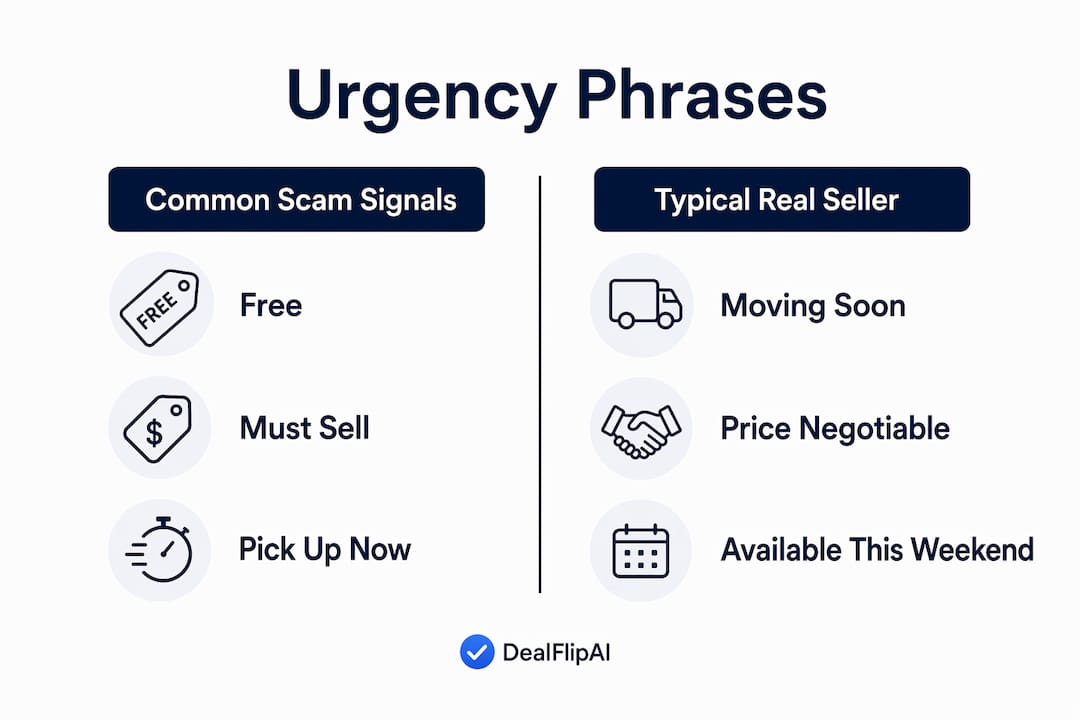
Beyond the data, here are the specific phrases that show up most often in Facebook Marketplace scam listings and messages:
- "Must sell today / must go today" — artificial deadline with no verifiable reason
- "First come, first served" — social pressure to skip verification
- "I have three other people interested" — manufactured competition
- "Deal ends in 30 minutes" — time-boxing designed to prevent research
- "I'm moving / deployed / going through a divorce" — emotional backstory to justify low price and rushed sale
- "Can't meet in person, will ship" — removes the safest transaction method
- "Venmo/Zelle/CashApp only" — pushes you toward non-reversible payment
Minor variants matter too. "Must pick up now" is more aggressive than "must go today" and usually signals a higher-pressure scam. "Serious buyers only" often precedes a request to move off-platform.
How urgency combines with other red flags to raise real risk
Urgency alone is a yellow flag. Urgency paired with other signals becomes a red one. Research on phishing design confirms that urgency cues were present in 94.1% of analyzed scam designs, almost always alongside authority or trust mimicry.
The highest-risk combinations for resellers on Facebook Marketplace:
- Urgency + price well below market value — the "too good to be true" pairing. NSF research found that unrealistic large gains are actually stronger fraud indicators than urgency alone.
- Urgency + request for off-platform payment — Zelle, Venmo, or wire transfer with a rushed timeline is the most common scam pattern.
- Urgency + new or sparse seller profile — an account created within the last 30 days with no reviews and a rushed sale is a near-certain scam.
- Urgency + vague item description or stock photos — low-effort listings combined with time pressure signal the seller does not actually have the item.
"Urgency is rarely used alone. It is most effective when paired with an illusion of authority and a shortcutted process." — Semantic urgency and authority in fraud messaging
Use a simple mental score: assign one point per red flag present. Three or more points means you should walk away and report, not negotiate. Check red flags in fake marketplace listings for a full breakdown by category.
Pro Tip: Low-effort listings, thin profiles, and urgency language together are the trifecta. Any one of them alone is manageable. All three together means stop.
60–90 second verification checklist before you reply
If a listing triggers urgency signals, run these steps before typing anything back.
- Reverse-image search the listing photos (Google Images or TinEye). Stock photos or images from other listings confirm a fake.
- Check the seller's profile age and review count. Accounts very newly created with no ratings are high-risk.
- Read the message thread tone. COLD framework research shows scammers escalate directive language as conversations progress. Early pressure is a tell.
- Confirm the payment method. Cash at a public meetup or Facebook Pay with buyer protection are the only safe options.
- Search the item's price on eBay sold listings. If the asking price is substantially below market value with no explanation, treat it as a scam signal.
- Call or video-verify if the item is high-value. A quick 60-second video call showing the item in real time eliminates most ghost-seller scenarios.
Decision rule: Two or more checks fail? Abandon the listing and report it. One check fails? Proceed only with cash at a public location.
Pro Tip: Screenshot the listing, the seller's profile, and every message before you do anything else. If it turns into a scam, that evidence is what you'll need for a platform report or bank dispute.
Scripts to neutralize urgency and test seller legitimacy
The fastest way to separate a real seller from a scammer is to introduce a process constraint. Scammers need you to act fast and off-platform. Legitimate sellers can wait.
This script does three things at once: it anchors a price, names a safe location, and sets a timeline that is yours, not theirs. A real seller will agree or counter. A scammer will push back on the location or the timeline.
For the "deal ends in 30 minutes" pressure:
For the off-platform payment request:
Expected scammer responses: insistence on Zelle or Venmo, a new story about why they cannot meet, or sudden silence. Any of those confirms the risk. Check the offer negotiation tactics checklist for more tested scripts.
Pro Tip: Never explain why you want to meet in person. Just state it as your process. Scammers look for objections to overcome. A flat statement of your terms gives them nothing to argue with.
How AI and Dealflip AI detect urgency-driven scams
AI can flag urgency language and risky signal combinations faster than any manual scan, but it cannot replace the 60-second human verification steps above. What it does well is surface the patterns you might miss when you're moving fast through 40 listings.
Dealflip AI's listing analyzer scans for:
- Time-pressure phrases in listing titles and descriptions
- Pricing outliers relative to comparable sold listings
- Profile anomalies (account age, review count, listing history)
- Payment method signals in the listing text
- Combined risk scores that weight urgency alongside other red flags
The scam checker assigns a risk score to a listing so you can triage fast. A high-risk score does not automatically mean scam, but it tells you exactly which flags to verify manually.
Limits to know: AI scores are based on text and metadata. A sophisticated scammer with an aged account and clean photos can score lower than the actual risk. Always run at least the photo reverse-search and profile check yourself.
Urgency also appears in CTA button text on linked pages ("Verify Now," "Secure My Account"). If a seller sends you a link, inspect the domain before clicking.
If it goes wrong: reporting and recovery steps for U.S. resellers
Act fast. The first 24 hours after a scam are when payment disputes and platform reports are most effective.
Immediate steps:
- Preserve evidence — screenshot the listing, all messages, the seller's profile, and any payment confirmation.
- Report on Facebook Marketplace — use the "Report" option on the listing and the seller's profile. Select "Scam or fraud."
- Contact your bank or payment app — for Zelle disputes, call your bank directly. For credit card payments, file a chargeback. Zelle and Venmo transfers are generally not reversible, but your bank may have fraud protections.
- File a complaint with the FTC at reportfraud.ftc.gov and with the FBI's Internet Crime Complaint Center (IC3) at ic3.gov if the loss exceeds a few hundred dollars.
Civil recovery is rarely worth pursuing for losses under $1,000 given legal costs. Criminal reporting through IC3 is the better path for larger losses and gives law enforcement the data they need to track repeat scammers.
Key Takeaways
Urgency language is the most consistent signal in scam listings, and pairing it with a fast verification workflow is what separates resellers who lose money from those who don't.
| Point | Details |
|---|---|
| Urgency is a risk signal, not proof | Pause and verify before replying; do not let time pressure force a decision. |
| Worst combinations | Urgency plus off-platform payment plus new profile strongly indicate a scam. |
| Visa data on phrase prevalence: "Free/giveaway" appears in 32%, "limited time offer" in 25%, "urgent" in 22%, and "action needed" in 21% of scam messages. | |
| Verification takes under 90 seconds | Reverse-image search, profile age check, and payment method confirm or kill a suspect lead fast. |
| Dealflip AI speeds up triage | The listing analyzer and scam checker score urgency and risk combos so you can prioritize which listings to verify manually. |
The part most resellers get wrong about urgency
Urgency language is not just a scam tactic. It is also how real sellers communicate when they genuinely need to move something fast. The mistake most resellers make is treating urgency as binary: either it is a scam or it is fine. The actual skill is reading the combination.
A seller who says "must sell this weekend, moving Monday" and has a two-year-old profile, clear photos, and is willing to meet at a Starbucks is probably legitimate. The same phrase from a three-week-old account with stock photos and a Zelle-only payment request is a different story entirely.
What the COLD framework research makes clear is that scammers escalate their language as the conversation progresses. If the urgency in the first message is moderate and then doubles in the second message, that escalation pattern is more telling than the original phrase. Legitimate sellers get less urgent over time as they build rapport. Scammers get more urgent because their window is closing.
The practical rule: judge urgency by what it is paired with, not by how it sounds in isolation.
Dealflip AI flags urgency scams so you can flip with confidence
Resellers who move fast on Facebook Marketplace need a filter that works just as fast. Dealflip AI's scam checker scores listings for urgency language, pricing outliers, and profile risk in seconds, so you spend your verification time only on listings that are actually worth pursuing.
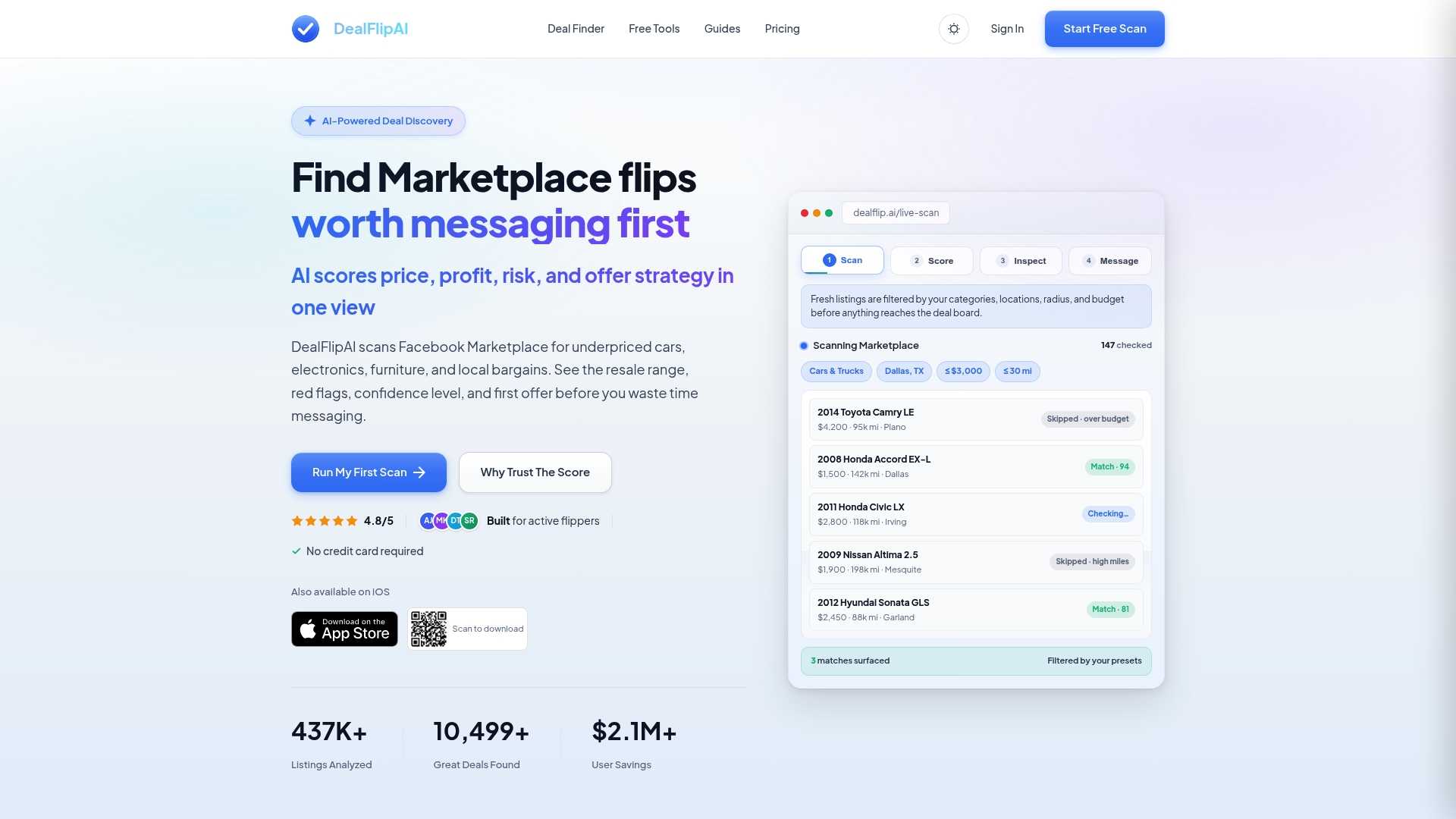
The listing analyzer gives you a full deal breakdown, including profit potential and risk flags, before you send a single message. Set up deal alerts to get notified the moment a high-potential, low-risk listing goes live in your target categories. Free scans are available to get started, with paid plans for resellers who run higher volume.
Useful sources and further reading
The research and platform resources that informed this guide:
- The impact of time pressure and fraud type on susceptibility to online fraud — Frontiers in Psychology; core study on how time pressure increases fraud susceptibility, especially for loss-framed scams.
- Urgency and trust cues in phishing scam designs — ResearchGate; analysis of 51 scam designs showing urgency cues present in 94.1% of cases.
- Linguistic dynamics of online scam conversations (COLD framework) — Nature; explains how scammers escalate directive language across conversation phases.
- The psychology of urgency in social engineering — Zoho eProtect; explains manufactured urgency and System 2 disengagement.
- Visa Fraudulese report — Visa 2022; phrase-category prevalence data for scam messaging.
- NSF phishing-suspicion study — National Science Foundation; shows unrealistic promises are stronger fraud cues than urgency alone.
- FTC fraud reporting — U.S. Federal Trade Commission; primary reporting portal for marketplace scams.
- IC3 Internet Crime Complaint Center — FBI; for reporting larger-scale fraud and preserving a criminal record.