

A low-effort listing is defined as any marketplace post that omits accurate photos, skips technical details, and shows minimal seller engagement. These listings signal elevated risk because they reflect a seller who has not invested in quality assurance, accurate description, or buyer confidence. For resellers and investors evaluating Facebook Marketplace deals, recognizing these signals is the difference between a profitable flip and a costly mistake. Dealflip AI scores listings on price, profit potential, and risk factors, giving you a structured way to cut through the noise before you commit to any deal.
Why low effort listings signal risk: structural red flags
A low-effort listing is not just aesthetically weak. It carries structural patterns that distinguish fraudulent from genuine listings with strong discriminatory power. Recognizing these patterns early protects your capital and your time.
The most common structural red flags include:
- No real photos. Stock images or a single blurry shot tell you the seller has not handled the item recently, or at all.
- Generic descriptions. Phrases like "works great" or "good condition" without model numbers, serial references, or defect disclosures are classic signals of low investment.
- Minimal seller history. New accounts with zero reviews and no prior sales activity appear repeatedly in fraudulent listing profiles.
- No response pattern. Sellers who take days to reply, or who only communicate through off-platform channels, are avoiding accountability.
- Vague location data. A listing pinned to a city center with no neighborhood detail is a visibility tactic, not a genuine location.
The table below maps each red flag to its associated risk category:
| Red flag | Risk category |
|---|---|
| Stock or no photos | Product condition unknown |
| Generic descriptors only | Hidden defects, returns risk |
| New or empty seller profile | Fraud or scam probability |
| Off-platform communication push | Payment fraud exposure |
| Vague or manipulated location | Bait-and-switch or ghost seller |
Pro Tip: Check the seller's profile before you check the price. A seller with zero completed sales and a one-week-old account is a risk signal regardless of how attractive the listing looks.
Listings using generic language and stock photos consistently generate higher complaint volumes and more returns. That correlation is not coincidental. It reflects a seller who has not verified what they are actually selling.

How do low-effort listings affect buyer behavior?
Low-effort listings do not just fail to attract buyers. They actively distort how buyers perceive every listing around them. Buyers rely on pattern matching rather than rational price calculations, which means a category page flooded with weak listings suppresses trust in good ones too.
This creates a specific problem for resellers. When you post a well-documented, fairly priced item next to a wall of generic posts, buyers may actually view your listing with more suspicion, not less. The surrounding context contaminates perception.
"Low-effort listings transfer the risk and anxiety cost to buyers, who are paid via deep discounts to accept uncertain product guarantees. The discount on a cheap listing is not a deal. It is compensation for the buyer's anxiety about hidden defects or failures."
Why does the cheap marketplace listing always feel like a gamble?
The practical impact on buyer behavior includes:
- Suppressed click-through rates. Buyers skip listings that look like every other low-effort post, even when the price is fair.
- Lower offer amounts. Buyers who do engage with minimal listings anchor their offers lower to compensate for perceived risk.
- Reduced trust in the category. Repeated exposure to poor listings trains buyers to distrust the entire product category on that platform.
Pro Tip: If you are selling in a category saturated with low-effort posts, your listing quality becomes your primary differentiator. Add three to five real photos from different angles, list the exact model number, and describe any cosmetic flaws honestly. That alone separates you from 80% of the competition.
Effective marketplace design pairs low prices with visible trust signals to convert skeptical buyers. As a reseller, you are essentially doing the same job: giving buyers enough evidence to feel safe saying yes.
What does 2026 research show about listing quality and sales outcomes?
Recent marketplace research confirms what experienced resellers already suspect. Listing quality is not cosmetic. It directly determines whether a deal closes, at what price, and with what level of post-sale friction.
The evidence breaks down across three key areas:
-
Photo quality drives sales volume. Improving photo quality increases sell-through rates by up to 25% in image-centric categories like handbags. That is not a marginal gain. It is the difference between a listing that sits for three weeks and one that sells the same day.
-
Generative AI tools raise the floor on listing quality. AI optimization of listing elements increased average order value and improved listing quality scores significantly. The catch: these tools require baseline seller investment in real product information. AI cannot fabricate accurate specs from nothing.
-
Accurate specs reduce buyer uncertainty. Comprehensive product specs paired with personalized photos reduce buyer uncertainty far better than generic descriptions, especially in tech goods. A buyer who knows the exact storage capacity, screen condition, and battery health of a phone is far more likely to commit.
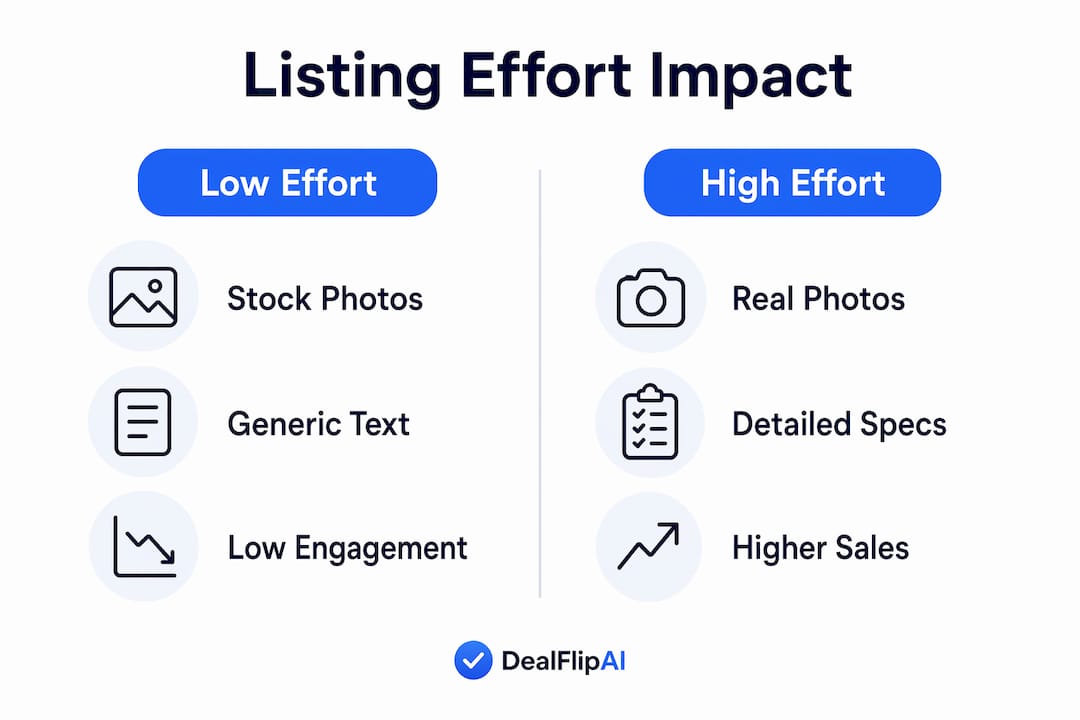
The table below summarizes the relationship between listing effort and measurable outcomes:
| Listing element | Low effort outcome | High effort outcome |
|---|---|---|
| Photos | Low engagement, more questions | Up to 25% higher sell-through |
| Product description | Higher complaint and return rate | Lower friction, faster close |
| Seller history | Fraud suspicion, low offers | Trust signals, stronger offers |
| Technical specs | Buyer uncertainty, price anchoring low | Confident buyers, fair price realization |
Platforms sometimes allow low-effort listings to establish price anchors that manipulate buyer perception of value. These listings are not always intended for sale. They exist to make other listings look more reasonable by comparison. Recognizing this tactic protects you from overpaying for a "deal" that was never a deal.
How to evaluate and reduce risk from minimal effort listings
Spotting a risky listing is a skill you can build with a consistent checklist. The goal is to assess listing quality before you assess price. Price only matters if the listing passes a basic quality threshold.
Use this process every time you evaluate a listing:
- Count the photos. A genuine seller with a real item will have at least three photos showing the actual product. One photo, especially a stock image, is an automatic flag.
- Read the description for specifics. Look for model numbers, purchase dates, defect disclosures, and included accessories. Vague language is a proxy for seller uncertainty about the item.
- Check the seller profile. Review completed sales, response rate, and account age. A ghost seller with no history is a structural risk, not just a preference issue.
- Compare the price to nearby listings. A price that is dramatically lower than comparable items is not automatically a deal. Context matters when evaluating price signals. A low price in a saturated category may reflect a price anchor, not genuine value.
- Look for communication red flags. If the seller immediately pushes you to text, email, or use an external payment method, stop. That pattern appears consistently in scam listing profiles.
- Use a listing analyzer. Tools that score listings on risk factors remove the guesswork from this process and flag patterns you might miss manually.
Pro Tip: Run any listing you are seriously considering through Dealflip AI's listing analyzer tool before making an offer. It surfaces risk signals and gives you a deal score based on price, condition, and seller behavior, so you negotiate from a position of knowledge, not hope.
Not every low-effort listing is a scam. Some represent stagnation, where a genuine seller simply did not invest time in presentation. Experienced sellers distinguish between listings that signal active risk and those that signal passive neglect. Both carry risk, but they require different responses.
Key Takeaways
Low-effort listings signal elevated risk because they reflect reduced seller investment in quality, accuracy, and buyer trust, which raises the probability of dissatisfaction, fraud, and financial loss.
| Point | Details |
|---|---|
| Structural signals matter most | Missing photos, generic descriptions, and thin seller history are the clearest risk indicators. |
| Buyer psychology amplifies risk | Saturated low-effort categories suppress trust in good listings and push offer prices down. |
| Photo quality drives outcomes | Improving photo quality can increase sell-through rates by up to 25% in key categories. |
| Price context requires analysis | A low price is not a deal signal without comparing it to nearby listings and verifying trust signals. |
| Use tools to remove guesswork | Listing analyzers and scam checkers surface risk patterns faster and more reliably than manual review. |
The uncomfortable truth about "cheap" listings
I have reviewed thousands of marketplace listings across electronics, furniture, and collectibles. The single most consistent mistake I see resellers make is treating a low price as the primary signal of opportunity. It is not. Price is the last thing you should evaluate.
The listings that have cost resellers the most money are almost never obviously fraudulent. They are the ones that look plausible but lazy. A photo taken in bad lighting. A description that says "selling as-is." A seller who responds slowly but eventually. Those listings feel like deals because the price is right. But the effort deficit is telling you something the price is not.
There is also a nuance worth understanding. Not every low-effort listing is a trap. Some sellers simply do not edit their listings once they are live, even when the listing is performing well. Changing a well-established listing can reset its search trust and visibility metrics. So a stale-looking listing from a seller with a strong history is a very different risk profile than a stale-looking listing from a brand-new account.
The skill is in reading the combination of signals, not any single one. Low effort plus thin history plus off-platform pressure equals walk away. Low effort plus strong history plus reasonable price equals negotiate carefully. That distinction is what separates resellers who scale from those who keep absorbing losses.
— Walsh Pex
How Dealflip AI helps you spot risky listings fast
Resellers who want to find good deals on Facebook Marketplace without absorbing unnecessary risk need more than a gut feeling. They need a system.

Dealflip AI analyzes listings across price, profit potential, and risk factors, giving you a deal score before you make contact with a seller. The scam checker flags structural red flags like thin seller history, generic descriptions, and off-platform communication patterns. The listing analyzer surfaces quality signals and compares the listing against market data so you know whether the price reflects genuine value or a risk discount. Real-time alerts put fresh listings in front of you before other resellers even see them. Every feature is built to help you act with confidence, not caution.
FAQ
What makes a listing "low effort"?
A low-effort listing lacks real photos, specific product details, and seller history. These omissions signal that the seller has not verified the item's condition or invested in buyer confidence.
Are all low-effort listings scams?
Not all low-effort listings are scams. Some reflect seller neglect rather than fraud, but both carry elevated risk and require careful evaluation before you commit.
How does photo quality affect listing risk?
Improving photo quality increases sell-through rates by up to 25% in image-centric categories. Listings with only stock photos or a single blurry image are statistically associated with higher complaint and return rates.
Why do low prices sometimes suppress buyer interest?
Buyers interpret very low prices in crowded markets as suspicious rather than attractive. Trust bias causes fairly priced listings to underperform when surrounded by low-effort, inflated posts.
How can I evaluate listing risk quickly?
Check the photo count, read for specific product details, review the seller's history, and compare the price to nearby listings. Tools like Dealflip AI's listing analyzer automate this process and flag risk patterns in seconds.