

Sourcing efficiency is how much profit you generate for every hour you spend finding, evaluating, and buying inventory. It's not how many listings you scroll or how many garage sales you hit on a Saturday. It's the ratio of dollars earned to hours burned.
The headline metric to watch is profit per sourcing hour. Two resellers can post the exact same 40% margin, but if one spends six hours a week finding inventory and the other spends twenty, their businesses are not remotely comparable. Time is the scarcest input in reselling, more scarce than cash for most part-time and full-time sellers, which is why profit-per-hour beats margin as your primary scoreboard.
Here are two things you can do right now to test your own sourcing efficiency:
- Log your next 10 buys: track hours spent sourcing, purchase price, and eventual sale price (or expected resale value).
- Apply a pass/fail rule: if an item won't clear at least $15 to $20 in profit after fees, shipping, and your time, skip it and move on.
Key Takeaways
Sourcing efficiency, measured as profit per sourcing hour, determines whether a reselling business can scale past a single seller's available time.
| Point | Details |
|---|---|
| Track profit-per-hour, not just margin | Two sellers with identical margins can have a fourfold difference in hourly profit depending on time spent sourcing. |
| Use a hard pass/fail threshold | Skip items that won't clear $15 to $20 in profit after fees, shipping, and time cost. |
| Price your labor when comparing channels | A "cheap" thrift find often costs more per hour than a pallet item once your time is valued. |
| Mix channels deliberately | Combine predictable vendor or pallet supply with occasional high-margin in-person finds. |
| Test tools with a real experiment | DealFlipAI's scoring and alerts speed pre-screening; measure your profit-per-hour before and after a 30-day trial to confirm the impact. |
Table of Contents
- Why Sourcing Efficiency Determines Your Growth and Time-Leverage
- What KPIs Should You Track to Measure Sourcing Efficiency?
- Which Sourcing Channels Actually Work for Resellers?
- What's a Fast Buy-or-Skip Checklist for Sourcing?
- How Can You Improve Sourcing Efficiency This Week?
- How Does an AI Deal Finder Fit Into a Sourcing Workflow?
- What Risks and Rules Should Resellers Watch For?
- What Does an Efficient vs. Inefficient Sourcing Trip Look Like?
- Raise Your Profit-Per-Hour With DealFlipAI
- Frequently Asked Questions
- Sources
Why Sourcing Efficiency Determines Your Growth and Time-Leverage
Sourcing efficiency isn't a vanity metric. It's the lever that decides whether your reselling business can scale or whether you're capped at whatever your personal hours allow. Every dollar of gross margin you generate still has to survive the cost of the time it took to find, evaluate, and haul that item home. Squeeze inefficient sourcing into the equation and your real net profit shrinks fast, even when your listing prices look great on paper.
Profit-per-hour matters more than margin percentage because your hours are finite in a way your capital often isn't. A seller with $500 to invest can theoretically source unlimited inventory if the math works. A seller with 10 hours a week cannot magically create more time. That constraint is exactly why pricing your own labor, a practice CLOSO's channel comparison recommends, often flips which sourcing channel actually makes sense.
Two sellers can post identical 40% gross margins and still run completely different businesses. Seller A spends 3 hours sourcing 5 items worth $150 profit total, netting $50 an hour. Seller B spends 12 hours sourcing 5 items worth the same $150, netting $12.50 an hour. Same margin. Four times the time-leverage difference.
That gap compounds. Seller A can quadruple output before hitting a time ceiling; Seller B is already maxed out.
What KPIs Should You Track to Measure Sourcing Efficiency?
You can't improve what you don't measure, and sourcing efficiency lives or dies on a handful of specific numbers. Here are the core KPIs, with formulas that account for fees and shipping, not just sticker price.
- Profit per sourcing hour = (Total profit from sourced items) ÷ (Total hours spent sourcing, including travel and evaluation time). Example: $300 profit from 6 hours of sourcing = $50/hour.
- Profit per usable item = (Sale price − purchase price − platform fees − shipping − packaging) ÷ (Number of usable items acquired). Example: A $40 item sold for $85, minus $12 in marketplace fees and $6 shipping, minus $15 cost, nets $52 per item.
- Hit rate (pass rate) = (Items purchased) ÷ (Items evaluated). A 20% hit rate means you buy 1 in every 5 listings you seriously consider, a benchmark consistent with the selectivity ResellMode's sourcing guide recommends for maintaining discipline.
- Inventory turnover = (Cost of items sold in a period) ÷ (Average inventory value held during that period). Higher turnover means less cash tied up in dead stock.
- ROI % = (Net profit ÷ total cost including fees and shipping) × 100. A $15 item that nets $45 profit after all costs delivers 300% ROI.
- Time-per-item = (Total sourcing hours) ÷ (Number of items acquired). This is the number that exposes whether a "cheap" channel is actually cheap once your labor counts.
Here's how those numbers can shift by channel type, using representative figures:
| KPI | In-person thrift/bin | Liquidation pallet |
|---|---|---|
| Time per item | 30 to 40 minutes | 3 to 6 minutes |
| Hit rate | 15% | Bulk buy, no per-item pass rate |
| Profit per item | $10 to $30 | $8 to $20 |
| Profit per sourcing hour | $15 to $40 | $150 |
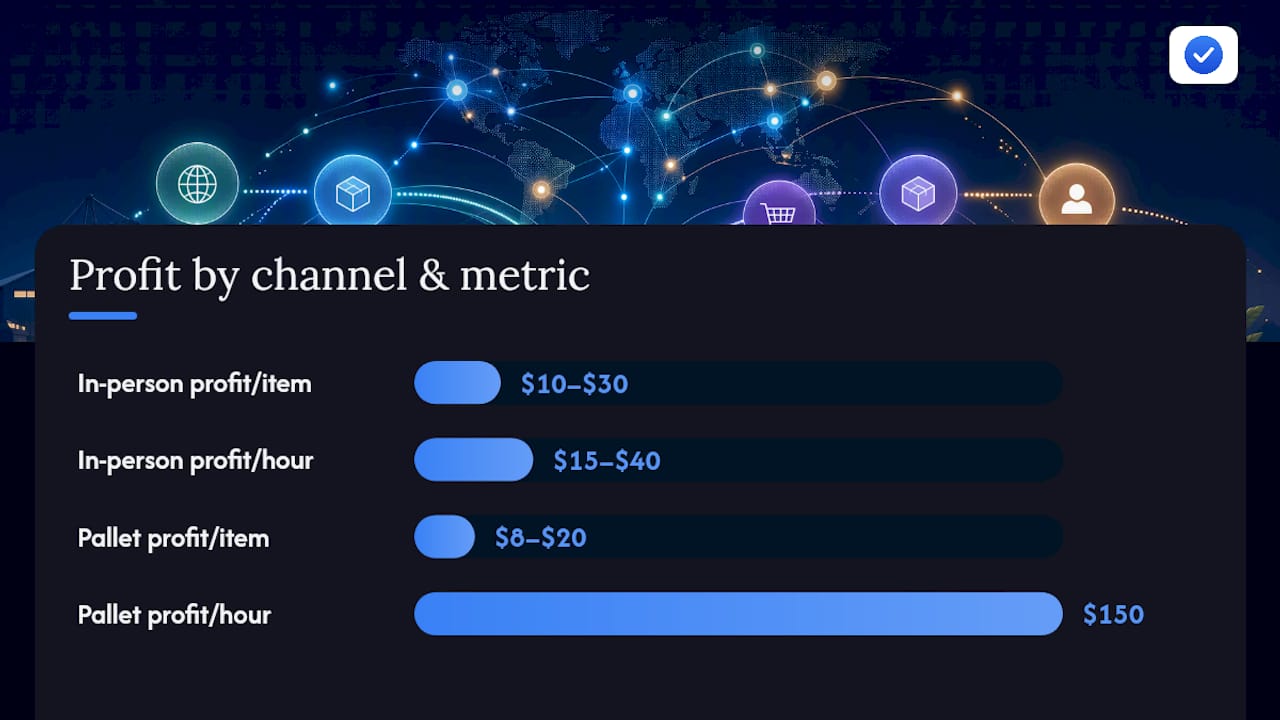
The pallet route often produces lower profit per item but dramatically higher profit per hour, because you're not burning 30 minutes evaluating a single $3 mug. That's exactly the dynamic CLOSO's research points to: price your labor at $15 an hour and the "cheap" bin find can quietly become your most expensive sourcing channel.
Which Sourcing Channels Actually Work for Resellers?
Every channel trades time for capital in a different ratio, and none of them is universally "best." The right mix depends on how much cash you have versus how many hours you can commit each week.
- Thrift stores and bins: low capital risk, high time cost, unpredictable hit rate, but occasional high-margin surprises.
- Garage and estate sales: similar time burden to thrift, often better condition items, but limited by geography and weekend availability.
- Liquidation pallets: higher upfront capital, much lower time-per-item, but variable quality and some dead stock built into the price.
- Wholesalers and vendor relationships: the most predictable channel once established, low time-per-item, but requires upfront trust-building and often minimum order quantities.
- Online marketplaces and auctions: flexible entry point, scalable with the right alerts, but competition drives up both price and time spent evaluating listings.
| Channel | Capital need | Time cost | Predictability |
|---|---|---|---|
| Thrift/bin | Low | High | Low |
| Estate sale | Low to medium | High | Low to medium |
| Liquidation pallet | Medium to high | Low | Medium |
| Wholesaler/vendor | Medium to high | Low | High |
| Online marketplace | Low to medium | Medium | Medium |
The trade-off is simple once you see it laid out: in-person channels demand time, capital-based channels demand cash. As your business grows, the constraint usually shifts from "not enough money" to "not enough hours," which is exactly when it makes sense to move toward pallets or vendor supply, a shift CLOSO's analysis frames as scaling past the labor ceiling. Most experienced sellers eventually run a mixed pipeline: vendors or pallets for steady baseline volume, in-person sourcing for the occasional high-margin find, a structure Reseller Source describes as the standard for disciplined operators.
What's a Fast Buy-or-Skip Checklist for Sourcing?
You need a decision framework you can run in your head while standing in a thrift aisle or scrolling a marketplace feed, not a spreadsheet you fill out later. Here's a compact version:
- Check price vs. comps: is the asking price at or below one-third of the realistic resale price? That one-third benchmark is a rule of thumb ResellMode's sourcing guide treats as foundational.
- Inspect condition: any damage, missing parts, or wear that limits which platform or price tier you can list at?
- Estimate shipping or pickup feasibility: will this item be a pain to ship (oversized, fragile) or is local pickup realistic for your buyer pool?
- Confirm resale channel fit: do you already have a platform and audience for this category, or would you be starting from zero?
- Run the profit threshold: does the item clear at least $15 to $20 in profit after every fee, or is it a maybe you should skip?
For borderline cases, like an item that clears only $8 to $10 profit, the fast rule is: skip unless you're already at that location for something else. Testing small batches before committing to a bigger buy, a practice CLOSO's inventory guide recommends, protects your cash flow from untested categories.
Pro Tip: Keep your minimum profit threshold written on a sticky note in your phone case. Decision fatigue is real, and a hard number stops you from talking yourself into bad buys at hour three of a sourcing trip.
How Can You Improve Sourcing Efficiency This Week?
Small workflow changes compound fast, because sourcing efficiency is really a habits problem disguised as a numbers problem.
Pre-screening routines save the most time of any tactic. Build a mobile checklist (price, condition, comps, shipping feasibility) you run through in under a minute per listing, and set a minimum acceptable profit before you even leave the house.

Batching and routing cut dead time between buys. Group thrift stops along one route instead of crisscrossing town, and schedule pallet or vendor pickups on a fixed cadence so you're not making separate trips for every restock.
Automation and alerts do the pre-screening work while you sleep. Saved searches and listing alerts mean you see fresh inventory the moment it posts instead of scrolling manually, which is where automated filtering earns its keep for high-volume sellers.
Quick sequence for a sourcing session:
- Check overnight alerts first, before opening general marketplace browsing.
- Filter by your pre-set minimum profit and category.
- Run the buy/skip checklist on anything that passes the filter.
- Negotiate using a comp-based first offer, not a guess.
- Log the result immediately, win or skip, so your hit rate stays accurate.
Pro Tip: Negotiate before you commit to pickup logistics, not after. Sellers who've already agreed to meet you somewhere are far more likely to accept a fair counteroffer than ones who haven't made a plan yet.
How Does an AI Deal Finder Fit Into a Sourcing Workflow?
A repeatable workflow looks like this: set alerts for your categories and locations, pre-filter by price and comps, evaluate finalists against your KPI thresholds, negotiate an opening offer, then log the result so your hit rate and profit-per-hour numbers stay current.
The slowest part of that loop is usually the pre-filter and evaluate steps, since manually checking comps on every listing eats the exact hours your profit-per-hour metric is trying to protect. This is where a tool like DealFlipAI's deal scoring speeds things up: it scores listings on price versus resale value, flags scam risk, and suggests a first offer based on market data instead of a guess.
- Alerts fire the moment a matching listing goes live, ahead of manual scrollers.
- Scoring replaces manual comp-checking on every single listing.
- Scam detection filters out red-flag listings before you waste a trip.
- Suggested first offers remove the guesswork from negotiation.
To validate whether any tool actually moves your numbers, run a real experiment: measure your baseline profit-per-hour over two weeks, then run 30 days with the tool active and compare the delta, a testing approach ResellMode's sourcing guide recommends for proving workflow changes actually work rather than just feeling better.
Pro Tip: Don't judge a new tool on your first three deals. Run the full 30-day window before you decide whether it's actually raising your hit rate or just changing which listings you notice.
What Risks and Rules Should Resellers Watch For?
Scam signals cluster around a few patterns: requests for payment outside the platform, photos that look reused or stock-sourced, and sellers who push unusual pickup locations or times. A quick scam checklist before you commit:
- Payment request outside the platform's protected system.
- Photos inconsistent with the listed condition or location.
- Pressure to meet somewhere unusual or skip in-person inspection.
Brands increasingly restrict who can resell their products and where, especially as more manufacturers formalize vetted reseller programs, a shift Reseller Source documents as the market moving toward professionalized channels. On the legal side, sellers should track payment thresholds tied to Form 1099-K reporting and avoid unverified origin claims, which the FTC's Made in USA standard governs strictly.
Pro Tip: Keep a simple spreadsheet of purchase price, date, and platform for every item. It solves both your tax recordkeeping and your KPI tracking in one file.
What Does an Efficient vs. Inefficient Sourcing Trip Look Like?
Take a $15 thrift item that resells for $65. Inefficient path: 45 minutes of driving and browsing, no pre-screening, item sells after fees and shipping ($12 total) for $38 net profit. Time cost at $15/hour value: $11.25. Real profit-per-hour: roughly $36.
Now the efficient path with pre-screening and an alert-driven find:
- Alert flags the listing in 2 minutes.
- Score and comps check takes 3 minutes.
- Pickup takes 15 minutes total.
- Same $38 net profit, but only 20 minutes invested.
That's $114 per hour versus $36, a threefold jump, without changing the item, the price, or the margin at all. Only the workflow changed.
A Rule Change That Actually Moved My Numbers
I used to evaluate every listing that looked interesting, which meant hours lost to items that never should have made the cut. Switching to a hard pass/fail rule, skip anything under a set profit floor before even messaging the seller, cut my evaluation time by roughly half in a single month. My current habit: I never negotiate until I've already calculated my walk-away price on paper.
Raise Your Profit-Per-Hour With DealFlipAI
Every tactic in this guide points to the same bottleneck: pre-screening eats the hours that actually determine your profit-per-hour. DealFlipAI closes that gap directly by scoring Facebook Marketplace listings on price, profit potential, and risk before you ever leave the couch, so you stop spending 30 minutes evaluating items that were never going to clear your profit threshold.
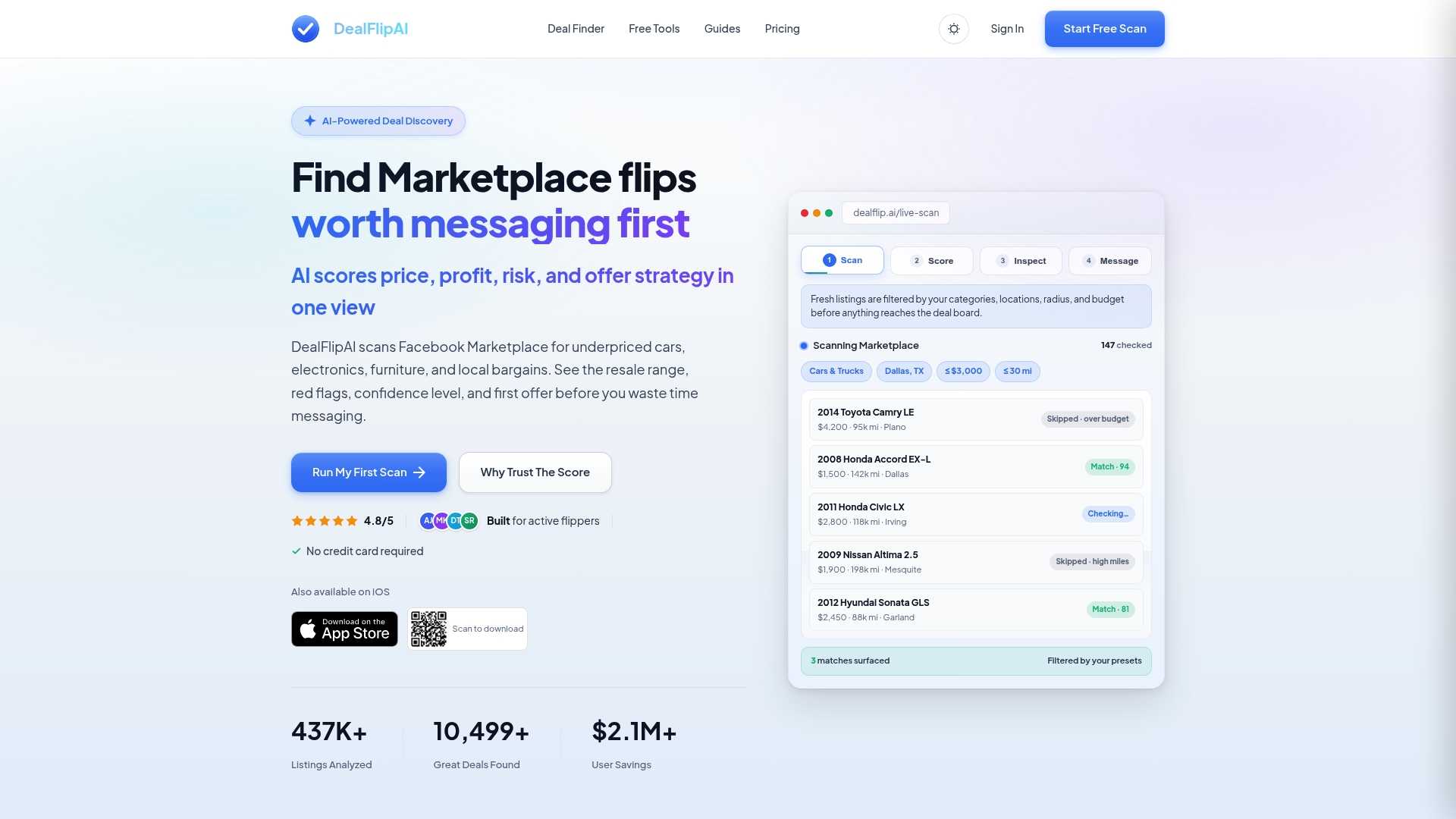
The platform flags scam signals automatically, suggests a data-backed first offer instead of a guess, and sends real-time alerts so you see fresh listings before other buyers do. Run a free scan with the Facebook Marketplace deal finder on your next sourcing session, log the results against your current baseline, and see the profit-per-hour difference for yourself over 30 days. If you want to test the math on a specific listing right now, the flip profit calculator will show your real margin after fees before you make an offer.
Frequently Asked Questions
What is sourcing efficiency in reselling, exactly? Sourcing efficiency measures how much profit you earn per hour spent finding, evaluating, and buying inventory, rather than just the margin on each individual sale.
How do I calculate profit per sourcing hour? Add up total profit from items you sourced in a period, then divide by total hours spent finding, evaluating, and acquiring those items, including travel time.
What's a good hit rate for resellers?
Is it legal to resell items I bought secondhand? Reselling secondhand goods is generally legal, but sellers should track payment reporting thresholds through Form 1099-K and avoid unverified origin or condition claims covered under FTC guidance.
Why do some brands dislike resellers? Brands sometimes restrict resale to protect pricing consistency and control distribution channels, though many now formalize vetted reseller programs instead of blocking resale outright.
Can automation tools actually improve sourcing efficiency? Yes, when tested properly. Running a 30-day comparison of profit-per-hour before and after adopting alerts or scoring tools is the clearest way to confirm real impact rather than assuming it works.
Sources
- Understanding Your Form 1099-K | Internal Revenue Service
- Complying with the 'Made in USA' Standard | Federal Trade Commission
- Sourcing strategies: how resellers find inventory in a competitive market | Reseller Source
- Sourcing guide: where to find inventory | ResellMode
Treat platform policies and supplier agreements as the primary rulebook whenever a sourcing decision touches brand restrictions or channel rules.