

What are the core benefits of automated listing filtering?
Automated listing filtering uses AI to instantly screen, rank, and sort large sets of listings based on price, quality, risk, and relevance. The result? You spend less time digging through noise and more time acting on real opportunities.
Here is what you get when you automate listing filtering:
- Speed: AI reviews thousands of listings in seconds, not hours.
- Accuracy: Filters apply consistent rules every time, removing human error from the equation.
- Relevance: Only listings that match your criteria surface, so search results feel personal and useful.
- Scalability: The system handles ten listings or ten thousand with equal ease.
- Risk reduction: Risky, restricted, or low-quality listings get flagged or removed before you waste time on them.
- Data-driven decisions: You get real performance signals, not gut feelings, guiding every sourcing or buying choice.
These advantages of listing automation compound quickly. The more listings you process, the more value the filters deliver.
How automated filtering makes search results feel personal to you
Buyers abandon platforms that waste their time with irrelevant results. Automated filtering solves this by learning from behavior and applying rules that match listings to what each user actually wants.
- Buyer preferences, past searches, and price ranges feed directly into filter logic.
- Low-quality or mismatched listings get removed before they ever appear in results.
- Fresh, high-potential deals surface first, keeping the experience exciting and useful.
- Faster, more relevant results reduce the frustration of endless scrolling.
AI filters can analyze thousands of SKUs and remove irrelevant or risky offers in real time, so the listings you see are already pre-qualified. That shift from "browse everything" to "browse only what fits" is what drives buyer satisfaction and conversion. When users trust that results are relevant, they come back.

How automation saves you time and cuts operational costs
Manual listing processes significantly delay time to market, often stretching product rollouts to weeks or longer. That delay has a direct cost: stock sits idle, revenue waits, and your team burns hours on repetitive tasks.
- Manual catalog work can cost significant labor per listing when you factor in writing, editing, and coordination.
- AI-driven listing creation cuts that unit cost dramatically in high-volume operations.
- One online pharmacy listed 8,000 SKUs in a single week using AI, a task that would have taken months manually.
- Automation reduces bottlenecks in product rollout workflows, letting small teams manage catalogs that would otherwise require large departments.
The so-called "Catalog Chaos Tax" describes how manual listing disorder hides lost sales and inflates costs. AI workflows eliminate it. Clean, structured input data is the prerequisite: poor supplier data leads to generic or faulty output that still requires human review, so data quality is a critical first step before any automation pays off.
Pro Tip: Before you automate, audit your listing data. Garbage in, garbage out applies here more than anywhere else. Clean your product fields, standardize your categories, and your filters will work far better from day one.

The true cost of manual distribution extends beyond labor hours. Errors, delays, and inconsistencies compound across every channel you sell on.
How smarter filtering keeps customers coming back
Retention starts with relevance. When a platform consistently shows listings that match what a buyer is looking for, they return. When it does not, they leave and rarely come back.
- Better listing matches increase the time buyers spend on a platform, which signals quality to marketplace algorithms.
- Removing poor or irrelevant listings reduces user frustration before it builds.
- Automated highlighting of fresh or high-potential deals creates a sense of discovery that keeps the experience engaging.
- Consistent filtering quality builds the habit of returning to check for new deals.
Deal alerts that notify buyers the moment a matching listing appears take this further. You are not just filtering what exists; you are making sure buyers never miss what just arrived. That combination of relevance and speed is what turns one-time visitors into loyal users.
Why listing automation scales across industries, not just reselling
Automated listing management is not limited to one market. The same filtering logic that helps a reseller find undervalued electronics on Facebook Marketplace also helps a real estate platform surface relevant properties, or a hardware distributor manage thousands of SKUs across multiple channels.
- Enterprise IT operations use self-service automation to process large hardware catalogs without manual intervention.
- E-commerce sellers can list across Amazon, Shopify, Etsy, and Walmart simultaneously with platform-specific optimization.
- Real estate platforms apply filters for price range, location, and listing quality to surface only relevant properties.
- Surveys found 45% of companies needed over six months to roll out product data to a new channel manually. Automation collapses that timeline dramatically.
The ability to filter low-quality listings fast applies whether you are managing 50 listings or 50,000. Automation does not care about volume; it applies the same rules at any scale.
How data-driven filtering gives you a real competitive edge
Automated filtering does more than sort listings. It generates performance data that helps you make smarter sourcing, pricing, and positioning decisions. Automated filtering converts complex supplier price lists into clear buying decisions by excluding risky or restricted products early, protecting your capital before you commit it.
- Real-time data integration means your filters reflect current market conditions, not last week's snapshot.
- AI analysis spots trends and risk signals early, before they become expensive mistakes.
- Profit, ROI, and risk-based filters let you set precise sourcing rules that match your business model.
- Smarter offer calculations and inventory decisions follow naturally from cleaner, filtered data.
How automated deal filtering works is straightforward: you define your criteria, the AI applies them at scale, and you receive a shortlist of opportunities worth your attention. The competitive advantage comes from acting on that shortlist faster than anyone working manually.
Security, ethical AI, and staying ready for what comes next
Speed without accuracy creates its own problems. AI systems can occasionally generate incorrect product details, which is why a quick human verification step, roughly 60 seconds per item, preserves trust and catches errors before they go live. That review step is not a sign that automation failed; it is the design working correctly.
- Automating only stable, repeatable tasks while keeping high-risk updates under human review ensures quality and control.
- Hybrid automation models that balance AI processing with human validation consistently yield the best outcomes in listing accuracy and efficiency.
- Compliance with platform policies requires transparency in how filters are applied and what criteria drive decisions.
- Filtering algorithms improve over time as they process more data, making the system smarter with every cycle.
Teams that measure automation quality beyond throughput and track error rates avoid the common trap of velocity rising while reliability quietly declines. Automation works best when it is treated as a quality execution tool, not a fixed guarantee of perfect output.
Dealflip AI in action: automated filtering for Facebook Marketplace resellers
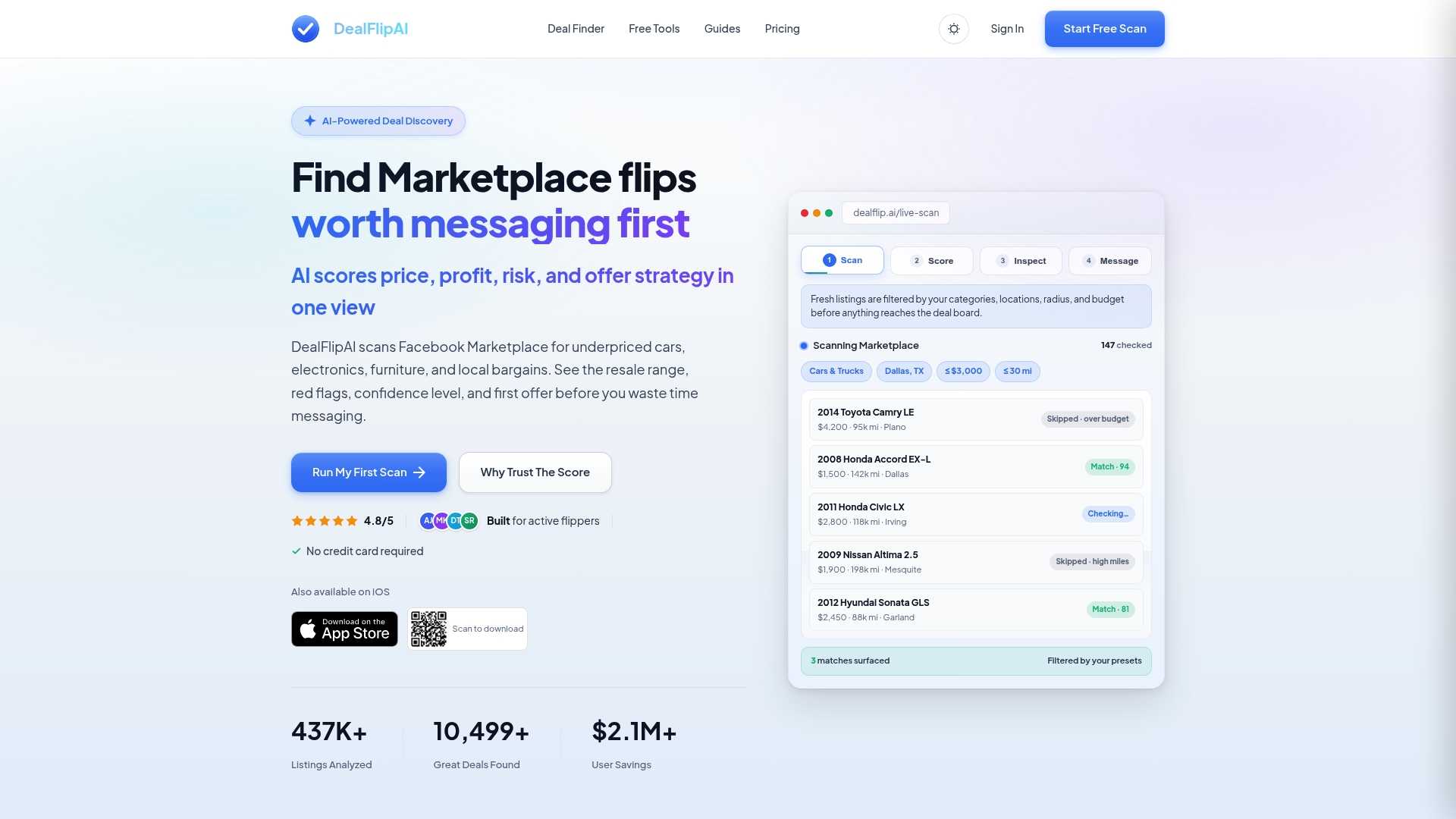
Dealflip AI applies every principle above to one of the most active resale markets in the United States: Facebook Marketplace. The platform scores each listing on price, profit potential, and risk factors, so you see a ranked, filtered feed instead of a raw, unorganized list.
| Feature | What it does |
|---|---|
| AI listing scoring | Rates each deal on profit potential and risk before you click |
| Scam detection | Flags suspicious listings automatically |
| Real-time deal alerts | Notifies you the moment a matching listing appears |
| Transparent valuation | Shows the methodology behind every score |
| Optimal offer suggestions | Calculates the best first offer based on market data |
Users report finding high-value deals faster and avoiding costly mistakes that manual browsing would have missed. The platform's scam detection alone saves time that would otherwise go toward investigating listings that were never legitimate.
Pro Tip: Use Dealflip AI's filters alongside its alert system. Set your profit and risk thresholds once, then let the alerts bring qualifying deals to you. You will cover more ground in less time than any manual search allows.
The listing analyzer tool gives you a free way to test this approach on any Facebook Marketplace listing before you commit. Start there, build your filter criteria, and scale from that foundation.
Ready to put automated filtering to work? Find good deals on Facebook Marketplace with Dealflip AI's AI-powered scoring and filtering system.
Key Takeaways
Automated listing filtering delivers the most value when AI speed is paired with human quality checks at the right decision points.
| Point | Details |
|---|---|
| Speed and accuracy | AI screens thousands of listings in seconds, applying consistent rules that manual review cannot match. |
| Cost reduction | — |
| Scalability across industries | One pharmacy listed 8,000 SKUs in one week with AI, a task that would have taken months manually. |
| Hybrid model wins | Balancing AI automation with human review for high-risk items yields the best accuracy and efficiency outcomes. |
| Data hygiene first | Clean, structured input data is the prerequisite for quality automated filtering output. |