

Market saturation reduces flip margins by squeezing sale prices down while pushing acquisition, holding, and fee costs up. The result: the same item that netted you $80 six months ago might clear $20 today. Before you place another offer, check these numbers in your category right now—note that recommended thresholds for each metric are detailed in the measurement table below and may vary by item type:
- Listings-per-buyer: Count active listings for your SKU, then estimate local demand. See action thresholds below for specific cutoff values.
- Median sold price trend: If recent comps are trending lower, price compression is underway.
- Days-to-sale: If average days-to-sale is rising in a category that used to move quickly, buyer demand may not be keeping pace with supply.
Run your numbers through the Flip Profit Calculator before you bid. If the math doesn't clear a 20% net margin after fees, it's a pass.
Key Takeaways
Market saturation reduces flip margins by compressing sale prices while raising acquisition, holding, and fee costs simultaneously, making measurement and sourcing discipline the most important margin defenses.
| Point | Details |
|---|---|
| Saturation hits six channels at once | Price compression, longer holding, higher buy costs, fees, refurb risk, and buyer bargaining all erode margin together. |
| Local pickup saves the 10% fee | Facebook Marketplace's fee-free local pickup preserves margin on low-ticket and bulky items that shipped checkout would make unprofitable. |
| 20% net margin is your floor | If the break-even formula returns less than 20% net after all costs, the deal fails the test regardless of gross spread. |
| Measure before you buy | Check listings-per-buyer, median sold price trend, and days-to-sale before every offer to catch saturation early. |
| Dealflip AI speeds up the process | Real-time alerts, deal scoring, and fee-aware profit estimates help you find and evaluate deals before other flippers do. |
Table of Contents
- What market saturation looks like on Facebook Marketplace
- How saturation reduces flip margins through six channels
- How to measure saturation in the categories you flip
- Practical tactics to protect your margins when saturation rises
- How AI deal-finders shift the odds in a saturated market
- Margin math: low-saturation vs. saturated category, side by side
- Your quick "skip or bid" checklist
- What I've learned flipping in saturated categories
- Dealflip AI helps you find deals before the margin disappears
- Sources
What market saturation looks like on Facebook Marketplace
Saturation is not an abstract economic concept. On Facebook Marketplace, you see it in real time: five identical iPhone 13 listings in your zip code, all dropping prices every 48 hours, none of them selling. Facebook Marketplace reaches an estimated 1.1 billion monthly visitors, and that scale accelerates both opportunity and overcrowding depending on the category.
Concrete signals to watch:
- Duplicate listings: Multiple sellers posting the same SKU at similar prices, with no differentiation.
- Sustained markdowns: Sellers editing prices down repeatedly without getting offers.
- Rising days-to-sale: Items that used to sell in a weekend now sit for two to three weeks.
- Falling median sold prices: Completed sales trending lower month over month.
Saturation is uneven across categories. High-volume niches like mass-market electronics and hype sneakers show clear oversupply and price compression, while harder-to-source items (vintage tools, niche appliances, specialty furniture) often stay profitable longer. The key variable is SKU fungibility: the more interchangeable your item is, the faster saturation hits.
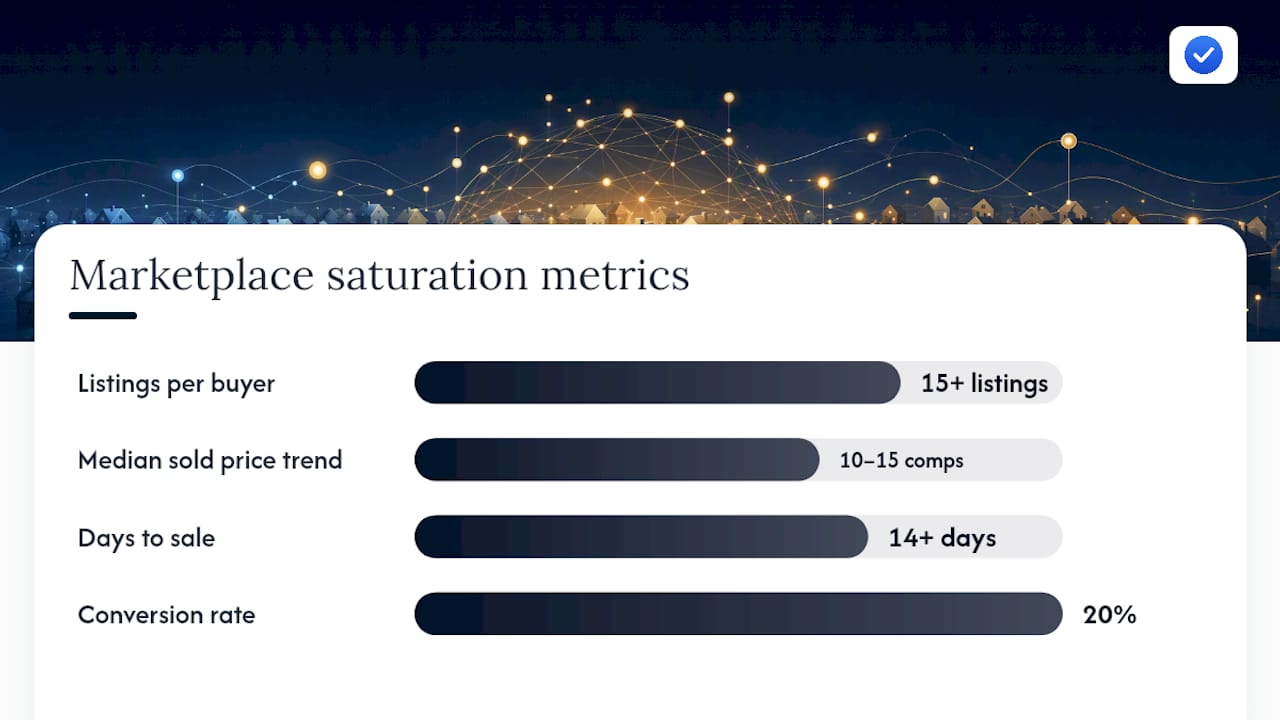
| Listings-per-buyer | Supply vs. local demand | 15+ listings for one SKU in your metro (see lede for qualifying note that thresholds may vary by category) | Median sold price trend | Price direction over time | Declining over last 10–15 comps | | Days-to-sale | Buyer absorption speed | Rising above 14 days in a fast category | | Conversion rate | Leads that turn into sales | Dropping below 20% on your listings |
How saturation reduces flip margins through six channels
More sellers in a category does not mechanically hurt every seller equally. Fee structures, product differentiation, and buyer concentration all shape margin outcomes. But when saturation hits a fungible SKU on Marketplace, six channels compress your profit simultaneously.
- Price compression. Buyers compare your listing to five others instantly. You drop your ask to compete, and so does everyone else. The floor falls fast.
- Longer holding time. Slower sales mean more days between your purchase and your cash-out. Storage space, tied-up capital, and opportunity cost all add up.
- Higher acquisition costs. When more flippers chase the same underpriced listings, sellers get more offers and hold out for better prices. Your buy-side leverage shrinks.
- Fee amplification. A 10% shipped checkout fee on Facebook Marketplace hits harder when your margin is already thin. On a $100 item, that's $10 gone before you account for shipping. Local pickup stays fee-free, which is why local-first is a core margin defense.
- Inspection and refurb risk. Saturated categories attract more distressed inventory. Sellers know buyers have options, so they price aggressively on items with hidden flaws. Your refurb cost estimate needs a buffer.
- Buyer bargaining power. When buyers can scroll past your listing to three identical ones, they lowball confidently. Platform competition and seller counts interact in ways that can shift pricing power toward buyers, especially on high-visibility platforms.
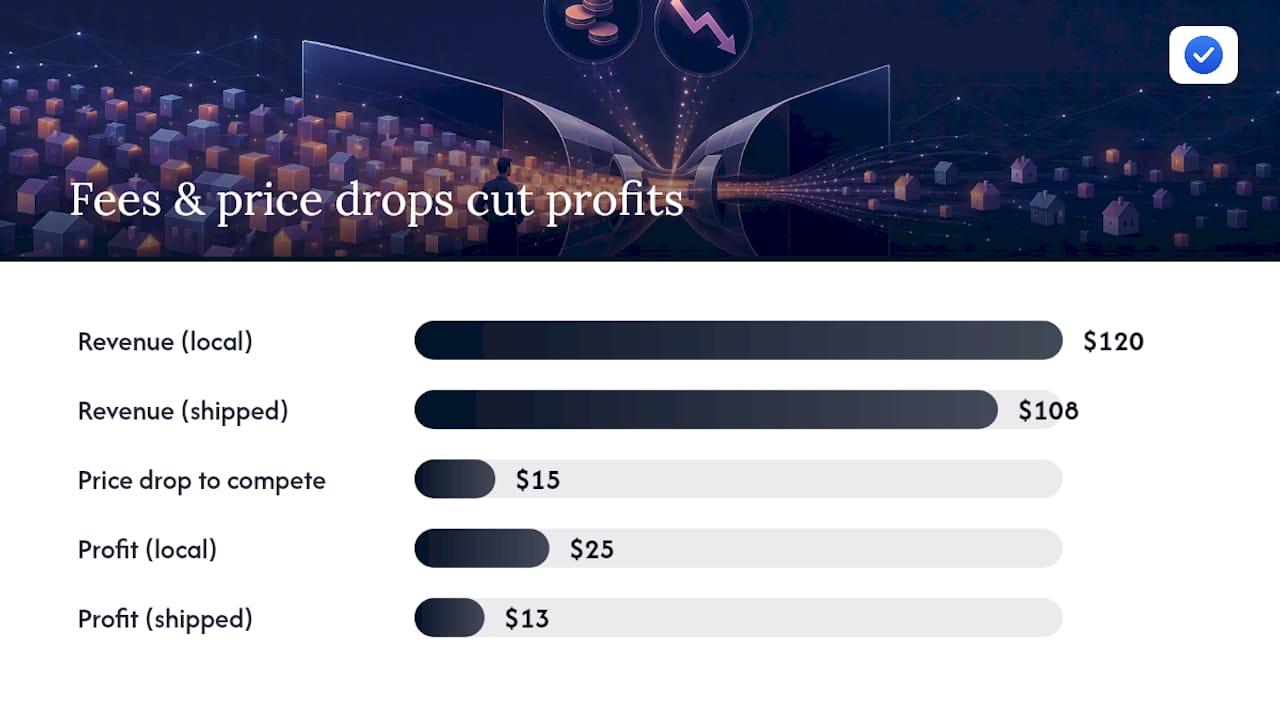
Fee callout: A $120 used phone sold via Marketplace shipped checkout nets roughly $108 after the 10% fee, before shipping costs. Sold locally with zero fees, you keep the full $120. In a saturated category where you already dropped your ask by $15 to compete, that $12 fee difference is the difference between a $25 profit and a $13 one.
How to measure saturation in the categories you flip
You don't need a data science degree. You need three repeatable checks before you commit capital.
| Metric | How to collect it | Action threshold |
|---|---|---|
| Listings-per-buyer | Count active Marketplace listings for your SKU in a 25-mile radius | Pause if 15+ listings for one model |
| Median sold price trend | Pull last 15 sold comps on eBay or Marketplace | Pass if trend is down 10%+ over 30 days |
| Days-to-sale | Track your own listings or check seller activity timestamps | Reconsider if average exceeds 14 days |
| Conversion rate | Leads received ÷ sales closed | Investigate if below 20% |
Quick formula for break-even margin:
Net Margin = (Sale Price) − (Buy Price + Fees + Shipping + Refurb) ÷ Sale Price × 100
Target 20% net minimum. If saturation has pushed the realistic sale price down so that formula returns less than 20%, the deal fails the test. Note that the 20% net margin floor applies consistently throughout all measurement and recommendation sections. Platform-specific buyer-seller ratios produce different realized prices across venues, so run this calculation separately for a local pickup listing versus a shipped eBay or Mercari listing before deciding where to post.
Practical tactics to protect your margins when saturation rises
The flippers who stay profitable in crowded categories are not the ones who work harder. They're the ones who pick smarter.
- Go local-first on bulky and low-ticket items. Skipping the 10% shipped checkout fee on a $60 item preserves more margin than any price negotiation. Check out why local reselling beats online arbitrage for a deeper breakdown.
- Bundle to escape the commodity trap. A standalone Keurig in a saturated category sells at the floor price. A Keurig bundled with a pod organizer and a bag of pods sells as a package with no direct comp. Buyers can't price-compare a bundle.
- Tighten your buy rules. Set a hard maximum buy price based on your break-even formula, not on what feels like a deal. Market saturation and platform dependency are primary resale business risks, and discipline on the buy side is your first line of defense.
- Rotate to less-saturated niches. Vintage hand tools, specialty kitchen equipment, and niche fitness gear often hold margin better than generic electronics. See profitable Marketplace categories for 2026 for category-specific data.
- Prioritize speed over price. A fast sale at a slightly lower price beats a slow sale at a higher one when holding costs and opportunity cost are factored in.
- Cross-list strategically. Post locally first. If it doesn't move in 7 days, cross-list to eBay, Mercari, or Poshmark, and run the numbers on each platform's fees before you decide. Use the cross-listing profit calculator to compare net payouts side by side.
Pro Tip: Before you boost a listing on Marketplace, run the math. Paid promotion on a thin-margin item in a saturated category often costs more than the incremental sale price it generates. Boost only when your margin can absorb it.
How AI deal-finders shift the odds in a saturated market
Speed and information are the two advantages that matter most when a category is crowded. Platform design and competition change seller incentives, and the flippers who act on fresh listings before the price drops are the ones who capture margin before saturation sets in.
Dealflip AI addresses this directly with a set of features built for exactly this problem:
- Real-time deal alerts notify you the moment a qualifying listing goes live, so you reach underpriced items before other flippers do. Set up your deal alerts by category, location, and price range.
- AI deal scoring rates each listing on profit potential, price vs. fair market value, and risk signals, so you spend your evaluation time on deals that actually pencil out.
- Fee-aware profit estimates factor in Marketplace's local vs. shipped fee structure automatically, so you see net margin, not just gross spread.
- Scam detection flags listings with risk signals before you drive across town or wire a deposit.
- Valuation transparency shows you the reasoning behind each estimate, not just a number, so you can negotiate with confidence.
Pro Tip: Use Dealflip AI's Facebook Marketplace Value Estimator before making any offer in a category you haven't flipped recently. Median sold prices shift faster than most flippers realize, and a stale comp can cost you $30–$50 per deal.
Margin math: low-saturation vs. saturated category, side by side
Here's a worked example using a used mid-range Android phone, the kind of item that moves from healthy margin to breakeven as a category fills up.
The saturated scenario is not a bad deal that got a little worse. It's a deal that flipped from profitable to a loss. The buy price rose because more flippers competed for the same source. The sale price fell because more sellers competed for the same buyers. Fees and shipping stayed fixed, so they consumed a larger share of a shrinking spread. Holding time tripled, adding cost. Every channel described earlier hit at once.
Your quick "skip or bid" checklist
Run through this in 60 seconds before you make any offer.
- Condition check. Is the item in the condition the photos and description claim? If you can't verify, add a $15–$20 refurb buffer to your math.
- Competing listings count. More than 15 active listings for this exact SKU in your metro? Flag as saturated.
- Median sold price trend. Are recent comps trending down? If yes, your sale price estimate should use the lower end of the range.
- Days-to-sale trend. Are similar items sitting longer than 14 days? Factor in holding cost.
- Fee mode. Local pickup or shipped? If shipped, subtract 10% from your projected sale price before calculating margin.
- Break-even check. Does the deal clear 20% net margin after all costs? If not, pass.
Decision rule: Bid if net margin clears 20% and days-to-sale is under 14. Skip if either condition fails.
What I've learned flipping in saturated categories
There was a stretch where I kept buying mid-range laptops because the buy prices looked great. The spread on paper was $60–$80 per unit. But I was slow to notice that the category had filled up. Days-to-sale crept from 5 to 22. I started dropping my ask. By the time I sold the last three units, I had averaged $11 net per laptop after fees and one battery replacement.
The fix was simple, but I had to stop and actually run the numbers to see it. I switched to local-only listings on bulky items, tightened my buy rules to require 20% net margin at the conservative sale price, and started checking listings-per-buyer before every sourcing run. I also started using a deal-scoring tool to filter out categories where the median sold price was already trending down.
The lesson: saturation doesn't announce itself. You have to measure it. The checklist above is exactly what I now run before every offer.
Dealflip AI helps you find deals before the margin disappears
Finding a profitable flip in a crowded category comes down to one thing: getting there first with better information. Dealflip AI gives you real-time alerts the moment underpriced listings go live, so you're not competing for deals that have already been picked over.

The platform scores every listing on profit potential, flags scam signals, and calculates fee-adjusted net margin for both local pickup and shipped checkout automatically. You see the deal's true value before you make an offer, not after. For flippers who want to stop guessing which categories are still worth working, the deal scoring and valuation tools give you a repeatable process built around real market data.
Run your next flip through the Flip Profit Calculator and see exactly where your margin stands before you commit.
Sources
This article is general information, not a substitute for advice from a qualified financial advisor. Consult a qualified financial professional about your own circumstances before acting on anything here.