

Local reselling is the practice of buying undervalued items in your area and reselling them locally for profit, and it consistently outperforms online arbitrage for most independent resellers. Why local reselling beats online arbitrage comes down to one core fact: you keep more of every dollar you earn. Online arbitrage typically costs resellers 15–20% in platform and shipping fees, while in-person sales on platforms like Facebook Marketplace carry zero platform fees. Add in the pricing gaps of 40–70% that local sellers routinely find on mispriced items, and the math strongly favors local sourcing. This article breaks down the cost differences, niche advantages, real risks, and the tools that make local reselling work at scale.
Why local reselling beats online arbitrage on costs
The single biggest advantage of local reselling is what you do not pay. Shipping a 10-pound item can consume 37–62% of a $40 sale, and that is before you factor in packaging materials that add $0.50–$3.00 per item. Online arbitrage also layers on platform fees, payment processing cuts, and return shipping costs that compound quickly.
Local in-person sales eliminate all of that. You meet the buyer, hand over the item, collect cash or a digital payment, and walk away with the full margin. There are no return fraud claims, no "item not as described" disputes, and no waiting on a carrier to deliver before you get paid.

The fee difference alone changes the math on low-to-mid-priced items. A $60 item sold online after fees and shipping might net you $38. The same item sold locally nets you $55 or more. That gap is why experienced resellers avoid shipping risks whenever the item and buyer are local.
Key cost factors to watch in online arbitrage:
- Platform fees: Typically 10–15% of the sale price on major resale platforms
- Shipping costs: Often $8–$20 for standard parcels, more for heavy items
- Packaging materials: $0.50–$3.00 per shipment
- Return handling: Time and cost absorbed by the seller in most disputes
- Payment processing: An additional 2–3% on most platforms
How does local reselling capitalize on market inefficiencies?
Local marketplaces act as civic infrastructure for proximity-based sales, filling a role that national retailers and online platforms cannot efficiently serve. That structural gap is where local resellers make their money.
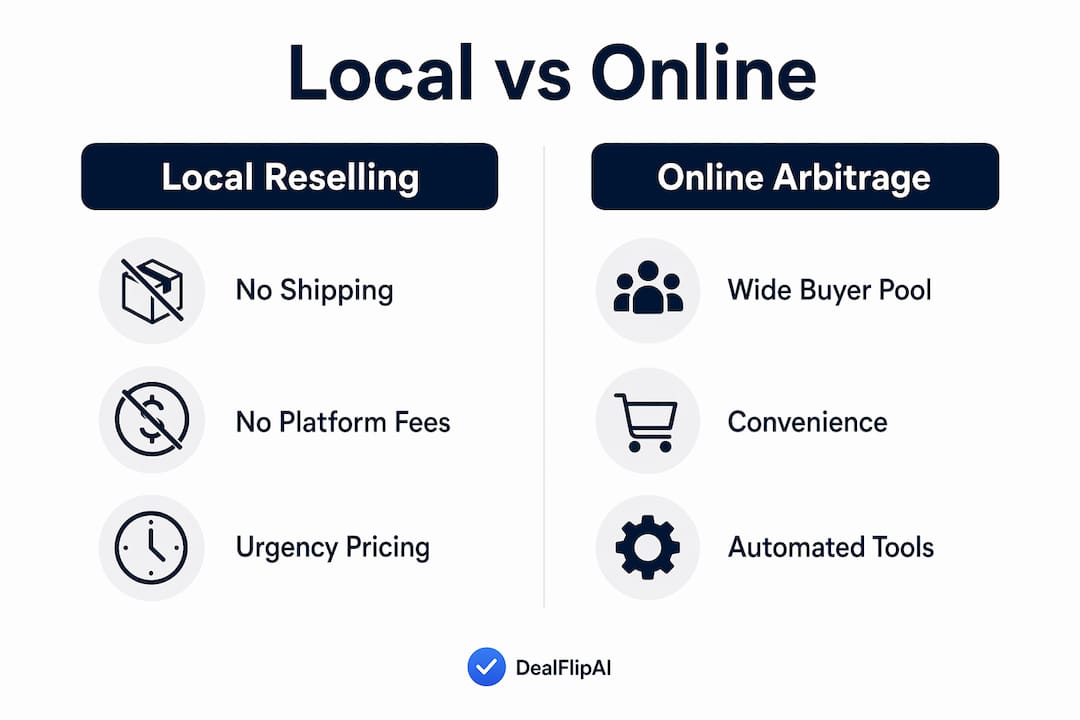
Sellers on Facebook Marketplace and similar platforms often price items based on urgency, not market value. Someone moving next week prices a treadmill at $80 because they need it gone. That same treadmill retails for $400 and resells locally for $200 without any shipping cost. Local resellers spot items mispriced by 40–70% on a regular basis, and urgency-driven sellers create those gaps consistently.
Heavy and bulky items represent the clearest niche advantage. Furniture and exercise equipment are routinely ignored by online sellers because shipping costs exceed the item's value. Local resellers fill that gap profitably with zero shipping involved. A used sectional sofa, a weight bench, or a riding lawn mower are all items where local resellers face almost no online competition.
Categories where local reselling consistently outperforms online arbitrage:
- Large furniture: Sofas, dining sets, bed frames
- Exercise equipment: Treadmills, weight sets, stationary bikes
- Power tools: Often underpriced by sellers who do not know current demand
- Musical instruments: Guitars, keyboards, and amps frequently mispriced locally
- Appliances: Washers, dryers, and refrigerators that no one wants to ship
Pro Tip: Search Facebook Marketplace by "free" or filter by items posted within the last two hours. Urgency sellers post and price low fast. Being first to message wins the deal.
What are the risks and limitations of local reselling?
Local reselling is not without friction. Knowing the real risks helps you plan around them rather than get blindsided.
The most common problem is buyer no-shows. No-show rates average 20–30% in local transactions. That is a real time cost, especially if you are driving to a meetup location. The fix is straightforward: confirm the meetup the morning of, ask buyers to message you when they are on their way, and never drive more than 10 minutes for an unconfirmed buyer.
- Buyer no-shows: Confirm every meetup twice. Require a message when the buyer is en route before you leave home.
- Limited market size: Your local buyer pool is smaller than a national online audience. Niche or high-value items may take longer to sell.
- Scaling challenges: Local reselling requires physical effort per transaction. You cannot automate pickup and delivery the way online sellers automate fulfillment.
- Safety considerations: Always meet in public places, preferably police station parking lots or busy retail areas. Many cities now designate official safe exchange zones.
- Condition verification burden: You inspect every item yourself. That takes time but also gives you an information edge that online buyers never have.
Online arbitrage does have real advantages in specific situations. High-value, lightweight, niche collectibles often need a national audience to find the right buyer at the right price. A rare vintage camera or a limited-edition sneaker sells faster and at a higher price online than locally. Knowing when to ship and when to meet is a skill that separates good resellers from great ones.
How do local resellers use technology to maximize profits?
Technology has closed the gap between local reselling's information advantages and online arbitrage's data tools. The right tools let you move faster, price better, and avoid bad deals before they cost you money.
Dealflip AI is built specifically for this workflow. It scores Facebook Marketplace listings based on price, profit potential, and risk factors, so you can evaluate a deal in seconds instead of minutes. The platform also flags potential scams and sends real-time alerts for fresh listings in your target categories. That speed matters because the best local deals disappear within hours of posting.
Pro Tip: Set up Dealflip AI alerts for your top three product categories. Fresh listings with urgency signals (words like "moving," "need gone," or "quick sale") are your highest-probability deals. Message those sellers first.
A solid local reselling tech stack covers four functions:
- Deal scoring: Evaluate profit potential before you commit to a meetup
- Pricing analysis: Use market price comparisons to price your relisted items competitively
- Scam detection: Screen buyers and listings for red flags before you respond
- Fee calculation: Know your exact margin before you make an offer, using a flip profit calculator to run the numbers fast
Local reselling startup costs run $0–$200, which is dramatically lower than the tool subscriptions and data fees required for competitive online arbitrage. That low barrier means your first few flips can cover your entire tech investment.
When should resellers consider a hybrid strategy?
A hybrid approach, combining local sourcing with selective online selling, gives you the best of both models. Hybrid reselling works best when you match the sales channel to the item's characteristics rather than forcing every item through one model.
The decision framework is simple. Ask two questions: How heavy or bulky is the item? And how large does the buyer pool need to be to get a fair price? Bulky items with broad local demand go local. Small, niche, high-value items go online.
| Item type | Best channel | Reason |
|---|---|---|
| Furniture, appliances, gym equipment | Local pickup | Shipping costs exceed item value |
| Lightweight collectibles, electronics | Online arbitrage | Needs national audience for best price |
| Mid-range tools and instruments | Either, test locally first | Local is faster; online reaches more buyers |
| Branded clothing and shoes | Online arbitrage | Size-specific demand needs national reach |
| Books, media, and games | Online arbitrage | Low weight, high competition locally |
Online arbitrage margins compress quickly as automated tools flood popular categories with competition. Local reselling, by contrast, delivers steady cash flow described by experienced resellers as reliable "car-payment money." A hybrid strategy lets you use online channels for high-value wins while local sales fund your ongoing operations.
The practical allocation for most resellers starting out: spend 70% of your sourcing time on local deals and 30% on online arbitrage for items that clearly need national reach. Adjust that ratio as you learn which categories perform best in your specific market.
Key Takeaways
Local reselling beats online arbitrage by eliminating shipping costs and platform fees, capturing 40–70% pricing gaps on urgency-priced local inventory, and building steady cash flow that online arbitrage cannot reliably match.
| Point | Details |
|---|---|
| Zero-fee local sales | In-person sales on Facebook Marketplace carry no platform fees, keeping more margin per flip. |
| Shipping kills thin margins | Shipping a 10-pound item can consume 37–62% of a $40 sale, making local pickup far more profitable. |
| Urgency pricing gaps | Local sellers routinely misprice items by 40–70%, creating consistent arbitrage opportunities. |
| Bulky items are a local niche | Furniture and exercise equipment are ignored by online sellers, leaving a profitable gap for local resellers. |
| Hybrid strategy extends reach | Use local pickup for bulky or low-margin goods and online arbitrage only for niche, high-value items. |
Local reselling is more underrated than most resellers realize
Walsh Pex here. I have watched a lot of resellers chase online arbitrage because it feels more scalable and more like a "real business." The dashboards, the data subscriptions, the automated repricing tools. It looks impressive. But when you run the actual numbers on a $35–$60 item after fees, shipping, and returns, the margin is often thinner than what you would make selling the same item out of your trunk at a parking lot meetup.
What I have found is that local reselling rewards a specific kind of discipline: knowing your local market cold, moving fast on fresh listings, and not overthinking the transaction. The resellers I have seen build consistent $1,000–$3,000 monthly side income are almost always doing it locally, not through online arbitrage. They are not chasing lottery-ticket flips. They are buying a treadmill for $75 and selling it for $200 every single week.
The honest limitation is that local reselling does not scale infinitely. You hit a ceiling based on your time and your local market size. That is real. But for most people reading this, that ceiling is well above where they are now. Start local, build your sourcing instincts, and add online channels selectively once you know what you are doing. The tools available today, including Dealflip AI's listing analysis and deal scoring, make the local model faster and less risky than it has ever been. There is no reason to start with the harder, lower-margin model first.
— Walsh Pex
Dealflip AI gives local resellers a real edge on Facebook Marketplace
Finding undervalued local listings used to mean hours of manual searching. Dealflip AI changes that by scoring Facebook Marketplace listings for profit potential, flagging scam signals, and alerting you the moment a high-value deal goes live in your area.
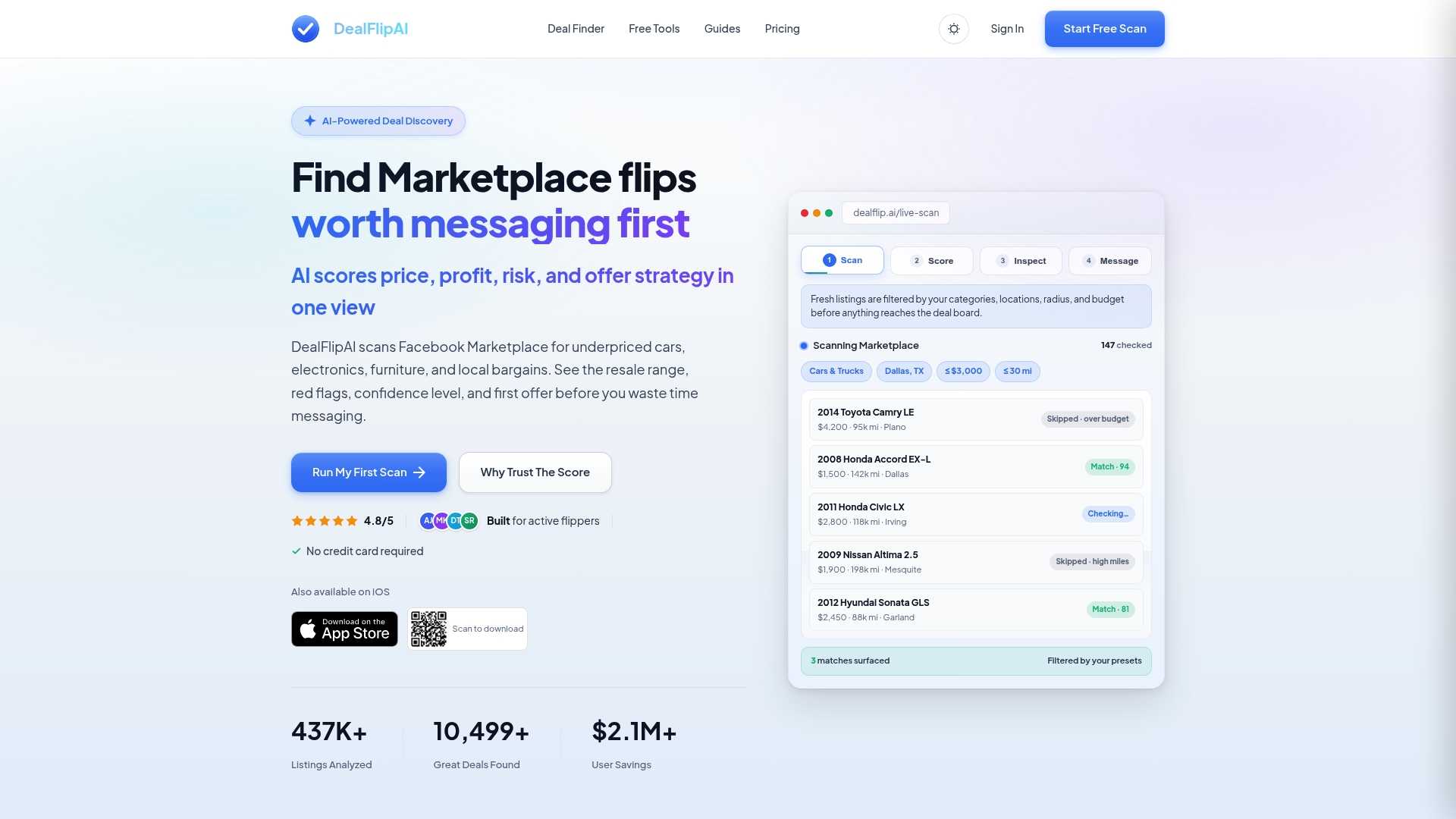
The platform's free tools cover every step of the local reselling workflow. Use the Facebook Marketplace deal finder to surface underpriced listings fast. Run any deal through the listing analyzer to get a profit score before you commit. Check suspicious buyers with the scam checker to protect your time and money. Dealflip AI is built for resellers who want to move quickly and confidently on local deals, without guessing at margins or missing the best listings.
FAQ
Why does local reselling have higher margins than online arbitrage?
Local in-person sales eliminate platform fees and shipping costs, which together consume 15–20% or more of an online sale. That retained margin is the primary reason local reselling outperforms online arbitrage on most mid-range items.
What is the biggest risk in local reselling?
Buyer no-shows are the most common problem, with average rates of 20–30%. Confirming meetups twice and requiring buyers to message when en route reduces wasted trips significantly.
Which items work best for local reselling?
Bulky, heavy items like furniture, exercise equipment, and appliances are the strongest local reselling categories. Shipping costs make these items impractical for online arbitrage, leaving local resellers with little competition.
When does online arbitrage make more sense than local reselling?
Online arbitrage works better for small, lightweight, niche items that need a national buyer pool to reach the right price. Rare collectibles, branded sneakers, and specialty electronics often sell faster and at higher prices online.
How do I find underpriced local listings quickly?
Filter Facebook Marketplace by listings posted in the last two hours and look for urgency language like "moving," "need gone," or "quick sale." Tools like Dealflip AI send real-time alerts for fresh listings in your target categories, so you see deals before most other resellers do.