

A price gap opportunity is a listing where the seller's asking price sits meaningfully below what comparable buyers are paying elsewhere, leaving room for you to buy, relist, and pocket the difference after all costs. For a Facebook Marketplace reseller, that gap is only actionable when three things line up: the gap is large enough in percentage terms (not just dollars), the listing has real visibility in search results or active category feeds, and your net margin after fees, repairs, and shipping clears a minimum threshold. Dealflip AI scores each listing against exactly these criteria, flagging deals that pass all three before you spend a minute on them.
Quick go/no-go checklist:
- Gap is significantly below comparable sold prices? ✓
- Listing is active, recently posted, and visible in category search? ✓
- Net margin clears your minimum after all costs? ✓
- No scam signals or vague photos? ✓
If any box is unchecked, pass and move on.
Table of Contents
- How do you spot a real price gap vs. noise on Facebook Marketplace?
- How do you calculate whether a price gap is actually profitable?
- What's the end-to-end workflow for acting on a price gap?
- What risks and red flags mean you should walk away?
- Which tools speed up your price gap decisions?
- Which Facebook Marketplace categories have the most price gap opportunities?
- Key Takeaways
- How experienced flippers actually think about price gaps
- Dealflip AI puts price gap analysis on autopilot
- Useful sources and further reading
How do you spot a real price gap vs. noise on Facebook Marketplace?
Not every cheap listing is a price gap opportunity. The five signals that separate a genuine gap from temporary noise:
- Duration. A gap that holds for days or weeks is more reliable than one that appeared this morning. Filled gaps that return to the prior price range quickly are almost always noise.
- Comparative interest. Saves, comments, and repeat views are your volume proxy on Marketplace. Heavy-volume gaps backed by strong interest are far more likely to hold than thin ones.
- Recent price range position. Check where the listing sits relative to the last 5–10 comparable sold prices. A listing priced at the low end of a stable range is a signal; a listing priced low because the whole category dropped is not.
- Condition and photos. Clear, well-lit photos with serial numbers visible suggest an honest seller. Blurry, stock-photo-only listings are a red flag, not a deal.
- Cross-list visibility. If the same item appears on eBay or Craigslist at a higher price, that spread confirms the gap is real.
Monitoring rule: Watch a fresh listing for at least 24–48 hours before committing. If it gets price edits, relists, or heavy inquiries without selling, the seller may be testing the market. A listing that sits untouched for a week often signals the gap is stable and the seller is motivated.
Pro Tip: Check the seller's profile history. A seller with multiple recent listings, clear photos, and no "firm, no lowballers" language is far more likely to negotiate. Seasonal distortions are real too: electronics gaps widen after the holidays and narrow before back-to-school; furniture gaps peak in spring moving season.
Reading seller signals on Marketplace listings is a skill that pays off every single time.
How do you calculate whether a price gap is actually profitable?
The formula is straightforward:
Net Profit = Estimated Sell Price − Purchase Price − All Costs ROI = Net Profit ÷ Total Amount Invested × 100
Every cost line matters. Include:
- Purchase price + pickup cost (gas, time)
- Shipping, if you're not doing local pickup only
- Platform fees (Facebook's 5% selling fee or $0.40 flat for shipments under $8)
- PayPal Goods & Services fee if the buyer pays that way
- Cleaning, minor repairs, or replacement parts
- Relisting or boosting fees
- Tax basis (if you're selling more than $600/year on a platform, expect a 1099-K)
Use the Facebook Marketplace shipping calculator to nail down shipping costs before you commit.
| Scenario | Buy Price | All Costs | Est. Sell Price | Net Profit | ROI |
|---|---|---|---|---|---|
| Electronics (gaming console) | — | — | — | — | 48% |
| Home goods (stand mixer) | — | $8 | — | — | — |

Decision thresholds: For a same-day flip, aim for 30%+ ROI. A one-week hold warrants at least 20% net margin. A one-month hold should clear a minimum net margin of 20–30% on items under $300, or a strict dollar-margin target on big-ticket items. The relative size of the gap is what drives buyer behavior, not the raw dollar difference. A $2 gap on a $900 item is noise; a $20 gap on a $60 item changes everything.
Factor in pickup cost and margins carefully, especially for heavy or bulky items where driving 30 minutes can erase your profit.
What's the end-to-end workflow for acting on a price gap?
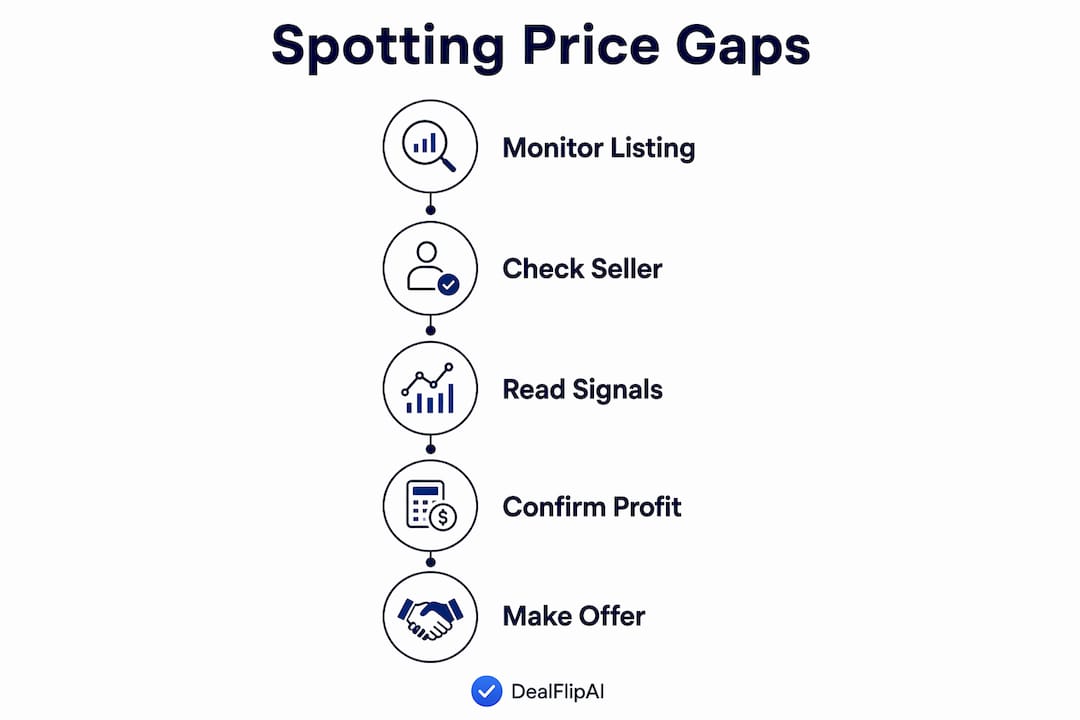
Run these steps in order, and you'll rarely get burned:
- Discover. Find the listing via search, category browse, or a deal alert. Note the post date and price.
- Benchmark. Pull 5–10 comparable sold listings on eBay or Facebook to confirm the gap is real. Use the Facebook Marketplace value estimator for a quick read.
- Score. Calculate your net margin using the formula above. If it doesn't clear your threshold, stop here.
- Message the seller. Open with a specific, polite offer. "Hi, I'm interested and can pick up today. Would you take $[X]?" works better than a lowball with no context.
- Request photos. Ask for serial number, model label, and any damage close-ups before you drive anywhere.
- Inspect in person. Test the item before handing over cash. Bring a phone charger, batteries, or whatever you need to power it on.
- Negotiate at pickup. If condition is worse than described, you have leverage. Reference the specific issue calmly.
- Buy and relist fast. Dead capital is the enemy. List the same day you pick up.
For negotiation scripts and counter-offer tactics, the counter-offer negotiation guide provides detailed advice.
Pro Tip: Schedule pickups in clusters by neighborhood. Two or three pickups in the same area on a Saturday morning saves gas and time. Cross-list immediately on eBay or Mercari to lock in margin from multiple buyer pools at once.
What risks and red flags mean you should walk away?
The top six red flags that signal a gap will backfire:
- Thin-volume gap. No saves, no comments, no inquiries. Low interest means the market already passed on this price.
- Rapid fill history. If the same item relisted multiple times at different prices, the seller is fishing, not motivated.
- Vague or stock photos. No serial number, no damage disclosure, no real-world shots.
- Unusual payment requests. Zelle, Cash App, or gift cards only. Facebook's checkout or cash in person are the only safe options.
- Seller won't meet or let you inspect. A legitimate seller has nothing to hide.
- Inconsistent serial or model info. Mismatched model numbers between the title and photos are a stolen-goods signal.
A gap that looks too good is usually a trap. Scammers deliberately price items 40–60% below market to generate fast responses. If a $1,200 MacBook is listed for $350 with a "moving, must sell today" story, the urgency is the red flag, not the deal.
Stolen-goods alerts on Facebook Marketplace are more common than most flippers realize. Facebook's own policies prohibit reselling items that violate their Commerce Policies, and buying stolen goods exposes you to legal liability regardless of whether you knew. Always verify serial numbers on sites like the CTIA's Stolen Phone Checker for electronics.
Short-lived price drops with no inquiry activity are almost always noise. A gap that holds for weeks without filling often converts into a stable price floor, which is the kind of opportunity worth acting on.
Which tools speed up your price gap decisions?
| Tool | What it does | Cost |
|---|---|---|
| Flip profit calculator | Instant margin/ROI math | Free |
| Cross-listing profit tool | Compares net across eBay, Mercari, Poshmark | Free |
| Listing analyzer | Scores deal quality and flags risk | Free |
| Price monitoring (third-party) | Tracks competitor price changes | From ~$39.95/mo |
| Deal alert system | Notifies you of fresh listings matching criteria | Free (Dealflip AI) |
Small sellers who track prices manually spend 5+ hours weekly on that task alone. Automation pays for itself fast.
Dealflip AI pulls all of this into one place. It scores each Facebook Marketplace listing on price gap size, profit potential, and risk factors, then surfaces the strongest deals with an alert before other flippers see them. The listing analyzer gives you a deal score based on comparable prices, seller signals, and scam indicators. The scoring inputs that matter most: gap percentage vs. comparable sold prices, listing age, seller history, and photo quality.
Quick inspection checklist:
- Serial number visible and matches model description
- Power-on test confirmed (or seller confirms)
- No missing parts or accessories
- Damage matches photos
Seller message script: "Hi! I'm interested and can pick up today or tomorrow. Would you consider $[X]? I'm a serious buyer."
Which Facebook Marketplace categories have the most price gap opportunities?
Electronics are the most consistent source of gaps, especially gaming consoles, laptops, smartphones, and headphones. Sellers often price by what they paid, not what the market currently pays, creating reliable gaps after new model releases. Use the electronics deal finder to filter for underpriced listings automatically.
Furniture and home goods are the second-best category. Large, heavy items are hard to ship, so sellers price low to avoid hassle. A sectional sofa listed at $150 that retails for $800 is a classic local-flip gap.
Power tools and outdoor equipment follow a similar pattern. Seasonal sellers (spring cleanouts, estate sales) often undervalue brand-name tools by 40–60% because they have no reference price. Brands like DeWalt, Milwaukee, and Makita hold resale value well.
Baby gear, musical instruments, and fitness equipment round out the top categories. Parents selling outgrown gear and gym-equipment sellers post-resolution-season are reliably motivated and often unaware of current resale prices.
Key Takeaways
A price gap opportunity is only worth acting on when gap size, listing visibility, and net margin all clear your minimum thresholds at the same time.
| Point | Details |
|---|---|
| Minimum gap threshold | Target listings priced 20%+ below comparable sold prices to avoid noise. |
| Seller signals matter | Prioritize sellers with clear photos, multiple listings, and no "firm price" language. |
| Net margin floor | Aim for 20–30% net on items under $300; use a dollar-margin target on big-ticket items. |
| Go/no-go timing rule | Watch a fresh listing 24–48 hours; act within the first week if signals stay strong. |
| Dealflip AI speeds decisions | Use Dealflip AI's deal scoring, alerts, and listing analyzer to find and validate gaps faster. |
How experienced flippers actually think about price gaps
Experienced flippers prioritize high-probability, rapid-turn gaps over speculative long holds. The mental model is simple: capital sitting in an unsold item is capital that can't find the next deal.
A few heuristics that hold up in practice: prefer a significant relative gap on lower-priced items, where buyer pools are deep and turns are fast. On higher-priced items, shift to a dollar-margin target because percentage math can mislead you on thin-margin big-ticket flips. Treat heavy-inquiry listings differently from single-post markdowns. If a listing has 15 comments and still hasn't sold, there's usually a condition or trust issue the photos aren't showing.
On scaling: flip quickly when capital is limited. A 30% margin flipped in three days beats a 60% margin that takes six weeks. When you have more capital and storage, holding for a seasonal price spike (electronics before the holidays, outdoor gear in spring) can justify a longer hold. But for most flippers starting out, velocity beats margin every time. Demand signals in sell pricing explain exactly how to read when a market is ready to absorb your relist price.
The single most important post-purchase metric: time-to-list. The faster you relist, the faster you learn whether your gap read was right.
Dealflip AI puts price gap analysis on autopilot
Manually hunting for price gaps on Facebook Marketplace works, but it's slow and easy to miss the best listings. Dealflip AI gives you a faster path: AI-powered deal scoring that evaluates each listing's gap size, profit potential, and risk factors in seconds, plus real-time deal alerts that ping you the moment a qualifying listing goes live. The scam detection layer flags suspicious listings before you waste a trip. It maps directly to the workflow above: discover with alerts, score with the listing analyzer, inspect with confidence, and buy knowing your margin is real.

Ready to find your next flip? Start with the free deal finder and see what gaps are live in your area right now.
Useful sources and further reading
- Competitor Pricing Analysis: Metrics That Actually Matter — covers gap duration, fill-risk validation, and the decision-ready metrics (price index, gap %, margin impact) that connect data to action.
- Price Gaps Explained: The Four Types and What They Mean — explains volume-on-gap multiples and how gap edges convert into support levels; translates directly into reseller heuristics.
- How to Find Micro-SaaS Ideas Using Pricing Gaps — the migration-window concept and impulsive price bands apply cleanly to Marketplace timing decisions.
- Small E-Commerce Stores Spend 5 Hours a Week Checking Competitor Prices — justifies automation; includes monitoring tool pricing starting around $39.95/month.
- Examples of Actionable Trade Signals for Traders — useful background on gap validation and volume signal interpretation for readers who want to go deeper on the technical side.
- Competitor Price Gap Calculator — free tool for computing absolute and percentage gap, gross margin, and scenario revenue impact.