

The time cost of a bad deal is the total value of hours you lose on a failing flip, plus the profit you never made because those hours were unavailable for better ones. As Alexa DAgostino puts it, bad deals are double penalties: lost capital plus lost opportunity. The formula is simple:
Time Cost = (Hours Spent × Your Hourly Value) + Opportunity Cost + Capital Tie-Up Adjustment
What that covers:
- Hours spent on messaging, pickup, repair, relisting, and disputes
- Opportunity cost (the profit from a better flip you couldn't pursue)
- Capital tie-up (the cost of money sitting in an unsold item)
Table of Contents
- What is the time cost of bad deals, really?
- How do you calculate the time cost of a deal?
- When should you walk away from a deal?
- How do you prevent bad deals before they happen?
- Which KPIs should you track to manage time cost?
- Key Takeaways
- The real math most flippers ignore
- Dealflip AI turns time cost into a number you can act on
- Useful sources
What is the time cost of bad deals, really?
The financial consequences of bad deals go well beyond the dollars you paid at pickup. Every bad flip drains you across multiple fronts simultaneously.
Here are the concrete components that create time cost for resellers:
- Inspection and travel — driving to view an item that doesn't match the listing
- Messaging and negotiation — back-and-forth that leads nowhere
- Transport and pickup — time and gas for a trip you can't recover
- Repair and refurb — hours fixing something you didn't budget for
- Testing — verifying functionality on electronics, appliances, or tools
- Relisting — rewriting descriptions, retaking photos, re-posting
- Returns and disputes — handling buyer complaints or Facebook Marketplace claims
- Admin — tracking costs, updating records, managing failed transactions
- Capital tie-up — money locked in an unsold item that can't fund the next flip
Two terms worth knowing: the opportunity tax is the profit you forfeited by spending time on a bad deal instead of a good one. The dead-deal tax is the daily time drain from managing listings that were never going to convert. Both are invisible on a spreadsheet but very real in your weekly output.
Pro Tip: Watch for early warning signals before you commit: vague photos, a price that's suspiciously low, a seller who avoids direct questions, or a listing that's been reposted multiple times. These patterns predict a time-costly deal before you spend a single hour on it.
How do you calculate the time cost of a deal?
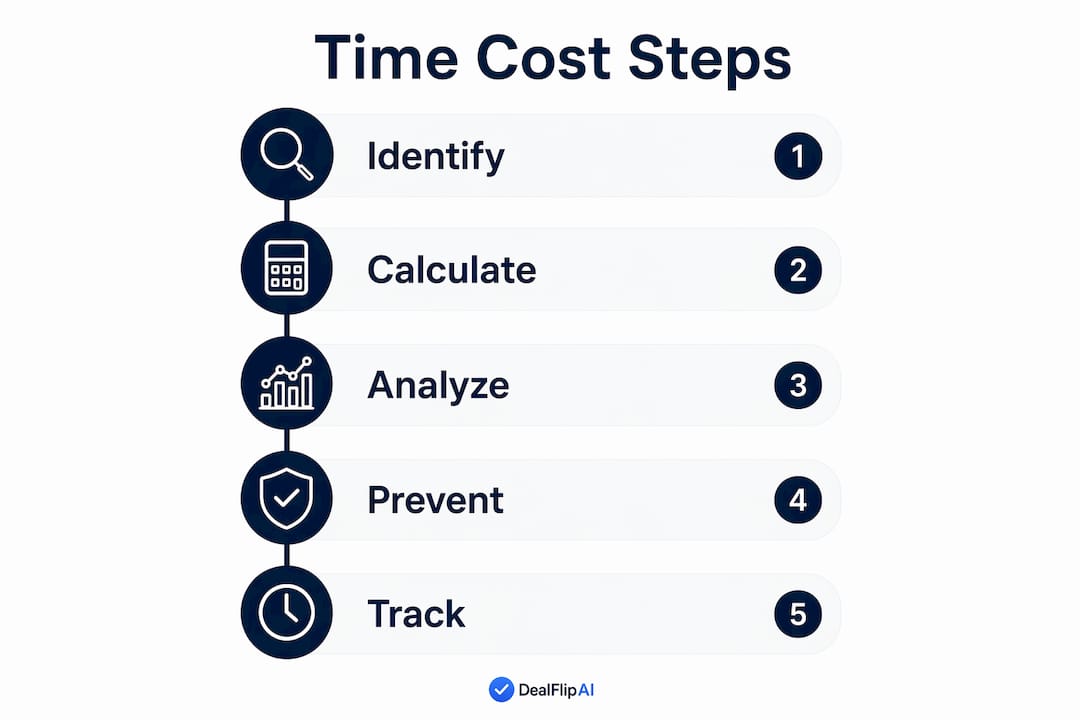
Follow these steps for any flip you're evaluating:
- Estimate hours per component. Add up realistic time for messaging, travel, inspection, repair, relisting, and any dispute handling.
- Assign your hourly value. If your goal is $25/hour flipping, that's your rate. Use it consistently.
- Calculate capital tie-up cost. Multiply the purchase price by your monthly opportunity rate (even 1–2% per month is a fair estimate for tied-up cash).
- Add repair and salvage costs. Include parts, labor, and the probability you actually sell it at your target price.
- Subtract total time cost from gross profit. What's left is your real net.
Worked example: a Facebook Marketplace electronics flip
| Input | Value |
|---|---|
| Gross profit (before time cost) | $70 |
A deal that looked like a $70 win is actually a $30 loss once you account for your time. This is why attaching a pursuit-cost estimate before you commit is one of the highest-leverage habits a reseller can build. Use Dealflip AI's Flip Profit Calculator to run this math in seconds before you ever leave the house.

When should you walk away from a deal?
Forbes contributors recommend setting clear markers for when a deal becomes a sunk cost and reallocating that time to higher-potential opportunities. Here are four stop-loss rules you can apply on the spot:
- Hours cap. If total projected hours exceed the point where profit-per-hour drops below your target rate, walk away before you start.
- Repair-to-profit ratio. If estimated repair cost takes a large portion of your projected gross profit, the deal rarely pencils out.
- Capital-tie threshold. If the item is expected to sit unsold for a prolonged period, factor in that tie-up before buying.
- Time-to-resell expectation. If comparable items on Marketplace appear to remain unsold for an extended time, your resale timeline may be longer than it looks.
When a deal is already in progress, apply the same rules to decide whether to salvage or cut:
- Can you recover your hourly target on remaining hours? If not, price to move fast.
- Is the repair cost now eating into your original margin? Stop spending and relist as-is.
- Has the item been listed for two weeks with no serious offers? Drop the price or donate it.
Pro Tip: The break-even trap is the most expensive mental habit in reselling. The sunk cost fallacy makes you hold a bad deal hoping to "at least get your money back," but every extra hour you invest is a new cost, not a recovery. Force an objective decision by asking: "If I didn't already own this item, would I buy it today at my current asking price?" If the answer is no, price it to sell now.
How do you prevent bad deals before they happen?
Prevention is where you reclaim the most time. Negotiating value, not just price, is the foundation. The cheapest listing often carries the highest total cost once you factor in defects, disputes, and rework.
Pre-screen checklist
Before messaging a seller, verify:
- Price is significantly below comparable sold listings
- Photos show the actual item (not stock images)
- Listing is recent, not reposted multiple times
- Seller has positive feedback or a complete profile
- Description answers condition, functionality, and reason for selling
Message templates that save time
Send a single qualifying message that gets the critical information fast:
One message. Four questions. If the seller can't answer all four clearly, that's a signal.
AI-assisted workflows
This is where automated deal filtering changes the math entirely. Dealflip AI scans Facebook Marketplace listings and scores each one on price vs. resale value, risk factors, and scam signals before you spend a minute evaluating it manually. Specific features that cut time cost:
- Listing Analyzer scores price, profit potential, and risk in one view
- Scam detection flags suspicious sellers and listing patterns automatically
- Real-time deal alerts surface fresh listings before other buyers see them
- Batch analysis lets you evaluate dozens of listings in the time it used to take to evaluate one
Pro Tip: Batch your pickups. Schedule two or three pickups in the same geographic area on the same day. You cut travel time per deal significantly, and your effective hourly rate on those flips goes up without changing anything else.
Which KPIs should you track to manage time cost?
Tracking the right numbers turns time cost from a vague feeling into a managed metric. Measuring wasted capacity is what lets you justify investing in automation and filters.
Track these six KPIs weekly:
- Time per deal (hours) — total hours from first message to sale
- Profit per hour — net profit divided by total hours invested
- Deal win rate — deals purchased that hit your profit target vs. total deals pursued
- False-positive rate — listings you flagged as good that turned into bad deals
- Average capital tie-up days — how long your money sits in unsold inventory
- Salvage rate — percentage of bad deals you recovered at any positive margin
Sample KPI tracking table
Progress like this is what managing your deal pipeline actually looks like in practice.
Pro Tip: Measure your dead-deal tax in minutes per day. Set a timer when you start working on a listing that isn't converting. Add those minutes up at the end of the week. When that number is high, it's a direct signal that your sourcing filters need tightening, not that you need to work harder.
Key Takeaways
The time cost of a bad deal always exceeds the visible dollar loss once you account for hours spent, opportunity cost, and capital tied up in unsold inventory.
| Point | Details |
|---|---|
| Calculate before you commit | Use the formula: hours × hourly value + opportunity cost + capital tie-up to find real net profit. |
| Set hard stop-loss rules | Walk away when repair costs exceed 30% of gross profit or projected hours kill your target hourly rate. |
| Track profit per hour | This single KPI reveals whether your sourcing is improving faster than any other metric. |
| Prevent with pre-screening | A five-point listing checklist and one qualifying message eliminate most bad deals before you invest any time. |
| Use Dealflip AI to automate filters | Dealflip AI's Listing Analyzer, scam detection, and real-time alerts cut sourcing time and reduce false-positive rates. |
The real math most flippers ignore
Most resellers track what they paid and what they sold for. Very few track what they earned per hour. That gap is where bad deals hide.
The hidden costs of poor negotiation and bad sourcing decisions don't show up as a line item labeled "wasted time." They surface as lower margins, more relisting cycles, and a creeping sense that you're working harder for less. The break-even trap makes it worse: holding a bad deal because you've already invested time is exactly the behavior that compounds the loss.
The flippers who scale past a side hustle are the ones who treat their hours as a finite, non-renewable asset. They set thresholds before they buy, not after. They measure profit per hour, not just profit per deal. And they use AI-driven filtering to eliminate the sourcing noise that eats the first hour of every bad deal before it even starts.
The formula isn't complicated. The discipline to apply it consistently is what separates a profitable flipper from a busy one.
Dealflip AI turns time cost into a number you can act on
Every hour you spend on a bad deal is an hour you didn't spend finding a great one. Dealflip AI is built specifically for Facebook Marketplace flippers who want to stop losing time to low-potential listings and start finding underpriced items faster.
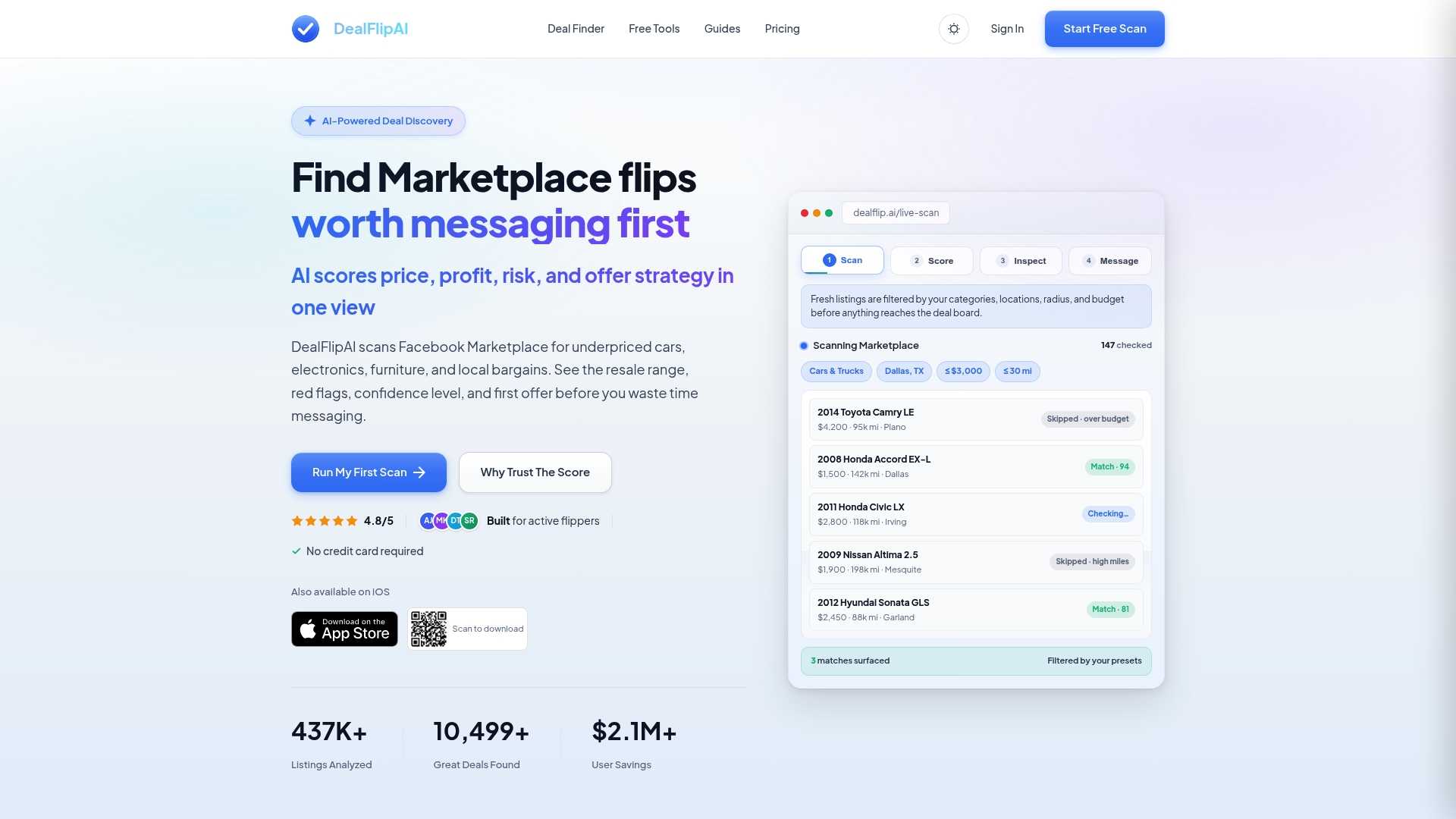
The Listing Analyzer scores any listing on price vs. market value, profit potential, and risk signals in seconds. The Facebook Marketplace Deal Finder runs your filters automatically and surfaces fresh deals before the competition. Scam detection flags suspicious listings before you waste a single message. And the Flip Profit Calculator runs the full time-cost math so you know your real net before you leave the house. As AI automation becomes standard practice for serious resellers, having these tools in your workflow is the difference between guessing and knowing. Try Dealflip AI free and see how much time you reclaim on your next flip.
Useful sources
- Alexa DAgostino, "The Deal You Should Have Never Taken" — supports the definition of time cost as a double penalty of lost capital and lost opportunity.
- Academy of Negotiation, Pawel Golembiewski — explains why the lowest-price listing often carries the highest total cost of ownership.
- Forbes Business Council, "The Hidden Cost of Chasing the Wrong Deals" — backs the sunk-cost cutoff rules and reallocation to higher-potential opportunities.
- Proprise.ai, Dead-Deal Tax Glossary — defines the dead-deal tax and supports the KPI tracking framework.
- Money and Planet, Sunk Cost Fallacy in Investing — behavioral guidance on breaking the break-even trap with pre-defined rules.
- Kent Hallmann, Precision Path LLC — framework for attaching pursuit-cost estimates to deals before commitment.
- Negotiation Training Institute, Hidden Costs of Poor Negotiation — supports the broader financial consequences of bad deals and the value of structured decision rules.
- PON at Harvard Law School, How to Renegotiate a Bad Deal — real-world case study on the long-term cost of committing to a bad deal without exit provisions.
- Dealflip AI Tools — free calculators and analyzers to automate the time-cost math covered in this guide.