

Original retail price matters for flipping, but not the way most beginners think. It's a clue, not a guarantee, and treating it as gospel is one of the fastest ways to overpay for inventory that never sells for what you hoped. The honest verdict: use the original retail price as a starting reference point, then confirm it against sold comps before you commit a dollar.
Here's how to apply that in the field, right now:
- Treat it as helpful when the brand is well known, the item is still in production, and you can find its MSRP on the manufacturer's own site or a major retailer's listing.
- Verify it by cross-checking the claimed price against at least two sold listings (not active ones) from the last 30 to 60 days.
- Take one action immediately: if the original price and your sold comps roughly agree, move forward on your margin math; if they don't, skip the item or hold it until you can dig deeper.
A listed "original price" is a claim, not a fact. Sold comps are the fact. If the two disagree, the comps win every time.
Pro Tip: Before you even touch the profit math, do a 90-second gut check: search the item's model number plus "sold" on eBay or a similar marketplace. If nothing comes up, that silence tells you more than any price tag does.
Key Takeaways
Original retail price only matters for flipping when it's verified against recent sold comps, not treated as an automatic measure of resale value.
| Point | Details |
|---|---|
| Verify before you trust | Cross-check any posted "original" or "compare at" price against two or more recent sold comps. |
| Comps beat list price | Base your resale target and buy decision on sold listings, not active listings or MSRP alone. |
| Run the full margin math | Subtract fees, shipping, and cost of goods from your realistic sale price to find true net profit. |
| Watch for red flags | Outlet-only SKUs, mismatched barcodes, and unverifiable "was" prices signal a misleading original price. |
| Let DealFlipAI do the checking | DealFlipAI scores listings by weighing original price claims against sold comps, fees, and risk signals automatically. |
Table of Contents
- Why Original Retail Price Matters for Flipping Decisions
- What Does Research Say About List Prices and Buyer Behavior?
- When Should You Trust the Original Retail Price?
- How Do You Calculate Real Flipping Profit?
- How Can You Spot a Fake or Misleading Original Price?
- What Tools Verify Price History and Market Value?
- How Does DealFlipAI Score Deals Using Original Price Data?
- Automate the Verification Work With DealFlipAI
- Frequently Asked Questions
- Sources
Why Original Retail Price Matters for Flipping Decisions
Retailers publish an "original" price for reasons that have almost nothing to do with helping you value a used product. Understanding those reasons is the first step to using the number correctly instead of getting played by it.
You'll see this figure under a few different names, and they don't always mean the same thing:
- MSRP (Manufacturer's Suggested Retail Price): what the brand recommends charging, often printed on packaging or listed on the brand's own website.
- List price: the price a specific retailer sets before any discount, which can drift from the MSRP.
- Compare-at price: a number shown next to a sale price to imply savings, sometimes based on a price the item was never actually sold at.
- Value at: a vaguer variant used mostly in outlet and clearance contexts, often disconnected from any real transaction history.
Retailers lean on these figures because a visible "was" price changes how a shopper perceives the deal in front of them. This is basic price anchoring: show a higher number first, and the sale price looks smaller by comparison, even if the sale price was always going to be the real price. Outlet stores take this further by manufacturing items specifically for outlet channels, then attaching a "compare at" price to a full-price version that may never have existed in that exact configuration.
Pro Tip: Watch for the phrase "compare at" on tags and listings. It's a strong signal the item may have been made for the outlet channel specifically, which means the original price might not reflect any real market transaction at all.
Legal frameworks in many U.S. states put limits on how loosely retailers can use these claims, which is worth knowing before you lean on a posted price as evidence of value. More on that in the red flags section below.
What Does Research Say About List Prices and Buyer Behavior?
Academic research backs up what experienced flippers already sense: a posted original price changes how buyers feel about a deal, even when the number itself is questionable. Three studies matter here, and each one tells you something slightly different about how much weight to put on a listed price.
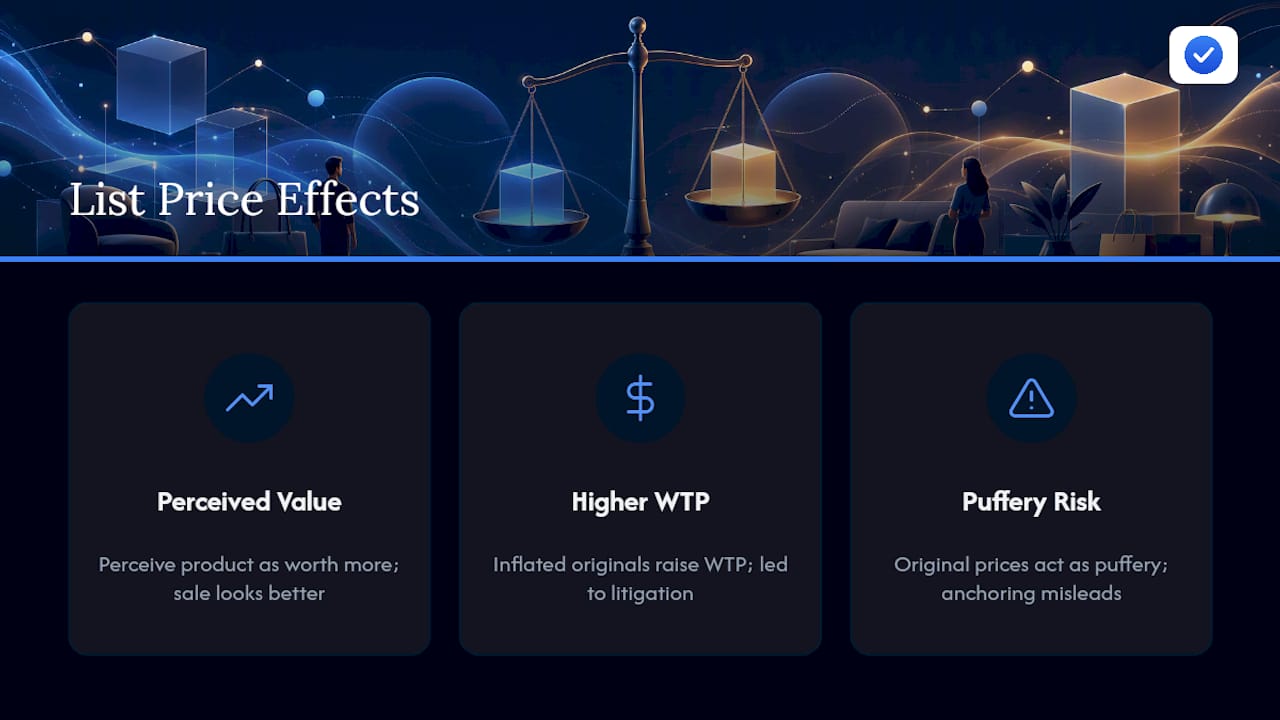
Researchers behind a study in the Journal of Consumer Research found that when shoppers pay close attention to a list price, they perceive the product as worth more and see the sale price as a better deal. That effect happens independent of whether the list price reflects reality. In practical terms, this is exactly why a "was $199, now $89" tag on Facebook Marketplace can move a buyer even when nobody ever paid $199 for that item.
Harvard Business School researcher Donald Ngwe went further, documenting cases where inflated posted "original prices" measurably increased what shoppers were willing to pay. His work also points to something flippers should sit with: some of these inflated comparisons have drawn real litigation, meaning the practice isn't just a gray-area marketing trick in the eyes of regulators.
Duke's Richard Staelin frames the whole practice bluntly: original prices often function as a form of marketing puffery, and that puffery can genuinely mislead buyers into misvaluing a product once the anchor takes hold.
The number on the tag isn't describing the market. It's trying to shape your read of the market. Those are two very different jobs.
If academic language moves too slowly for you, the shorthand is this: anchoring works on shoppers, and it can work on you too if you're not deliberately checking the posted price against actual sold data before you buy or set your own resale price.
When Should You Trust the Original Retail Price?
Original retail price earns its keep in specific, recognizable situations. Outside of those situations, it turns into noise that can actively steer you toward a bad buy.
Original price tends to be a decent reference when:
- The item is from a well known, still-in-production brand where MSRP is publicly listed and stable (think a current-generation gaming console or a mainstream power tool brand).
- You're flipping a limited-run or collector item where the original retail price sets a known floor, even if resale runs far above it.
- The listing includes a SKU or model number that matches a live, verifiable retail listing elsewhere.
Original price becomes unreliable when:
- The item carries an outlet-only SKU, meaning it was manufactured specifically for a discount channel and never sold anywhere at the claimed "compare at" figure.
- You're looking at deep clearance stock that the FitSmallBusiness reseller guide and similar sourcing resources note rarely sold meaningfully at its original tag to begin with.
- The category is driven by scarcity rather than brand recognition. Out-of-print board games, for example, regularly sell for multiples of their original MSRP once a print run ends and Kickstarter exclusives dry up, which makes the original price almost irrelevant to what the item commands today.
Run this quick field checklist before you accept a posted price as meaningful:
- Does the SKU or model number match a current or recently discontinued retail listing?
- Can you find at least two sold comps within the last 60 days that roughly match this price?
- Is the brand one where MSRP is publicly enforced (some brands use minimum advertised pricing agreements, which keeps prices consistent across retailers)?
If you answer "no" to two or more of those, flag the original price as unreliable and price purely off sold comps instead.
Pro Tip: Keep a mental shortlist of categories where MSRP tends to hold up (electronics, name-brand tools, sneakers) versus categories where it rarely does (fast fashion, generic home goods, outlet-exclusive furniture). You'll start recognizing the pattern within a few weeks of active sourcing.
How Do You Calculate Real Flipping Profit?
The original retail price never determines your profit. Your net margin comes from what you paid, what fees you'll owe, what shipping costs, and what the item actually sells for based on sold comps, not list price. Here's the formula, then a worked example.
- Start with your realistic sale price, based on recent sold comps, not active listings and not the original retail price.
- Subtract platform and payment fees, which typically run 10 to 15% depending on the marketplace.
- Subtract shipping costs, including packaging materials if you're not doing local pickup.
- Subtract your cost of goods, meaning what you actually paid the seller.
- What's left is your net profit. Divide that by your total cash outlay to get your return percentage.
Say you spot a listing for a well known cordless drill kit, originally sold at $249 MSRP, priced at $60 on Facebook Marketplace with a claimed "was $249" tag. Before trusting that number, you check sold comps and find similar used kits in good condition consistently selling for $110 to $130.
If you'd anchored your expectations to the original MSRP and assumed you could flip it for $180 or $200, you'd have overpriced the listing and let it sit for weeks. A flip profit calculator can run this math for you automatically once you have your comp range, which saves the manual spreadsheet work every time you evaluate a new item.
How Can You Spot a Fake or Misleading Original Price?
Some sellers, and plenty of retailers before them, inflate the original price on purpose. Spotting the pattern takes seconds once you know what to look for.
Watch for these red flags:
- A "compare at" price with no matching SKU or model number you can independently verify.
- Frequent "was" tags on items that show no evidence of ever selling at that price on any archived listing.
- Barcodes or labels that don't match the branding shown in the listing photos.
- Round, suspiciously convenient "original" numbers (a lot of $199 or $299 tags that never show up in any retailer's price history).
Verification takes just a few steps: search the model number with "sold" appended on your marketplace of choice, check archived price history through a browser extension or price-tracking site, and look at the seller's posting history for a pattern of inflated "was" prices across multiple listings.
Many states have promotional pricing laws that require a retailer to have actually offered an item at its claimed regular price for a set period, often 28 of the preceding 90 days, before using that price in a sale comparison. That rule targets retailers more than individual resellers, but it explains why so many "original price" claims you see online don't hold up under scrutiny. It's not always a lie; sometimes it's just a number that never had a legal or factual basis to begin with.
Pro Tip: If you suspect a listing is using a fabricated original price, screenshot it with a visible timestamp before it gets edited or deleted. That documentation matters if you ever need to flag deceptive pricing to a marketplace's trust and safety team.
What Tools Verify Price History and Market Value?
You don't have to do this verification manually every single time. A handful of practical resources cover most of what you need to confirm whether an original price and current demand are real.
For sold-data research, eBay's sold and completed listings filter remains one of the most direct ways to see what an item actually closed at recently, and platforms like StockX publish real transaction data for sneakers and streetwear where resale premiums swing fast. For general category demand and seasonal shifts, reading marketplace price trends helps you understand whether current pricing reflects a temporary spike or a stable baseline.
Barcode and SKU lookup tools help you catch outlet-only products before you buy, since outlet SKUs often carry a slightly different code structure than mainline retail versions of the same item. Price-archive browser extensions can show you a product's price history on major retail sites, which is often the fastest way to confirm whether a "was" price is fiction.
Here's a practical order of operations when you're standing in front of a listing trying to decide fast:
- Search the model number plus "sold" on your primary resale platform.
- Cross-check the barcode or SKU against a lookup tool if the listing seems outlet-sourced.
- Run the numbers through a fee calculator for whichever platform you plan to sell on.
- Confirm shipping costs if you're not doing local pickup, since that line item quietly kills more flips than bad pricing does.
Understanding broader pricing psychology also helps you read retailer intent faster. Resources on how ecommerce pricing strategy works break down why brands set the anchors they do, which sharpens your instinct for spotting a manufactured discount versus a genuine one.
How Does DealFlipAI Score Deals Using Original Price Data?
Manually running every check above on every listing you consider is exactly the kind of repetitive work that eats a flipper's evening. DealFlipAI was built to compress that entire verification process into a single score you can read in seconds.

The platform ingests several signals at once: the listed price, any "compare at" or "was" language in the description, sold comps pulled from recent market data, SKU or model matching where available, condition cues from the listing's photos and text, and the seller's posting history for red flags. It weighs all of that together rather than trusting any single input, including the original retail price, on its own.
What you see on the other end is a deal score, an estimated net profit range after typical fees and shipping, specific risk flags (like a mismatched SKU or a seller pattern that looks scam-adjacent), and a suggested first offer based on the gap between the asking price and the calculated fair value.
If a listing claims a $300 original price but sold comps only support $90 in resale value, the score should reflect the $90 reality, not the inflated tag. That's the whole point of running the comps instead of trusting the label.
Whatever tool you use for this kind of scoring, insist on transparency in three places: how it sources its comps, what fee assumptions it's building into the profit estimate, and how it adjusts for condition. A score you can't audit is just a guess with better formatting.
An author's take on trusting price tags versus trusting comps
I'd push back gently on any framing that treats original retail price as either useless or essential. It's neither. Treat it as one input in a small stack of signals, weighted well below sold comps and your own margin math, and you'll avoid most of the mistakes newer flippers make.
The bigger shift worth making is behavioral: stop asking "was this a good original price?" and start asking "what did this actually sell for last month?" That single reframe does more for your win rate than any amount of anchoring theory. If you're changing how you source, test the new rule on a handful of small buys before you commit real capital to it. Small bets teach you faster than big theories do.
Automate the Verification Work With DealFlipAI
Running sold comps, checking fees, and flagging suspicious pricing on every single listing gets exhausting fast, especially if you're sourcing across multiple categories on Facebook Marketplace. DealFlipAI automates that entire workflow: it scores each listing on profit potential, pulls comp data automatically, calculates fee-adjusted margins, and flags risk signals like mismatched SKUs or scam-pattern sellers before you spend a minute on manual research.
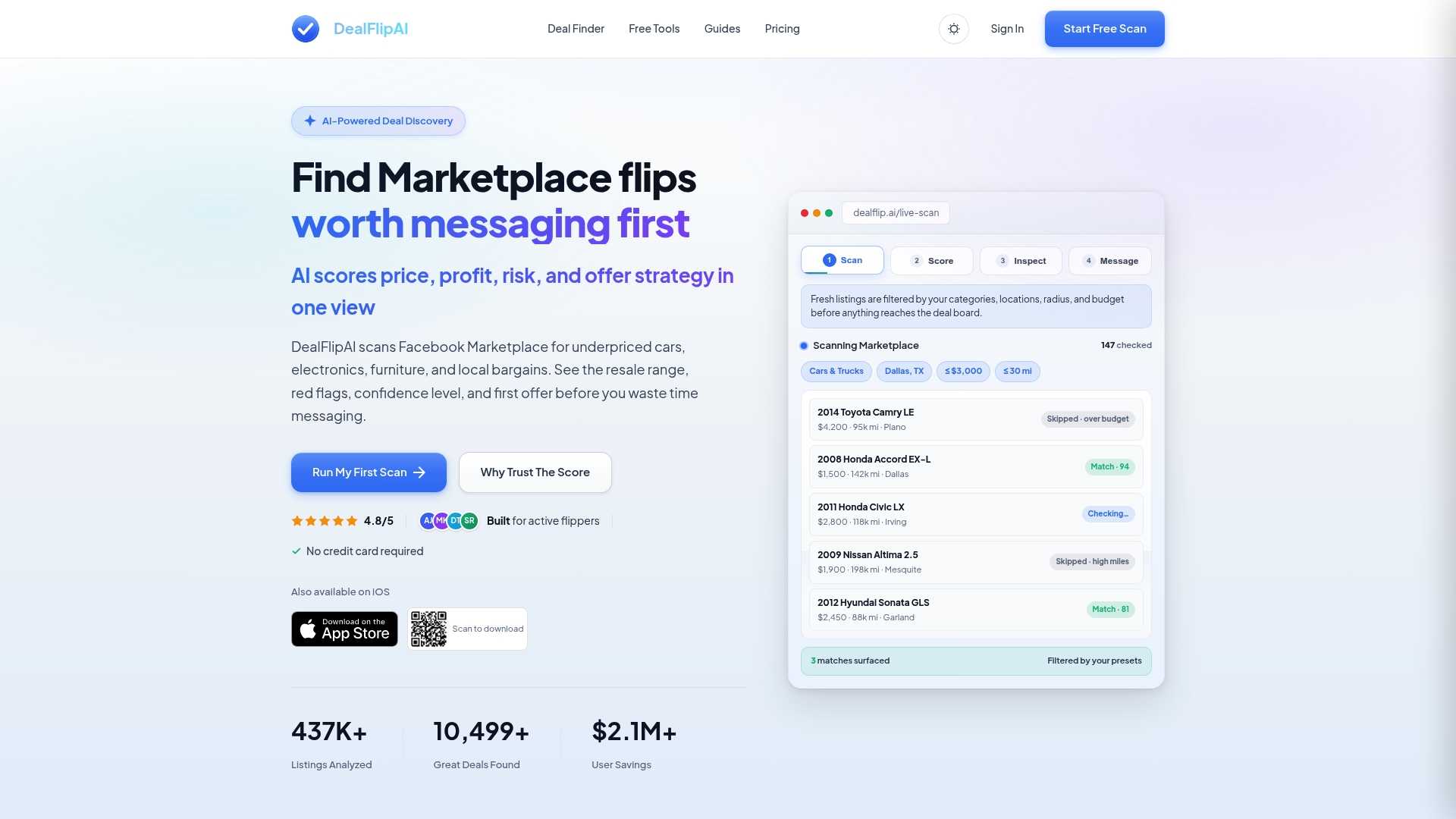
If you want to see the math on a specific item right now, the Facebook Marketplace Listing Analyzer will break down a listing's original price claims against real market comps and hand you a suggested first offer. Every score comes with visible comp sources and fee assumptions, so you can check the logic yourself rather than taking a black-box number on faith. Start with the free scans included on the entry plan, run a few listings you're already considering, and see whether the tool's read matches your own gut before you commit to anything bigger.
Frequently Asked Questions
Does the original retail price ever guarantee resale value? No. It never guarantees anything on its own. It's useful only as a rough reference point for well known, still-in-production brands, and even then it needs to be checked against sold comps before you rely on it.
Why do retailers keep showing an original price next to a sale price? It leverages anchoring: a visible higher number makes the sale price look like a bigger discount, which research on list prices and perceived value shows genuinely shifts how buyers judge the deal, even when the original figure is questionable.
What's the fastest way to check if a listed original price is real? Search the item's model number or SKU with "sold" added on your resale platform of choice. If you can't find matching sold history within about 90 seconds, treat the claimed original price as unverified.
Should I ever ignore the original retail price completely? Yes, in cases involving outlet-only SKUs, scarcity-driven categories like out-of-print collectibles, or clearance stock that likely never sold at its claimed original tag. Sold comps should carry the weight in those situations.
How does DealFlipAI factor original retail price into its deal score? It weighs the listed or claimed original price against sold comps, SKU matching, and seller history rather than trusting the posted number alone, which keeps the resulting deal score grounded in actual market behavior instead of a marketing anchor.
Sources
- How a ‘good deal’ can mislead: Fuqua professor says “original” prices may be misleading
- Bargain hunters beware: A store's 'original price' might not be after all
- Promotional pricing under the law (JDSupra overview)
- Research summary: List prices can increase perceived value (EurekAlert summary of Journal of Consumer Research)
- Best products to flip for profit: A beginner's guide (FitSmallBusiness)