

Multi-city sourcing means searching listings in other cities, not just your own, to find underpriced items you can flip for profit. The single best move you can make today is setting targeted alerts for multiple cities at once, tied to a clear profit threshold, so you're notified the second a matching deal posts instead of hunting for it manually.
Here's why this matters: every city you're not watching is inventory you're leaving on the table. You don't need to work more hours to find more deals. You need more sourcing surface area, and alerts are what make that possible without you sitting at your phone all day.
To start today:
- Pick 3-5 nearby cities based on price differentials or commuter patterns
- Set saved searches with tight keywords and a price ceiling
- Turn on instant push notifications for high-value categories
- Use a tool like DealFlipAI to scan multiple cities at once and score listings automatically, so you're not the one doing the filtering
Key Takeaways
Multi-city sourcing works when you replace manual browsing with automated, profit-threshold alerts across a deliberately chosen set of cities.
| Point | Details |
|---|---|
| Pick cities by signal | Choose cities based on price differentials, college-town turnover, and commuter corridors, not proximity alone. |
| Automate the scanning | Use saved searches and instant alerts so listings reach you before other flippers see them. |
| Run comps before offering | Check sold listings for exact model and condition matches before sending any offer. |
| Favor local pickup | Local pickup preserves margin on bulky items by avoiding shipped-order platform fees. |
| Use DealFlipAI to remove manual work | DealFlipAI scans multiple cities, scores listings for profit potential, and flags scam risk before you act. |
Table of Contents
- What Is Multi City Sourcing and Why Does It Beat Local-Only Flipping?
- How Do You Set Up Alerts to Monitor Multiple Cities?
- What's the Fastest Way to Evaluate a New Listing?
- Local Pickup or Shipping: Which Is Actually Safer?
- How Do You Calculate Profit Before You Buy?
- When Should You Scale Beyond a One-City Operation?
- How DealFlipAI Handles Multi-City Sourcing for You
- Sources
What Is Multi City Sourcing and Why Does It Beat Local-Only Flipping?
Local-only flipping caps your deal flow at whatever gets listed within your own radius on a given day. Multi-city sourcing removes that cap. You're pulling from several supply pools instead of one, which means more listings hit your filters even on a slow week in your home market.
The catch is that Facebook Marketplace wasn't built for this. Its native search locks you into one selected location and radius at a time, and seeing listings beyond that radius requires manually changing your city or using an outside tool. That's fine if you're browsing casually. It's a bottleneck if you're trying to run five city searches at once without missing anything.
This is also where the standard industry term comes in: what resellers call multi-city sourcing, procurement and supply-chain professionals sometimes call geographic arbitrage, buying where prices run low and selling where demand or prices run higher. For your purposes, the mechanics are the same either way: expand where you look, filter hard, and act fast when something clears your bar.
How Do You Set Up Alerts to Monitor Multiple Cities?
Guessing which cities to watch wastes time you don't have. Build your city list on signals, not gut feel.
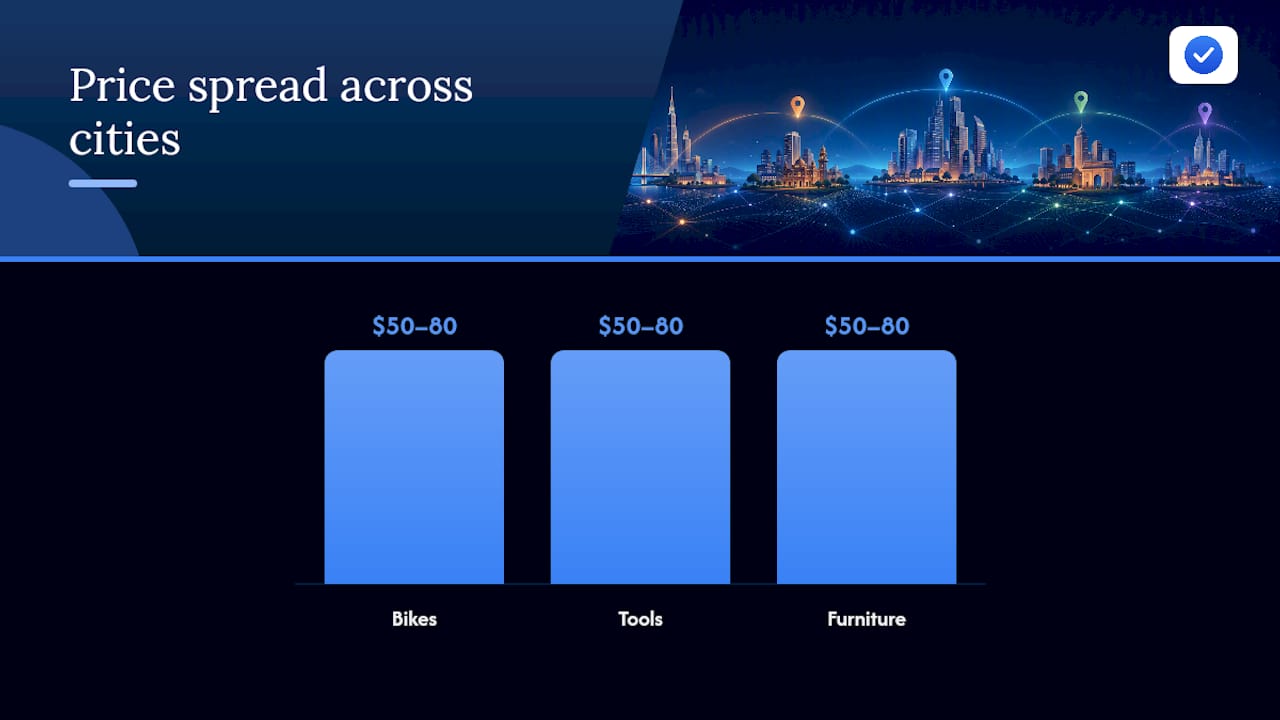
1. Identify price-differential cities. Compare average sold prices for your core categories (bikes, tools, furniture) between your home market and nearby metros. A $50-80 spread on the same item, repeated across dozens of listings, is worth chasing.
2. Add college towns to your rotation. Move-out season floods these markets with dorm furniture, electronics, and appliances at fire-sale prices, especially in May and again around winter break.
3. Watch commuter corridors. Suburbs feeding into a major city often have less competition from other flippers but similar item quality.
Once you've picked your cities, lock in these saved-search parameters:
- Specific keywords, not broad categories (searching "Cannondale" beats searching "bike")
- A firm price ceiling below your target resale range
- Condition filters set to "used, like new" unless you're sourcing for parts
- Sort by newest-first or "just listed" rather than relevance
Set instant push alerts for your highest-margin keywords, and batch everything else into a daily digest so you're not drowning in notifications. This is exactly the gap dedicated multi-city monitoring tools were built to close, letting you define a city list once and get alerted continuously instead of manually switching locations all day. DealFlipAI runs this scanning across multiple cities in the background and scores each listing for profit potential before you ever open the app, which is the difference between checking five apps a day and checking one alert.
Pro Tip: Set your price ceiling below your realistic resale floor to allow for travel, minor repairs, or negotiation variance. That buffer covers travel, minor repairs, or a negotiation that doesn't go quite as low as you hoped.
What's the Fastest Way to Evaluate a New Listing?
Every alert deserves a fast, consistent decision process. Here is the sequence experienced flippers run in under two minutes:
- Triage on price and feasibility first. Does it clear your profit threshold before travel? Is the city within a reasonable pickup radius?
- Pull rapid comps. Check eBay's sold listings and completed sales on the platform itself. Compare exact model, condition, and included accessories, not just the category.
- Estimate landed cost. Add purchase price, travel or shipping, platform fees, and any prep or repair cost.
- Send your offer. Use a short, specific first offer that references a real comp: "I can do $85 today, cash, based on similar listings selling for $110-120."
- Lock in pickup fast. Buyers who respond within minutes close more deals, especially on underpriced items other flippers are also watching.
Before you hand over cash, run this inspection checklist:
- Confirm the item powers on or functions as described
- Check for damage not visible in photos
- Verify serial numbers match any documentation
- Test electrical items with your own charger or outlet if possible
- Meet at the agreed public location, not a last-minute change of address
Skipping the comps step is the single most common mistake new flippers make. A listing looking underpriced at first glance means nothing if the actual sold comps show it's only worth $10 more than the asking price. A tool that automates deal scoring, like the DealFlipAI listing analyzer, can shortcut this by pulling comparable valuation data before you even message the seller.
Local Pickup or Shipping: Which Is Actually Safer?
Local pickup wins for most categories, especially bulky or high-value items. It lets you inspect before you pay, skips shipping damage risk, and often preserves margin, since shipped orders on Facebook Marketplace carry a selling fee that eats straight into your profit.
When you do meet in person, follow these safety practices:
- Meet in a public, well-lit location, ideally during daylight
- Use a designated police exchange zone if your city offers one
- Bring a friend for higher-value transactions
- Test the item's function before any money changes hands
- Trust your instinct if a seller pushes you to rush the exchange
Scam patterns tend to repeat themselves, and once you can spot them, they're easy to sidestep. Shipping-dependent deals are one of the most common vectors, because a scammer wants your item shipped and paid for before you ever get to inspect it. Watch for:
- Requests to move the conversation off-platform to text or email
- "Overpayment" scenarios where a buyer sends more than asked and requests a refund
- Fake escrow or shipping-label links that route around Marketplace's own protections
Pro Tip: If anyone insists on moving payment or messaging off-platform as a condition of the deal, treat that as a near-certain scam and walk away. Legitimate buyers and sellers rarely care where you message them.
If shipping truly can't be avoided, keep the transaction inside the platform's payment protections, confirm tracking updates match the shipping label details, and build the platform fee into your offer math before you agree to a price. Our own guide to spotting scam listings walks through additional red flags worth memorizing.

How Do You Calculate Profit Before You Buy?
Run this formula on every deal before you commit:
Buy price + travel or shipping cost + platform fees + prep/repair cost = total landed cost. Target resale price − total landed cost = gross margin.
Set two hard rules and don't budge on either:
- A percentage margin floor. Many flippers won't buy below a 40-50% margin on resale, adjusted down slightly for high-ticket items where dollar margin matters more than percentage.
- A dollar-margin floor by category. A $15 margin might be fine on a $40 flip; it's a waste of your time on something requiring a 40-minute drive.
Fees matter more than most new sellers assume. Facebook Marketplace charges a selling fee on shipped orders, a percentage with a set minimum, so a shipped deal that looks profitable on paper can shrink fast once that fee and packaging materials come out. Local pickup often sidesteps that fee entirely, which is one more reason it tends to protect margin better on bulky or mid-value items.
Doing this math by hand on every alert gets exhausting fast, especially once you're tracking five cities. A flip profit calculator automates the landed-cost formula, and a pickup cost calculator factors in your actual travel distance so you're not eyeballing gas money against margin.
When Should You Scale Beyond a One-City Operation?
Once multi-city sourcing is generating more leads than you can personally chase, it's time to build a system, not just a habit.
- Batch your pickups geographically. Grouping three pickups into a single route can cut your per-item travel cost roughly in half compared to three separate trips.
- Bring in help for pickup-only tasks. A vetted local contact who can inspect and collect an item on your behalf extends your radius without extending your day.
- Set turnover targets. Items sitting unsold past 30 days tie up cash you could be redeploying into fresher inventory.
- Keep bookkeeping simple. Track purchase price, resale price, and fees per item in a single spreadsheet or ledger from day one, before volume makes it painful to reconstruct.
- Watch your scan volume. If you're manually checking more cities than you can realistically cover, that's the signal to move to a higher automation tier instead of adding more hours.
Scaling by expanding coverage, not hours
I've watched flippers plateau for years chasing the same three neighborhoods, convinced the problem was effort. It's usually coverage. None of it replaces capital discipline. Inventory that doesn't turn is inventory that's costing you, no matter how many cities you're watching.
— Walsh Pex
How DealFlipAI Handles Multi-City Sourcing for You
DealFlipAI is built around exactly the workflow this article just walked through: multi-city scanning, automated deal scoring, scam detection, and instant alerts, so you're not the one manually switching cities or running comps by hand. Every listing gets scored on profit potential, price versus resale value, and risk factors before it ever reaches your notifications, and the platform suggests an optimal first offer based on real market signals rather than a guess.
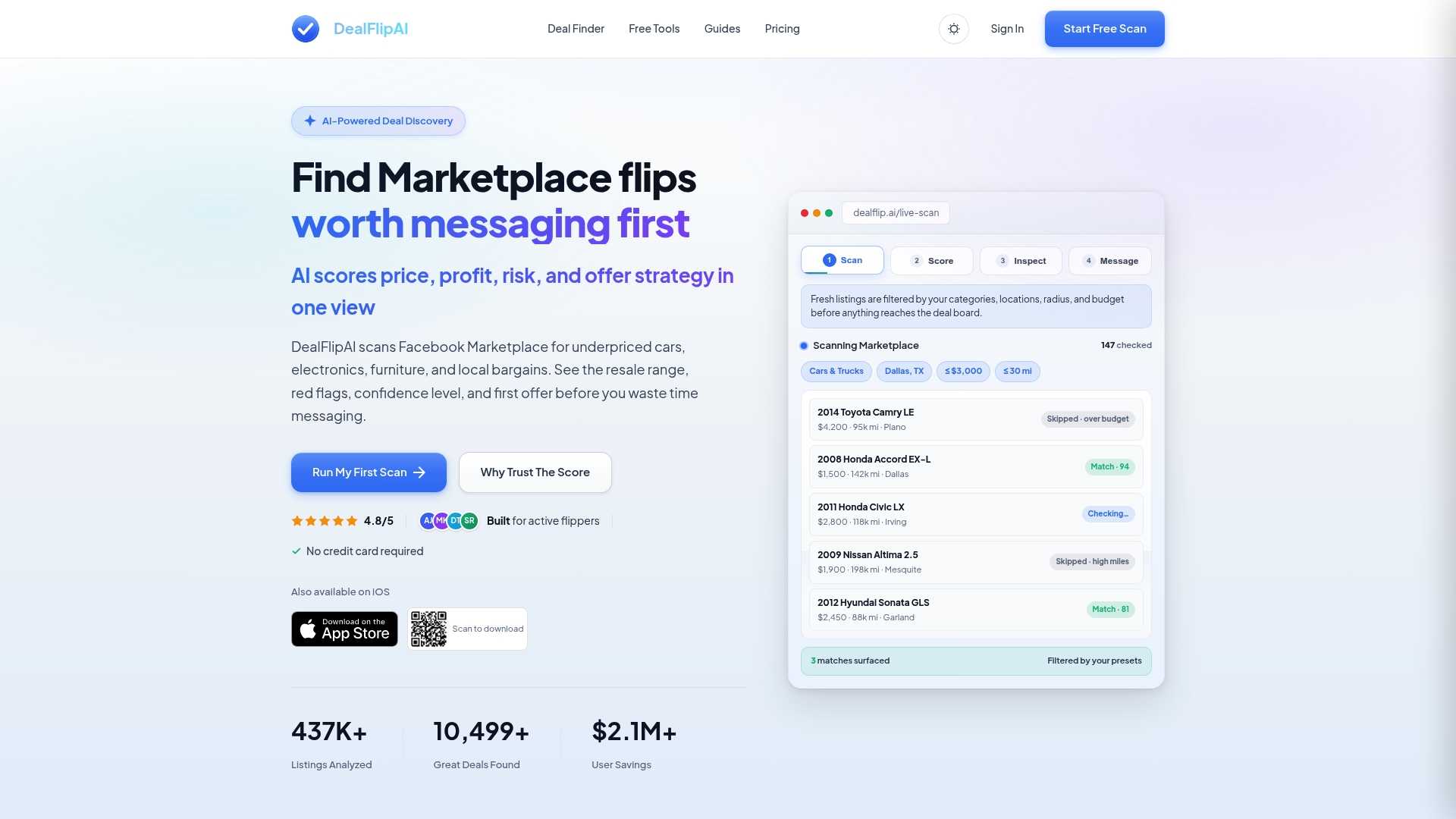
If you're still triaging listings by eye, run one through the free Listing Analyzer and see the profit breakdown DealFlipAI generates in seconds, including flagged scam signals and a suggested first offer. Users report the alerts alone save hours of manual searching per week, and the deal-scoring methodology behind every score is fully transparent, so you can see exactly why a listing scored high or low before you ever message a seller. Pair it with the flip profit calculator to confirm your margin before you commit to a pickup. Start with a free scan and see what your current radius has been missing.
Sources
For hands-on tools mentioned above, see the marketplace pickup cost calculator and the real-time deal alert setup guide. For a deeper look at negotiation tactics, review the negotiation red flags checklist.
External reporting worth reviewing includes ExpressVPN's breakdown of Marketplace's location behavior and ScamInsight's reporting on shipping-related scams.
- How to change location on Facebook Marketplace | ExpressVPN
- Geographic Arbitrage: Finding Deals in Other Cities' Marketplaces | DealHunter
- The Facebook Marketplace Shipping Scam Starts When the Deal Leaves the Platform - ScamInsight